

Archive for the ‘war’ Category

Same goes for military intervention…

Every election there seems to be a string of retired military flag and general officers that come out of the woodwork to support one candidate or another. The media acts like these opinions really matter, and we’ll hear endless debate about what “the generals” think. But do these people’s opinions really matter?

Like any good question, the correct answer is “it depends.” First, retired military members can share whatever opinion they want. Active duty members are restricted on what opinions they can share, since they work for the executive branch of the government. That’s why you see the disclaimer at the bottom of my articles, and why I don’t get too edgy on any sitting President from either party. Retired military members don’t have these restrictions, despite what people may think or want.

OK, so they can talk, but do they say anything useful? Most retired flag or general officers were in the service for between 25 and 40 years. That translates to somewhere between 8 to 16 different duty stations. Many of these were in different states and different countries, so in terms of understanding how different parts of the world work, these officers were certainly exposed to that. Moving between different continents exposes them to the good and the bad of how countries operate and the issues each country faces. This is particularly important when thinking about foreign policy, where the U.S. news service is terrible at covering issues like the water crisis in the Sudan, competition between Russia and China in central Asia, and the continuing problems in the Balkans.

There is a caveat to this that is really important. Military members go to places that have trouble. We don’t send people to Africa or the Middle East because its fun. Every overseas tour or travel is in the lens of failed diplomacy or democracy, so the member is there to fix it. Civil war in Yemen? Shoot some missiles in and kill some bad guys! Military members are primed for action. That’s not a bad thing. The military mindset of solving problems is positive, but it has two drawbacks. First, we hesitate to say “not my problem,” and second, we value U.S. intervention over others.

Let’s look at Syria for the first issue. Syria is a mess. We have Russia attempting to maintain influence in the country, especially since it owns a major naval base at Latakia. Turkey, a NATO ally, and Syria share a long, not the best defined border that has a host of illegal crossings. Then we have Iran shipping weapons and people across a poorly controlled Iraqi border to Syria. Combine that with a government focused on maintaining power rather than protecting its own people, and you have a California-sized tinder box just waiting for a gender reveal party.

So, could we go in and sort it out. Yes! Whats the cost? I’d start at ~5,000 U.S. deaths and we’d need to sit there for at least 15-30 years. Sounds crazy? Well, we won World War 2 over 70 years ago and we’re still in Germany and Japan. Maybe that’s not fair, let’s go with when the Berlin Wall collapsed…that’s still 44 years! Thirty years might be an understatement. That sounds a lot like colonization, and is guaranteed to get us a lot bad press.

Is there suffering in Syria? Yes, and at horrible levels. I’m not denying that. There is a lot of suffering all over the place. Should we care about Syria? Yes. But that’s not the important question. The important question is:

Do we care about Syria enough, and more than anyone else in the area, to commit to a very long term stay that will cost American lives?

It’s like a mortgage that you can’t sell back. You buy a house with a 30 year mortgage. You can just walk away, but it’ll rot and rust, and someone else might move in. That’s our problem with making everything our problem. We simply don’t have the resources to fix every problem in the world. We should pick and choose wisely. I wasn’t surprised when President Trump pulled the U.S. out of Syria. I was surprised by the backlash from military members. That’s the first big issue with retired flag and general officers: they all too often don’t ask whether we should get involved at all.

The second issue is valuing U.S. intervention over others. We talk the talk about loving our allies, but lets be honest, only about a handful are capable in any sort of extended, high intensity fight. That’s OK, because they’re allied with us, but it also makes them wary of jumping feet first into what looks like reckless U.S. intervention. Everyone loved being part of the first coalition to free Kuwait, but once we freed Kuwait, there was no desire by other countries to turn north to Iraq. We invaded Iraq years later to topple a really bad dictator, and we had allies come with, but they weren’t exactly thrilled. Our allies were happy to jump into Afghanistan, but after it dragged past four years, that enthusiasm waned.

When our allies work without us, it takes them longer, and our retired military members make plenty of comments like “we should support them,” without asking whether it makes any sense. When Mali fought Islamic insurgents and France wanted U.S. support, President Obama asked them to pay for it. He’s not wrong, because the correct question to ask is, are we willing to stay there for a long time? Most Americans can’t find Mali on a map, let alone pick out any U.S. interest in that country.

We also need to ask a really hard question about what retired admirals and generals do when they get out of the service. A few of them retire and “go fishing,” but plenty get another job, and most of these jobs are with major defense contractors. If I’m working at Raytheon and the government is shooting a lot of Raytheon missiles, I’m keeping a nice job for many years to come. Its the hammer tool problem: if all you have is a hammer, the world is full of nails. If you go from working 30+ years on solving military problems, then shift to a job making military equipment, you are likely inclined to think the military is the only (or at least, the best way) to solve problems. In many cases you are right, but there are plenty where you are not.

That’s the grain of salt you need for retired military opinions. Are they valuable? Yes! Retired military have different experiences than the populace, and their understanding of the world has value in many cases. But it comes with its own biases and special interests that aren’t obvious at the outset. We need to keep that in mind when we determine how much value to place on someone’s opinion.

This post represents the views of the author and not those of the Department of Defense, Department of the Navy, Raytheon Corporation, or any other government agency.

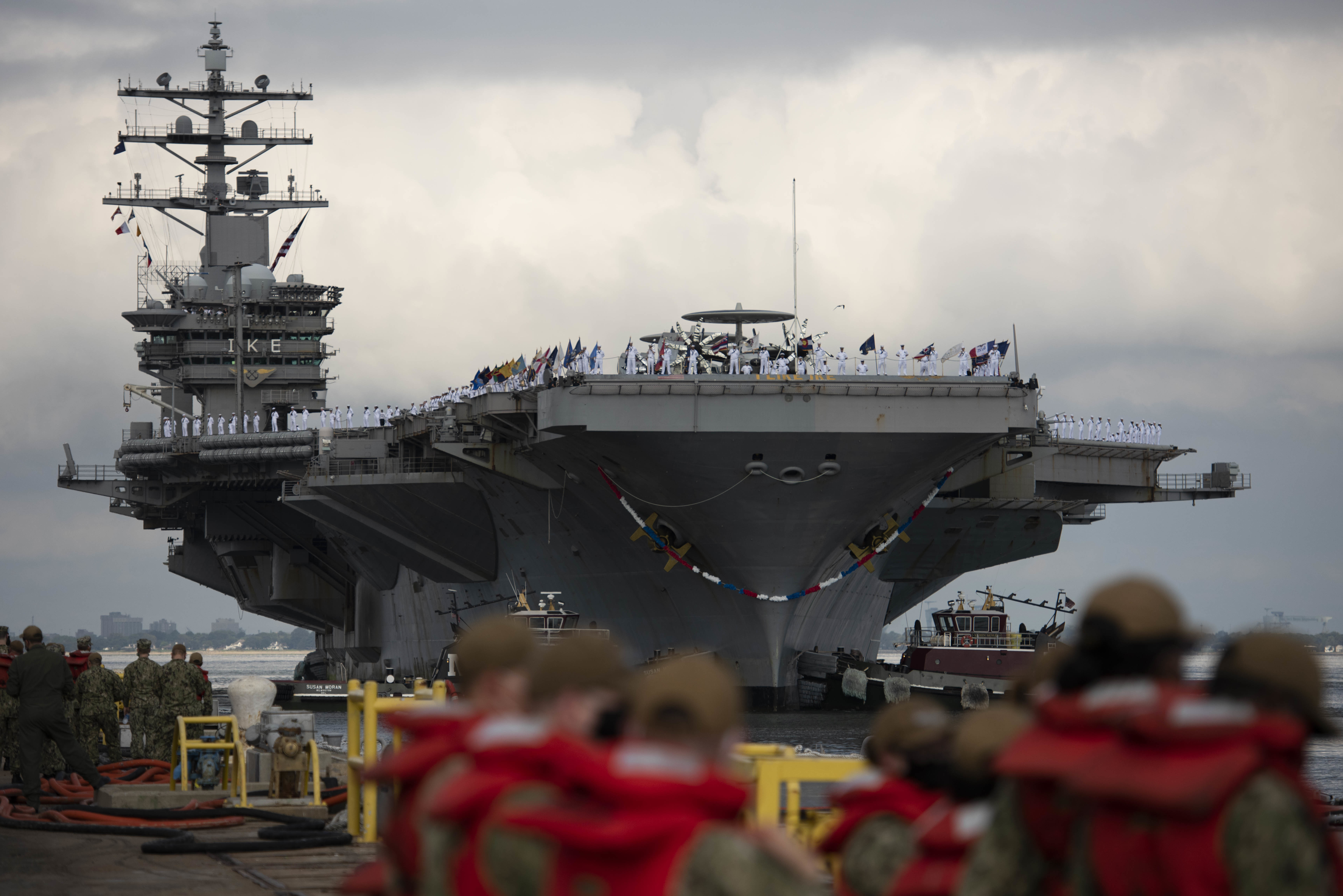
One of two prototypes purchased by the Office of the Secretary of Defense’s Strategic Capabilities Office for its Ghost Fleet Overlord program, aimed at fielding an autonomous surface ship capable of launching missiles. (U.S. Defense Department)

Military drones are popping up everywhere. In Afghanistan and Iraq, we became used to seeing Predator drones flying around with Hellfire missiles, flown from bases in the United States and providing a near 24/7 watch for opportunities to blow up terrorists. The latest batch of drones are now becoming increasingly autonomous, meaning they can not just think for themselves, but react faster than a human and respond to an ever changing environment. In the news recently was how Artificial Intelligence that beat a top US Air Force F-16 pilot, and previously the Navy discussed how its Sea Hunter would operate as an autonomous missile barge.

But I’m not here to talk about technology, not only because details are classified, but also because any technological issues will solve themselves over time. Human engineers are pretty smart. If some piece of code doesn’t work, we’ll find a solution. Technology isn’t holding us back in the realm of military drones. People are, and unfortunately people are the real weakness, as emphasized in this quote:

“AI matters because using drones as ‘loyal wingmen’ is a key part of future air power developments,” said Teal Group analyst Richard Aboulafia via email. “It’s less important as a fighter pilot replacement.”

If we build an AI that is smarter, faster and all around better than top notch fighter pilots, why on earth would we not replace pilots? The Army just raised the minimum contract for pilots to 10 years, which in military human resources speak means that they can’t keep these people in. All the military services struggle to retain people with skills like flying, electronic warfare, cyber, and anything else that requires significant technical expertise. Using AI to fill these billets gives the military significantly more flexibility in where it sends its manpower. This manpower can be used to lead squadrons of drone aircraft, or on people who lead armies of online bots in cyberspace. It’ll require more training and expertise, and certainly a culture change in how we view people in the military.

Besides being short sighted about replacing people, the other weakness we are going to find with autonomous systems is that we do a terrible job writing out our intentions. I worked with some highly skills folks on the Navy’s autonomous sea systems, and one of the biggest challenges was turning what we call “Commanders Intent” into code. If a vessel is out looking for an enemy, its easy to say “Kill this type of enemy when you see them.” It’s harder to give instructions like “Taking the current geopolitical events into consideration, make a judgement call on whether to shoot down an adversary aircraft.”

To put it bluntly, what does that even mean? The military throws around the idea of “Commanders Intent” like its some sort of magic that springs forth from someone’s brain. In reality, its a lot of processing happening in the back of your mind that constantly takes in data from the world around you. The military benefits from having extraordinary people that stick around long enough to reach command. These extraordinary people find ways to take an ugly bureaucracy devoted toward mediocrity and somehow make it work. As our military bureaucracy has grown, this has gotten more difficult. Extraordinary people are less likely to stick around to fight a bureaucracy devoted to maintaining status quo, especially when business is happy to snap them up and pay them more. Autonomous systems give us a chance to drop much of the bureaucracy and focus on intent, strategy and “end state,” or what we want the world to look like at the end. If we don’t embrace this change, we’re missing out on the truly revolutionary changes that autonomy gives us.

Future warfare is going to feature autonomous systems, and its going to highlight how weak human beings are in a variety of areas. Rather than fight this, the military should embrace autonomous systems as a chance to recapitalize manpower. It should also begin training its future commanders, flag and general officers, about how to actually write out their intent, and stop relying on chance to give us great commanders. We can’t let a military bureaucracy devoted to maintaining a status quo on manpower stifle the massive innovation that AI offers us.

This post represents the views of the author and not the views of the Department of Defense, Department of the Navy, or any other government agency.

AFRICOM HQ building, from https://www.dabangasudan.org

The US military in Europe is in a bit of a shakeup. After years of tolerating Germany’s low military investment, President Trump announced that 12,000 troops would move out of Germany, many of them moving to Poland, which has been investing in its military. Because of the “Orange Man Bad” complex, somehow the fact that this saves us money over the long term, is part of continued investment in a country that will be purchasing more US energy resources, and places troops closer to Russia as a deterrent seems to be lost in the media. It’s a smart move economically and strategically.

The shift of forces includes moving the US European Command headquarters to Belgium and the US Africa Command headquarters to…somewhere. But not Africa, according to a few news sources. When AFRICOM stood up, placing it in Stuttgart initially made sense, since many of the staff members came from the EUCOM staff. But AFRICOM’s lack of presence in Africa isn’t smart long term. The US should be more invested in Africa, and moving AFRICOM to Africa would help that investment.

Where in Africa? The best spots are Nigeria, Morocco, Ethiopia or Liberia. Nigeria is a long-term powerhouse in Africa. Not only will it become one of the world’s most populous nations, but it has a positive view of the US and has a democratic government. Morocco was the first nation in the world to recognize the US and we’ve maintained friendly relations for most of our countries history. Ethiopia is another democratic powerhouse in Africa. Liberia, while not as developed as the other three, is still a good choice given its close history with the US.

There is some concern about “militarizing” Africa, but I contend that’s a poor argument. Did we militarize Europe by stationing troops there, or did we stop a continued trend of larger and larger wars that seemed to erupt between European powers? We’ve had a longer peace since the US stationed troops in Europe. Other nations are directly moving into Africa, and while some seem altruistic (like France), others are not aligned with the US (Russia and China). We can’t counter these large investments with minimal footprints.

There are plenty of good options for AFRICOM to be in Africa. Africa is only going to get more important in coming years. We’re either all in on Africa, or we cede that ground to China.

This post represents the views of the author and not those of the Department of Defense, Department of the Navy, or any other government agency.
Hope or Hezbollah?

Posted: August 11, 2020 by chrisharper in war
Tags: ,

By Christopher Harper

For nearly a decade, I lived and traveled into Beirut—a time that molded me into a journalist.

In Beirut, you worked hard and played hard. Almost every day, journalists went into a dangerous city, where many thousands of people died, and almost every night, they retired to the bar at the Commodore Hotel.

My wife Elizabeth and I arrived in Beirut in 1979, where we lived for two years. After that, we spent many days back in Lebanon during a variety of news stories, including the Israeli invasion of Lebanon. We returned in 2011 during the Arab uprising to see Beirut had risen from the ashes, with restaurants and businesses booming from an economic resurgence.

Although we both loved the city and made friends with whom we remained close for many years, recent events did not surprise us.

Lebanon has existed for decades without a government. When it had a good leader like Rafic Harari, a businessman and prime minister, he ended up dead in 2005 as the victim of assassination. Ironically, last week’s explosion occurred just as a United Nations tribunal was set to determine the guilt or innocence of those suspected of killing Harari. See https://www.reuters.com/article/us-lebanon-tribunal-hariri-idUSKCN2512IC

For the past year, Lebanese have been protesting the current government for its corruption and inability to deal with day-to-day issues, such as garbage collection. As an example, my former colleague can only received $500 a month from his ABC News and government pensions because the government has placed severe restrictions on the country’s banking system.

Although the Lebanese president, Michel Aoun, is a Christian—as delineated in the country’s constitution–he is beholden to Hezbollah, the Shia militia, for his power. He remains in power despite the resignation of the prime minister and the cabinet.

Hezbollah has links to Iran and Hamas and is considered a terrorist organization by the U.S. government. Hezbollah was behind the 1983 attack against the U.S. Marines that left more than 200 dead and the hijacking of TWA 847 in 1985 that left a U.S. sailor dead. The group has a vast militia, which rivals the country’s army, and has engaged in a variety of battles with Israel.

More important for Lebanon, Hezbollah helped create a corrupt and negligent political system that created the lack of enforcement at the port and allowed the storage of 2,700 tons of ammonium nitrate.

Moreover, a new report by the Foundation for Defense of Democracies asserts that Hezbollah siphons off billions of dollars from around the world. Money is laundered through Lebanon, allowing Hezbollah to function as a kind of parallel state, one with its financial and social services. See https://www.fdd.org/analysis/2020/08/04/crisis-in-lebanon/

When my wife and I lived in Lebanon, the country embraced the song “I’ll Will Survive” as it national anthem. The resignation of the government may be a step toward survival, but Hezbollah still has a choke hold on the country. No survival will occur until the organization no longer holds significant power in Lebanon.