

Posts Tagged ‘journalism’

Musings from a longtime journalist

Posted: January 22, 2024 by chrisharper in Uncategorized
Tags: ,

By Christopher Harper

It’s been 50 years since I started my first full-time job as a reporter at the Associated Press in Chicago.

As I’ve written earlier, it’s sad how far the AP has tilted toward the left, erasing its history as a dependable and accurate institution that provides news and information worldwide. See https://wordpress.com/post/datechguyblog.blog/38878

But the underlying problems in journalism go far deeper than the mess at the AP. More than 1,600 journalists responded to the annual survey from Syracuse University’s Newhouse School of Public Communications, and the results are damning.

Only 3.4% of those U.S. journalists polled claim to be Republicans, with another 36.4% saying they’re Democrats. That’s more than 10 times more Democrats than Republicans. Or at least the ones who will admit they are on the left. 

More than half (51.7%) call themselves “independents” and another 8.5% “other.” Journalists have been getting these survey questions for over 50 years and have grown savvier. Many carefully list themselves in those “other” categories to avoid being called biased.

At the time I started in journalism, 25% of U.S. journalists said they were Republican. In 50 years, journalism has essentially purged any political opposition in its ranks. Amazingly, only 12.7% think “perceived bias and opinion journalism” is a problem.

I’m pleased to see all the financial and political problems the media are having because it’s possible media operations will realize they must change. I may be too optimistic. 

As the prospects for news publishers waned in the past decade, billionaires swooped in to buy some of the country’s most fabled brands. Jeff Bezos, the founder of Amazon, bought The Washington Post in 2013 for about $250 million. Dr. Patrick Soon-Shiong, a biotechnology and start-up billionaire, purchased The Los Angeles Times in 2018 for $500 million. Marc Benioff, the founder of the software giant Salesforce, and his wife bought Time magazine for $190 million in 2018.

All three publications are losing money at record rates, amassing millions of dollars in debt and facing massive layoffs. 

The media analysts blame the losses on the changing environment for news organizations. But the real reason for the declining readership and revenues is that there’s little worth seeing in these left-leaning outlets. 

I wince when people ask me what work I did because journalists have few friends except the elite class. Almost everyone else hates us!

Rather than ignore the problems, it may be time for those who want to save journalism to dig deeper into the disconnect between news organizations and those they’re supposed to serve. 
By Christopher Harper

Journalists have no idea how little their readers and viewers trust the media.

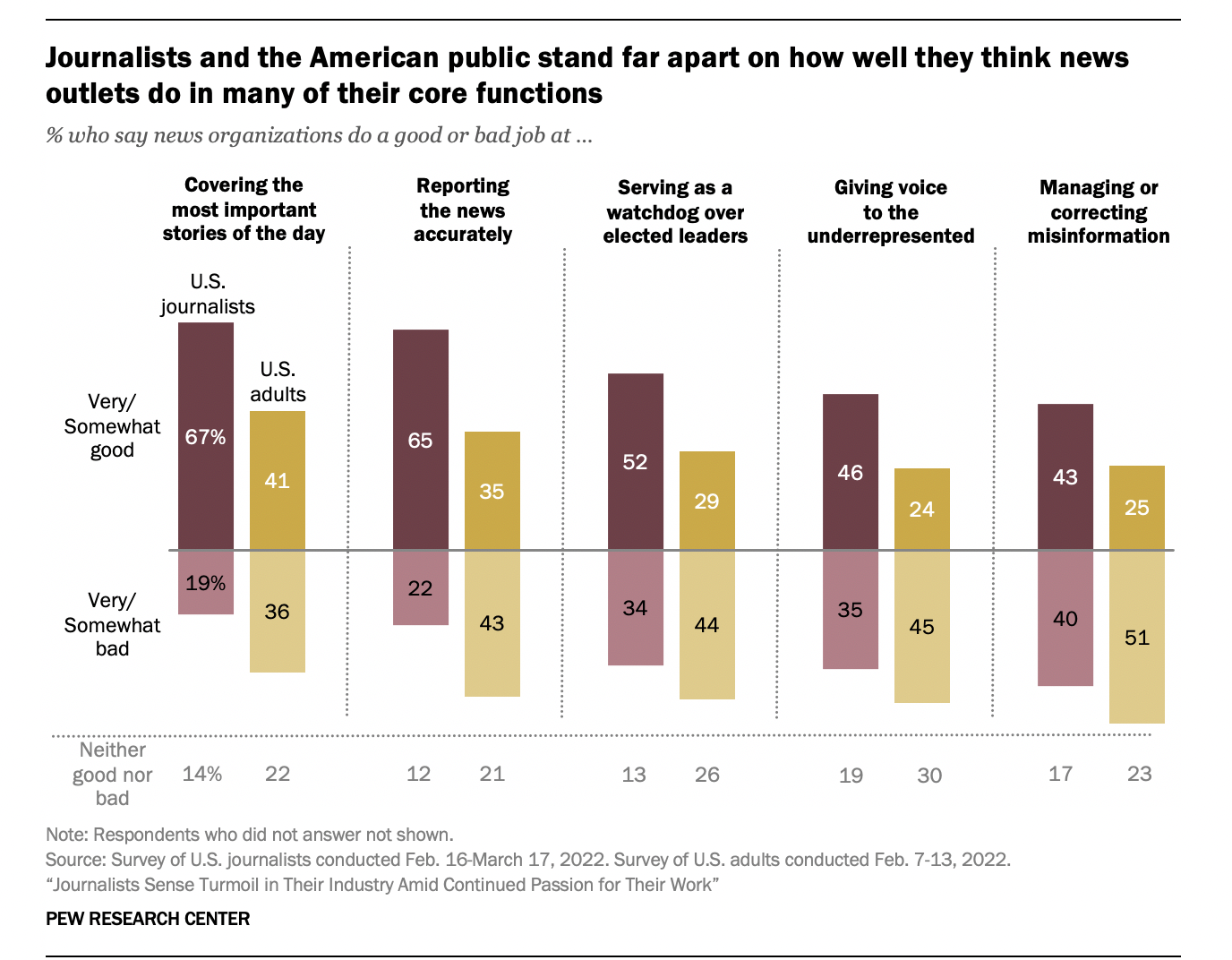
That’s readily apparent from a new analysis from the Pew Foundation, which found that “overall, journalists give themselves relatively high marks on performing several of the core functions of journalism. The public, however, does not see it the same way.” See https://www.pewresearch.org/journalism/2022/06/14/journalists-and-the-public-differ-on-how-journalists-are-doing-how-connected-they-are/

The survey should be required reading for the media!

Sixty-five percent of journalists surveyed think news organizations reported news accurately. That compares with only 35 percent of the public.

A significant majority—83 percent—of journalists think their audience trusts the news organization they work for. Another 13% said their audience has some trust, while just 3% said their audience has “a little” or no trust at all.

Here, journalists are entirely out of touch with reality. Only 29 percent of the public said they trust the media, while 27 percent say they have some trust. A plurality—44 percent—reported that they have “a little” or no trust.

Some of the other findings include the following:

–Fifty-two percent of journalists think they do a good job playing the watchdog over government. Only 29 percent of the public agreed.

–Forty-six percent of journalists think they give voice to the underrepresented. The public provides a rating of 24 percent. 

–Forty-three percent of the media think the industry does a good job of correcting misinformation. The public puts that figure at 25 percent. 

Another disparity between journalists and the public is how much reporters think they are “connected” to their audiences, while readers and viewers disagree.

Among journalists, close to half—46 percent–said they feel extremely or very connected to their audience, while another 37 percent said they feel somewhat connected. Far fewer—16 percent—said they feel little or no connection.

Underlining how out of touch journalists really are, the public sentiment is almost exactly the opposite.

Twenty-six percent of those surveyed said they are extremely or very connected to news organizations, far lower than the 46 percent of journalists who feel extremely or very connected to their audiences. 

Another 37 percent said they feel somewhat connected to their primary news sources, while 36 percent feel little to no connection.

In many cases, the media have become part of the American elite rather than remained part of the body politic. Reporters often look down on their readers and viewers and have increasingly little contact with real people.

Whatever the case, I think the media can’t regain the public’s confidence. After nearly 50 years as a reporter and a journalism professor, these development makes me both angry and sad. 

The wusses of journalism

Posted: April 5, 2022 by chrisharper in Uncategorized
Tags: ,

By Christopher Harper

Temple University has determined that its journalism graduates are having a tough time.

In an announcement, the administration said: “[W]e are seeing an increase in our journalism graduates go into their first jobs and leave before their first contracts are up. Some of our alumni are telling us they just weren’t prepared for the stress and the challenges they are facing.

“We all know it’s always been difficult to adjust to those first years in the field, but between the pandemic and a growing number of people who think journalists are ‘fake news,’ in addition to many other new challenges, we are losing some of our best potential journalists.”

I am admittedly old school. But I’m amazed at how journalism graduates and current practitioners have become wusses.

In my first few years in journalism, I covered demonstrations, terrorist attacks, a civil war, and mass murder.

I am not alone in my amazement. New York Times reporter Matthew Rosenberg called his younger colleagues “little dweebs” and “f—ing bitches” for “going on about their trauma” from the events on January 6, 2021.

In a hidden-camera video, Rosenberg called the mainstream media’s reaction to the events “over the top.”

He joked, “I know, I’m supposed to be traumatized.”

During much of my career in training journalists, I assigned students to some of the most dangerous neighborhoods in the city to find stories that demonstrated the true nature of the locales.

My colleague Linn Washington, a longtime Philadelphia journalist, and I created Philadelphia Neighborhoods, an award-winning news organization.

From 2007 to 2013, our students told the stories of poor neighborhoods throughout the city, providing a much subtler view of how people—whatever their income and education—just wanted to have safe streets, a future for their children, and a way to make a good living.

The experience also toughened up student journalists who had rarely strayed outside of their comfort zone.

I’m not entirely sure what happened in the past decade, but I am saddened that some journalism students at Temple, which has a motto of “Temple Tough,” have gotten soft.

But what has happened at Temple is indicative of what has happened in much of the news media.

-30-

Posted: August 17, 2021 by chrisharper in Uncomfortable Truths
Tags: ,

By Christopher Harper

When I joined the Associated Press in Chicago, “-30-“ signaled the end of a story. Depending on the source, the designation apparently began in the Civil War as a typesetter’s code. In recent years, it has been the name of a movie starring Jack Webb and even the title of the final episode of The Wire.

After 50 years as a reporter and a journalism educator, I have decided to place a -30- on my career and hang up my green eyeshade, pica pole, and glue pot. I’ll retire on July 1, 2022.

I joined the academy after more than years in journalism at the AP; Newsweek in Chicago, Washington, and Beirut; and ABC News in Cairo, Rome, and New York.

A couple of years after I started in journalism at the Idaho Statesman in Boise, Watergate was reaching its crescendo, and I had an opportunity to do some reporting on the events that led to the resignation of Richard Nixon. After that, I covered the deaths at Jonestown, Guyana, the Iran hostage crisis, three wars, numerous terrorist attacks, and several investigations into major corporations, such as Federal Express.

When I started in the academy in 1994 at New York University, the internet played virtually no role in journalism. The internet had virtually no penetration until AOL marketed its service. People reached the internet via what was called a “handshake,” a ka-chunk-chunk sound that screeched through telephone lines.

A few years later, I wrote a book that looked at the future of online journalism. Few journalism educators and working editors paid much attention to the implications of the internet, although I was able to teach some of the first classes in multimedia design and journalism at New York University, Ithaca College, and Temple University. At the latter, I helped start a journalism website in 2007, www.philadelphianeighborhoods.com, which reported on low-income and minority locales that got little positive attention in the mainstream media.

Today, however, the state of journalism and journalism education are far less rosy than in my days as a reporter and my days as a teacher.

First, most people don’t trust journalists anymore. Reporters have always been nosy sorts and not well-loved. But many people saw a role for journalists to keep tabs on government actions.

The reappearance of the partisan press, particularly during the Trump years, has left many with a negative view of what the media do.

I don’t see much journalism can do about the lack of trust. I think the only possibility is to emphasize accuracy above all else—as well as to incorporate as many voices as possible into the debate about the country’s future. Even so, the media are so badly broken that I’m not sure that any new bridges can be built between journalism and its public.

Second, the media failed to respond to the massive intrusion of the tech companies—Google, Facebook, and others—into the news business. Again, it may be too late to force these companies to pay for the news and information that should be a violation of copyright. But the media companies have failed to press their case in the courts.

Third, although some of my students have gone on to excellent careers in places like ESPN, The New York Times, The Philadelphia Inquirer, and various local news organizations, the number of people interested in journalism has plummeted.

When I started at Temple in 2005, more than 800 students majored in journalism. Today, that number is roughly half. I can’t say I blame students who face limited job prospects and mediocre salaries. But no one ever went into journalism to become wealthy.

Moreover, the number of educators who practiced journalism for more than a few years has been declining dramatically over the past decade or so. As a result, students learn more about social issues than storytelling.

I’m thankful of all the opportunities I’ve had to travel the world on the bank accounts of news organizations and universities and the ability to witness important events throughout the world. But as I mosey off into the sunset, I wish I could be more optimistic about the craft I plied for more than 50 years. Alas, I cannot.