

Author Archive

Democrat angst in Pennsylvania

Posted: July 12, 2022 by chrisharper in politics
Tags: ,

By Christopher Harper

The media pundits who predicted a Democrat walkover in the gubernatorial race in Pennsylvania are getting nervous. 

Although the Philadelphia Inquirer and the Pittsburgh Post-Gazette, the liberal media in leftist towns, have portrayed State Senator Doug Mastriano as a wingnut, the people between the two coasts are leaning heavily toward the Republican. 

While I don’t place a lot of stock in polls, Democrats have to be worried about the last one, which was about a month ago from USA Today

Mastriano pulled to within three points—49-46—of Democrat Attorney General Josh Shapiro—a number within the margin of error. 

But there’s more troubling news for Democrats in the poll. Almost 85 percent of respondents said the country is heading on the wrong track, and more than 75 percent said the state is going in the wrong direction. 

Only 30 percent said they felt the economy was working for them, pointing to inflation as their most critical issue. 

The big-city media fail to understand how my fellow residents of central Pennsylvania—part of what is known as “the red T” that votes about 70 percent GOP—hate polls and Joe Biden.

Philadelphia political adviser Kurt Knaus wrote after the 2020 election that Democrats got creamed in almost everything but the presidential vote.

“Where federal races produced a bit of blue mixed with neutral tones, state results were decidedly red – blood red, in fact, solidifying Pennsylvania voters’ reputation for splitting their tickets on Election Day,” he wrote.

 “Before November 3, Democrats boasted about their chances to potentially wrest control of the state House and chip away at Republicans’ majority in the Senate. Neither happened. Instead, Republicans knocked out the House Democratic leader and enlarged their majorities in both chambers. 

 Will Bunch, the leftist columnist for the Philadelphia Inquirer, is apoplectic about the current gubernatorial race. 

“If the staunchly anti-abortion Mastriano—currently polling within the margin of error against Democratic opponent Josh Shapiro—rides a predicted GOP midterm wave of voter anger over inflation and President Joe Biden’s unpopularity, and if his victory also were to extend the right-wing dominance in the legislature, the long-term consequences would likely reach far beyond women’s health,” Bunch wrote recently.

“An extreme abortion ban in Pennsylvania will turn the Keystone State into a pariah for many of the nation’s best and brightest young people when they are deciding where to attend college, and not only stunt but probably reverse the growth of high-tech and professional jobs that have fueled the 21st century revival of Philadelphia, Pittsburgh, and their suburbs.” 

[Note: Grammarly.com, a computer program I use, insisted that both of the above paragraphs be rewritten for clarity].

It’s difficult to glean any logic from the argument. Does Bunch really believe that the choice of a college depends on a pro-choice state government? Does he really think businesses determine economic viability based on fetus viability?

Whatever the case, his screed underlines just how worried he and other leftists must be. 
A good ride

Posted: July 5, 2022 by chrisharper in media
Tags:

By Christopher Harper

After working for nearly 50 years, I finally retired last week.

It was a good ride for much of my working life.

I stumbled into journalism at the University of Nebraska in Lincoln, which I attended mainly because my high school girlfriend went there.

In relatively short order, I dumped the girlfriend and my accounting major, choosing journalism because cool kids in my graduating class in Sioux Falls, South Dakota, worked for the high school newspaper.

I got a chance to cover events, such as the ill-fated presidential campaign of George McGovern and the American Indian Movement takeover in Wounded Knee, South Dakota, catapulting me into various exciting jobs.

While attending Northwestern University, I started at The Associated Press, where I wrote about economics, including the downturn of Playboy’s hold on American men and the fifth anniversary of the murder of Black Panther leader Fred Hampton.

With a helpful hand from a Northwestern professor, I got a job at Newsweek, which allowed me to ramble throughout the Midwest, covering labor and some local politics. I even got to profile Minnesota Twin Rod Carew as he almost succeeded in hitting .400 one year.

Nevertheless, I had an overwhelming desire to work in Washington, D.C., where I had spent a semester reporting for two small newspapers in South Carolina and Tennessee during the days of Watergate.

But I found Washington wanting—a boring place of people who thought too much of themselves.

During my two-year stay there, however, I got a chance to report on one of the most intriguing stories of the 20th century: the death of more than 900 people in Jonestown, Guyana. I was one of a handful of reporters who surveyed the scene of bloated bodies killed in a ritual of suicide and murder.

When I complained to my boss at Newsweek that I wanted to get out of Washington, he only half jested that Beirut was open. My wife Elizabeth and I headed off to the Mideast for a fascinating frontline look at the history of deceit and death there.

An unwilling war correspondent, I managed to cover three significant Middle East confrontations: the Lebanese civil war, the 1982 Israeli-Palestinian war, and the Iraq-Iran war.

When I discovered that the Beirut reporter for ABC News made more than two times what I did at Newsweek, I switched to television. My talents in front of the camera were far inferior to my abilities as a producer/reporter, where I lasted for 15 years in Cairo, Rome, and New York.

Along the way, I had a front-row seat at history, meeting several presidents, many influential individuals, and myriad common folk who made a difference in our world.

I jumped into academia at the end of my journalistic line, mainly because the news business had changed into a profit-making enterprise.

Although the time wasn’t as exciting, I taught several thousand students how to write—a once-needed skill that has fallen on hard times.

I also managed to travel throughout the world, holding teaching assignments in China, England, Italy, Poland, and Russia.

Now I’ll focus on the next phase of life, where I have several legal cases to analyze as an expert witness, three dogs to walk every day, a weekly trip to the Catholic Church as a lector, and this column to write.

I think I’ll still have some good times ahead!

By Christopher Harper

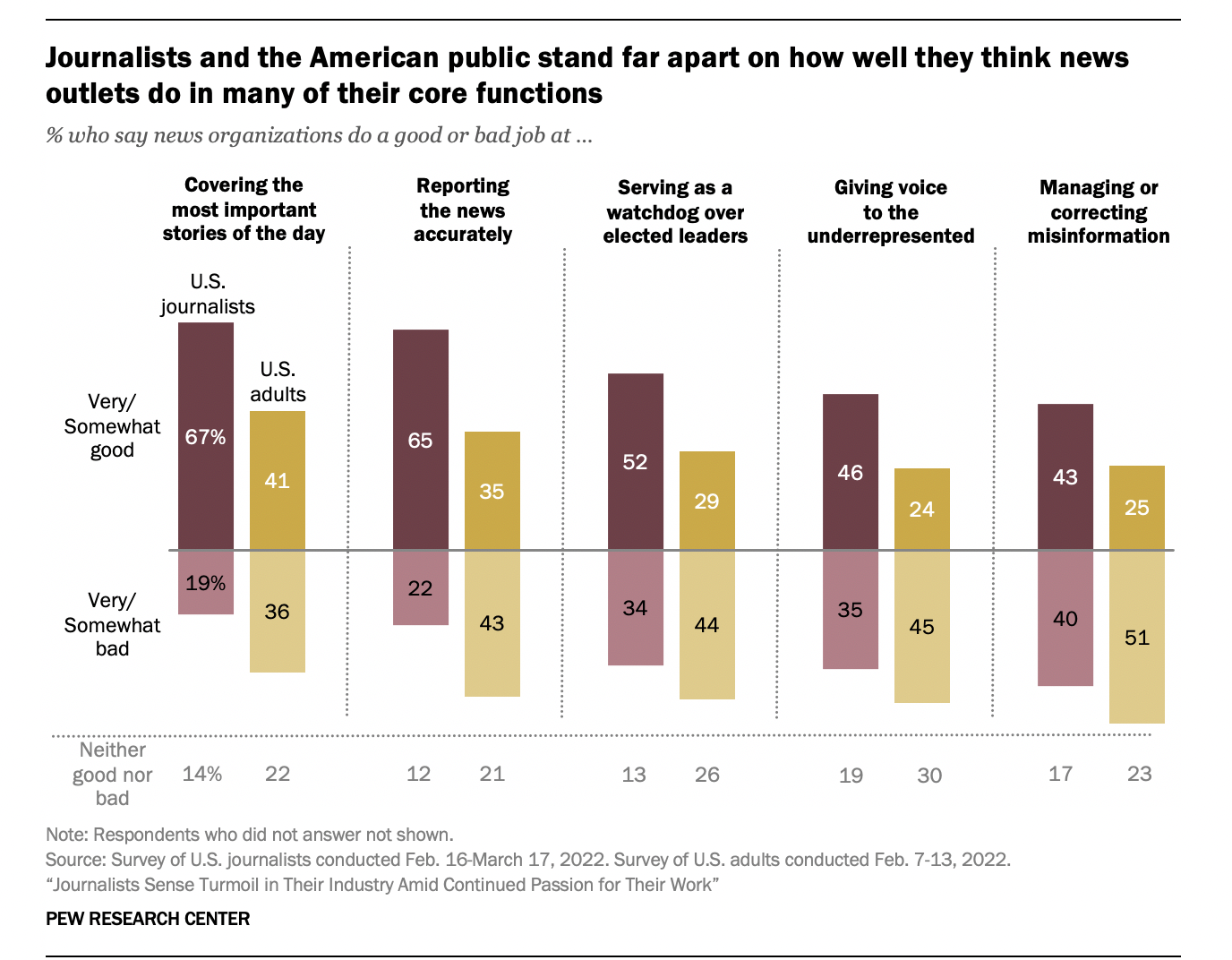
Journalists have no idea how little their readers and viewers trust the media.

That’s readily apparent from a new analysis from the Pew Foundation, which found that “overall, journalists give themselves relatively high marks on performing several of the core functions of journalism. The public, however, does not see it the same way.” See https://www.pewresearch.org/journalism/2022/06/14/journalists-and-the-public-differ-on-how-journalists-are-doing-how-connected-they-are/

The survey should be required reading for the media!

Sixty-five percent of journalists surveyed think news organizations reported news accurately. That compares with only 35 percent of the public.

A significant majority—83 percent—of journalists think their audience trusts the news organization they work for. Another 13% said their audience has some trust, while just 3% said their audience has “a little” or no trust at all.

Here, journalists are entirely out of touch with reality. Only 29 percent of the public said they trust the media, while 27 percent say they have some trust. A plurality—44 percent—reported that they have “a little” or no trust.

Some of the other findings include the following:

–Fifty-two percent of journalists think they do a good job playing the watchdog over government. Only 29 percent of the public agreed.

–Forty-six percent of journalists think they give voice to the underrepresented. The public provides a rating of 24 percent. 

–Forty-three percent of the media think the industry does a good job of correcting misinformation. The public puts that figure at 25 percent. 

Another disparity between journalists and the public is how much reporters think they are “connected” to their audiences, while readers and viewers disagree.

Among journalists, close to half—46 percent–said they feel extremely or very connected to their audience, while another 37 percent said they feel somewhat connected. Far fewer—16 percent—said they feel little or no connection.

Underlining how out of touch journalists really are, the public sentiment is almost exactly the opposite.

Twenty-six percent of those surveyed said they are extremely or very connected to news organizations, far lower than the 46 percent of journalists who feel extremely or very connected to their audiences. 

Another 37 percent said they feel somewhat connected to their primary news sources, while 36 percent feel little to no connection.

In many cases, the media have become part of the American elite rather than remained part of the body politic. Reporters often look down on their readers and viewers and have increasingly little contact with real people.

Whatever the case, I think the media can’t regain the public’s confidence. After nearly 50 years as a reporter and a journalism professor, these development makes me both angry and sad. 

The Medicare morass

Posted: June 21, 2022 by chrisharper in Uncategorized
Tags: ,

By Christopher Harper

As I head toward retirement at the end of the month, my wife and I have had to delve into the Medicare morass.

Simply put, Medicare is one of the most confusing bureaucracies I’ve ever dealt with. Since I used to report on government bureaucracies, I thought I would have some expertise in cutting through the weeds.

For the most part, I was wrong.

For those who have yet to head into the Medicare morass, I pity you. For those who have managed to get through the barriers already, I applaud you and also pity you.

Medicare, run by the Social Security Administration, is one of the most complex organizations in the country, providing some form of hospital, medical, and drug coverage for millions of Americans, most of whom are 65 and older.

Here’s my story of banging my head against the Medicare walls.

I wanted to sign up for Medicare coverage a few months before I retired, and that’s tricky. I was able to sign up for Medicare, but I couldn’t tailor our coverage until one month before I retired.

That’s when the voluminous number of letters and responses started with Medicare. It appears that the organization doesn’t know how to use email or other forms of electronic correspondence.

I had to file three separate letters to Medicare to convince the minions that I was retiring.

I then was told my Medicare costs would be significantly higher for my wife and me because I earned more than I should in 2020. I had to appeal that decision, convincing the authorities that my retirement in June would mean I wouldn’t make as much money. That took two appeals—another set of letters and responses—until I finally returned to the original Medicare cost.

Then I decided to obtain a Medicare Advantage program from a private insurance company to ensure my wife and I got decent coverage for health issues and drugs. It’s rather strange since we don’t have many health issues.

The number of Medicare Advantage programs is voluminous and complicated. I still don’t truly understand the drug formula, known as the “donut,”—which is supposed to make it less costly the more drugs you have to use.

Most of my doctors take Medicare, but my chiropractor doesn’t. He finds it too costly to get paid by the government.

Our dentist doesn’t take Medicare. In fact, only a handful of dentists in our area take Medicare, so we added an extra dental plan at $109 a month.

For the past decade, I have had a Health Savings Account, which allowed us to save about 25 percent in taxes on the money spent for copays and other approved procedures that insurance plans didn’t cover. That saved us about $600 a year in taxes.

Medicare doesn’t allow such accounts. Although Congress has tried to pass such measures, not much has happened.

During the 2020 campaign, most Democrats called for “Medicare for All,” meaning that everyone would be brought under the umbrella of the health program. Since it’s estimated that Medicare may go bankrupt in a few years on its present course, it seems evident to me that would be a bad idea.

I’ll report later whether Medicare works for my wife and me. But I’ve added a few more gray hairs and seen my blood pressure rise during my lengthy attempt just to get signed up for the program.