You know, these big ships break more when you can’t fix them right the first time.
Navy. We’ve been cool for a number of years now. We’ve endured lots of changes, everything from new uniforms to physical readiness exams to more uniforms. I’m sure yet more uniform changes are on the horizon. But we’ve gotta talk about this thing called expanding the bureaucracy.
‘Cause I gotta tell you, its not good.
We got issues, Navy. The shipyards can’t seem to ever fix a ship in time. Yeah, like 75% of the maintenance projects are overbudget and late! If Navy shipyards were a grocery store, it would be like ordering grocery delivery for Thanksgiving, but the delivery guy rolls up in a scooter to dump off bologna sandwiches at the end of your driveway instead of a turkey and stuffing on your porch.
Its not just shipyards. We’ve got a lot of bureaucracy. At the top, we’ve got more admirals than ships. Sure, we have to put someone in charge of important things like motorcycle safety, but come on man. More admirals than ships? Even when we count submarines? That seems a bit much.
So given those two really basic problems, why on earth would we want to build yet another numbered fleet? Are we lacking in 3-star admirals (hint: we’re not!)? Does a new fleet give us more capability?
No and no. Right now, we can’t man, train and equip the Navy we have. Ships are only manned to 92%. That sounds good, right? Its not. On a 4,000 Sailor crew of a carrier, that means we’re short 320 people. That’s almost a destroyer’s worth of people, which means we’re leaving lots of positions open. And shore commands? You’re doing well if you reach 85%.
Our response to get ships to sea seems to be to constantly take some “slackers” from shore duty, because heaven forbid we give people a break. Ships are constantly using ashore manpower “volunteers” to fill gaps. That works in the short term, but long term we simply aren’t bringing in enough people.
Even when we do, we give them no incentives to stay. I’ve had three crappy bosses in my short career, two of which were fired. I had people dress me down in public because it “suited them,” even when it was over minor offenses. If you’re not in the military, that sort of behavior makes HR scream. In the Navy, its just Tuesday, and you’re expected to simply take it. So guess what happens when we ask Sailors to reenlist, most of whom have nice job prospects in the civilian world that don’t involve getting screamed at over minor things or signing Page 13s that limit your right to eat in a restaurant? They don’t sign, and we resort to canceling failing PRT scores to try and keep enough people in.
So, while I applaud SECNAV’s efforts to find new niches for the Navy, I’d rather we get what we have to being well again. Get our manning to nearly 100%. Make the shipyards not suck again. Fill the billets we have now before we consider adding more. But please, don’t start up a new fleet until that part is done.
This post represents the views of the author and not those of the Department of Defense, Department of the Navy, or any other government agency.Obviously.
ATLANTIC OCEAN (Oct. 1, 2020) An F/A-18E Super Hornet attached to the “Wildcats” of Strike Fighter Squadron (VFA) 131 launches from the flight deck aboard the Nimitz-class aircraft carrier USS Dwight D. Eisenhower (CVN 69). Ike is operating in the Atlantic Ocean in support of naval operations to maintain maritime stability and security in order to ensure access, deter aggression and defend U.S., allied and partner interests. (U.S. Navy photo by Mass Communication Specialist 3rd Class Cameron Pinske)
News that Defense Secretary Esper is calling for a 500 ship Navy is good news. We’ve had a Navy too small trying to do too much for some time now, and its been ignored while we stayed focused on fighting terrorism. This resulted in a lot of extended deployments, poorly executed maintenance periods and burned out ships and Sailors.
But while a 500 ship Navy would help, we have a long way to go to get there. When policy makers discuss ships, it’s as if the numbers of ship is what matters. But there is a lot more to it:
Personnel. The last time we had 500 ships was in 1991. Since then, we’ve drawn down Navy personnel to about 330,000 to cover about 270 ships. Essentially, to get to 500, we’d have to double the number of Sailors. That would make the Navy larger than any of the other services, and a massive jump in personnel costs.
Shipyards. We can’t fix the ships we have now fast enough. Nearly doubling ships would mean we need more shipyards to build and maintain them. Given that American shipbuilding is almost exclusively government, we don’t have a great civilian infrastructure to turn to. So we’re either building new yards (expensive) or building in foreign countries (sending money overseas).
Support. Ships have to communicate, and rely extensively on satellite systems, which we don’t have enough of now. Combined with a variety of other support, and the price adds up quickly.
We can get away from personnel costs with more unmanned systems, but unmanned systems still require humans, and considerably smarter people to run them, which the military struggles to keep in, because other companies like Amazon will throw a lot of money at unmanned operators. This only gets worse as AI and unmanned systems spread in the commercial sector.
We’re getting to a tipping point with the Navy. We expect ships to be everywhere all the time, but we don’t have the ships, infrastructure or people to do that in peacetime, let alone war. We’re smart to recognize that, but its going to take a lot more than wishful thinking to get to a sustainable fleet level.
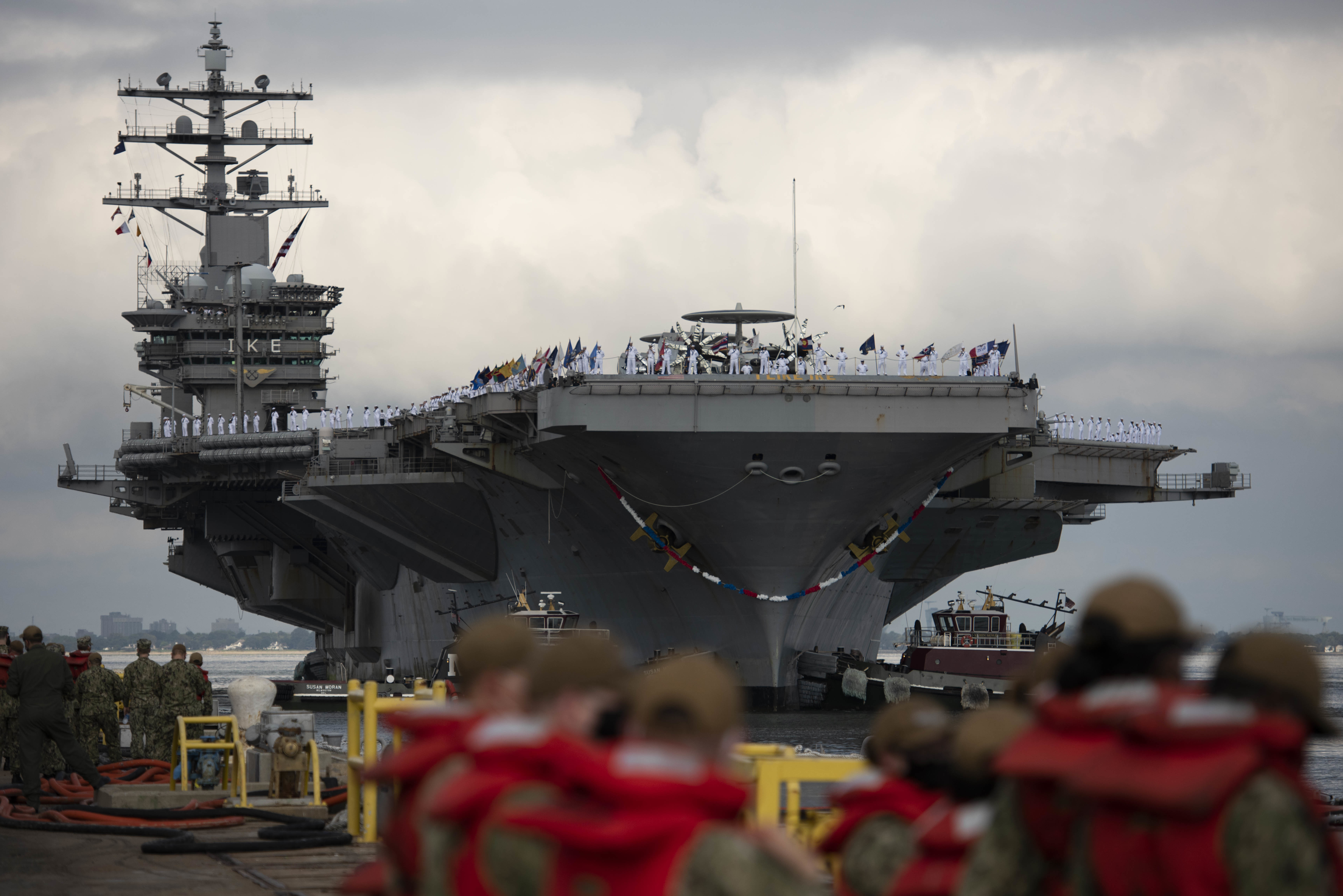
As a side note, the above picture was labeled “Rosy Outlook” on defense.gov. Most appropriate I think.
This post represents the views of the author and not those of the Department of Defense, Department of the Navy, or any other government agency.
Now, on the day that is celebrated as Taiwan’s Independence Day (10 October, or “Double 10” day), #TaiwanNationalDay is trending throughout India. Communist China tried to snuff it out in advance with a strongly worded “reminder” that there is only one China. Not long ago China and India were fighting each other along their mountainous border, so its no surprise that this “reminder” found its way to the press. The reaction by Indians is telling. Even better, the timing is great, with Secretary Pompeo meeting with top Indian officials at the end of the month to discuss how to deepen ties between India and the United States.
After taking Hong Kong, China showed the world it will weather any storm of protests to achieve its own goals. Anything short of hard military and economic power doesn’t work. People continue to protest the horrible maltreatment of Uighurs and development of South China Sea artificial islands, and yet nothing has changed. The only reason China hasn’t grabbed Taiwan is the risk it faces of US military action. To get over this, China has built a navy now larger than the US (at least in terms of number of ships) and modernized its ground and rocket forces.
Traditional thinking would condemn the US to build an even bigger military, and recently Defense Secretary Esper called for just that: a 500 ship Navy. That’s currently a pipe dream, because we can’t even man the Navy we have now. The Navy currently has roughly 350,000 Sailors; an increase to 500 ships would require gaining at least 200,000 more, not to mention ships and Sailors take time to build and train.
But India? India is already worried about China. India is already in conflict. If Taiwan brings India into any future conflict with Communist China, its a winning move. China doesn’t want to fight on two fronts. It might be able to hold off the US long enough to cement gains in Taiwan, but its not going to do well if India pushes into its western territories. Worse still, if a place like Tibet or Xinjiang decides to not rejoin China, that could drag any conflict out for years, dragging down the economy and the Chinese middle class in the process. That’s a double whammy, because Communist China has to provide a good economy in exchange for not being a democracy. If the economy goes south for too long, it risks revolt.
Deepening ties with India is a smart move for Taiwan and the US. Let’s hope we get more of this diplomacy to stave off future conflicts.
This post represents the views of the author and not those of the Department of Defense, Department of the Navy, or any other government agency.
Every election there seems to be a string of retired military flag and general officers that come out of the woodwork to support one candidate or another. The media acts like these opinions really matter, and we’ll hear endless debate about what “the generals” think. But do these people’s opinions really matter?
Like any good question, the correct answer is “it depends.” First, retired military members can share whatever opinion they want. Active duty members are restricted on what opinions they can share, since they work for the executive branch of the government. That’s why you see the disclaimer at the bottom of my articles, and why I don’t get too edgy on any sitting President from either party. Retired military members don’t have these restrictions, despite what people may think or want.
OK, so they can talk, but do they say anything useful? Most retired flag or general officers were in the service for between 25 and 40 years. That translates to somewhere between 8 to 16 different duty stations. Many of these were in different states and different countries, so in terms of understanding how different parts of the world work, these officers were certainly exposed to that. Moving between different continents exposes them to the good and the bad of how countries operate and the issues each country faces. This is particularly important when thinking about foreign policy, where the U.S. news service is terrible at covering issues like the water crisis in the Sudan, competition between Russia and China in central Asia, and the continuing problems in the Balkans.
There is a caveat to this that is really important. Military members go to places that have trouble. We don’t send people to Africa or the Middle East because its fun. Every overseas tour or travel is in the lens of failed diplomacy or democracy, so the member is there to fix it. Civil war in Yemen? Shoot some missiles in and kill some bad guys! Military members are primed for action. That’s not a bad thing. The military mindset of solving problems is positive, but it has two drawbacks. First, we hesitate to say “not my problem,” and second, we value U.S. intervention over others.
Let’s look at Syria for the first issue. Syria is a mess. We have Russia attempting to maintain influence in the country, especially since it owns a major naval base at Latakia. Turkey, a NATO ally, and Syria share a long, not the best defined border that has a host of illegal crossings. Then we have Iran shipping weapons and people across a poorly controlled Iraqi border to Syria. Combine that with a government focused on maintaining power rather than protecting its own people, and you have a California-sized tinder box just waiting for a gender reveal party.
So, could we go in and sort it out. Yes! Whats the cost? I’d start at ~5,000 U.S. deaths and we’d need to sit there for at least 15-30 years. Sounds crazy? Well, we won World War 2 over 70 years ago and we’re still in Germany and Japan. Maybe that’s not fair, let’s go with when the Berlin Wall collapsed…that’s still 44 years! Thirty years might be an understatement. That sounds a lot like colonization, and is guaranteed to get us a lot bad press.
Is there suffering in Syria? Yes, and at horrible levels. I’m not denying that. There is a lot of suffering all over the place. Should we care about Syria? Yes. But that’s not the important question. The important question is:
Do we care about Syria enough, and more than anyone else in the area, to commit to a very long term staythat will cost American lives?
It’s like a mortgage that you can’t sell back. You buy a house with a 30 year mortgage. You can just walk away, but it’ll rot and rust, and someone else might move in. That’s our problem with making everything our problem. We simply don’t have the resources to fix every problem in the world. We should pick and choose wisely. I wasn’t surprised when President Trump pulled the U.S. out of Syria. I was surprised by the backlash from military members. That’s the first big issue with retired flag and general officers: they all too often don’t ask whether we should get involved at all.
The second issue is valuing U.S. intervention over others. We talk the talk about loving our allies, but lets be honest, only about a handful are capable in any sort of extended, high intensity fight. That’s OK, because they’re allied with us, but it also makes them wary of jumping feet first into what looks like reckless U.S. intervention. Everyone loved being part of the first coalition to free Kuwait, but once we freed Kuwait, there was no desire by other countries to turn north to Iraq. We invaded Iraq years later to topple a really bad dictator, and we had allies come with, but they weren’t exactly thrilled. Our allies were happy to jump into Afghanistan, but after it dragged past four years, that enthusiasm waned.
When our allies work without us, it takes them longer, and our retired military members make plenty of comments like “we should support them,” without asking whether it makes any sense. When Mali fought Islamic insurgents and France wanted U.S. support, President Obama asked them to pay for it. He’s not wrong, because the correct question to ask is, are we willing to stay there for a long time? Most Americans can’t find Mali on a map, let alone pick out any U.S. interest in that country.
We also need to ask a really hard question about what retired admirals and generals do when they get out of the service. A few of them retire and “go fishing,” but plenty get another job, and most of these jobs are with major defense contractors. If I’m working at Raytheon and the government is shooting a lot of Raytheon missiles, I’m keeping a nice job for many years to come. Its the hammer tool problem: if all you have is a hammer, the world is full of nails. If you go from working 30+ years on solving military problems, then shift to a job making military equipment, you are likely inclined to think the military is the only (or at least, the best way) to solve problems. In many cases you are right, but there are plenty where you are not.
That’s the grain of salt you need for retired military opinions. Are they valuable? Yes! Retired military have different experiences than the populace, and their understanding of the world has value in many cases. But it comes with its own biases and special interests that aren’t obvious at the outset. We need to keep that in mind when we determine how much value to place on someone’s opinion.
This post represents the views of the author and not those of the Department of Defense, Department of the Navy, Raytheon Corporation, or any other government agency.





 Da Techguy's (no longer backup) Blog