The recent budget deal to fund the Department of Defense, once again, showed how much elected Republicans are absolute wimps about negotiating. While continued billions to Ukraine was halted, we got nothing banning paid travel for abortion and a very limited spending cap on DEI.
We’re in the middle of funding one war in Ukraine, watching Israel fight another and trying to prepare to fight China…and we’re still wasting money on DEI and abortion?
But honestly, I’m not surprised, because most Republicans fail to put their money behind their values.
An easy example is Starbucks. Starbucks has long championed abortion, yet I still watch hundreds of Catholics order their Unicorn Latte (or whatever other sugary nonsense they prefer) from a company that happily donates to Planned Parenthood and a host of other reprehensible organizations. There are now hundreds of small coffee shops and plenty of other chains, and there is zero reason you can’t drink coffee from somewhere else. Yet here we are, throwing money towards the people that hate us.
Worse still, Republican voters are typically the stingiest in supporting alternative media. I’m becoming more and more impressed with Daily Wire’s “Bentkey” programming that my wife and I are likely going to cancel our Disney+ membership. Given the increasing amount of dumb programming coming out of Disney, its harder and harder for me to justify sending money to them when there is plenty of good kids content on Bentkey. I might have to use the DVD to watch Star Wars once in a while, but that’s already paid for, and at least they can’t change Luke’s preferred pronouns in my copy of Empire Strikes Back.
This Christmas, you should look at where you are spending your money, and try to find an alternative if that source is a raging liberal dumpster fire. Budweiser was a great example of people waking up and going “Hmm, not going to support this anymore,” and it sent a strong message to other businesses. But more has to be done. Continuing to pour money into organizations that hate your values is going to continue to breed feckless politicians, who follow the money.
While you’re at it, since Christmas is coming soon, why not send a friend or relative a copy of my book? It’s available in printed and audiobook format, and you can’t go wrong sending money to me.
This post represents the views of the author and not those of the Department of Defense, Department of the Navy, or any other government agency.
For many Netflix subscribers, their focus is on the next week’s release of the second part of the final season of The Crown. While I have enjoyed the series, the first batch of Season Six of The Crown was a huge disappointment for me.
A more enjoyable use of your time–75 minutes to be precise–can be found by watching Radical Wolfe, a documentary about the legendary writer Tom Wolfe, a pioneer of the New Journalism movement of the 1960s who later, and seamlessly, made the transition into fiction, penning one of the greatest novels ever, The Bonfire of the Vanities.
Radical Wolfe, which had a brief theatrical run this autumn, is directed by Richard Dewey. It is filled with interviews of Wolfe; Jon Hamm narrates passages from Wolfe’s work. The documentary is based on an Esquire article by Michael Lewis.
Gay Talese, Tom Junod, Christopher Buckley, and Lewis are among the writers interviewed for Radical Wolfe.
Buckley’s father, conservative firebrand William F. Buckley, says here. “Tom Wolfe is probably the most skillful writer in America. I mean by that is that he can do more things with words than anyone else.”
“If you want to be a writer,” Wolfe, who died in 2018 said of himself, “you’ve got to be standing in the middle of the tracks to see how fast the train goes.”
“Nobody is writing like Tom Wolfe today,” Junod says in Radical Wolfe. “And no one has written like Tom Wolfe.”
Wolfe is someone America needs now. Oh, to have seen him running loose among the hypocrites at COP28.
The title of the film comes from Wolfe’s 1970 essay for New York magazine, Radical Chic: That Party at Lenny’s, when Wolfe, after co-opting an invitation to a fundraiser for bail money for some Black Panthers held at Leonard Bernstein’s Park Avenue home, skewered the liberal virtue signaling culture, even before that term existed.
Oh yeah, phrases. Phrases!!! Besides “radical chic,” Wolfe coined the terms “the right stuff,” the title of his of his rollicking yet informative bestseller about the early days of the space program, and “masters of the universe,” the group that Sherman McCoy, the lead character in The Bonfire of the Vanities, placed himself in.
Not mentioned in the documentary while Wolfe didn’t create the now-common phrase “pushing the envelope,” which is used repeatedly in The Right Stuff, he popularized it.
The repeated use of ellipses (…) and multiple exclamation points (!!!) are a trademark of Wolfe’s early work.
As with the fetid film version of The Bonfire of the Vanities, Radical Wolfe tiptoes around race. Wolfe was a master storyteller and, strictly in the storytelling sense, race presents a crucial ingredient for any narrative–conflict. The Reverend Bacon character in Bonfires, an Al Sharpton knockoff, is a comic foil. Fareek “The Cannon” Fanon, an African American college football star in Wolfe’s 1998 novel, A Man in Full, comes across as a boor when he confuses lead character Charlie Coker’s old moniker as a 60-Minute Man, not as a football starter on both defense and offense, but as a man who could, let’s say, “do it” in bed for 60 minutes.
Black people can be boors in Wolfe’s world. As can white people. As can everyone. That’s the way it ought to be. Because that’s the way society is.
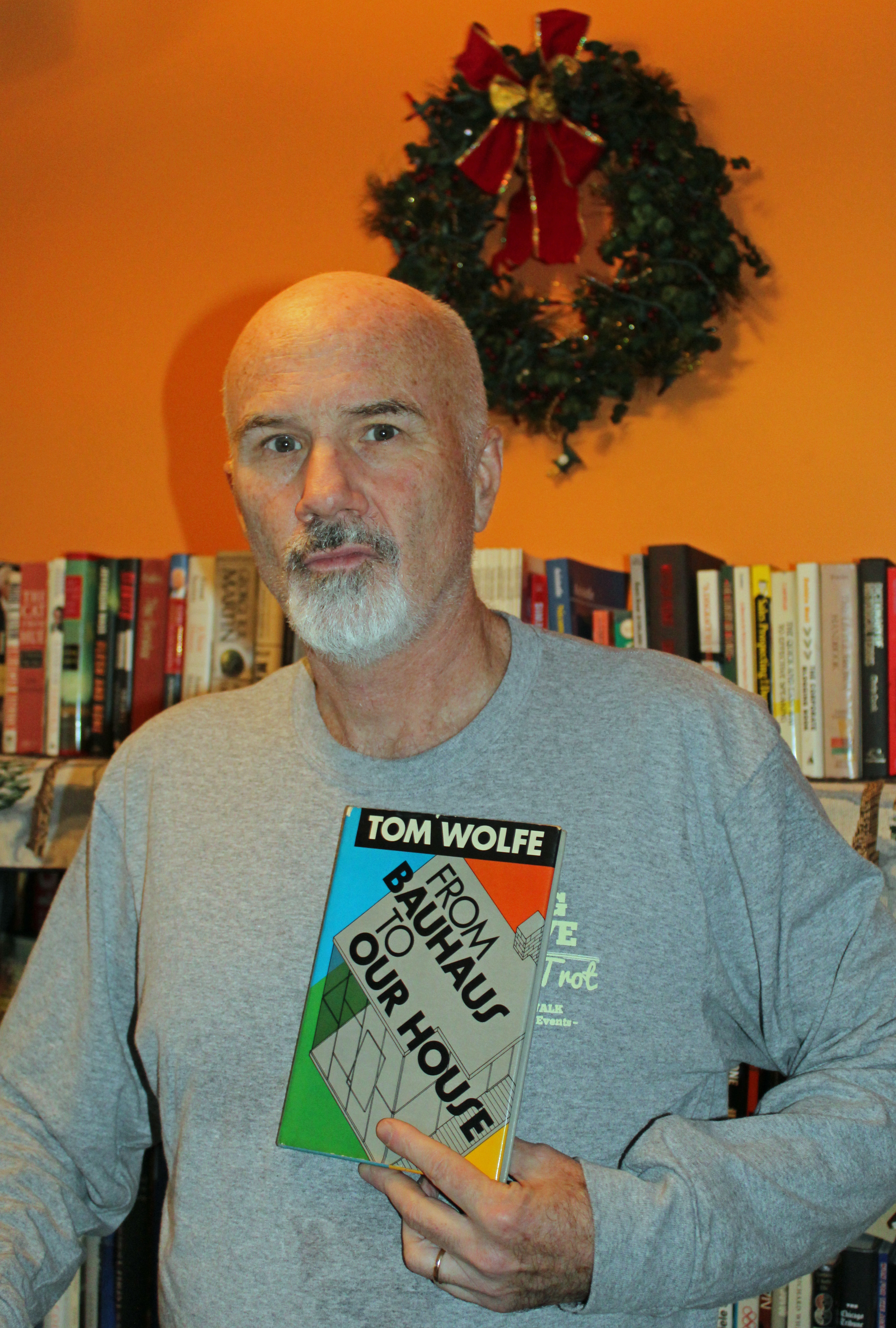
In Wolfe’s takedown of ugly glass-box and faceless architecture, From Bauhaus to Our House, he gives a rundown of the horrors of public housing, and joyously recalls the response when tin-eared bureaucrats in St. Louis–after decades of failing the residents of the city’s housing projects–finally did the unthinkable. They asked the tenants of the notorious Pruitt-Igoe homes, most of them Black, what they wanted done to the buildings. Their response? They chanted, “Blow it up.”
And the bureaucrats did just that. Why isn’t this poignant story in Radical Wolfe?
Wolfe was always coy about his political stance. “I belong to the party of the opposition,” he says in the documentary. But I suspect he was a slightly conservative, with a strong libertarian bent.
Despite the quibbles I mentioned, I loved Radical Wolfe. Oh, one more thing. To capture the Varoom!!! Varoom!!! uniqueness of Wolfe’s genius, a surreal mashup, along the lines of the one in The Life and Death of Peter Sellers, would have been a welcome addition.
Last year, Netflix sent a message to its workers that not all of its programming–not these words of course–will kowtow to wokeism. Radical Wolfe is a big step in the right direction for the streaming service. Next year Netflix will stream a six-episode limited series based on Wolfe’s A Man in Full. It will star Jeff Daniels and Diane Lane.
Keep it up, Netflix.
But I have one more quibble. Radical Wolfe is rated TV-MA for–wait for it–language and smoking.
For the longest time multiple people have raised the alarm about the Chinese Navy developing more ships, more capabilities and especially more missiles. The worry has been the US Navy would get “out-sticked,” as in the range of Chinese missiles would be so great they could hit US ships before those ships could even fire back.
This was true over the past decades because the Navy primarily used the Harpoon anti-ship missile, which has an effective range of 75 miles, and has been in service since 1977. Meanwhile, the Chinese Navy rolled out a nearly matching missile, the C-705, in 2006, and kept rolling out missiles, from the YJ-12 and YJ-18 to now the YJ-21, which claims to be a hypersonic, sea-borne anti-ship missile. During this time, the US sat on its hands and did almost nothing to increase the range of our missiles.
This was made worse by the fact we already HAD a long range missile. The Tomahawk, normally considered a land-strike missile, had a maritime strike version known as the TASM as early as 1990, yet they were all scrapped after the first Gulf War. The TASM had an effective range of around 900 miles, making it far superior to the Harpoon in all things but speed.
Range makes a big difference…if I can shoot first and force an enemy to maneuver to avoid getting hit, I get to call the shots and drive any engagement. While Chinese missiles aren’t known for their quality (just ask the Indonesians, who watched two failed C705 launches from his vessels in 2016), having multiple missiles hurtling towards, even if they aren’t the greatest quality, still puts you in a reactive mode.
This proves a much bigger point though: decline is a choice. We never had to give up long range missiles. Even if we would have kept them in low production, we could have easily updated the design over the 90s and 2000s to keep a competitive edge over any adversary. Instead, we pissed away our advantage for years and are now playing catch up. We chose to decline, but thankfully we’re slowly choosing to do otherwise.
This post represents the views of the author and not those of the Department of Defense, Department of the Navy, or any other government agency.
As college football fans look forward to bowl season, it’s time to realize that the sport has become an absolute mess.
I’ll put aside the flap over Florida State being excluded from the playoffs because I can see both sides of the argument. I also never liked FSU, so I admit my bias against the Seminoles. I also don’t understand why FSU has eluded the PC police for its mascot and name.
But I digress.
The collegiate model is changing, and revenue streams might need to be improved to fill the growing money pit. It should be noted that the average operating deficit among the 100 major programs stood at $18.8 million in 2019.
“Almost nobody is in good shape, and the few schools in decent shape are experiencing a world that’s much more unstable and uncertain,” Andrew Zimbalist, a sports economist professor at Smith College, told 247Sports. “Even if they’re in decent shape now, they still have to worry about it.
For example, the Big 10 started as a Midwestern conference that has grown into 18 universities spanning the country from east to west. That’s primarily because the league has the most lucrative TV contracts worth more than $1 billion annually. As the realignment of various leagues started, the Pac-12 took the biggest hit, falling to a mere two schools—Oregon State and Washington State—as Oregon, UCLA, USC, and Washington moved to the Big 10. Arizona, Arizona State, Utah, and Colorado joined the Big 12. Two West Coast teams, UC Berkeley and Stanford, are joining the Atlantic Coast Conference. The Big 12 lost Oklahoma and Texas to the Southeast Conference.
The impetus for conference realignment is rooted in money. That’s why Oklahoma and Texas secretly pursued the SEC in the summer of 2021 and opted to surrender $100 million to leave the Big 12 one year earlier than expected in 2024. UCLA and USC bolted the Pac-12 for the Big 10 in the summer of 2022 and will begin competing in the wealthiest conference in college athletics in 2024.
The salaries for coaches are out of control. According to an ESPN analysis, well-known programs spent more than $533 million in dead money owed to coaches who were fired without cause with time left on their contracts from 2010 to 2021. Now add the buyout of $76 million to Jimbo Fisher of Texas A&M!
The Wall Street Journal’s Jason Gay reminisced recently about the time Alabama coach Bear Bryant stipulated in his contract that he had to make a dollar less than the university’s president.
Two other changes—the transfer portal and the Name, Image, and Likeness plan—have created even more havoc in college football. According to Higher-ed Ethics Watch, the transfer portal has created “a lack of loyalty to the schools from which they transfer, a lack of loyalty to their teammates, many of whom cannot take advantage of the transfer portal because of their anonymity as a student-athlete, commercialization of college athletics, which once was a fully amateur sport, and outsiders buying the allegiance of student-athletes through promises of being able to financially benefit from their NIL after they transfer.”
Moreover, the NIL program has benefited only a few players and makes little sense when one looks at the top earners. For example, Shedeur Sanders and Travis Hunter of Colorado earned $4.1 million and $1.8 million, respectively, even though they played on a team that won only four games this year. Arch Manning has an excellent pedigree but has yet to start a game for Texas. Still, he’s estimated to earn nearly $3 million this year.
Simply put, college football is about making more and more money, but only a few colleges and players benefit from the current system.



 Da Techguy's (no longer backup) Blog