I mean seriously, Navy manpower woes are the gift that keeps on giving. There are three (!!!) more NAVADMINs that show the Navy is really struggling to keep its people, especially its technical people, from leaving.
The first is NAVADMIN 186/22, which concerns Special Duty Assignment Pay (SDAP). SDAP is an additional monthly pay for Sailors that are in hard-to-fill jobs or qualify in difficult assignments. The Navy uses SDAP to help incentivize Sailors taking the hard duty assignments, because a few hundred dollars extra a month might motivate someone to fill that position.SDAP has been changed for nuclear-qualified Sailors in the following manner:
Billet / NEC Level Pay Change RDMC/EDMC/CVN DLCPO 7 525.00 +75.00 N33Z NEC 6 450.00 New NPTU W/SUPERVISOR NEC 6 450.00 No change SEA W/SUPERVISOR NEC 5 375.00 No change SHORE W/SUPERVISOR NEC 3 225.00 -75.00 SEA W/OPERATOR NEC 2 150.00 No change SHORE W/OPERATOR NEC 1 75.00 -75.00
So what does that mean? In a nutshell, shore assignment SDAP was lowered, while at-sea SDAP was either added or increased. The N33Z NEC refers to an at-sea Sailor that qualifies as an Engineering Watch Supervisor (EWS), which is the senior most enlisted watchstander on a nuclear power plant.Since SDAP is an incentive pay, this is yet more proof that the Navy is trying to push Sailors towards at-sea assignment and to qualify as an EWS at-sea. They wouldn’t bother increasing SDAP if Sailors were already filling those roles without issue.What about technically-savvy officers? Well, NAVADMIN 188/22 changes the accession rules for the Baccalaureate Degree Completion Program (BDCP), which is a program where civilians or enlisted Sailors that have at least 60 credit hours can apply to get a commission, where they get paid while they finish their degree. It’s not as great a deal because it doesn’t pay for tuition, however it does land you a job as an officer afterwards, with the catch of requiring an 8 year commitment. If that sounds a bit long, it is, because a normal ROTC commitment used to be only 4 years…which was increased to 5 years, and for aviators, to 5 years AFTER you qualified to fly (which ends up becoming 8-10 years).BDCP eligibility was extended to…you guessed it…the technical fields of cryptology, cyber, intelligence, networks and oceanography. The only reason to extend this program to those fields is because the normal methods of obtaining officers are not working.The last odd NAVADMIN is 184/22, which simply says that the O-6 continuation board will immediately follow the O-7 selection board. For those not in the know, an O-6 in the Navy is a Captain and an O-7 is a Rear Admiral.Now, normally this board is one of many that are on a routine schedule without any real attention paid to it. Remember that Captains eligible to be reviewed for selection to admiral are well past the 20 years needed to retire, and are allowed to hang out until 30 years of service. They can hang out longer if a continuation board allows it. Since the board already meets on a schedule, why would someone need a NAVADMIN to change when the board meets, and inform the rest of the Navy?Simply put, there was a significant uptick in O-6 retirements after the last O-7 selection board. I asked a few people in the know (who asked to remain nameless) and the word was that the Navy Personnel Office apparently didn’t bother to communicate with a lot of O-6s that were not selected for O-7, and a lot of them submitted retirement requests in response to this poor treatment. While nobody is entitled to be selected for O-7, its not hard to communicate with officers to let them know they weren’t picked. Especially for someone that has given over 20 years to the Navy, you would think the Navy could reciprocate and treat them with respect. The number of retirements stung Navy manpower, hence the short NAVADMIN to try and prevent this from happening again this year.Now, that’s all speculation, but given all the other things happening…is anyone surprised? I sure wasn’t. I am surprised at just how bad recruitment and retention are getting. I had predicted that 2023 would be the breaking point, but that was before the vaccine mandate and terrible withdrawal from Afghanistan. I think those events have accelerated a process that was underway long before this year. I see more and more servicemembers that would otherwise happily stay on a few extra years because they enjoyed the job instead decide to leave for greener pastures. When you go all out to make the Navy a miserable place to work, why would anyone be surprised that you have to increasingly bribe people to stay in?This post represents the views of the author and not those of the Department of Defense, Department of the Navy, or any other government agency.
The news media has finally jumped on the military recruitment crisis. The smart, intelligent, witty and dashingly handsome readers of this blog that look just like you already knew it was comingbecause of all the previous reporting here. But let’s say you weren’t so smart, intelligent, witty and perhaps only average in your looks. Let’s say that this not-nearly-as-good version of you wanted to know the truth, because the media likes to blow up a small story into something big to make money. Would there be a way to figure out if the military was really struggling to recruit new members?
Well, stand-in dumber-version-of-you reader, there is, because you can use the military’s readily available instructions to figure out just that! But first, we need a primer on military recruitment and promotion.
Military manpower is a big pyramid scheme, with lots of young blood on at the base of the pyramid, and fewer crusty old folks at the top ranks. Most military members only serve for 3-5 years, getting out for the much greener pastures in the civilian world. The one’s that stay in have some pretty good incentives: guaranteed pay, a pretty cool mission, a chance to get skills and experience on fancy, taxpayer funded weapon systems, and that sweet, sexy uniform that entices all the ladies.
Anyway, this pyramid scheme of manpower relies on a big influx every year of new recruits. We’ve already talked at length about why normal recruiting isn’t working. If recruitment sags, the military has other tricks to keep its numbers up, namely by making it more difficult for people to leave. They can do this by not letting people leave early, or even go so far as to force people to stay.
Let’s say that hypothetically we recruit a lot more people then we really need. Instead of showing them the door, the military can allow other members a chance to leave early. OR the military can tighten down on physical fitness standards, which they can use to boot people out. OR they can create some new stupid rule that will piss people off, which will cause more existing members to leave. These rules are like the handle on a water faucet that you can adjust so the water flow is just right.
Knowing this, guess which way the handle is moving?
Let’s look at the Navy, which releases NAVADMIN messages. These are bland, dull administrative things that nobody except slightly-inebriated Sailors actually read. At the end of June, the Navy released NAVADMIN 142/22 titled FISCAL YEAR 2022 ACTIVE COMPONENT ENLISTED FORCE MANAGEMENT ACTIONS (CORRECTED COPY), because I guess the admin person made a mistake and had to correct it.
Doesn’t inspire much confidence in our administrative people!
Anyway, let’s read the message.
1.  The purpose of this NAVADMIN is to implement key force
management personnel policy actions in the enlisted active component
to ensure the Navy remains fully manned and operationally ready.
References (a) and (b) are hereby updated for enlisted personnel.
For those who have decided to separate, please review reference (c)
for additional career progression opportunities in the Navys
Selected Reserves.  Navy encourages all qualified Sailors to stay
Navy.  See your career counselor for more information.  While we
strive to retain all qualified Sailors, commanding officers should
continue to exercise their obligation to document performance and
adjust their recommendation for retention, accordingly.

2.  Sailors are encouraged to look for selective reenlistment bonus
(SRB) updates frequently to take advantage of the opportunities
published on the Navy’s SRB website at:
https://www.mynavyhr.navy.mil/References/Pay-Benefits/N130D/.
Please keep in mind SRB levels may be adjusted up or down depending
on rating health.
OK, not much here. Maybe this section was put in to put the inebriated Sailors to sleep?
3.  Early Separation Cancellation.  Effective immediately, all
enlisted early out programs and new time in grade requirement
waivers are hereby cancelled.  Service commitments such as
enlistment contracts, service obligations for accepting permanent
change of station orders, advancements, bonuses, training, etc.,
will be fulfilled.  Service members experiencing difficulty in
fulfilling obligated service requirements are encouraged to work
with their chain of command and respective detailers to examine
available alternatives to complete their obligation.
    a.  Commanding officers still retain the 90-day early out
authority for policy outlined in references (d) and (e).
    b.  Service members previously granted approval will not be
affected by this policy change.
    c.  Service members interested in pursuing commissions in the
Navy are still encouraged to submit requests.  As always, these
requests will be considered on a case by case basis.
    d.  United States Space Force applicants are not affected by
this policy change.
Well, that’s a change! No early-out options. Definitely closing the faucet handle.
4.  Delaying separation or retirement.  The Navy is accepting
applications from enlisted personnel who desire to delay their
separation or retirement.  The deadline for application submission
is 31 August 2022.
How about that! Did you want to rethink getting out? Well, now you can, just delay that separation or retirement for another year! Unless you didn’t take the COVID vaccine, in which case you better be part of the class-action lawsuit or else you’re out on the street!
The rest of the NAVADMIN is the dirty details of who can or can’t apply. Another NAVADMIN to look at is 172/22, titled: ACTIVE DUTY ENLISTED ADVANCE-TO-POSITION PROGRAM UPDATE. No corrected copy, looks like they got this one right the first time. I’ll summarize it: enlisted members can apply for billets one paygrade above their current one.
That sounds good right? Let people take on more challenges early? You might think that, until you realize the reason this is happening is because there isn’t enough people at that paygrade to fill all the slots…meaning the Navy is desperate to fill them, even if it means sticking otherwise not-as-qualified individuals in there to meet their numbers.
By the Navy’s own admission, it is hitting a personnel wall that it can’t seem to scale. One contributing reason might be all the “smart people” in the room telling us we could use part-time people, cut back on pay and benefits, and magically we’d have a better, cheaper Navy. I’m not making this up, see every single report that Beth Asch authored at RAND. She’s one of many “smart people” that writes up nice looking reports about policy that influences many people in Washington DC, but don’t seem to understand the nuances associated with a job where you actively kill people while they try to kill you. Since the military services did put into place many of RAND’s recommendations, how’s that working out?
The next steps I expect to see is the military suspending physical fitness separations. After that, expect waivers galore for things like tattoos and prior non-violent felonies. After that…expect stop-loss and calls to bring back the draft.
This post represents the views of the author and not those of the Department of Defense, Department of the Navy, or any other government agency, because those people will simply point you to some RAND report to justify their actions.
If you liked this post, why don’t you share it with big sites so we get a traffic bump? Even better, you can buy one of my books for you or a friend.
Back in September I warned that military recruiting would nose dive over the next few years, complicated with a rise in early retirements and people leaving after their first enlistment. Given the trend starting in 2018 when the Blended Retirement fully replaced the old retirement system, my estimate was that in 2024 we would reach maximum recruiting pain, where people would be leaving and we couldn’t keep up.
A flurry of recent stories seems to indicate that this prediction is still valid.
Camarillo said the Army’s end strength, or total number of forces, would go from 485,000 soldiers currently to 476,000 in fiscal year 2022, which ends in September, and further down to 473,000 in fiscal year 2023.
He said the Army decided on reducing its recruitment goals instead of lowering standards.
Breitbart
But maybe this is just an Army problem? Or maybe the Army was told to shrink and this is a face saving measure? While that’s possible, let’s look at the Air Force.
The Air Force recruitment goal is 27,452 new airmen by Sept. 30. Halfway into the fiscal year, 9,920 new recruits are in uniform and 5,314 have signed contracts, according to Air Force data.
“We will struggle to meet our recruiting goal for fiscal year 2022,” Thomas said. “This is really the hardest recruiting environment since about 1999.”
The Navy is offering up to $50,000 bonuses for someone to enlist for six years. That’s unheard of in the Navy unless you happen to be a nuclear trained Sailor. The only reason you throw lots of money at a human resource problem is because you can’t get the talent with your current method.
And the Marines? They do a better job hiding it, calling it “Becoming pickier” about who they recruit, but its still right in first paragraph: “…as the Corps looks to recruit fewer and better Marines…”
Recruiting is getting tougher. That point is pretty clear. But why is it getting tougher? Well, if you trust the Army and Air Force, they say its because Americans are fatter and mentally less fit.
“The biggest disqualifying factors are obesity, fitness and mental health issues. This should not come as a surprise. Obesity in America, including among youth, continues to increase. More and more youth are being treated for mental health issues and being prescribed psychotropic drugs for treatment. Current numbers coming out of the Pentagon are that the percentage of individuals qualified to enlist without a waiver has dropped from 29% in 2016 to less than 25% in 2022.”
Now, obesity is on the rise. Whether or not you trust the CDCs numbers, there are plenty of other graphs showing Americans, on average, being more overweight and more grossly overweight. There is also a rise in mental health issues, but I think its a problem of classifying darn near everything as a mental health issue and prescribing drugs for it. Its also not nearly as big an issue as one might think: by the CDCs data, its affecting somewhere around 6% of children.
I’d like to offer a different view here, and that is that even if the populace got healthier overnight, the military would struggle to recruit anyway, because the public no longer trusts the military.
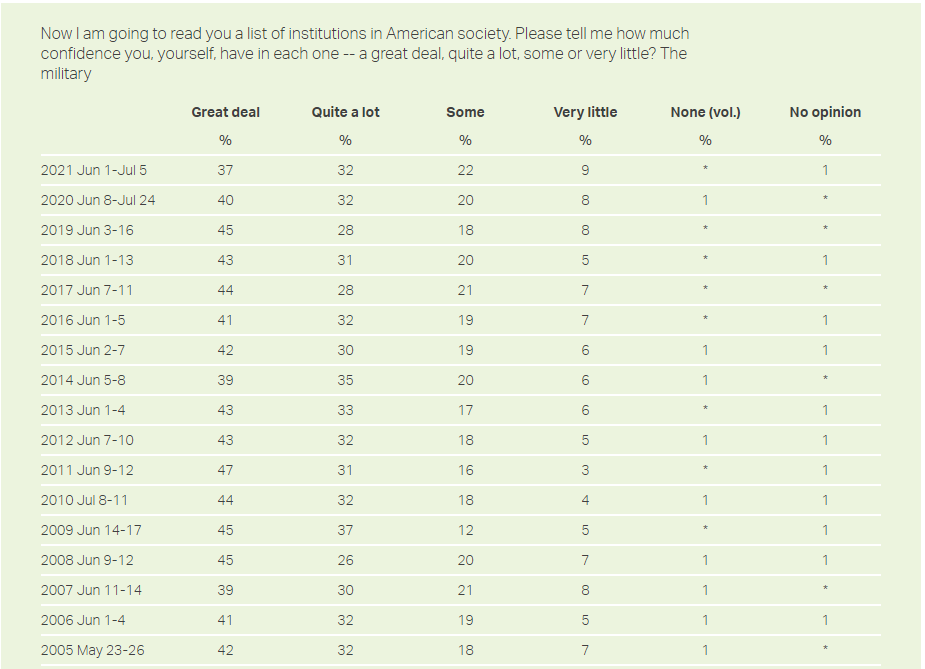
There are plenty of pollsters that track trust in the military, often as part of a larger poll looking at trust in government institutions. If you look at Gallup, you’ll see a slight decline in trust, although Gallup lumps “a great deal” and “quite a lot” into the same category of trust when reporting numbers. It’s still a decline though, and when you look at a more in-depth breakout, we see the percentage of people responding “a great deal” declining while the “some” and “very little” crowd slowly grows.
Other polls also show this. This poll from the Reagan Foundation shows a massive drop in people who trust the military “a great deal,” and a large rise in people who don’t trust it “much at all.” Now, given its the Reagan Foundation, I was skeptical as to who they selected for the poll, but scrolling down to the bottom showed a pretty even split between Republicans, Democrats and Independent voters, so I’d like to think this is fairly representative of all Americans.
This lack of trust manifests itself in a lot of ways, from voting in politicians who actively campaign to cut defense spending to parents suggesting alternatives to their children desiring to join the military. When nearly half of parents would actively push their kids away from joining the military, that’s a pretty stark indicator that parents lack trust in the military. These actions make it much harder to recruit new members.
Take the disastrous Afghanistan withdrawal. While almost no Americans (except the CEOs at Northrup Grumman and BAE) supported staying in Afghanistan, most Americans wanted an orderly withdrawal from Afghanistan, similar to the US withdrawal from Iraq that left an intact government (no, not the Obama withdrawal, the Trump one). Did we get that? Nope. Not by a longshot. Afghanistan was at a stalemate, and the number of deaths and injuries had dropped to nearly zero. An orderly withdrawal over a year or two would likely have left a functioning government and a decent US and NATO victory in the region. Instead, we got a cowardly retreat.
What about the military’s COVID-19 vaccine policy? The military chose to die on this hill and forced out hundreds, likely soon to be thousands, of members over the COVID vaccine. Religious waivers were denied out of hand, to the shock of many. The military really said the quiet part out loud: they wanted compliance, and they would crush people as needed to get it.
What about the military’s increasingly woke pandering, alluded to in the Army article? The recent push to be more “inclusive,” along with extremism training, has really irked plenty of service members. While its hard to get numbers on this, many service members are voting with their feet. It is starting to show in retention numbers. The military has always been a triangle, with lots of junior people on the bottom and less on the top. But that relies on the bottom people staying past their first enlistment. And well, they aren’t. The trend is slow, but with the Navy numbers here, you can see that there are less E4 and E5 Sailors staying around. The E6 and above numbers are steady, but as those members reach 20 years, many will choose to retire, and the new retirement system doesn’t incentivize staying in the military long term, so the young people joining today will be leaving in droves after a 4-6 year enlistment.
Let’s also look at one more statistic that is pretty shocking: the military’s use of non-judicial punishment. Most people don’t realize that if the military suspects a service member committed a crime, they really can violated the rights that citizens normally have in terms of due process. The process of punishing a service member through non-judicial punishment (called NJP) involves gathering some evidence and declaring that there is a “preponderance of evidence” to find them guilty. This legal standard means that the judge (in most cases, a military officer not trained in the law) finds there to be enough evidence that he or she is convinced by at least 50% that the service member committed a crime. Contrast this with “beyond a reasonable doubt,” which requires members to be convinced that there is essentially no real doubt that a member committed a crime.
If this sounds like it can be abused, you better believe it is. It’s hard to get data, but the Air Force released some information on the number of NJP cases per thousand airmen. If I add up the numbers, I get a rate of 45.32 cases per thousand in 2019, or 4,532 cases per 100 thousand. That seems really high, especially given that crime overall is falling in the US. Comparing it to total property crime rates in the US (1,953 per 100 thousand) and total violent crimes (398 per 100 thousand), it seems really high. Are Airmen engaging in more criminal behavior then their civilian counterparts? What kind of people are we recruiting that we get this high number? Or perhaps the system is grinding on otherwise innocent people in the disguise of “maintaining good order and discipline.” If that’s the case, how long will service members want to stay in a system like this?
The point here is that the military has become a hostile work environment, which is motivating people to seek employment elsewhere. Blaming obesity and mental health is a cop-out, because its something external to the organization that allow you to throw up your hands and say “People are fat and mentally unstable, thus I cannot reach my recruiting goals!” The SEALs and Marines have had tough standards for years, yet they always made numbers, largely due to people trusting those organizations and wanting to be there. That trust is gone due to actions the military took. Between losing wars, eliminating benefits and promoting an justice system that is broken and corrupt, the military has only itself to blame for creating a workplace that nobody wants to work in anymore.
This post represents the views of the author and not those of the Department of Defense, Department of the Navy, or any other government agency. That should be obvious, since those organizations will tell you everything is just fine with them. If you liked this article, please consider donating to Da Blog and purchasing a book by the author for you or your friends.






 Da Techguy's (no longer backup) Blog