
Posts Tagged ‘military’

Spoiler alert: its because we’re solving the wrong problem.

You can’t walk around on a military base without being innundated with suicide prevention materials. Walk down any hallway and there’s a poster with the hotline number. Navigate to any DoD website and there is a 24/7 military suicide chat line linked at the bottom. Heck, even if you sit down to do your business in the bathroom, you’ll see a suicide prevention poster on the inside of the door.

Granted, the suicide rate in the military is rising. The military is composed mainly of 18-25 year old men, who traditionally have the highest rate of suicide. Combined with the stress of working in a job field where people actively try to kill you while you kill them, and you’d think that would spike the suicide rate. But for the longest time, despite the many years spent in Afghanistan and Iraq, military suicide was statistically lower than average.

From Suicide Rates Among Active Duty Service Members Compared with Civilian Counterparts, 2005–2014

Look at 2005-2008 here. The rate is far below what you would expect. You can look at the crude numbers here as well.

It’s obvious though that the rate was rising. If you look at combat deaths and the news, the United States had a nasty surge in combat deaths from 2009-2011. This was when we were trying to drawdown in Iraq and surging in Afghanistan. It would be easy to blame the added stress for the rise in suicide. But I’m not so sure. After the surge, the number of combat deaths plummeted, yet the military suicide rate continued to rise. The additional stresses of combat, once removed, don’t support the hypothesis that it caused the increase in suicide.

In order to have enough troops to surge, the military, particularly the Army, waived a lot of requirements, including physical standards and prior drug use. This means that instead of selecting from the best of the crop, you get a swath of people that look more like most Americans, which means you get the suicide rate of most Americans. Notice that the suicide rate plateaus and matches the average civilian rate.

This is further confirmed by looking at the most recent suicide rates. The rate slowly began rising again from 2018 until today, despite a continued decline in combat deaths. Now its rising again. What are we doing that might cause it to rise?

From DoD Suicide Report
From DoD Report on Suicide

If you look at my previous posts here, I’ve been complaining about the drop in standards and loss in direction for the military for a while now. The Army finally admitted it will simply be short 10,000 troops, but that it “wanted to maintain high standards” instead of recruiting more soldiers. To that I call BS, because they already lowered standards a lot in order to get to where they are at now.

Worse still, we’re cutting back on training. The Army softened its boot camp, which caused retention to go up, but likely didn’t help build soldier’s confidence. Most of the services have cut back on specialized training (the Navy in particular), so its harder for service members to feel like an expert in their field. Combine that with a refocus on things like “extremism training,” and military members can’t be faulted for feeling a bit adrift.

So we’re lowering entrance standards, which we have proof raises our sucide rate, AND we’re shortening and softening our training, making less capable military members (who, by the way, KNOW that they aren’t as capable). That’s a bad combination, and its the real reason behind the continued rise in suicide. It’s not that we lack the funding for suicide prevention programs. It’s that we’re solving the wrong problem.

Until we solve the standards problem, we can’t begin to prevent military suicide.

This post represents the views of the author and not those of the Department of Defense, Department of the Navy, or any other government agency.

And if you’re thinking about suicide, put it off for a day, watch this Jordan Peterson video, and then call a friend or a hotline. We’d rather have you around.

The National Defense Authorization Act for FY22 just passed this week. While there are some nice changes, like a 2.7% pay increase (sadly offset by rampant inflation) and some additional baby leave, there is a lot that is left to be desired.

Now, given looming war with China and Russia, our gaps in hypersonic technology, space, bioweapons, and cyber, and our poorly maintained “battle” fleet that seems to barely limp along from extended deployment to extended deployment, you would think anyone writing the executive summary of this bill would want to reassure the public that its going to make us stronger and ready for war with the hopes of deterring it to make peace.

And well, you’d be wrong. Here’s the highlighted portion of page one of the summary:

The FY22 NDAA builds on previous attempts to close the pay gap by authorizing support for a 2.7 percent pay increase for our service men and women in uniform, makes historic and sweeping
changes to the Uniform Code of Military Justice to combat sexual assault in the military,
authorizes record funding for Historically Black Colleges and Universities, contains
measures to ensure our military is diverse and inclusive, and makes key investments to
address the threat of climate change and bolster energy resiliency across the Department
of Defense, and takes full advantage of our diverse talent pool to meet the complex national
security challenges of today and tomorrow.

House Armed Service Committee NDAA FY22 executive summary

What the heck is this? HBCUs? Diversity? Climate Change? Seriously?

Xi Jinping and Vladimir Putin have got to be laughing at this.

Now, don’t get me wrong, I’m all about getting research money to HBCUs to support weapons and tactics development. Why not? It would be awesome to see an HBCU open a cyber center, or contribute to space warfare, or some other highly technical area. That would have long reaching benefits, encouraging young black kids to aspire to be great engineers and scientists. There is a lot to love with ideas like that, and its a win-win for the Department of Defense.

But how is that the highlight? Defense is about combating our enemies and helping our policy makers negotiate peace from the best possible position. Think about World War 2. Could we have negotiated a lasting peace with Hitler or the Japanese Emperor without being in a position of strength? I’d argue that half of the reason Hitler rose to power in the first place was that he saw weakness and pushed against it. The same could be said for Putin today as he gazes at Ukraine, challenging the US and its NATO allies to do something.

Nothing in those opening paragraphs radiate strength. As you dig through the document, the increases in equipment are buried, but they are paltry. We’re getting 13 additional ships, if they can be built on time. We really need another actual shipyard, yet that piece of vital infrastructure isn’t in the bill, since it would compete with companies that already have a lock on shipbuilding (and the Congress-people on their payroll to prove it). If you need proof of how bad it is, just check our CDR Salamander’s blog.

From CDR Salamander

But most disingenuous is that military personnel are going down in numbers. Yup. Hidden away in the actual text is a decrease in manpower:

With regard to military end strength, the number of Army soldiers would drop by 900 (to 485,000) compared to this year’s levels and the Marine Corps would cut its troop numbers by 2,700 (to 178,500). That’s in line with White House end strength plans. The Navy’s end strength total would drop by about 900 (to 346,920), about 700 more sailors than the White House requested. The Air Force would see a decrease of about 4,200 personnel (to 329,220), about 1,000 more airmen than the administration requested.

From Military Times

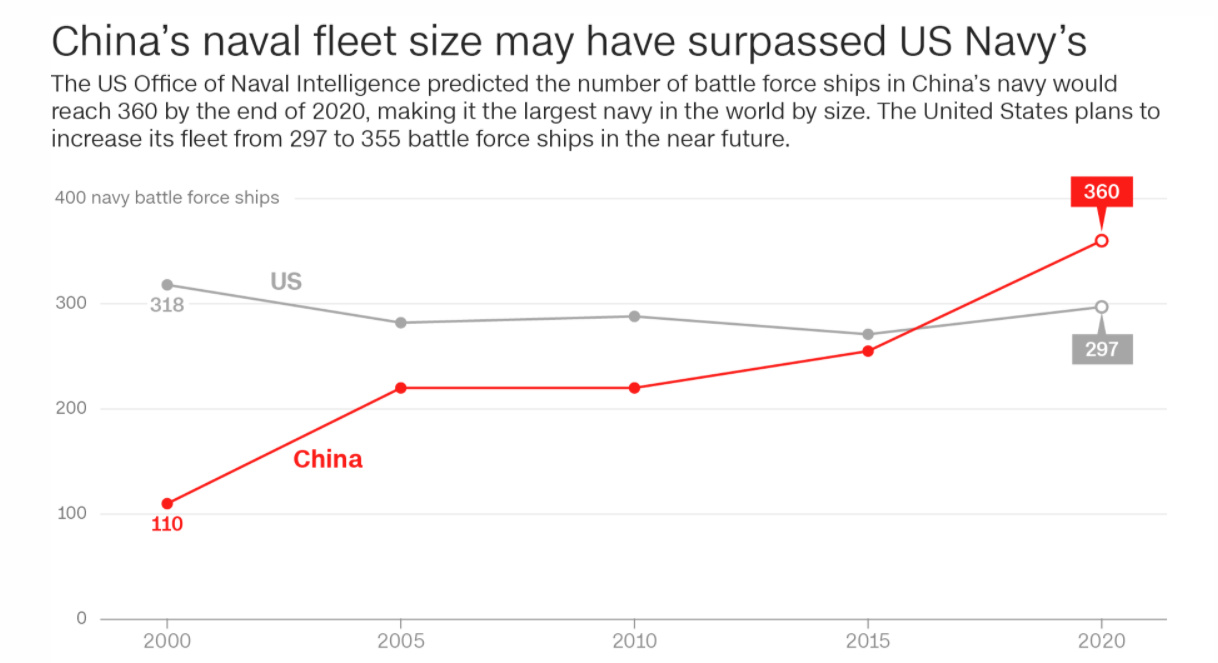
If we’re already not doing a good enough job keeping up with China, how on earth will we do that with less people, specifically less people in the Navy and Air Force, the services that will take the brunt of any Pacific conflict?

This year’s NDAA is a joke. It’s laser locked on social justice issues while missing all the important items needed for any future conflict. Sadly, it’ll likely take a war where we lose thousands of service members before Congress will shelve the pet programs and get serious about winning.

This post represents the views of the author and not those of the Department of Defense, Department of the Navy, or any other government agency. If you liked this article, please consider supporting the author by buying his book on Amazon, also available as an audiobook on Audible.

Answering that question depends what you think a cult is.

The magazine Wired has produced a number of fascinatingly good articles and videos with interesting stories, and one of this weeks YouTube videos hit the mark yet again. Dr. Janja Lalich is a survivor of a political cult, the Democratic Workers Party, and she answers a number of cult-related questions in her video. Her responses are both focused and enlightening.

Dr. Lalich defines a cult as having 4 characteristics

  1. A charismatic leader that is typically a narcissist
  2. A transcendent belief system that has the answers to all questions
  3. A System of Control that controls behavior
  4. A System of Influence that plays on emotions to encourage conformity

Dr. Lalich also separates cults from religion in that religions encourage freedom and independent thought while having guidelines to live by, whereas cults enforce their guidelines.

Given her definition, let’s see how today’s military stacks up:

  • The charismatic leader part is a mixed bag. On one hand, the glitz and glamor that many of the flag and general officers decorate themselves in definitely contributes to a feeling of awe for these people. However, many of them aren’t very charismatic or engaging. The narcissist trait is definitely present in the military’s worst leaders.
  • The transcendent belief system is spot on. The military has a set of rules for everything. Haircuts? Check. Restrictions on your first amendment rights? Check. Poke-mon Go? Check.
  • Control is achieved through the Uniform Code of Military Justice, which can still punish offenses like adultery and conduct unbecoming of a gentlemen that aren’t considered offenses in most civilian systems.
  • Influence is achieved through awards, assignments, and promotions. If you conform with the rules and stay out of trouble, you tend to promote.

3.5 out of 4 is pretty close. The only questionable point is leadership, and that doesn’t surprise me. Every time I’ve had a bad military leader, military life felt oppressive. Dr. Lalich talks about how all people have doubts when they are in a cult, but they get put on a shelf. If too much builds on the shelf, it collapses.

I think shelves are now starting to collapse in bigger numbers than before. The military has the setup to become a cult, and it is only good leadership that prevents this from happening. But military leaders continue to get put in hard circumstances. How do you explain the Afghanistan withdrawal to your soldiers? Or the poor maintenance our ships receive at a shipyard to your Sailors? Or how almost nobody was fired for massive scandals like the mismanagement of Arlington National Cemetery? You simply can’t, and young people asking hard, pointed questions won’t be satisfied by the bland responses from a Pentagon press secretary.

At some point, the good people get tired and leave, making way for those all too happy to defend the status quo. We’re seeing that happening now. The vocal ones, like Lt. Col. Scheller, make the news, but quietly, we’re going to see more and more people simply walk. The military is designed to replace people. The Marines will find another person to fill Lt. Col. Scheller’s spot. The person will at least be adequate, but anyone taking that roll is going to think twice about speaking out or showing too much independence.

That lack of independent thought will make the military stick to what it knows. We shouldn’t be surprised that the military is slow to embrace ideas like autonomous vessels, AI and robotic fighters. When you’re the best, or at least you think you are, you keep doing what was done in the past. Thus, it shouldn’t surprise people that the Navy still uses an antiquated program designed in 1998 to administer personnel reports, instead of moving to a secure cloud based system, or at least something resembling Microsoft Word.

We will eventually pay dearly for these mistakes, even if it isn’t so obvious now.

This post represents the views of the author and not those of the Department of Defense, Department of the Navy, or any other government agency. If you want an epic story to read in the meantime, please check out my book on Amazon.

…and not in a good way

We’re seeing more news on people leaving the military, even when within one or two years of retirement. First it was Marine Corps Lt Col Stuart Scheller. Next it was Army Lt Col Paul Hague. I’m sure over the next two months we’ll get about one of these every two weeks before it dies down. They’ll make the news, people will comment needlessly on Twitter, and then life will go on.

That’s not the real story. The real story is that for every one of these very public resignations, there are thousands that are quietly leaving. These people aren’t willing to throw away a pension if they are close to it. For the ones that are ending their first five year commitment, they are simply preparing now to walk away. They won’t make a big stink about it. They won’t leave five page resignation letters talking about Marxism, transgender policy and imbedded racism. Nope. These people will simply leave. They won’t make a ruckus or create waves, they’ll simply vote with their feet.

The military will cover this up. Not like X-Files “I want to believe” sort of cover up. It’ll just not make headlines. You’ll hear things like “We’re short on fighter pilots” now and again, but nothing earth shattering will make the news. The media that cover military stories focus almost exclusively on operations, because operations is sexy. It’s sexy and cool to interview the Blue Angels and look at drones landing on an aircraft carrier. It’s boring to look at numbers. That stuff is for nerds.

But nerds rule, and the numbers already look bad on the Navy side. The best indicator of what is called “community health” is how well you’re filling control grade officers, specifically the O-4 (LCDR), O-5 (CDR) and O-6 (CAPT) ranks. These are important for a few reasons.

  • Almost all of your commanding officers and executive officers come from these ranks. These officers control the day-to-day operations and they have by far the biggest impact on Sailor morale. If morale is suffering and things are getting done, this is the first place to check.
  • These people are lifers. They’ve stayed past 10 years, so they are “in it” for the long haul. They either love what they do, or at least don’t hate it enough to quit.
  • These ranks have the not-fun jobs. These ranks run the show from the background. The sexy jobs flying fast planes, driving boats and shooting at bad people are now past. That makes these jobs harder to fill.

So how is the Navy doing in this area? Easiest way to check is selection rates. The Navy’s officer manning is a pyramid. There are lots of O-1, O-2 and O-3 young officers at the bottom. The ideal selection rate to O-4 is 70%, meaning that 30% of otherwise qualified people are not selected. That seems brutal, but it allows you to pick the best. It also takes into account people that leave anyway, since O-3s that are eligible for promotion would also be finishing their first 5-year committment.

As we go up the pyramid, it gets harder. Ideal selection to O-5 is only 60% of eligible people, and selection to O-6 is about 50%. You only want the best people in positions of command and responsibility, and there aren’t as many jobs that high up, so you’re naturally going to shed more people. Also, these ranks allow people to stay until retirement, so you’ll have more non-selected officers that fill slots until they retire.

So how are selection rates now? LCDR selection rate is roughly 90%, CDR is 80% and CAPT is around 65%. This varies a lot by community, with some communities significantly higher.

That’s bad. High selection rates mean not enough people are staying in until they are eligible for promotion. In a business environment, you can simply hire people from outside or promote younger people, but the military is only allowed to pick 10% from what they call “below zone” officers, who are typically 1-2 years younger than officers that are “in zone” for selection. Now, you can pick officers that were previously passed over for promotion, and in many cases, these officers are otherwise great selections. But officers that are passed over once are likely planning their exit already. Once they see opportunity elsewhere, many are going to walk away.

Worse still, look at the communities with the highest selection rates. For CAPT, these are Cryptologic Warfare (85%) and Information Professional (70%). For CDR, these are…the same group, and the same for LCDR. Cryptologic Warfare officers make and break codes, specializing in cyber warfare, signals intelligence and electronic warfare. Information Professionals connect and maintain Navy communications. Both groups require significant engineering backgrounds, and yet both groups are leaving in droves. If the people that conduct the most advanced warfare areas are leaving, it means we aren’t providing enough incentives for them to stay around compared to what they can achieve in industry.

This is the canary in the coal mine. The numbers are trending worse, not better. This has been happening for the past three fiscal years. Now, combine this with a job market that is begging people to work, and one that is rapidly adopting the use of advanced technology to replace low-skilled jobs. The first people to leave the Navy, much like the first people to leave the fictional company in Ayn Rand’s Atlas Shrugged, are the engineers and people with technical skills. Others in the chain will take notice, and short of significant business setbacks, people with good skills will bail. Once they have “Gone Galt,” the Navy is going to struggle to find competent leaders.

I used to laugh at movies like “Battleship,” where the only tactics the military seems to use are bum-rush the bad guy with big guns, resembling the often suicidal battle charges from the Civil War. Sadly, that’s what we’re going to get when its not worth it for smart people to stay around.

This post represents the views of the author and not those of the Department of Defense, Department of the Navy, or any other government agency. All data was publicly available at https://www.mynavyhr.navy.mil/Career-Management/Boards/Active-Duty-Officer/.

Since you read this far, you should buy my book, “To Build A House,” available here on Amazon.