

Posts Tagged ‘NG36B’

No, seriously, its not

There has been plenty of discussion about Microsoft’s attempted acquisition of TikTok and the recent executive order that barred working with TikTok, WeChat and other Chinese social media apps. But amid all of this came an interesting article in the BBC accusing the United States of “splitting the internet.” Yup, really.

“It’s shocking,” says Alan Woodward, a security expert based at the University of Surrey. “This is the Balkanisation of the internet happening in front of our eyes.

“The US government has for a long time criticised other countries for controlling access to the internet… and now we see the Americans doing the same thing.”

Dr. Alan Woodward

The article does backtrack a bit and brings up legitimate security concerns posed by China. It sparked my curiosity in Pompeo’s speech, which hasn’t really made the news. So I found the transcript, and Pompeo had outlined five lines of effort for a Clean Internet:

First, Clean Carrier. We are working to ensure that untrusted Chinese telecom companies don’t provide international telecommunications services between the United States and foreign destinations.

Second, we call Clean Store. We want to see untrusted Chinese apps removed from U.S. app stores.

Third, Clean Apps. We’re working to prevent Huawei and other untrusted vendors from pre-installing or making available for download the most popular U.S. apps. We don’t want companies to be complicit in Huawei’s human rights abuses or the CCP’s surveillance apparatus.

Fourth, Clean Cloud. We’re protecting Americans’ most sensitive personal information and our businesses’ most valuable intellectual property – including COVID vaccine research – from being accessed on cloud-based systems run by companies such as Alibaba, Baidu, China Mobile, China Telecom, and Tencent.

Fifth and finally, Clean Cable. We’re working to ensure that the CCP can’t compromise information carried by the undersea cables that connect our country and others to the global internet.

Mike Pompeo, Secretary of State, in a speech on August 5, 2020.

This list doesn’t resemble censorship. Nowhere in the list does the U.S. censor information from other countries, prevent people from being critical of the United States, or otherwise interfere with other countries operations. It narrowly targets tech Chinese companies with known issues while leaving an open door to every other nation. It highlights some significant problems like stealing of COVID vaccine research that not enough people are tracking.

There is this libertarian view that a free and open internet means government’s should have no role whatsoever in the internet. There are plenty of flaws with this idea. The largest flaw is that this view fails to act when an entity like the Chinese Communist Party seeks to dismantle the Internet and subvert it for its own good. The BBC would perhaps brush this off as “market forces,” and to be sure, the UK has stood on the sidelines while China filters Hong Kong’s internet and even the internet at UK universities.

Perhaps better said in the movie Team America: World Police: “Freedom isn’t free.”

You can, and should, limit government involvement and allow the market to drive innovation, but when an obviously dark force threatens to break the freedom of information on the internet, you must act to stop it.

This post represents the views of the author and not those of the Department of Defense, Department of the Navy, or any other government agency.

Russian consulate in Svalbard, which looks like my kid built it out of Legos. From The Barents Observer.

Russia continues to make big news that stays under the wave tops of COVID-19 news. I’ve written about Russia many times in the past, and made a few predictions:

I’ve also said that Russia would never give up footholds in Ukraine and Georgia. So, how is that playing out? Sadly, I’m not far off.

Turkmenistan

Turkmenistan is facing a spread of COVID-19 in its country. Who has lined up to help? Russia, of course. They’ve done this while trying to find ways to boost Turkmenistan’s economy, all while Turkmenistan gets closer to the Commonwealth of Independent States (CIS), which is Russia’s stand-in for the USSR.

Belarus

Belarus recently arrested a number of Russians that it accuses of inciting riots ahead of its 8 August election. Not surprisingly, Russia asked those people be released. There was in fact a large rise in the democratic movement that seeks to unseat the 5-term Belarussian President Lukashenko. With a soon-to-be contested election and shared border with Russia, what could go wrong?

Svalbard

Russia has started the messaging train once again for Svalbard, this time demanding that Norway comply with Russian demands on Svalbard. Which they still call Spitsbergen, just to make the Norwegians angry.

Georgia

Russia continues to manufacture a “border crisis” in Georgia. It’s slowly stopping any aid from reaching the breakaway sections while not removing troops in accordance with the cease fire.

Russia isn’t pulling any “crazy Ivan” moves. It knows that the US and Europe just don’t care enough (with the exception of Norway in Svalbard) about Georgia, Belarus and Turkmenistan. If Americans can barely find these places on a map, they certainly won’t care enough to risk their sons and daughters in the military to save them. In truth, if we want to stop this, we have to ask ourselves if we’re willing to go to war with Russia to save some territory in Georgia. And because the Russians think we won’t, they aren’t likely to stop taking that territory.

This post represents the views of the author and not those of the Department of Defense, Department of the Navy, or any other government agency.

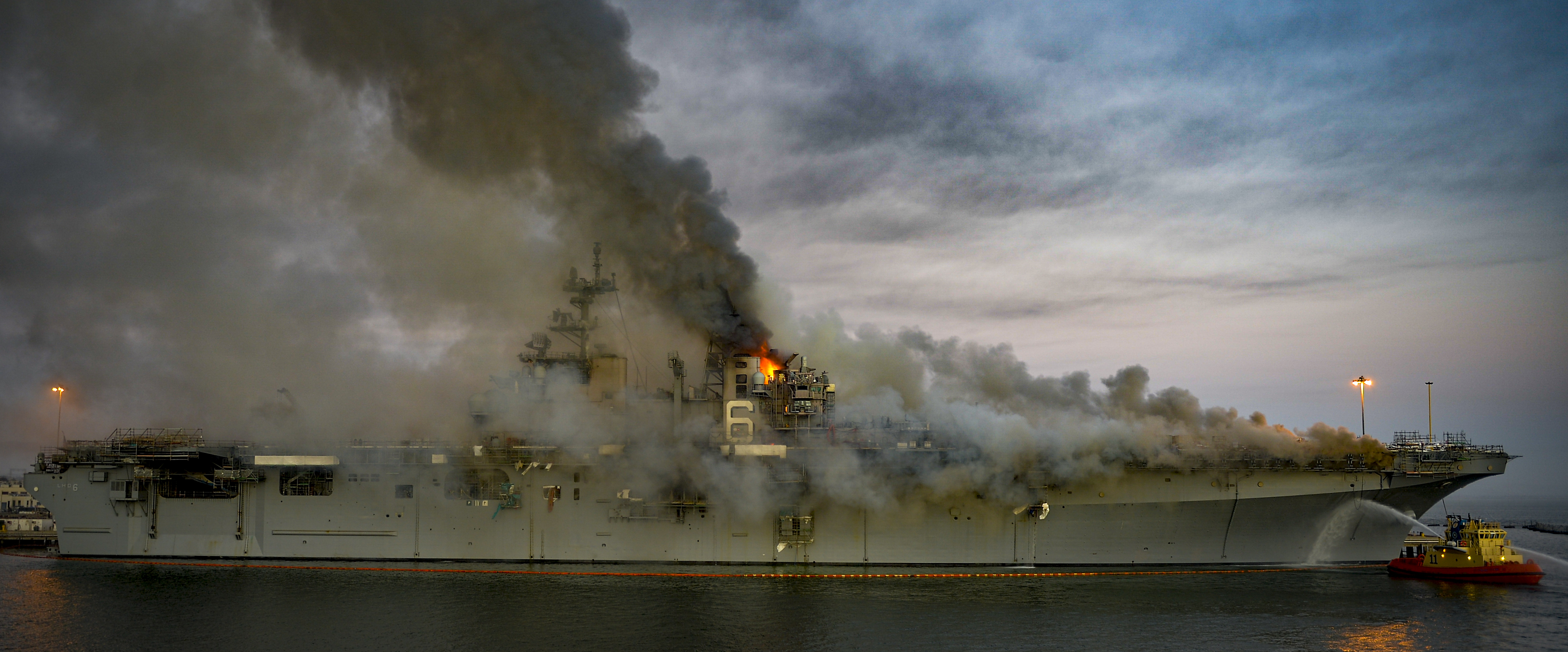
USS BONHOMME RICHARD on fire in San Diego, from Wikipedia

Starting on Sunday, there was fairly non-stop news about the USS BONHOMME RICHARD (LHD-6) on fire in San Diego. The fire was extensive, burning from the middle of the 844 foot long ship, burning in 11 of her 14 decks all around the ship. It’s caused significant damage, and there are already talks it may not be salvageable. To put a dollar amount on it, she cost about 750 million to make in 1998, but today it would cost more like $3.3 billion to build a replacement vessel.

Most people’s first question is, how in the heck can a fire rage through a ship like that? The answer is complicated. First, BONHOMME RICHARD was in a maintenance availability period. She had a large number of shipyard workers fixing a variety of systems onboard. Imagine if you hired contractors to replace your roof, drywall and paint two rooms, replace your kitchen sink, and rewire half your house all at the same time. My first ship was in a maintenance period, and I didn’t recognize the rooms I was in while walking around. It’s a confusing, crazy, dirty mess to try and fix complex systems.

Extra complexity means nothing is normal, with firefighting as no exception. Firefighting equipment gets moved around to support maintenance, and on an 844 foot ship, that might mean extensive portions where there isn’t much equipment. Holes get cut in decks, requiring extra ventilation equipment and rerouting of normal movement paths, which makes getting to and from places hard. All that extra equipment is an inviting target for a fire. Even small fires take way more time and effort to find, fight, isolate and eventually put out.

Fighting fires on a ship is scary business. I’ve gone through our basic firefighting trainers. They are difficult. Contrary to the movies, a firefight is almost pitch black due to the smoke. So imagine you’ve got on 40 pounds of extra gear, breathing through a mask, walking in pitch black conditions, dragging a hose with you while the guy behind you with an infrared sensor guides you towards hot spots that you can’t see. That’s the reality of firefighting. A friend of mine fought a large fire on a submarine and nearly drown when the deck gave out below him and dumped him in a large pool of water, the same water he had been spraying on the fire. He’s really in shape, and even he struggled to get out.

I’m not surprised BONHOMME RICHARD caught fire and that it was bad. What I want to know is whether it’ll cause changes in the future. The shipyard has always been a dirty place, and shipyard workers aren’t normally known for cleanliness. Navy Sailors, unfortunately, get used to this and develop just as bad of habits, which the senior enlisted try desperately to fix. When I visited Japan, I was shocked at just how clean the shipyard was. While you can’t always keep an area clean, going days and weeks without cleanup significantly increases the chance for fires, accidents and all sorts of problems. If this fire forces the Navy to work with shipyards to clean up their act, it would be something useful in an otherwise tragic circumstance.

This post represents the views of the author and not those of the Department of Defense, Department of the Navy, or any other government agency.

Screen capture of President Trump’s Farsi tweet

I’ve been helping a new Public Affairs Officer get setup at her new job. We had a chance to talk about what influence’s people, specifically in news media, and specifically about the importance of understanding and communicating to your audience in a way that they understand. I brought up how during our BALTOPS exercise, one of the most popular items was an interview my boss had with a local news organization that was translated into Russian. It spiked traffic and I was shocked at how well received it was.

This Public Affairs officer called me this week with a short request, and then asked “Hey, did you see Trump’s tweet in a foreign language?”

Me: “Nope.”

Her: “Yeah, he tweeted about the Iranian executions in their language.”

Sure enough, a quick Google revealed that she was correct. President Trump tweeted in Farsi (the most common language in Iran) about his opposition to the execution of Iranian protesters. It’s quickly become one of the most popular Farsi posts. Ironically, Trump had previously tweeted in Farsi in January which became the most popular Farsi tweet ever. And just as interesting, I had not heard of this tweet. Granted, I’m not a Twitter user, but normally that sort of thing makes the news.

Tweeting in Farsi is hard. It’s not an easy language to use, and not easy to convert English into Farsi. President Trump is showing a pretty good understanding of how to make his tweets viral with a foreign audience he wants to influence. And yet…no mention of this, at all, in the media. Not even to make fun of it.

It’s the lack of coverage on these things that makes it too easy to believe the media is horribly biased.

This post represents the views of the author and not those of the Department of Defense, Department of the Navy, or any other government agency.