
Archive for the ‘media’ Category

White is bad

Posted: August 16, 2022 by chrisharper in media
Tags: ,

By Christopher Harper

The ideological attack on white men in the United States has gained considerably in recent years, including a series of blatantly racial attacks. 

Simply put, being white in America has become inherently bad.

For example, Rolling Stone recently highlighted the arrest of a man the publication contends wanted his compatriots to rape white women and kill blacks to increase the majority of Caucasians in America. 

“[A] former U.S. Marine plotted mass murder and sexual assault to ‘decrease the number of minority residents’ in the United States as part of his membership in a far-right neo-Nazi group, ‘Rapekrieg,’ the news organization writes. 

“Belanger was the subject of an FBI Joint Terrorism Taskforce investigation into allegedly plotting to ‘engage in widespread homicide and sexual assault.’ Much of Belanger’s ideology and plotting…is based around a desire to lessen the number of nonwhite Americans and to rape ‘white women to increase the production of white children,'” Rolling Stone contends.

What’s noteworthy about the report is the final paragraph: The Senate Armed Services Committee recently stated that the Pentagon was spending too much money on investigating such matters because the number of individuals is so small.  

So why does Rolling Stone even report the arrest? Because it promotes a frequent meme: Marines are primarily white, rightist wingnuts rather than soldiers who deserve the nation’s respect. 

But there’s more. Atlantic published an article equating Catholic rosaries with extremism. “Just as the AR-15 rifle has become a sacred object for Christian nationalists in general, the rosary has acquired a militaristic meaning for radical-traditional (or ‘rad trad’) Catholics,” Atlantic’s Daniel Panneton writes.

“On this extremist fringe, rosary beads have been woven into a conspiratorial politics and absolutist gun culture,” Panneton adds. “These armed radical traditionalists have taken up a spiritual notion that the rosary can be a weapon in the fight against evil and turned it into something dangerously literal.”

Just think about the outrage if someone wrote that worry beads were a sign of a terrorist in the Middle East.

But there’s even more. Wired, known primarily as a tech publication, has picked up the anti-white meme in a book review. 

“Whiteness is a seduction. Whiteness is also an illusion. These are the twin motifs on which Pakistani writer Mohsin Hamid props up The Last White Man, his latest novel,” Wired states. 

The novel focuses on how whites wake up as nonwhites and how society becomes better for the change.

It’s heartening that Atlantic’s outrageous slander against Catholics has faced some blowback on social media. Still, it appears that the current meme in the media elite is to publish even more outrageous and offensive attacks against whites.  
By John Ruberry

Outside of sheer incompetence, a theme has emerged from the Joe Biden administration. When they need help, the White House calls on people they deem to be experts. 

Here’s a dirty secret of politics, or if your prefer, of advancing a preferred narrative. Anyone can find an “expert,” more on them in a bit, to support any opinion. It works in journalism too, the media wing of the Democrat Party.

When the discovery of the Hunter Biden laptop was revealed by the New York Post nearly two years ago–the mainstream media, social media, and of course the Biden campaign immediately moved to denounce it. The casus belli for journalists, Facebook, Twitter, and the like–Biden brought this up in a presidential debate–was that its emergence three weeks before Election Day in 2020 had “all the classic earmarks of a Russian information operation,” according to 51 former national security experts, led by James Clapper, a director of National Intelligence under Barack Obama. Every one of these “experts” either lied, signed on to something they knew little about, or just simply wanted to do whatever it took to prevent the reelection of Donald J. Trump. 

Eighteen months later, the New York Times admitted Hunter’s laptop, which provided voluminous evidence of his influence peddling centered on his being the son of a powerful politician, was authentic. The 51 experts can expect subpoenas from the House Judiciary Committee next year, assuming the Republicans take control of the House. Every one of these “experts” should have their security clearances permanently revoked.

Biden of course won the election. As a result of his policies, such as cancelling the construction of the Keystone XL pipeline, blocking new permits for drilling on federal land, gasoline prices soared and remain high. Although the economy was well into recovery mode two years ago, Biden signed into law the unfunded American Rescue Plan. Many experts at the time claimed it would not fuel inflation. They were wrong. Just as those national security “experts” were wrong on Hunter’s laptop. 

When inflation began its ascent, the White House cited 15 Nobel laureates in economics who said that Biden’s Build Back Better bill, enacted in late 2021, would not fuel inflation. They were wrong too. Inflation is now at levels not seen since the early 1980s. Last year Biden and other “experts” were saying inflation was “transitory.” Liberals reading this post will blame inflation on the War in Ukraine, you know, “Putin’s price hike.” Sure, the war likely has an effect on inflation, but the scourge was with us before Russia’s invasion Ukraine. 

Build Back Better was originally part of a much larger bill, the green energy stuff was split off and later discarded after Sen. Joe Manchin (D-WV) said he wouldn’t support it. Well, Build Back Better Part Two is back, laughably renamed the Inflation Reduction Act. And to bolster its support, the Biden White House has–are you ready?–called on experts, this time, four former Democratic Treasury secretaries and one Republican, who claim, among other things, that the Inflation Reduction Act will “fight inflation” One of those ex-Treasury secretaries is Larry Summers, who warned last year the Biden White House, “We’re taking very substantial risks on the inflation side.” 

A good journalist would track down Summers and ask him specifics on why this bill really will fight inflation.

Earlier I mentioned that journalists have a role in advancing political narratives. For example, at Forbes, Rhett Buttle offers a slobbering French kiss of propaganda, which is accompanied by this headline, “Experts Agree: The Inflation Reduction Act Accomplishes A Lot For Small Business And Working Families.” While late in the piece Buttle manages to write about the bill, “some who represent select corporate interests in Washington don’t completely agree” with the hype. But if Buttle was truly a journalist, he would have tracked down opponents of the Inflation Reduction Act and presented a balanced article.

Then again, real journalism is dead. Twenty years ago such a piece as the one written by Buttle would contain the sub-headline, “news analysis,” assuming a magazine like Forbes would even publish it. I took some journalism classes at the University of Illinois. If I turned in such an article for an assignment, a professor would have deservedly given me an “F,” enhanced by this underlined comment written in red ink, “This garbage reads like a press release.”

But Biden’s new batch of experts have spoken: The Inflation Reduction Act, which the Senate will vote on Sunday afternoon, will “fight inflation.”

Watch your wallet. Watch the cash in it lose its value.

Disclosure: This blog post should be classified as “news analysis.”

UPDATE 5:15pm EDT: The Democrats’ Inflation Reduction Act passed the Senate.

John Ruberry regularly blogs at Marathon Pundit.

A good ride

Posted: July 5, 2022 by chrisharper in media
Tags:

By Christopher Harper

After working for nearly 50 years, I finally retired last week.

It was a good ride for much of my working life.

I stumbled into journalism at the University of Nebraska in Lincoln, which I attended mainly because my high school girlfriend went there.

In relatively short order, I dumped the girlfriend and my accounting major, choosing journalism because cool kids in my graduating class in Sioux Falls, South Dakota, worked for the high school newspaper.

I got a chance to cover events, such as the ill-fated presidential campaign of George McGovern and the American Indian Movement takeover in Wounded Knee, South Dakota, catapulting me into various exciting jobs.

While attending Northwestern University, I started at The Associated Press, where I wrote about economics, including the downturn of Playboy’s hold on American men and the fifth anniversary of the murder of Black Panther leader Fred Hampton.

With a helpful hand from a Northwestern professor, I got a job at Newsweek, which allowed me to ramble throughout the Midwest, covering labor and some local politics. I even got to profile Minnesota Twin Rod Carew as he almost succeeded in hitting .400 one year.

Nevertheless, I had an overwhelming desire to work in Washington, D.C., where I had spent a semester reporting for two small newspapers in South Carolina and Tennessee during the days of Watergate.

But I found Washington wanting—a boring place of people who thought too much of themselves.

During my two-year stay there, however, I got a chance to report on one of the most intriguing stories of the 20th century: the death of more than 900 people in Jonestown, Guyana. I was one of a handful of reporters who surveyed the scene of bloated bodies killed in a ritual of suicide and murder.

When I complained to my boss at Newsweek that I wanted to get out of Washington, he only half jested that Beirut was open. My wife Elizabeth and I headed off to the Mideast for a fascinating frontline look at the history of deceit and death there.

An unwilling war correspondent, I managed to cover three significant Middle East confrontations: the Lebanese civil war, the 1982 Israeli-Palestinian war, and the Iraq-Iran war.

When I discovered that the Beirut reporter for ABC News made more than two times what I did at Newsweek, I switched to television. My talents in front of the camera were far inferior to my abilities as a producer/reporter, where I lasted for 15 years in Cairo, Rome, and New York.

Along the way, I had a front-row seat at history, meeting several presidents, many influential individuals, and myriad common folk who made a difference in our world.

I jumped into academia at the end of my journalistic line, mainly because the news business had changed into a profit-making enterprise.

Although the time wasn’t as exciting, I taught several thousand students how to write—a once-needed skill that has fallen on hard times.

I also managed to travel throughout the world, holding teaching assignments in China, England, Italy, Poland, and Russia.

Now I’ll focus on the next phase of life, where I have several legal cases to analyze as an expert witness, three dogs to walk every day, a weekly trip to the Catholic Church as a lector, and this column to write.

I think I’ll still have some good times ahead!

By Christopher Harper

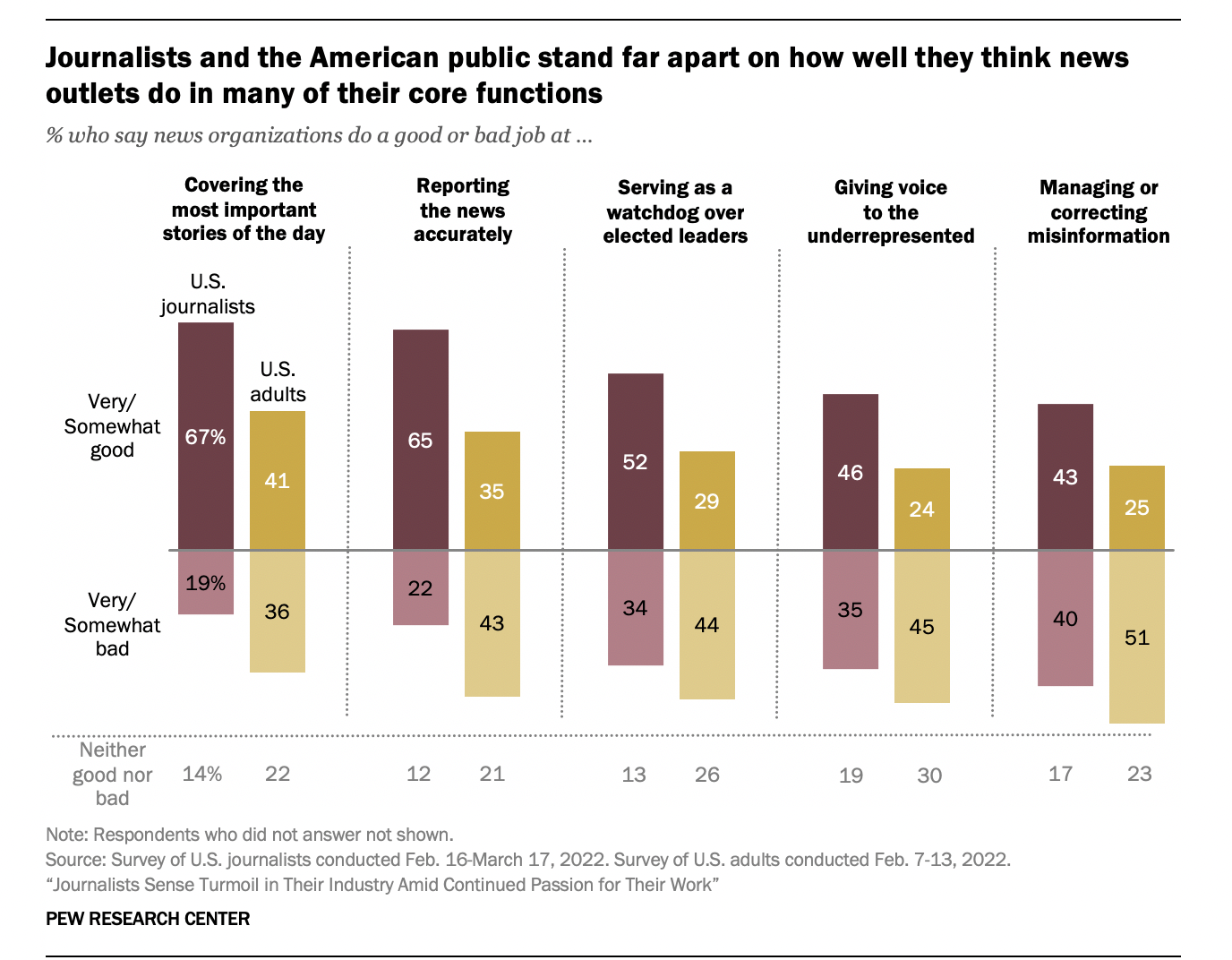
Journalists have no idea how little their readers and viewers trust the media.

That’s readily apparent from a new analysis from the Pew Foundation, which found that “overall, journalists give themselves relatively high marks on performing several of the core functions of journalism. The public, however, does not see it the same way.” See https://www.pewresearch.org/journalism/2022/06/14/journalists-and-the-public-differ-on-how-journalists-are-doing-how-connected-they-are/

The survey should be required reading for the media!

Sixty-five percent of journalists surveyed think news organizations reported news accurately. That compares with only 35 percent of the public.

A significant majority—83 percent—of journalists think their audience trusts the news organization they work for. Another 13% said their audience has some trust, while just 3% said their audience has “a little” or no trust at all.

Here, journalists are entirely out of touch with reality. Only 29 percent of the public said they trust the media, while 27 percent say they have some trust. A plurality—44 percent—reported that they have “a little” or no trust.

Some of the other findings include the following:

–Fifty-two percent of journalists think they do a good job playing the watchdog over government. Only 29 percent of the public agreed.

–Forty-six percent of journalists think they give voice to the underrepresented. The public provides a rating of 24 percent. 

–Forty-three percent of the media think the industry does a good job of correcting misinformation. The public puts that figure at 25 percent. 

Another disparity between journalists and the public is how much reporters think they are “connected” to their audiences, while readers and viewers disagree.

Among journalists, close to half—46 percent–said they feel extremely or very connected to their audience, while another 37 percent said they feel somewhat connected. Far fewer—16 percent—said they feel little or no connection.

Underlining how out of touch journalists really are, the public sentiment is almost exactly the opposite.

Twenty-six percent of those surveyed said they are extremely or very connected to news organizations, far lower than the 46 percent of journalists who feel extremely or very connected to their audiences. 

Another 37 percent said they feel somewhat connected to their primary news sources, while 36 percent feel little to no connection.

In many cases, the media have become part of the American elite rather than remained part of the body politic. Reporters often look down on their readers and viewers and have increasingly little contact with real people.

Whatever the case, I think the media can’t regain the public’s confidence. After nearly 50 years as a reporter and a journalism professor, these development makes me both angry and sad.