
Archive for the ‘media’ Category

By Christopher Harper

Journalists have no idea how little their readers and viewers trust the media.

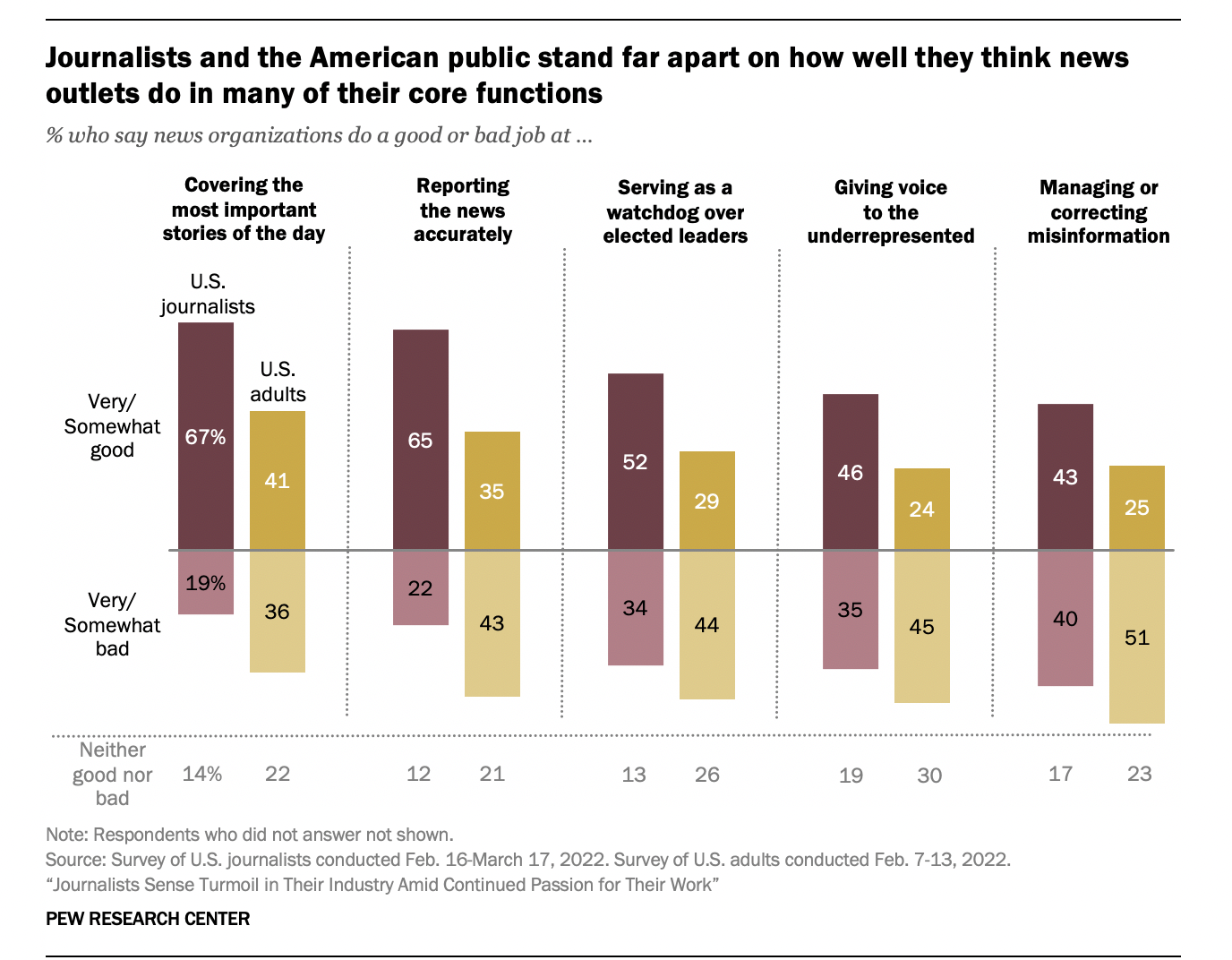
That’s readily apparent from a new analysis from the Pew Foundation, which found that “overall, journalists give themselves relatively high marks on performing several of the core functions of journalism. The public, however, does not see it the same way.” See https://www.pewresearch.org/journalism/2022/06/14/journalists-and-the-public-differ-on-how-journalists-are-doing-how-connected-they-are/

The survey should be required reading for the media!

Sixty-five percent of journalists surveyed think news organizations reported news accurately. That compares with only 35 percent of the public.

A significant majority—83 percent—of journalists think their audience trusts the news organization they work for. Another 13% said their audience has some trust, while just 3% said their audience has “a little” or no trust at all.

Here, journalists are entirely out of touch with reality. Only 29 percent of the public said they trust the media, while 27 percent say they have some trust. A plurality—44 percent—reported that they have “a little” or no trust.

Some of the other findings include the following:

–Fifty-two percent of journalists think they do a good job playing the watchdog over government. Only 29 percent of the public agreed.

–Forty-six percent of journalists think they give voice to the underrepresented. The public provides a rating of 24 percent. 

–Forty-three percent of the media think the industry does a good job of correcting misinformation. The public puts that figure at 25 percent. 
Another disparity between journalists and the public is how much reporters think they are “connected” to their audiences, while readers and viewers disagree.

Among journalists, close to half—46 percent–said they feel extremely or very connected to their audience, while another 37 percent said they feel somewhat connected. Far fewer—16 percent—said they feel little or no connection.

Underlining how out of touch journalists really are, the public sentiment is almost exactly the opposite.

Twenty-six percent of those surveyed said they are extremely or very connected to news organizations, far lower than the 46 percent of journalists who feel extremely or very connected to their audiences. 

Another 37 percent said they feel somewhat connected to their primary news sources, while 36 percent feel little to no connection.

In many cases, the media have become part of the American elite rather than remained part of the body politic. Reporters often look down on their readers and viewers and have increasingly little contact with real people.

Whatever the case, I think the media can’t regain the public’s confidence. After nearly 50 years as a reporter and a journalism professor, these development makes me both angry and sad. 

By John Ruberry

Earlier this month Season Six of the BBC gangster drama, Peaky Blinders, began streaming on Netflix.

The show centers on a Birmingham Romani organized crime family, the Shelbys, and the leader of that gang, Tommy Shelby (Cillian Murphy). He’s a World War I veteran suffering from post-traumatic stress syndrome, who manages to build a business empire, while getting elected to Parliament as a member of the Labour Party.

This will be the final season of Peaky Blinders, although a movie is said to be in the works.

The next two paragraphs contain some Season 5 and 6 spoilers.

During Season 5 a new major character, Oswald Mosley (Sam Claflin), a Birmingham member of Parliament like Tommy Shelby, is introduced. He’s the founder of a British fascist party–and Mosley was a real person. Shelby’s relationship with Mosley is complicated, which fits the show as the plot lines are anything but simplistic. Shelby’s plot to assassinate Mosley–the real Oswald died of natural causes in 1980–is foiled by the Irish Republican Army. The IRA kills the would-be assassin and other member of the Peaky Blinders, the “muscle” end of the Shelby operation.

While Tommy is the leader of the gang, his aunt, Elizabeth Pollyanna “Polly” Shelby Gray (Helen McCrory), was the glue of the enterprise, formally known as Shelby Family Limited. But McCrory died at 52 of lung cancer in 2021, just as production of this season started. Other than Tommy Shelby, Aunt Polly was the most important character in Peaky Blinders. Her off-screen death was a tough blow for the show. To compensate, the role of Tommy’s sister, Ada Thorne (Sophie Rundle), is elevated, but Rundle is placed in an impossible position. Meanwhile, Polly’s son, Michael Gray (Finn Cole), holds Tommy responsible for Polly’s murder.

Also back in Season 5, another new character Gina (Anya Taylor-Joy), Michael’s wife, makes her debut. We learn in the new season that Gina is the niece of South Boston gangster Jack Nelson (James Frecheville). He’s a not-too-thinly disguised characterization of Joseph P. Kennedy Sr. Like the patriarch of the Kennedy dynasty, Nelson has anti-Semitic and fascist leanings. Calm down my liberal friends, it’s true about Kennedy. With Prohibition over, Tommy and Nelson hope to offset the end of it by smuggling opium into Boston. 

Mosley has a new lover, Lady Diana Mitford (Amber Anderson). She declares herself to Ada, in cruder terms, as a bisexual but she also has her eyes on Tommy. The real Mitfort was the first cousin of Winston Churchill’s wife, Clementine. Unless this plotline is being saved for the Peaky Blinders movie, I am stupefied why this angle wasn’t developed into the storyline. The future wartime leader, amazingly is portrayed by three actors over the six seasons, makes a cameo appearance in Season 6. 

Season 5 ends and Season 6 begins with Tommy wallowing in mud. And mud is fitting metaphor for this season, while good, falls short of the greatness of Peaky Blinders, although I didn’t care for the Russian diversion in Season 3. The final episode of this last season, nearly 90 minutes long, is the best, as Tommy’s older brother, Arthur (Paul Anderson), emerges somewhat from his alcohol and drug induced haze as the Shelbys face a two-front war. A third front of sorts is there too as Tommy’s marriage with Lizzie (Natasha O’Keeffe) faces challenges. 

In regard to Nelson, Season 6 would have been much more interesting if instead Joseph P. Kennedy was the Boston foil for Tommy.

Surprisingly, while the show continues with a dark and gothic soundtrack, the unofficial theme song, Nick Cave and the Bad Seeds’ “Red Right Hand” is sadly missing. But arguably the worst song Bob Dylan ever recorded, “All The Tired Horses,” covered by Lisa O’Neill, is included.

All six seasons of Peaky Blinders are currently streaming on Netflix. It is rated TV-MA for nudity, drug use, foul language, and violence. 

John Ruberry regularly blogs at Marathon Pundit.

By John Ruberry

When one looks back the great artists–and I dislike this term–of the classic rock era of the mid-1960s thru the early 1970s, the usual big names to come to mind, the Beatles, the Who, the Rolling Stones, Creedence Clearwater Revival, and Bob Dylan. 

One name–and he just released his 43rd studio album last week–is generally overlooked. And that artist is Van Morrison, also known as Van the Man and the Belfast Cowboy. Oh sure, he’s recorded some memorable hits, such as “Brown Eyed Girl,” along with “Moondance” and “Have I Told You Lately.” Before Morrison’s first album, Blowin’ Your Mind, was released in 1967, he was the frontman for Them. That band’s anthemic “Gloria” deservedly appears on many best-ever song lists. 

But Morrison isn’t a much of a self-promoter–he doesn’t do many interviews and he’s not the best media conversationalist–even though Van the Man’s lyrics are generally eloquent and articulate. 

Two years ago Morrison began attracting media attention for his impassioned opposition to COVID-19 lockdowns, which, during the height of them, prevented Van, who turns 77 this summer, from performing live.

Morrison just concluded a short USA tour, a British tour begins Monday. 

In 2020, Morrison released three anti-lockdown songs, “Born to Be Free” and “As I Walked Out,” as well as “No More Lockdown.” That same year Eric Clapton recorded a Morrison-penned anti-lockdown song, “Stand and Deliver.” Clapton, who celebrated his 77th birthday in March, was diagnosed with COVID-19 last week. Hey, no reasonable person believes COVID is un-catchable. 

Those anti-lockdown songs led Northern Ireland’s health minister, Robin Swann, to write a Rolling Stone op-ed attacking Morrison, where Swann declared, “Some of what is he saying is actually dangerous.”

Last year in Belfast, after four of his concerts were cancelled, Morrison led a “Robin Swann is very dangerous” chant at a banquet. Because of the chant, Swann sued Morrison.

Which brings us to “Dangerous,” the opening track of Morrison’s brand-new album, What’s It Gonna Take?

Somebody said I was dangerous
I said something bad, but it must’ve been good
Somebody said I was dangerous
I must be getting close to the truth, alright, alright

But Morrison isn’t done with lockdowns, as the first ten songs of this 15-song effort attack COVID-19 restrictions on varying levels.

On the title track, Morrison opines,

Politicians don’t represent the people
Government doesn’t represent us at all
Government takes and ruins all our business
Big tax about to take it all.

In life, I’ve learned that sometimes life is just blah blah blah. Really, because that’s another great tune here, entitled of course, “Sometimes It’s Just Blah Blah Blah.”

How do you like the new normal?
Tell me, how is that going for you?
How did you overcome the restrictions?
How do you handle the news?
Do you still think the government’s not lying to you?
Oh, has the penny dropped yet?
Seems there’s no way out of this impasse
Is it something we’ll live to regret?

What’s It Gonna Take? is absolutely an essential musical release but I suspect it will be savaged by the critics, most of whom are liberals. Morrison’s prior collection, a double album, Latest Record Project, Volume 1, also blew the whistle on lockdown restrictions, as well as social media–quite obviously so on the song “Why Are You On Facebook?” It’s a good album, albeit a bit long, but still far better than the swill that passes as 21st century music. And the critics for the most part hated that Latest Record Project, Volume 1.

As recently as 2017 Morrison described himself as apolitical. Clearly, at least in regards to COVID lockdowns and government overreach, he is now a strident libertarian. 

Rock music, with few exceptions, hasn’t been the soundtrack of rebellion for decades. It’s ironic that the most rebellious rocker today–or perhaps he’s a bluesman?–is a man in his late 70s, the Belfast Cowboy, Van Morrison.

Here’s one final brilliant lyrical excerpt from Van’s latest album, this time from “Damage and Recovery.”

Snowflakes hiding in their houses
Most of us need to get right back to work
Money doesn’t grow on trees
Jobs don’t thrive on barren ground
Narrow-minded politics
So-called social scientist tricks
Telling lies, they’re meant to be
Watching morons on TV.

There are a couple of references to “Gates,” as in Bill Gates, a COVID-alarmist. A couple of weeks ago, the Microsoft founder and self-appointed virus expert said about COVID-19, “We didn’t understand that it’s a fairly low fatality rate and that it’s a disease mainly in the elderly, kind of like flu is, although a bit different than that.”

Wow. Two years ago, if someone posted that sentence on Facebook or Twitter, they’d probably have their accounts suspended.

Morrison was right in 2020 about lockdowns and Gates was wrong.

There’s a little bit of Van Morrison in all of us. There’s a lot of Van Morrison in all thinking people.

What’s It Gonna Take? is available for download on iTunes and for purchase in the CD format on Amazon, where, as of this writing, the reviews are fairly good. And you can buy it or stream it from the Van Morrison official website.

UPDATE May 31, 2022:

Yesterday multiple United Kingdom news outlets reported that Morrison has turned the tables on Robin Swann. He’s suing the Northern Ireland health minister.

John Ruberry regularly blogs at Marathon Pundit, he’s married to Mrs. Marathon Pundit. Morrison’s “Have I Told You Lately” plays on their wedding video.

By John Ruberry

Five years after the fictional story of the Naperville, Illinois crime family, the Byrdes, began streaming on Netflix, Ozark has come to an end. 

Late last month the final seven episodes, comprising of Season 4 Part 2, were released. 

If you haven’t heard of the Byrdes, the family is headed by Marty Byrde (Jason Bateman), a financial planner whose firm makes the fatal mistake of laundering money for a Mexican drug cartel run by Omar Navarro (Felix Solis). Marty is married to Wendy (Laura Linney), a former Democratic Party operative, although the word “Democrat” hasn’t been mentioned for the past two seasons. Their children, Charlotte (Sofia Hublitz), and Jonah (Skylar Gaertner), are reluctant partners in the family business, which is based in the Lake of the Ozarks region of Missouri. A riverboat casino is the centerpiece of their laundering operation.

Leaving an organized crime network is much harder than joining one. But that’s what the Byrdes continue to strive for, looking back at the Chicago area as a safe haven. For real. Clearly, the Byrdes haven’t been keeping an eye on the dramatic rise of violent crime here. 

The Byrdes have formed a shaky alliance with a member of a local small-time crime family, Ruth Langmore (Julia Garner). A two-time Prime Time Emmy winner for Outstanding Supporting Actress in a Drama Series for that role, Garner is simply fabulous. Marty and Wendy can’t protect and grow their operation, let alone leave it, without assistance from other villains, convenient and tired ones, including a former Republican US senator from Illinois, Randall Schafer (Bruce Davison), and the CEO of a Chicago-based pharmaceutical corporation, Clare Shaw (Katrina Lenk). Yawn. Republicans bad, pharmaceutical firms, also bad. The money laundering Brydes? Not so much, at least according to the scriptwriters. Wendy, to protect their rackets, finds herself a reluctant participant in a Midwestern vote-suppression scheme that Schafer is behind. 

In real life, between the release of Part 1 and Part 2 of Season 4 of Ozark, the decades-long Democratic boss of Illinois, Michael Madigan, was indicted. But never forget, in television land, the GOP is evil.

Oh, what was that about Netflix losing subscribers?

A character introduced in Season 4, a disgraced former Chicago Police detective with good intentions, Mel Sattem (Adam Rothenberg), confronts the Byrdes over their hubris gained from their power and money, equating them with the Kennedy family and the conservative Koch family from Wichita. Slow down there. There is no Koch-equivalent to the Kennedys using their influence to allow Ted Kennedy to walk away with only a hand slap after arguably murdering Mary Jo Kopechne at Chappaquiddick

Okay, I’ve hit the things that I didn’t enjoy with Ozark. Back to the good stuff–and there is plenty of it. 

The Navarro family has its own struggles. Omar’s nephew, Javi Elizondro (Alfonso Herrera), has plans that don’t coincide with those of his uncle. One of the many appeals of Ozark is the shifting of alliances–and the betrayals that accompany them. And of course, so are the performances–led of course by Garner–of the major characters and minor ones. One of the minor characters, Rachel Garrison (Jordana Spiro), makes a surprise return.

The cinematography of Ozark is at a feature-movie level. 

While of course set in Missouri, Ozark except for some Chicago scenes in Season 1, is filmed in the Atlanta area. In Part 1 of Season 4 I noticed a light rail train in what was supposed to be downtown Chicago. What were called streetcars way back when haven’t been running in Chicago for decades. In Part 2 of the final season, I spotted what appears to be a cabbage palm tree in front of Ruth Langmore’s Lazy-O Motel. That tree cannot survive a Midwestern winter.

And what about Wendy and Marty Byrde? As I remarked in a previous review, they are the television version of Tom and Daisy Buchanan, who in The Great Gatsby “smashed up things and creatures and then retreated back into their money or their vast carelessness.”

All four seasons are available for streaming on Netflix. The series is rated TV-MA for graphic violence, drug use, nudity, and obscene language.

Earlier post:

Review: Ozark Season 4 Part 1.

John Ruberry regularly blogs from the Chicago area at Marathon Pundit.