With the premiere of the motion picture Oppenheimer, the nuclear naysayers are starting to creep back into the public arena.
Writing in Time, Mary Robinson, the pacifist former president of Ireland, says: “As a young woman, I marched alongside hundreds of thousands of protesters against ‘the Bomb.’ Now a grandmother, I am appalled that my grandchildren still face the same specter of nuclear war.”
When I taught journalism, I had students read two sides of the nuclear debate. John Hersey’s Hiroshima, which many consider the finest piece of journalism in the 20th Century, chronicles the lives of six people who survived the bombing. Hersey’s descriptive prose underscored the horrors of the atomic age.
The other side of the debate—and one few people understand—comes from Paul Fussell’s view from the front lines of Allied soldiers launching an invasion of Japan.
As a lieutenant in a rifle company, Fussell was poised to go to Japan after the Axis had surrendered. He notes that hundreds of thousands of soldiers like him were heading toward Japan in an attack that would take a year and cost one million casualties. That’s one million Allied casualties—most of whom would be Americans.
Fussell writes: “In general, the principle is, the farther from the scene of horror, the easier the talk. One young combat naval officer close to the action wrote home…: ‘When I read that we will fight the Haps for years if necessary and will sacrifice hundreds of thousands if we must always like to check from where he’s talking; it’s seldom out here.’ That was Lieutenant John F. Kennedy.”
Fussell notes that the Japanese government planned to launch counteroffensives with its two million soldiers, 10,000 kamikaze aircraft, and even young people and seniors to defend the islands.
When news of the attack on Hiroshima reached his unit, Fussell and his fellow soldiers almost couldn’t believe the news. He quotes from American historian John Toland:
…[W]ith quiet disbelief coupled with an indescribable sense of relief. We thought the Japanese would never surrender. Many refused to believe it. . .. Sitting in stunned silence, we remembered our dead. So many dead. So many maimed. So many bright futures consigned to the ashes of the past. So many dreams lost in the madness that had engulfed us. The survivors of the abyss sat hollow-eyed and silent, trying to comprehend a world without war.
Fussell returned to the United States and became a well-known scholar of culture and literature at the University of Pennsylvania. He died in 2012.
Despite his many noteworthy articles and books, “Thank God for the Atom Bomb” is the one most people remember.
Another company, this time the CMT Network, finds itself in trouble by angering its base by going woke. Now both are facing boycotts. The Bud Light one has been devastating for what until recently was America’s best-selling beer.
Last week, CMT, whose core audience comprises of country music listeners, pulled the video for Jason Aldean’s “Try That in a Small Town.” The song, which was released in May with no controversy, decries the pro-criminal sentiments celebrated in big cities, like New York City, where CMT is headquartered, and it shows BLM and Antifa riot news clips as Aldean croons.
That was too much for CMT.
Country music fans lean right. I am one of them, although I favor the Americana genre over mainstream country. Country listeners are likely to be the men and women who repair your car, service your air conditioner, or build your home. They may not have Ivy League degrees like Bud Light’s vice president of marketing, the on-leave Alissa Heinerscheid, but these “deplorables” are not dopes. And they aren’t Manhattan-style know-it-alls.
I imagine, until the Heinerschied-led marketing debacle with trans influencer Dylan Mulvaney, many country music fans drank Bud Light.
As of this writing on the evening of July 23, Aldean’s “Try That in a Small Town” is the number one song on iTunes and it has been viewed 15 million times on YouTube.
For Friday’s CMT Music 12 Pack Countdown, Aldean’s massive hit was not among the dozens of songs nominated for the final cut.
Clearly, CMT is as out of touch with its consumers as much as Anheuser-Busch and Bud Light are.
CMT has Nashville offices but as I mentioned earlier, it is based in New York. Anheuser-Busch has its headquarters where it was founded 171 years ago, in St. Louis, although it is now owned by Belgian firm InBev.
Would things be different now for Anheuser-Busch if Heinerscheid and her marketing geniuses were instead based in St. Louis? And while no one is coming forward from CMT claiming credit for pushing the “kill” button on Aldean’s video, my guess is that the decision came from someone at their New York headquarters.
The anger that brought forth the Bud Light and CMT boycotts are byproducts of elites who are isolated from the consumers they are supposed to be experts on.
Can these brilliant minds do their jobs from places like St. Louis? Nashville? Of course, they can. As they can in Cincinnati, Billings, and Oklahoma City. You know, medium-sized cities. To be sure, they’re not Aldean-favored small towns, but these other cities are filled with less sophisticated types than the “betters” that you find in New York City.
Oh, there are telephones, computer lines in those smaller cities. And there is this thing called Zoom.
However, Bud Light did farm out the Mulvaney campaign to an advertising agency thousands of miles from Manhattan.
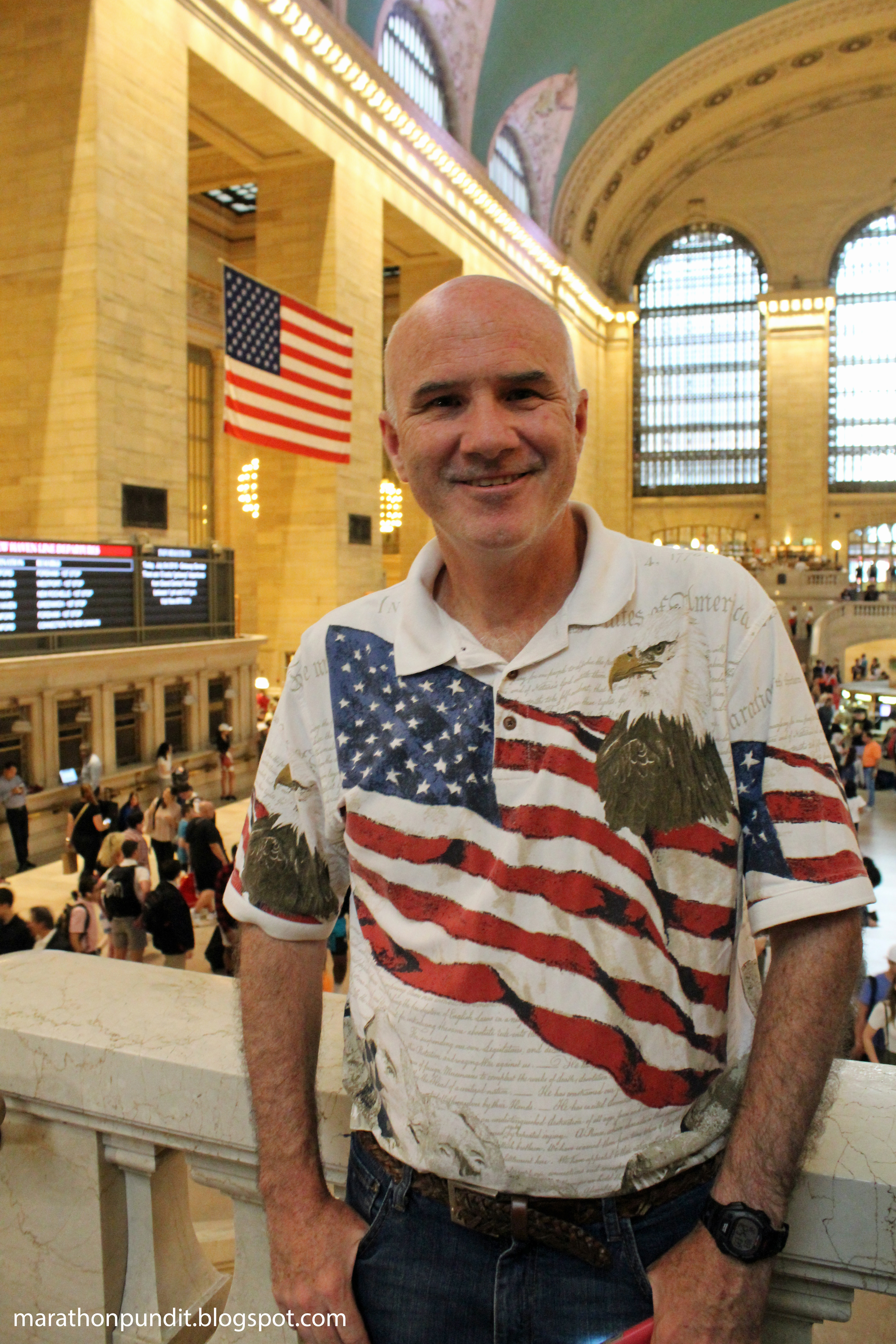
John Ruberry, who regularly blogs at Marathon Pundit, was a bachelor’s degree in advertising from the University of Illinois at Urbana-Champaign. He’s pictured here at Penn Station (correction Grand Central Station) in New York.
Because I run a business installing network equipment, security cameras and offline storage, my business phone number rings all the time with someone wanting me to sell their latest stuff. Most of the time its a cloud-based service, and I politely tell the person on the phone my clients aren’t interested in cloud based…anything. One person challenged me on this about a year ago, saying that I simply didn’t understand the technology.
Remember, I have a bachelors in electrical engineering, AND a masters in electrical engineering (with a 100+ page technical thesis), AND quite a few industry certifications, plus many, many years working in this field. To say I was insulted is an understatement. Rather than rage on the guy, I simply replied “All that cloud means is my data is on someone else’s computer, which gives someone else control of it, and my clientele don’t like that.”
Now, I still use cloud services for some storage and a lot of network access. It’s convenient and makes it possible to open the garage door while you’re on vacation so your neighbor can borrow your posthole digger. But I don’t depend on it. If the internet goes down tomorrow, I still have access to my data locally, still can see my security cameras, and still can operate my doors. False accusations can’t stop any of my stuff from working.
The one big thing that cloud services offer is security from fire. If your house burns down, you can still pull all your files from the cloud. And well, by the featured image, you can guess what happened.
My mom called me yesterday to tell me my dad’s shop caught on fire. Thankfully the firefighters got there in time to keep it from spreading to the rest of the house. But his shop is where all his business paperwork, business computer, Veteran’s Affairs paperwork, and plenty of other important items are stored. It’s a mess.
THANKFULLY, I had set them up with a QNAP Network Attached Storage (NAS) a while back. While I don’t know if my dad had scanned and backed everything up, most of his files are there. He lost at least two external hard drives and his computers, but the NAS is in a different part of their house and wasn’t affected by the fire.
The current theory (pending a complete investigation) is that a recent string of power surges damaged a power strip, causing it to smolder and then catch fire. My parent’s home lost a refrigerator, stove, microwave and other appliances after 3 days of surges and power loss affected their area due to ongoing storms. The NAS is plugged into a UPS with a monitoring cord, so it shuts down gracefully during extended power outages.
Which brings me to my main point: you should be thinking NOW about your data. If everything you have is in the cloud and the cloud company decides it hates you because you’re a conservative, or because the FBI thinks you’re a terrorist for being a traditional Catholic, or because you support Donald Trump, or because you opposed people brainwashing your children at public school, that company could wipe everything, or simply hold it hostage, like some kind of bitLocker scam. The cloud makes it deceptively easy to place yourself at the mercy of tech giants that want to keep you under their thumb. On top of that, you need to protect yourself from natural disasters as well, and the most common item that breaks is an external hard drive. It’s very easy to forget about the drive in a fire, or leave it somewhere where water can damage it.
My go-to setup is a local NAS hooked up to your robust home network with a VPN for remote access. You get the benefits of storing all your files in one spot and making it easy to access them from multiple devices, while also being able to remotely access them. If you needed to do it on the cheap side, it would cost about $500 dollars for the network and between $500 to $1000 for a NAS. You don’t have to be a tech person either, nowadays the network and storage solutions are well documented and the companies are typically more than happy to help you set it up. I am partial to Ubiquiti for networking gear and QNAP for storage, but there are a variety of companies you can use. You can even setup your device to backup to the cloud, but otherwise store your data locally, getting the best of all worlds. It’s more important that you think and plan accordingly now so that when these disasters happen, whether man-made or natural, your data isn’t affected.
This post represents the views of the author and not those of the Department of Defense, Department of the Navy, or any other government agency.
Three days ago, the Marathon Pundit family saw the revival of The Who’s Tommy at Chicago’s Goodman Theatre.
The original The Who’s Tommy was directed by Des McAnuff, who collaborated with Pete Townshend for the musical. Townshend, the Who’s lead guitarist wrote most of the songs for the Tommy rock opera. The original theatrical production was first performed in 1993, and that was directed, as is the Goodman Theatre production, by McAnuff.
While not the first rock opera, most rock scholars give that honor to Pretty Things’ S.F. Sorrow,Tommy was a commercial and critical success for the Who; they had struggled to gain attention in America, as did some of the other bands who emerged at the tail end of the British Invasion, such as Small Faces and the Move.
The plot of Tommy, the rock opera, is quite clunky. The atmosphere of Tommy is of the late 1960s, and it is a reaction to the guru culture of that strange time, which was filled with charlatans such as Timothy Leary, the Maharishi Mahesh Yogi, and much more darkly, Charles Manson. A better guru was Meher Baba–Pete Townshend remains a follower of his teachings.
However, inexplicably, Townshend set the story of Tommy to begin shortly after the end of World War I.
Tommy Walker becomes deaf and blind at around age four after he witnesses his father, who his mother believed was killed in the Great War, shooting her lover to death. Tommy’s parents look for a cure for their son, those attempts include bringing him to a “gypsy,” the Acid Queen, who fails to cure Tommy with LSD. Two relatives abuse him, Uncle Ernie, sexually, and Cousin Kevin, who tortures him. Tommy, despite his deafness and blindness, becomes a pinball champion and a celebrity. Tommy’s mother notices that her son often stares intently at mirrors. She smashes a mirror during one such gaze, which cures Tommy. He then becomes a cult leader, but eventually his followers reject him. Finally, Tommy realizes that he isn’t special, but everyone else is, as he sings in “We’re Not Gonna Take It.”
Listening to you I get the music Gazing at you, I get the heat Following you I climb the mountains I get excitement at your feet.
But it was the songs, despite some dull filler such as “Underature,” that made the Tommy rock opera a smash. And the Goodman Theatre makes the most of the best-known numbers–along with some stupendous dancing–including “I’m Free” and of course “Pinball Wizard,” but also lesser-known tunes, such as “Amazing Journey” and “Sensation.” With a church backdrop, “Christmas” shines.
For those Who purists out there, beware, some of the lyrics of the songs have been altered to fit the adapted narrative of the musical.
There are many stand-out performances, foremost by Ali Louis Bourzgui as an adult Tommy, Alison Luff as Mrs. Walker, and Adam Jacobs as Captain Walker. The supporting cast is also superb, particularly Christina Sajous as the Acid Queen and Bobby Conte as Cousin Kevin. There are no casting mistakes here, unlike Ken Russell’s over-the-top Tommy film from 1975, which, like The Who’s Tommy, begins the story right after World War II. While Russell got it right with Who lead singer Roger Daltrey as Tommy, Tina Turner as the Acid Queen, Elton John as the Pinball Wizard, and Ann-Margaret as Mrs. Walker, there were some serious casting disasters in that move, including Eric Clapton (not an actor), Jack Nicholson (not a singer), and Oliver Reed, a drunk who played a drunk, but on the flipside, Reed couldn’t sing either.
Back to The Who’s Tommy at the Goodman: Not to be overlooked, the lighting, the costumes, the sparse but effective scenery, and the computer graphics are dazzling.
The play ends in an undefined, presumably fascist, future, with Cousin Kevin looking a bit like Joseph Goebbels. And with an attack, somewhat understated, on today’s celebrity and social media influencer culture.
Last week, Bourzgui explained to the New York Times his interpretation of his Tommy portrayal, “He gets filled up by his followers,” adding “He keeps feeding off that, getting more gluttonous with power, until he realizes they’re following him because they want to feed off his trauma.”
The key word, in the 21st century context, is “followers.”
On the downside, a couple of songs, both penned by Who bassist John Entwistle and performed in succession, fall flat, “Cousin Kevin” and “Fiddle About.” In the latter, Uncle Ernie [John Ambrosino], sings about, well, I said what it is earlier. Both tunes are perfect times for a bathroom break, assuming you will be let back in before the end of first act. Mrs. Marathon Pundit dozed off during these tunes.
Townshend, since the release of the Tommy LP, said he was molested as a child. He was not charged after logging in a few times to a for-pay website that was advertising child pornography, stating at the time his motive to visit the site was “purely to see what was there” and that he was researching sexual abuse. In 2003, Townshend was placed on a sexual offenders registry for five years and he received a caution from the London Police. Townshend strongly denies every possessing child pornography. Citing those two sadistic Entwistle songs, Townshend said that he is too traumatized to ever perform Tommy again.
None of the other reviews of The Who’s Tommy I’ve read mentioned Townshend’s legal issues, but on the other hand, I paid for our tickets to this show.
Although not seen, the nine-piece band, led by Rick Fox, has some big shoes to fill by performing these songs–particularly those of Who drummer Keith Moon–is spectacular. I saw The Who in concert twice, in 1979 and 1980, with Kenney Jones on drums, Moon passed away in 1978. Entwistle died in 2002. Both of concerts were fantastic–and loud. My ears were ringing for days afterwards both times.
Yes, it was a Sunday matinee performance, but it was a geriatric audience, reminiscent of the crowd on the Lawrence Welk Show, in attendance for the Goodman of The Who’s Tommy that day. Earplugs were available for the “loud” music at the Goodman–which wasn’t that loud. Oh, have times ever changed.
The Who’s Tommy has been extended twice at the Goodman, some upcoming shows are sold out, the final Chicago performance is scheduled to be on August 6. The production is believed to be a dry-run for a return to Broadway, and presumably, a whole bunch of well-deserved Tony Award nominations.




 Da Techguy's (no longer backup) Blog