On September 5, 1522, The Victoria sailed into the harbor near Seville, Spain, after completing a three-year, 60,000-mile trip around the world.
For centuries, the expedition, launched by Ferdinand Magellan, was regarded as one of the most outstanding achievements in history and had a significant impact on the West’s understanding of the world.
Mired in today’s wokeness, the voyage is regarded as the beginning of colonialism and the dominance of the Catholic Church over those colonies.
But Magellan’s vision and his sailors’ persistence against all odds demonstrate what’s wrong with wokeness.
Would the world really have been better if people didn’t know how to sail around it?
After studying maps for years, Magellan had a dream. He was convinced that by sailing west instead of east, he could find a better route to Indonesia and India from Europe. The king of Portugal wouldn’t finance his trip, so he headed for Spain, where he gained citizenship and Charles V’s backing for five ships.
But he was in an awkward position regarding his crew and royal mission. “The [Spanish] resented sailing under a Portuguese commander, and the Portuguese considered him a traitor,” historian Lincoln Paine wrote.
After winter weather forced his ships to wait for months in what is now Argentina, Magellan’s crew mutinied. One ship was wrecked; another headed back to Spain.
Magellan managed to navigate a treacherous passage around South America that later was named in his honor—the Strait of Magellan. He’s also credited with naming the Pacific Ocean.
But the troubles weren’t over. As the crew traveled across the Pacific, food spoiled, and scurvy and starvation occurred. The sailors reached the Philippines, where Magellan was killed in April 1521 by a local tribe.
After Magellan’s death, his crew continued in the single ship that remained, captained by Juan Sebastian Elcano. Only 18 of the 270 men survived, but the expedition had proven that the globe could be circumnavigated and opened the door to European colonization of the New World in the name of commerce.
A legend was born—and in 1989, one of Magellan’s namesakes even traveled to Venus. During a five-year-long journey, NASA’s Magellan spacecraft made images of the planet before burning up in its atmosphere.
According to Antonio Pigafetta, who chronicled the journey and lived to tell the tale: “Magellan’s main virtues were courage and perseverance, in even the most difficult situations; for example, he bore hunger and fatigue better than all the rest of us. He was a magnificent practical seaman who understood navigation better than all his pilots. The best proof of his genius is that he circumnavigated the world, none having preceded him.”
Today, Magellan’s vision and fortitude should be praised rather than placed on the altar of wokeness.
A few months ago Van Morrison released his 43rd studio album, What’s It Gonna Take? It’s a stupendous work, and most of its songs focus on the COVID-19 lockdown. Van the Man gives well-deserved musical punch in the nose to lockdown zealots Mark Zuckerberg, Bill Gates, and Klaus Schwab.
This week, on August 31, Van Morrison turns 77. He’s still touring, in fact, he begins a short American tour the day after his birthday, which includes, hello Peter, two gigs in Massachusetts.
In 2020 was a rare year for Morrison as he didn’t release a studio album, but he did issue three anti-lockdown songs, “Born to Be Free,” “As I Walked Out” and “No More Lockdowns.” Eric Clapton, another foe of lockdowns, recorded a Morrison-penned anti-lockdown song, “Stand And Deliver.” Morrison has been the most prominent artist who has stood up to opposition to the 2020-2021 shutdown of musical venues.
Of course Morrison is rich, but most musicians aren’t. Many are just getting by.
My DTG review of “What’s It Gonna Take?”is here. And yes, sometimes I am wrong. I predicted the mainstream media, as it did with the collection’s predecessor, the double album Latest Record Project: Volume 1, would savage it. On the contrary, because the hostile reviews of that collection probably helped sales–it charted well, the media took a different approach this time. By mostly ignoring What’s It Gonna Take? But not entirely. Morrison has “descended into lunacy,” is what one reviewer, Arthur Lazarus, a psychiatry professor, said of the album in his review. I was under the impression that mental health professionals now avoid words like “lunacy.” Who is the “crazy” one here, Lazarus? On a positive note, National Reviewgave a favorable notice to What’s It Gonna Take?
To a small extent, Van Morrison, a member of the Rock and Roll Hall of Fame, has become a non-person. Oh, he appears in Google News searches, as the media dutifully covers his concert appearances. I follow Morrison on Twitter. And like myself, likely because he shares views that run counter to those of the Twitter leftists, in his case about COVID, he’s almost certainly been shadowbanned. I never see the Belfast Lion’s Tweets on my feed, although he has been quiet there lately. Remember, this is a person whose first hit, “Brown Eyed Girl,” is one of the most-played songs on radio–ever.
I’ve been a Van Morrison fan for decades, so I decided to listen to every studio album of his, remember, there are 43 of them–in succession–about a week after I posted my Da Tech Guy writeup on What’s It Gonna Take? It was a wondrous musical adventure that took me through many musical genres, mainly, especially in the second half of his career, Chicago blues, but also of course rock, as well as jazz, country, Celtic, swing, as well as Van the Man’s stream-of-consciousness works, best exemplified on his Astral Works landmark album.
Morrison is a multi-instrumentalist, playing guitar, harmonica, keyboards, and saxophone. But outside of the craftmanship of the songs he writes, he’s best know for his vocals. Morrison’s singing style is a combination of Hank Williams, Muddy Waters, James Brown, and here’s an obscure name for you, Louis Prima. Oh, on a side note, Prima was one of my mother’s favorites. And about that voice, it’s most distinctive quality is “the growl,” which I believe is inspired by bluesmen like Waters.
Morrison has influenced many artists, including Bob Seger, Graham Parker, Elvis Costello, and Bruce Springsteen. Of the latter two, on their debut albums the feel of Van is quite apparent.
During my Morrison musical sojourn, during which I ironically contracted COVID-19–I am fully recovered–I decided to write a blog post where I list, well, in my opinion at least, his ten best albums. It’s time for me to be Casey Kasem–so let the countdown begin!
Oh, but first, links in the album’s titles bring you Morrison’s website, where you can purchase or download each collection, and also find the Wikipedia article on each of them.
10: Hymns To The Silence (1991). Morrison’s first double album is a tad long, but it contains one of his best ballads, “Carrying A Torch.” You’ll find an even better rendition of that song on Morrison’s duet album, where Clare Teal accompanies him. Van the Man on this record takes a song that has been covered countless times, Ray Charles’ hit “I Can’t Stop Loving You,” but he gives it a fresh take by having traditional Irish musicians the Chieftains accompany him. There’s also an intriguing spoken word piece too, “On Hyndford Street.”
9: No Guru, No Method, No Teacher (1986). Morrison’s 1980s efforts were mostly jazz and Celtic-influenced songs, many of them expressing a love of nature, with some stream-of consciousness songs throw in. The best of these is No Guru, No Method, No Teacher. Its highlights include “In The Garden,” “Tir Na Nog,” and an homage to his 1970s pop hits, “Ivory Tower.” It was around this time I saw Morrison in concert–so far the only time I have done so. I was under the impression, based on his ’80s works, that the Belfast Lion had lost the roar of his growl. Wrong. He growled a lot that night and it returned to his later studio albums.
8: Three Chords & the Truth (2019). The title alone makes this effort at least an honorable mention. “Angry Van” of the 2020s didn’t emerge once the COVID lockdowns kicked in. In “Nobody In Charge” Morrison decries, “politicians that waffle endlessly.” A haunting love sing, “Dark Night Of The Soul,” is another highlight. And Van offers a gorgeous re-working of “Auld Lang Syne” on “Days Gone By.”
7: What’s It Gonna Take? (2022). I’ve discussed this work already in this blog post–but to flesh out my love for this album, it’s as fresh as breathing in, mask-free, mountain air in spring. While anti-COVID lockdown songs dominate the collection, including “Dangerous,” which Morrison’s response to comments about him made by Northern Ireland’s health minister, Robin Swann, as well as “Fighting Back Is The New Normal” and “Fodder For The Masses,” the collection ends with another great love ballad, “Pretending.”
6: Veedon Fleece (1974). Stream-of consciousness Van is at the forefront here. Like gourmet cuisine, you may not appreciate Veedon Fleece at first bite, but it’s a hearty musical meal. “Bulbs,” “Linden Arden Stole The Highlights,” and “Streets Of Arklow” are among the great tracks.
5: Saint Dominic’s Preview (1972). Released 50 summers ago, this album contains two of Morrison’s best-known songs, the title track and “Jackie Wilson Said (I’m In Heaven When You Smile).” Van the Man’s greatest “stream” work, “Listen To The Lion,” is an 11-minute long masterpiece.
4: Magic Time (2005). This is the best Van Morrison album you’ve never heard of. There is quite a bit of swing music influence on Magic Time. While Van the Man, as we discussed early, re-worked “Auld Lang Syne” in 2019, he gifts us a New Year’s Eve alternative here with “Celtic New Year.” There’s another preview of “Angry Van” on “Keep Mediocrity At Bay.” Magic Time opens with another great ballad, “Stranded.” And there is a luscious sequel to “Listen To the Lion” in “The Lion This Time.”
3: Into The Music (1979). The Belfast Cowboy–Morrison has a lot of nicknames–ended the 1970s with a bang. It opens with two now-familiar songs, “Bright Side Of The Road” and “Full Force Gale.” There is rock, blues, gospel, and more here. And if Morrison’s “growl” is what you enjoy about him the most, then Into The Music is your album.
2: Moondance (1970). Like many all-time-best albums, Moondance comes across as a greatest hits album. The title track, “Caravan,” “Crazy Love,” and “Into The Mystic” are just four of the great tracks here. And while “Brown Eyed Girl” from Morrison’s first album is one of the most played songs on radio, “Into The Mystic” is a popular song at funerals. And “Crazy Love” is played at many wedding receptions.
1: Astral Weeks (1968). Arguably his first album, as his debut collection, Blowin’ Your Mind, was released without his input, Morrison, with jazz musicians backing him up, recorded a collection that sounded like nothing else up to that point. Is Astral Weeks a rock album? Jazz? Folk? Blues? The answer is none of the above. It’s simply Van Morrison. “The Way Young Lovers Do” foreshadows his 1970s hits, but like Veedon Fleece, stream-of-consciousness dominates here. “Cyprus Avenue” and “Ballerina” are majestic songs. “Madame George” is an enigmatic work, which is one of its enduring qualities.
So, if you are now inclined to explore Van Morrison, you might be wondering “Where do I start?” As I’ve said before, I deplore the term “classic rock,” but if that is your “jones,” then start with Moondance. If your first love is vintage country, then take a look at Pay The Devil. Blues? Get an album that just missed my top ten, Too Long In Exile, where John Lee Hooker teams up Morrison to revisit his “Gloria” hit that he recorded with his band Them in 1964. Are you a punk rocker? Then dig into Morrison’s recordings with Them. If your a jazz aficionado, I recommend Versatile to you. How ’bout Celtic music? Morrison collaborated with The Chieftains on Irish Heartbeat.
Now that I’ve listened to all 43 of Van Morrison’s studio albums I have a plan for what’s next: the Belfast Cowboy’s live albums.
The Little League World Series, just a few miles up the road from my home in central Pennsylvania, provides a wonderful sense of sanity amid the chaos and controversy throughout the country.
For two weeks in Williamsport, once a thriving lumber town, the focus is on the crack of the baseball bat until the end of the month, offering a celebration of Americana that is difficult to surpass.
The players between 10 and 12 years old come from some of the smallest towns in the United States, including Hollidaysburg, Pennsylvania; Bonney Lake, Washington; Hagerstown, Indiana; Pearland, Texas; Santa Clara, Utah.
The 20 teams also include groups from Guaynabo, Puerto Rico; Aguadulce, Panama; and Bologna, Italy.
Whatever their language or background, the games are all about the kids, the parents, and the city of Williamsport.
As ESPN put it: “Williamsport is the happiest town in America for nearly two weeks starting in the middle of August. It opens with The Grand Slam Parade the night before the games begin, the kids riding down the street with their team, next to other teams that have come from thousands of miles away. They don’t all understand the same language, but they know a party and a parade when they see one.”
In 1939, Carl Stolz started Little League baseball in Williamsport because he enjoyed playing baseball with his two young nephews and ultimately decided that he wanted to create an organized league for them to play in. There were just three original teams in the league: Lundy Lumber, Lycoming Dairy, and Jumbo Pretzel. See https://www.nytimes.com/1992/06/05/sports/carl-stotz-82-founder-of-little-league-baseball.html
Little League baseball eventually expanded to 12 leagues in Pennsylvania in 1946. Today, there are an estimated 180,000 teams throughout the world.
The first official Little League World Series occurred in August 1947 in Williamsport. This year’s event, which can be seen on ESPN, will continue until August 28, when a champion is declared. Or, you can drop by to see a game for free.
According to the Little League website, the World Series has featured some participants who had notable sports careers in the MLB, the NFL, and the NHL, including Yankee third baseman Todd Frazier, Stanley Cup winner Chris Drury, and Tennessee Titans quarterback Matt Cassel.
This year brought Yankee Hall of Famer Mariano Rivera, former President George Bush, and Rachel Robinson, the widow of Jackie Robinson.
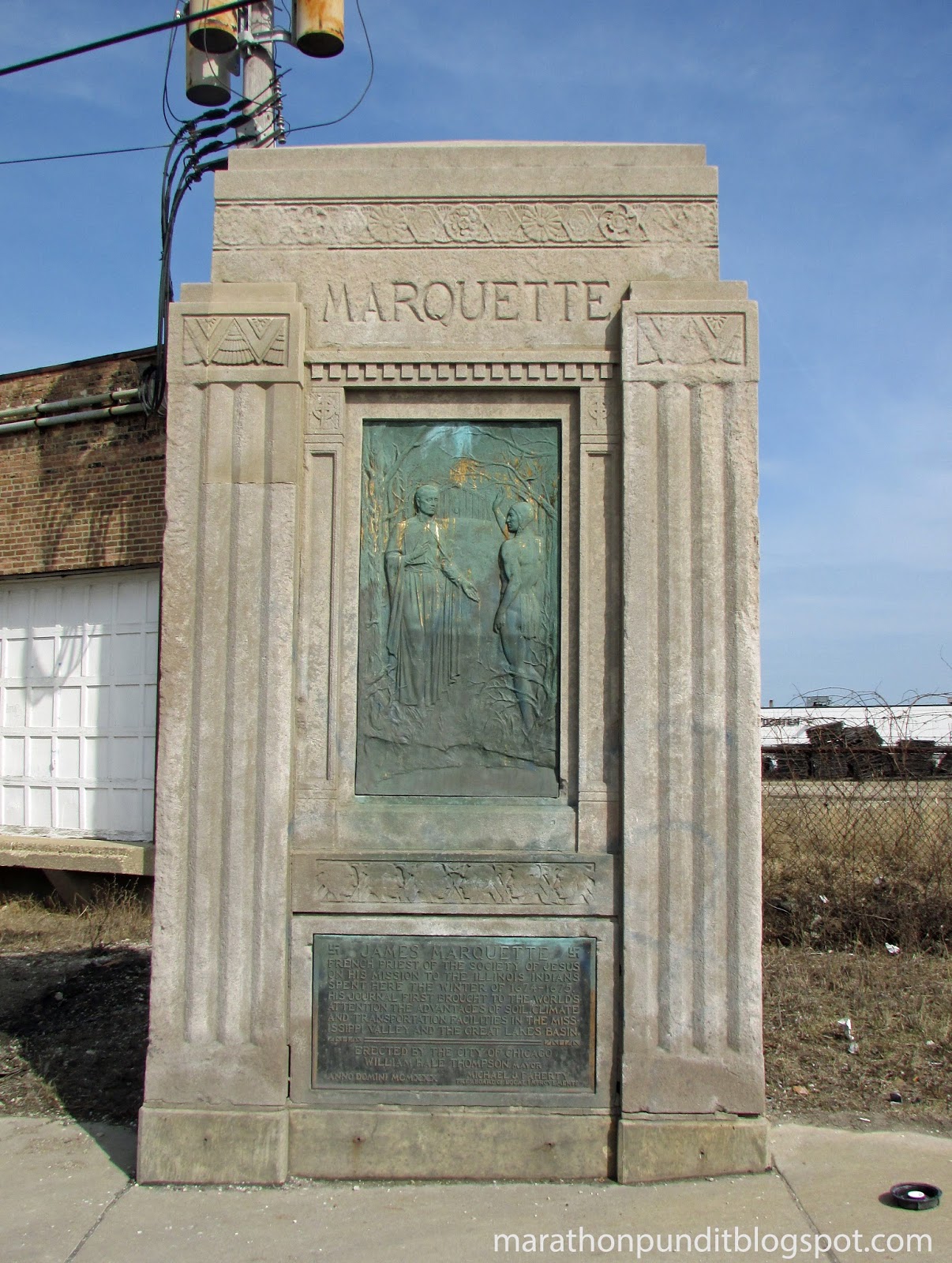
Father Marquette monument on Chicago’s Southwest Side
By John Ruberry
As I’ve stated many times before in this space, Chicago’s best days are behind it. Seemingly random and numbing violence is everywhere. Yes, shootings and murders are down from 2020 and 2021, but remain much higher than in 2019, the year its embattled mayor, Lori Lightfoot, was sworn into office.
However, theft, burglary, and automobile theft are dramatically higher compared to 2021–overall crime is up 36 percent. Since two waves of riots in 2020, major retailers such as Macy’s, the Gap, and the Disney Store have closed their massive stores on Chicago’s premier shopping district, North Michigan Avenue, for now at least, known as the Magnificent Mile.
Boeing is moving its headquarters out of Chicago, as is investment firm Citadel, which is headed by Ken Griffin, a prominent donor to Illinois Republican candidates. Griffin mentioned Chicago crime as a reason for departing for Miami.
Chicago’s CTA public transportation system includes its sprawling el train lines. Violent assaults and murders have become common on the el. The criminal descendants of Jesse James aren’t attacking trains from the outside, they are paying, well…maybe paying, customers. I suspect most of the creeps are turnstile jumpers.
Click here for my confrontation with a CTA thug, from my most recent, and perhaps last, ride on a Chicago el train.
In 2020, soon after the violent riot outside a Christopher Columbus statue in Grant Park, in the middle of the night Lightfoot had the statue removed for “temporary” storage. She was too much of a coward to do so during daytime, and too much of a financially reckless liberal to care about the expense, as it is likely the workers removing the Columbus statue were being paid doubletime wages. Illinois, the home of Abraham Lincoln and a solid Union state, has no Confederate monuments, but the always-angry left chose an old “favorite,” Christopher Columbus, both a brilliant and flawed man, to vent its rage.
Two other Columbus statues were also placed into storage around that time.
Since then, a former city of Chicago attorney claimed in a lawsuit that not only did Lightfoot, who is up for reelection early next year, prevent an agreement with a local Italian-American group to return the Columbus statues for public view, but she had this to say, “My d— is bigger than yours and the Italians, I have the biggest d— in Chicago.”
To be fair, in March, Lightfoot said she “fully expects” the Columbus statues to return to their former locations.
On Friday afternoon, in an old-school “news dump,” Lightfoot’s committee revealed its recommendations. It’s hard to believe, but Chicago’s Lincoln statues were on the committee’s hit list. Honest Abe survived, as did the other US presidents on the committee’s woke naughty list. But a whole bunch of others, including the Columbus statues, a Roman column monument to Italian aviator Italo Balbo, a Mussolini cohort, monuments to French explorers Louis Jolliet and Father Jacques Marquette–they were the first recorded Europeans to visit what is now Chicago–and a statue of General Phil Sheridan on horseback at the southern end of Sheridan Road, are recommended for removal. In regards to Marquette and Jolliet, semblances of “white supremacy” is the reason. Some monuments that have been in storage for years will not be returned to public view.
Sheridan’s prominent role in the Indian Wars is why he may be toppled from Chicago. Few people know these facts, but Sheridan, one of the North’s ablest generals in the Civil War, had a home in Chicago and “Fightin’ Phil” was present during the Chicago Fire. When the city’s mayor placed Chicago under martial law, Sheridan was in charge.
Three statues, including ones of George Washington and William McKinley, should have “artistic prioritized interventions,” the committee says. My guess is that signs will be placed next to them, pointing out the honored ones flaws. Who among us is flawless? Liberals can’t imagine the non-enlightened ones thinking for themselves, or using their smartphones to Google “President McKinley.” And yes, slavery is the worst scourge in American history, but how many Americans don’t know Washington owned slaves?
For now, Abraham Lincoln’s statues will be spared these “artistic prioritized interventions,” but the committee warns, “such measures may be employed in the future through ongoing program investments.” Illinois, of course, is known as “the Land of Lincoln.”
Lightfoot’s monument committee is recommending new monuments, mostly “red meat” ones appealing to the left, although I support a statue of Chicago’s gospel legend, Mahalia Jackson. But why not one for Muddy Waters too?
What about a Ronald Reagan statue? The Gipper was the first president to live in Chicago and the only one born in Illinois.
There is no monument recommended for Lightfoot, “Triple Threat” is not only an African-American, but she is Chicago’s second female mayor and its first lesbian one.
If a Lightfoot statue is ever erected, I’m sure I won’t be the only one focusing on her crotch.


 Da Techguy's (no longer backup) Blog