

Posts Tagged ‘damagnificent seven’

The bailout hustle

Posted: March 14, 2023 by chrisharper in Uncategorized
Tags: ,

By Christopher Harper

Silicon Valley and New York City bankers got a good deal: a bailout worth billions of dollars in exchange for millions in campaign funds for Democrats.

But the cozy relationship between bankers and Democrats is a fairly recent development.

My father was a banker in the Midwest and a diehard Republican. He condemned FDR’s spending policies, loved Ronald Reagan, and wanted the government to balance the budget and stay away from his paycheck.

In fact, I thought for years that you had to join the Republican Party to become a banker. As a boomer, I thought my father was a bit off his rocker in his politics, and I wish I had told him just how right he was.

Today’s bankers remind me of the commodities traders I reported on in the 1970s. They’ll bet on almost anything.

Silicon Valley Bank bet on almost every tech idea that came through the doors.

But Andy Kessler of The Wall Street Journal goes beyond the gambling. “Management screwed up interest rates, underestimated customer withdrawals, hired the wrong people, and failed to sell equity. You’re really only allowed one mistake; more proved fatal. Was management hubristic, delusional, or incompetent? Sometimes there’s no difference,” he wrote.

Signature Bank of New York added political wokeness to the combination. The bank refused to do business with Donald Trump, scolding him for the events of January 6, 2021.

Despite all this nonsense, Biden & Co. will bail out the banks even though the White House says it’s not a bailout, providing funds to depositors who recklessly kept more than $250,000 in the banks. Federal bank insurance would not have covered that money until Biden waived the limit.

But the math doesn’t work. Silicon Valley Bank had $173 billion in total deposits, including $152 billion not covered by the Federal Deposit Insurance Corporation. Also, the FDIC did not cover $79 billion of the $88 billion in deposits at Signature Bank.

That’s nearly double the amount at the FDIC to cover all the depositors over $250,000.

Treasury officials said any losses to the DIF would be repaid in full by raising fees on the system’s banks. If the FDIC charges banks higher fees to cover the extra money, those costs will probably be passed onto the consumer through higher costs, such as increased ATM charges and overdraft fees.

So we will end up paying much of the bill for the bailout!

At least there’s a silver lining to all these shenanigans: no one will ever take Jim Cramer seriously, who told people to buy Silicon Valley Bank stock.
Shining light on Penn State’s foibles

Posted: December 13, 2022 by chrisharper in education
Tags: ,

By Christopher Harper

It’s difficult to find a journalistic enterprise that is worth supporting.

I just found one: PA Spotlight’s bureau in State College, the home of Penn State University.

After nearly 20 years at a public university, I saw many examples of waste, mismanagement, and potential fraud.

It’s rare to see the emphasis of a journalistic organization on a public university like Penn State, even though colleges employ thousands of people and allegedly educate thousands more in the ways of the world. For example, Penn State has a massive $7 billion annual budget.

Here are some of PA Spotlight’s most recent headlines about Penn State:

–Penn State’s Board of Trustees spent nearly $318,000 on its past six in-person meetings, covering travel, lodging, food, and other expenses of attendees, according to newly released records.

–Unlike nearly all of its Big Ten counterparts, Penn State does not have to publicly disclose the salaries of its employees, which include $7 million to head football coach James Franklin. Penn State’s special status as a state-related university makes it largely exempt from Pennsylvania’s open records law.

–Given the university’s budget shortfall, hiring freeze, and recent tuition increase, Spotlight PA tracked the use of its jet, discovering that it flew 44 times in one month. The university declined the provide the cost of maintaining and using the plane.

The Spotlight PA team also provided one of the most extensive profiles of Neeli Bendapudi, the new president who took over last year. See https://www.spotlightpa.org/statecollege/2022/11/penn-state-president-bendapudi-profile/

The profile included a subtle analysis of a woman born in India, educated in Kansas, a one-time banker, and a Republican who faced significant issues at her former post at the University of Louisville. She currently faces similar matters from the left-leaning faculty at Penn State.

The State College bureau is the first regional outpost outside Harrisburg, the state capital, and covers issues of interest to north-central Pennsylvania, where I live. The bureau includes four reports and a budget of $500,000 a year.

The reports are available through a free weekly newsletter and regional news organizations. See https://www.spotlightpa.org/newsletters/talkofthetown

I applaud the team’s effort so far and hope the organization will be around for some time to come!

Democrat angst in Pennsylvania

Posted: July 12, 2022 by chrisharper in politics
Tags: ,

By Christopher Harper

The media pundits who predicted a Democrat walkover in the gubernatorial race in Pennsylvania are getting nervous. 

Although the Philadelphia Inquirer and the Pittsburgh Post-Gazette, the liberal media in leftist towns, have portrayed State Senator Doug Mastriano as a wingnut, the people between the two coasts are leaning heavily toward the Republican. 

While I don’t place a lot of stock in polls, Democrats have to be worried about the last one, which was about a month ago from USA Today

Mastriano pulled to within three points—49-46—of Democrat Attorney General Josh Shapiro—a number within the margin of error. 

But there’s more troubling news for Democrats in the poll. Almost 85 percent of respondents said the country is heading on the wrong track, and more than 75 percent said the state is going in the wrong direction. 

Only 30 percent said they felt the economy was working for them, pointing to inflation as their most critical issue. 

The big-city media fail to understand how my fellow residents of central Pennsylvania—part of what is known as “the red T” that votes about 70 percent GOP—hate polls and Joe Biden.

Philadelphia political adviser Kurt Knaus wrote after the 2020 election that Democrats got creamed in almost everything but the presidential vote.

“Where federal races produced a bit of blue mixed with neutral tones, state results were decidedly red – blood red, in fact, solidifying Pennsylvania voters’ reputation for splitting their tickets on Election Day,” he wrote.

 “Before November 3, Democrats boasted about their chances to potentially wrest control of the state House and chip away at Republicans’ majority in the Senate. Neither happened. Instead, Republicans knocked out the House Democratic leader and enlarged their majorities in both chambers. 

 Will Bunch, the leftist columnist for the Philadelphia Inquirer, is apoplectic about the current gubernatorial race. 

“If the staunchly anti-abortion Mastriano—currently polling within the margin of error against Democratic opponent Josh Shapiro—rides a predicted GOP midterm wave of voter anger over inflation and President Joe Biden’s unpopularity, and if his victory also were to extend the right-wing dominance in the legislature, the long-term consequences would likely reach far beyond women’s health,” Bunch wrote recently.

“An extreme abortion ban in Pennsylvania will turn the Keystone State into a pariah for many of the nation’s best and brightest young people when they are deciding where to attend college, and not only stunt but probably reverse the growth of high-tech and professional jobs that have fueled the 21st century revival of Philadelphia, Pittsburgh, and their suburbs.” 

[Note: Grammarly.com, a computer program I use, insisted that both of the above paragraphs be rewritten for clarity].

It’s difficult to glean any logic from the argument. Does Bunch really believe that the choice of a college depends on a pro-choice state government? Does he really think businesses determine economic viability based on fetus viability?

Whatever the case, his screed underlines just how worried he and other leftists must be. 

By Christopher Harper

Journalists have no idea how little their readers and viewers trust the media.

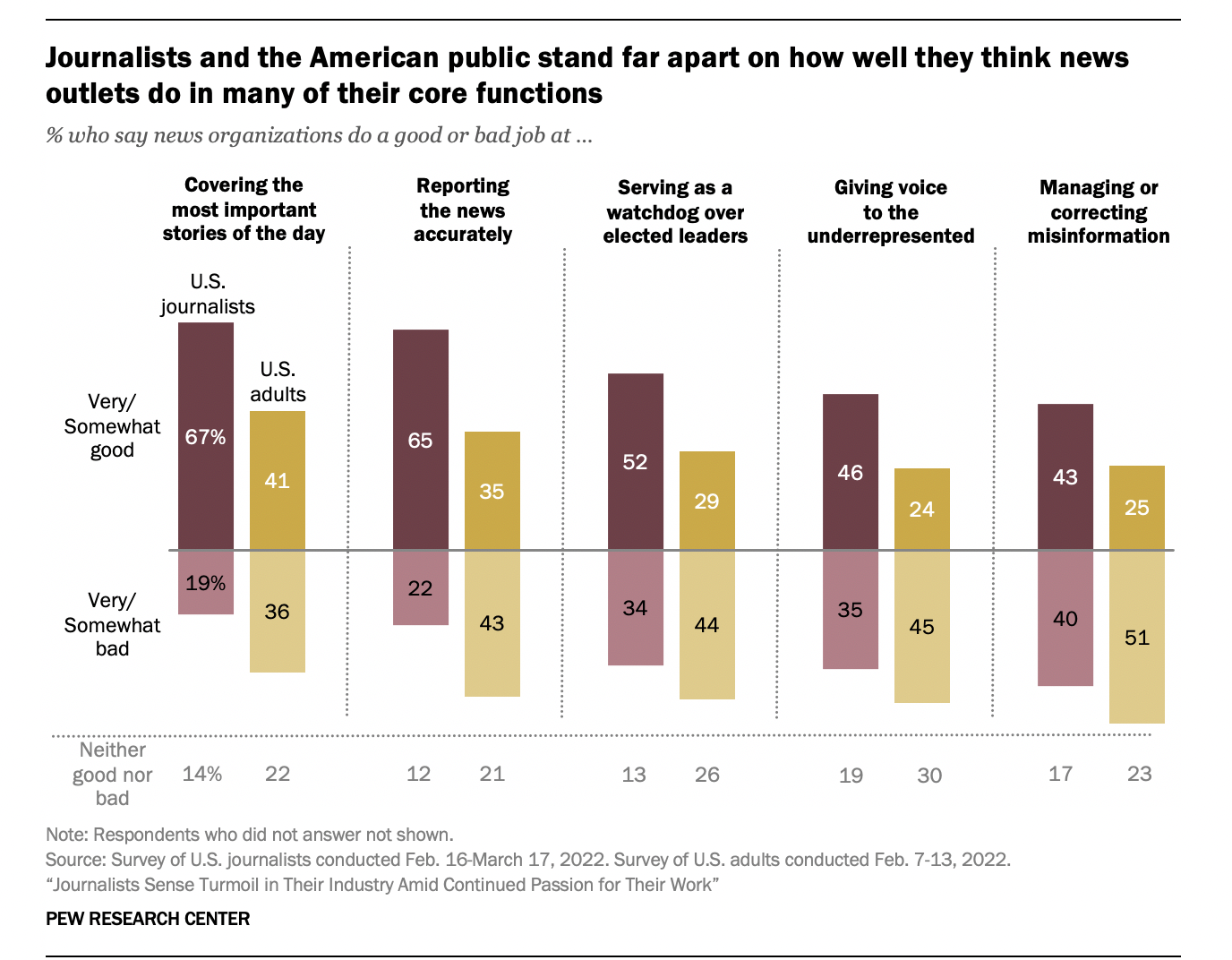
That’s readily apparent from a new analysis from the Pew Foundation, which found that “overall, journalists give themselves relatively high marks on performing several of the core functions of journalism. The public, however, does not see it the same way.” See https://www.pewresearch.org/journalism/2022/06/14/journalists-and-the-public-differ-on-how-journalists-are-doing-how-connected-they-are/

The survey should be required reading for the media!

Sixty-five percent of journalists surveyed think news organizations reported news accurately. That compares with only 35 percent of the public.

A significant majority—83 percent—of journalists think their audience trusts the news organization they work for. Another 13% said their audience has some trust, while just 3% said their audience has “a little” or no trust at all.

Here, journalists are entirely out of touch with reality. Only 29 percent of the public said they trust the media, while 27 percent say they have some trust. A plurality—44 percent—reported that they have “a little” or no trust.

Some of the other findings include the following:

–Fifty-two percent of journalists think they do a good job playing the watchdog over government. Only 29 percent of the public agreed.

–Forty-six percent of journalists think they give voice to the underrepresented. The public provides a rating of 24 percent. 

–Forty-three percent of the media think the industry does a good job of correcting misinformation. The public puts that figure at 25 percent. 

Another disparity between journalists and the public is how much reporters think they are “connected” to their audiences, while readers and viewers disagree.

Among journalists, close to half—46 percent–said they feel extremely or very connected to their audience, while another 37 percent said they feel somewhat connected. Far fewer—16 percent—said they feel little or no connection.

Underlining how out of touch journalists really are, the public sentiment is almost exactly the opposite.

Twenty-six percent of those surveyed said they are extremely or very connected to news organizations, far lower than the 46 percent of journalists who feel extremely or very connected to their audiences. 

Another 37 percent said they feel somewhat connected to their primary news sources, while 36 percent feel little to no connection.

In many cases, the media have become part of the American elite rather than remained part of the body politic. Reporters often look down on their readers and viewers and have increasingly little contact with real people.

Whatever the case, I think the media can’t regain the public’s confidence. After nearly 50 years as a reporter and a journalism professor, these development makes me both angry and sad.