
Posts Tagged ‘online gaming’

Milwaukee (2nd seed) AL Beta Division title

Divisional Series vs Twins

Game 1 at County Stadium in Milwaukee

The Twins entered their season series vs Milwaukee 0-10 and Last Year’s Cy Young winner Don Wilson turned it up to 11 pitching a complete game shutout allowing only two hits and not letting any Twins runner reach scoring position. Steve Blass was almost as good pitching 1 hit ball over 7 innings allowing only one Brewers runner reach scoring position and be stranded. Alas in the 7th Ron Fairly hit a solo home run to give Milwaukee the lead and then in the 8th after a error by shortstop Dan Monzon put a man on Johnny Edwards (3-4) hit a 2 run shot off the lefty for the final 3-0 score

WP Wilson (1-0) LP (Blass 0-1) HR Fairly (1) Edwards (1)

Game 2: at County Stadium in Milwaukee

Milwaukee jumped right off into a lead in the first inning Johnny Edwards reached with a 1 out walk & Pete Rose with a walk with two down setting up. Ron Fairly singled to left loading the bases for Doug Rader who didn’t manage to hit his 4th grand slam of the year but did single to center scoring Edwards and Rose who beat the throw from Al Oliver. That would be all they would need as Ken Holtzman proved almost as effective as Wilson shutting them out on 4 hits. The Brew crew would score 5 more via RBI’s from Edwards, Geronimo and Bob Heise as each of the three twins pitchers gave up at least two runs before the day was through but Holtzman made sure they were superfluous.

Mil 7 Min 0

WP Holtzman (1-0) LP Bahnsen (0-1) HR none

Game 3 At Metropolitan Stadium Minnesota

The change of scenery didn’t seem to make a big change in results as the Brewers jumped to a 1-0 lead on a Ron Fairly shot in the 1st off of Marty Pattin. In the 3rd the Twins finally managed their first run on the series as Blue Moon Odom loaded the bases in the 3rd on a HBP (Hebner) an Al Oliver walk and a Bobby Darwin single to left, but instead of a big inning Odom managed to coax a pair of ground outs to get out of a jam with only one run (on the Monzon slow grounder) to tie the game at 1.

The tie didn’t last as Pattin hit Ron Hunt, Fairly singled and Pete Rose singled scoring Hunt and putting Milwaukee back up 2-1. There it stayed till the 8th, Richie Hebner singled to center to lead off and moved to 2nd on a grounder to the mound. Milwaukee was two outs away from their 13th straight win vs Minnesota and their 3rd complete game victory when Bobby Darwin put a hanging curve just over the left field fence and suddenly it was a 3-2 Twins lead. and while Pete Rose managed a one out single off closer Sparky Lyle, he would strike out both Jack Hiatt & Doug Rader to give the Twins their first win of the season and playoff life for another day.

Final Min 3 Mil 2

WP Pattin (1-0) LP Odom (0-1) HR Fairly (2) Darwin (1)

Game 4 At Metropolitan Stadium Minnesota

For the 4th time in 4 games the Brewers struck first and early as Cesar Geronimo singled to center, went to 2nd on a grounder and scored on a Ron Hunt single to give them a 1-0 lead. It became 2-0 when Dick Woodson gave up back to back doubles to Rose and Fairly to make it 2-0. That would all that the Brewers would manage as three pitchers would hold them to those two runs. Meanwhile Al Downing kept pulling rabbits out of his hat. In the 2nd after a walk he managed a strike em out throw em out double play. In the 3rd the Twins left a man in scoring position. In the 5th Bobby Darwin led off with a double and a two outs later pinch hitter Bob Watson walked putting the tying runs on for pinch hitter Cito Gaston who struck out looking. ln the 7th a double play erased a lead off single and in the 8th they loaded up the bases with two out but Downing struck out Nate Colbert to get out of it.

In the 9th still down 2-0 the Twins tried again, with one out Angel Mangual doubled to left and after a John Boccabella ground out Downing walked Dan Monzon to put the tying runs on base. Milwaukee Closer Ken Sanders came in with two outs and Ron Blomberg came up as the winning run to either tie the series or end the Twins season. He smoked a line drive but right at second baseman Ron Hunt who didn’t have to move an inch and the game and series was over.

Milwaukee 2 Minnesota 1

WP Downing (1-0) LP Woodson (0-1) SV Sanders (1) HR none.

Yankees (1st seed) AL Alpha Division Title

Divisional series vs Redsox

Game 1 at the Polo Grounds NY

The Red Sox struck first as Carl Yastrzemski took a Wilbur Wood knuckle ball that didn’t knuckle to right for a 1-0 lead. That however would be the extent of The Boston offense and Wood would not give up another run over seven and four other Yankee pitchers would hold the Sox scoreless for the remainder of the game. Claude Osteen managed to keep the Yanks off the board for six innings but in the seventh Thurman Munson and Horace Clarke led off the inning with singles. Phil Roof batted for Wood and singled in Munson to tie the game. After a force out at 3rd Pat Kelly ran for Roof and 2nd and then the bases were loaded on a Ron Santo walk. Osteen managed to retire Clemente on a grounder to short but Kelly scored to give them the lead and with two out John Mayberry and Danny Thompson both singled to score two more and the Yanks were up 4-1. In the 8th they added three more on a Horace Clarke single, a Reggie Smith Triple, a Ron Santo sac fly and a solo shot from Roberto Clemente.

The Sox made one more shot in the 9th. A Santo error put Parker on 1st. After a Petrocelli strike out Carlton Fisk singled chasing Barry Lersch. Yaz greeted reliver Mike Paul to load it up, but Paul got Willie Davis to fly out and Lindy McDaniel came in to face pinch hitter Vada Pinson who struck out swinging for a Yanks victory

Yankees 7 Red Sox 1

WP Wood (1-0) LP (Osteen 0-1) HR Yastrzemski (1), Clemente (1)

Game 2 at the Polo Grounds NYC

The Yankee offense didn’t slow down for game two. In the 2nd Roberto Clemente led off with a single and was driven home on a two out Danny Thompson double who would go to 3rd on the throw and score on a Horace Clarke single off John Curtis. Curtis would give up two more in the 3rd. After getting the first two yanks, Ron Santo, Roberto Clemente and John Mayberry singled to load the bases. Murcer hit what should have been an inning ending grounder to first but it went between the normally sure handed Parker legs scoring two more and just like that it was 4-0. They added two more before the Sox finally got to starter Steve Kline loading the bases on singles by Pinson and Parker and a walk to Carlton Fisk. Yaz came up with the chance to cut the lead in half and hit a drive over Bobby Murcer’s head deep to center but in his best imitation of Willie Mays Murcer managed to track it down turning a sure bases loaded double or triple into a Sac fly and Kline got Rico Petrocelli to ground harmlessly to third to keep it 6-1. But the Bosox didn’t go quietly with one out and Rob Gardner on the mound for NY Ollie Brown and Doug Griffin singled and when the Yanks counted with Barry Lersch pinch hitter Bernie Williams battled for Ken Brett (a slight surprise as Brett is one of the best hitting pitchers in the game) and singled loading the bases . Terry Forster came in to face Pinson and the Redsox countered with switch hitting Don Buford who ripped a ball to third that became a game ending double play to end it.

Yankees 6 Red Sox 1

WP Steve Kline (1-0) LP Curtis (0-1) SV Forster (1)

Game 3 at Fenway Park Boston

With the Red Sox season on the line Ace Gary Nolan holding the Yankee offense to 4 hits and a single 9th inning run as Boston offense produced 11 hits off of three Yank pitchers for a 3-1 win. Carlton Fisk’s first HR of the series and 2nd of the playoffs in the 4th would put the Sox on the board and only a very nice play by Horace Clarke turned a Bud Harrelson smash up the middle into a force at 2nd instead of an RBI single to hold them to one. Meanwhile Nolan not only kept the Bronx bombers grounded but helped his own effort at the plate when Harrelson walked stole second and reached 3rd with nobody out after a Doug Griffin single. Nolan singled to center for the 2nd run and Vada Pinson would do the same scoring Griffin and again it Horace Clarke who stopped the bleeding gloving a Wes Parker liner and doubling Nolan off second that spiked the rally keeping it 3-0 and giving the Yanks their best chance in the 9th when Ed Kirkpatrick started the inning with a pinch single and Ron Santo followed with another with one out. When Bobby Murcer walked to load the bases John Mayberry came up as the go ahead run and waited out a walk of his own to make it 3-1 with at the plate. A single could tie the game but Harrelson quickly came home with Roberto’s grounder for the 2nd out and with everything on the line Nolan coaxed another grounder to short from Thurman Monson allowing the Sox to live to fight another day.

Game 4 at Fenway Park Boston

The Yanks scored first thanks to Redsox mistakes, a rare error by Doug Griffin put Pat Kelly on first and a balk by Rick Wise put him on 2nd to be doubled in by Bobby Murcer and added a 2nd run in the 6th off a Ron Santo shot way over the green monster. Meanwhile the Sox got the lead off man on in both the 1st and second and runners in scoring position with less than two outs in the first three innings without getting them vs Bob Moose. In the bottom of the 6th Moose coaxed a double play off of Carlton Fisk after a leadoff single but then had to leave with a bad arm. Willie Davis immediately doubled to center but Yaz was unable to deliver him. In the 7th with one out Petrocelli singled and stole 2nd but again the Sox couldn’t plate the run so when Bobby Murcer hit a solo shot deep into the right field bleachers in the 8th and Ed Kirpatrick singled in John Mayberry who doubled directly after Murcer’s shot it appeared to be curtains. Yaz managed to put one over the wall in the last of the 9th with one out but it was too little too late.

Final New York 4 Boston 1

WP Bob Moose (1-0) LP Rick Wise (0-1) HR Yazstrzemski (2) Murcer (1)

Season Series

Series 1

April at the Polo Grounds in NY

The Yanks already with a 16-8 record began a five game winning streak with a sweep of the Brew Crew. Game one the teams traded runs for a 2-2 game going into the ninth when John Edwards hit a two run two out shot off reliever Fred Beene. Milwaukee brought in their closer Ken Sanders with one out in the 9th who promptly gave up back to back homers to Phil Roof and Reggie Smith to tie the game and gave up his third solo shot in the bottom of the 10th to John Mayberry to lose it 5-4. The homer parade continued off Blue Moon Odem in game two as he gave up two run shots from Bobby Murcer and Roberto Clemente as Steve Kline and three relivers gave up only six hits the only run on a Doug Rader homer in the 2nd for a 6-1 win. In Game three Mike Torrez only gave up a single run over 6 but Wilbur Wood shut out the Brewers who went 1-6 with runners in scoring position Wood himself added the final scoring with a two run double of his own in the 7th for a 3-0 shutout taking over the best record in the AL from Milwaukee

Series 2 June at Country Stadium Milwaukee

Milwaukee proved to be a less friendly venue for the Yankees as Don Wilson who had held them to two runs in their first meeting over seven held them to one over 9 a Clemente double doing the damage in the 6th. Meanwhile Caesar Geronimo went 2-4 scoring Milwaukee’s first run in the 3rd and driving in 2 in the 4th and one in the fifth for the 4-1 final. In Game 2 a three run shot by Doug Rader in the 3rd off Wood answered a Clemente RBI in the first answered a the Brew Crew struck for 3 vs Wilbur Wood in the 2nd and an Earl Williams doubled made it 4-1 in the fifth when starter Ken Holtzman drilled Clemente in the 6th (possibly in retaliation for Wood hitting Mike Jorgenson in the 4th). While Roberto was unhurt the benches cleared. Holtzman would be ejected and eventually suspended for seven games but he would still get the win as Rader would homer again in the 6th and a two run shot by Pat Kelly in the 8th would bring NY no closer than the 5-3 Final. The Yanks would get their revenge in game three when a 1-1 tie after six was broken open against Al Downing with a 6 run 7th including a Bobby Murcer Grand Slam with 2 outs leading to an 8-1 rout.

Series 3 July at the Polo Grounds New York

The Yanks would get their 4th straight win vs the Brewers at home in another wild afair that went into extras as a 3-0 Milwaukee lead after 4 1/2 was squandered thanks to a solo shot by Clemente in the 5th and a two run rally in the 9th with one out Clemente tying the game on a fielder’s choice after John Mayberry singled in Ron Santo. Torrez managed to get out of that inning and was relieved by the hated Ken Holtzman in the 10th. Both teams traded runs in the 11th Geronimo and Clemente driving in the runs. The Brewers waisted a bases loaded nobody out situation in he 12th and loaded them again in the 13th but failed to score when the Yanks loaded the bases with none out off Holtzman in the 13 and Roberto Clemente drove in his 3 third run on a warning track out deep enough to win the game 5-4. The Brewers earned a split as Don Wilson held the Bronx Bombers to 2 runs in 6 2/3 innings and Ray Lamb shut them out for the final 2 1/3 while Earl Williams hit two Homers driving in three, Caesar Geronimo slammed a two run triple and Jack Hiatt added a solo shot for the 7-2 final

Series 4 September at County Stadium Milwaukee

The fact that both teams had clinched seemed to change nothing in terms of the rivalry as Yanks finally got the better of Don Wilson with a 6 run 3rd including another Bobby Murcer grand slam chasing him after 2 2/3 Milwaukee refused to go quietly however added two in the 3rd and 4th to the getting two their single run in the bottom of the first to make it 6-5 The bombers seemingly put it out of reach in the 8th adding another for to the run they scored in the fifth with Reggie Smith hitting a solo shot and Murcer hitting a three run shot for 7 RBI’s on the day but in the 9th the Brewers rallied with two outs in the 9th off of three pitchers with a bases loaded walk to make it 11-6 followed by a Doug Rader’s 3rd grand slam of the season to make it a one run game but that would be it as Skip Lockwood got Bob Heise to ground out and leave a comeback a run shot. In game 2 Steve Kline would outduel Al Downing giving up 2 over 8 while Downing would give up 3 over 7. Terry Forster came in to close and for the 2nd time in two days the Brewers would mount a 9th inning rally but this one though smaller would prove more successful as Ken Berry’s lead off double would be followed one out later by a pinch hit double by Mike Jorgenson to tie things up. Clines was intentionally walked and Fred Beene was brought into face pinch hitter Tim Foli whose sacrifice bunt turned into a single allowing Ron Hunt to single to center to win their final meeting

Season Series. Yankees 6-4

This looks like it is going to be a great series that will be decided by pitching. If Don Wilson and Ken Holtzman can pitch as they did early in the year Milwaukee can pull it off but the Yanks have home field advantage and were 4-1 vs the Brew Crew at home. As the Manager of Milwaukee I fully intend to win this series but as the person doing the write up objectively while Milwaukee has a better pitching staff the Yankees offense is far stronger and add to that home field advantage I have to give them the advantage at least on paper.

Yanks in 7
Two things today.

First if you’re a baseball fan I have openings in two leagues that I hope to have drafts for before the end of this month.

Our 1972 league of Dynasty baseball (162 games) has the following teams available: Atlanta Braves and Chicago Cubs

Our 1997 league (80 games) has the following teams available ( Seattle Mariners, Houston Astros, Pittsburgh Pirates)

In both leagues you can relocate the franchise you take to a new location if so desired and if the franchise is open.

Contact me in comments if you are interested.

Secondly while it’s a day late here the Indulgence Calendar for February is now available for download here. Be aware if I’m late again on this it will be always be available at the WQPH Web site. 

The regular one

And the Blank one

Here are the rules for the 2nd season (1997) of the 1996 short season draft league.

How the league is to be played

We will be playing the 1997 season We will be playing under 1997 rules with two exceptions. There will be at least one interleague play to allow each player to play each other player at least one home and away series. There will be no wild cards.

The schedule

We will be playing an 80 game schedule with two series against each opponent.

  • 2 Two game series vs interleague opponents
  • 2 Three game series vs teams in the same league but different divisions
  • 2 Four game series vs division rivals

One change in this season is that at least the final series of the season will be within the division

Frequency of games

There will be one series per week. This will make it easier to get in series vs division rivals and to prevent conflicts with my other leagues.

Number of teams

We will have a fixed number of teams 16.

Division setup:

2 leagues, 2 divisions in each no wild cards.

Trades and waivers.

After the fifth series of the season teams may trade. Any player on the current roster may be traded along with any of the first seven draft picks for the next season If a trade is made that increases a roster beyond the 40 man limit a player must be released before the next series is played. Any trades agreed will not be executed until all the teams involved have the same amount of games played.

Waivers takes place after the sixth series. Teams make waivers picked based on their current record and are made from the undrafted players not on rosters.. If a pick brings a Roster over 40 a player must be released or an injured player not on the DL must be placed there to make room.

Note: Any player who is planning to leave the league at the end of the season is encouraged NOT to trade as it is unfair to both the other teams and the player who will replace him or her.

NEW DRAFT TRADE WINDOWS

Pre-Draft Trade window:

There will be a 48 hour window before the formal draft where trading will be allowed.

Any player on the roster (rookie or retained player) may be dealt along with drift picks up to the 7th round at this time.

Only draft picks for the upcoming draft will be tradable.

The trade window will end 15 minutes before the start of the formal draft to allow for any updates to lists to be recorded before the start.

Draft Day Trading up or down window.

At the end of each round there will be a 10 minute window for rosters to be adjusted and all the paperwork to be done.

For the first five rounds of the draft During those 10 minutes teams will be allowed to Trade. NO PICKS BEYOND THE 7th ROUND ARE TRADABLE

Early Waivers:

Teams who drop out of the draft early (before round 26 season) can qualify for Early Waivers

Early waivers begin after week 1 and end after week 4

  • Players who leave the draft before round 30 may pick early waivers after week 4
  • Players who leave the draft before round 29 may pick early waivers after week 3
  • Players who leave the draft before round 27 may pick early waivers after week 2
  • Players who leave the draft before round 26 may pick early waivers after week 1

During Early Waivers the following rules apply

  1. Players may choose up to two players
  2. Order depends on when the player left the draft the earlier you left the higher you are in the order
  3. If two teams picking early waivers left the same round the team who drafted later in the base draft has priority
  4. Unlike regular waivers teams with a worse record can’t “counterclaim” you get who you pick.

The DL:

The DL WILL count toward your roster but to make up for it we will have a maximum 40 man roster. We will still only draft 30 but players may expand their rosters to 40 via trade and waivers.

Playing Games.

All games must be completed before the next scheduled series. the Dynasty system will take over and auto play any games that are not completed one hour before the next scheduled game (even if said unfinished game is in progress) Players are encouraged to use the chat room and the Dynasty message system to reschedule games if needed and are also encouraged to make a manager profile in case a game has to autoplay. Instructions on how to do that are here.

Be aware that if you have your team on AUTO and your opponent requests a rescheduled in the system Dynasty will automatically allow it so keep this in mind when or if you turn auto on. Also be aware if both team are on auto and you reschedule the game will be played automatically so make sure your team is not on auto before you do this. I also suggest when you go on auto if you plan on playing your next series make certain you checked off the “take off auto before the next series” button.

Expansion

This league will NOT have expansion. It is designed as a short season to contrast with the 1969 league and to give me an easy schedule to make. If you want a longer season and / or a bigger league check out my 1969 league currently playing 1971.

Selecting a franchise:

Players picked from existing franchises keeping two batters and two pitchers the rest go in the draft

Franchise locations and parks

Every team is presumed to have the park their team played in during the season they entered the league.

Franchises whose teams move in real life are not required to relocate their teams. So the Montreal Expos are not required to move to Washington but they retain the option to do so at the start of any season but such a move must be announced by draft day.

Franchises are NOT required to build new stadiums and my continue to play in their old stadiums if they wish. So Houstony can stay in the Astrodome if they wish but they retain the right to move into Minute Maid park at any time If a team chooses to move into their new park in the same city the old park is considered demolished and no other team may use it from that point on.

A team may NOT move into a park that in a different city because the Dynasty system bases the weather on the park used NOT the city that a team’s label claims it is in. .Example from the 1971 league: If the Seattle Pilots want to play in Country Stadium they MUST move to Milwaukee

A team may NOT move into a park in the same city that belongs to a future franchise. Example from 1971 league: If the Seattle Pilots choose to remain in Seattle rather than move to Milwaukee they may NOT move into the Kingdome because it is reserved for the Mariners franchise when it becomes available.

Old parks

A team MAY move into an old park from the same city under the following conditions:

  1. The park was once the home park of the franchise OR
  2. The franchise that once owned the park is now located in another city
  3. You or the previous owner of the team in this league did NOT move the team out of the park.

Examples,

  • the Seattle Pilots move to Milwaukee the Mariners if taken MAY move into Sick Stadium.
  • The Cardinals may move into sportsman park because it was once their old stadium.
  • Both the Yankees and the Mets may move into the Polo Grounds because the park is in NY and both teams were once based there.

Franchise Moves and or Replacement players or teams

A player may decide to take a different franchise after playing one season under the following rules

The player who movies will get the city and park of the new franchise at once but will NOT get the rookies for said new Franchise until the season AFTER the move

Example: Boston decides to move to California after the 2010 season. he does NOT get the rights to Mike Trout but retains the rights to any RedSox player who has their first card in 2011. If Boston makes the move to California in 2009 then after keeping the Boston rookies for 2010 in 2011 Mike Trout is his as a rookie (see rookies below)

If due to circumstances in the real world a player has to temporarily drop out of the league their team will be put on auto until a substitute can be found. Said substitute shall take over the team and play games until the original player can return but may not make trades or drop players from the roster (excepting for injury).

If at the end of the season the base player can’t return the substitute has first rights to the team and gets full control over it.

If a player has to drop out permanently the team will go on auto until a substitute or replacement player can be found. Said player will get full rights to the franchise unless they declare that they will only be a substitute till the end of the season.

If no replacement player is found during the season a new player will be recruited for the next season. Said player will retain the franchise and draft picks of the player he is replacing. If said new player wishes to move the franchise he can per the limitations listed above, namely he retains the rookies of the current franchise for his first season and then get the rookie rights to the new franchise the following year.

Example The Yankees drop out of the league due to illness. A substitute is found to play their games. The sub places the games until the Yankees recover. If they do not recover sufficiently to return to the league the substitute may over the Yankees franchise permanently

Example 2: A replacement player is found for the Yankees in the above example but is a big Texas fan. Said substitute can move their franchise to Texas but will retain the Yankees rookies for the 1998 season. Starting in 1999 they will have rights to Texas rookies.

Rookies

A “Rookie” is define as any player who did not have a card for the previous season.

A rookie is considered to be part of the team listed on their card regardless of who they actually played their first game for (Dynasty lists cards based on who a player finishes a season with thus any rookie that was traded by an MLB team in his first season will have their card listed for the team they were traded to NOT the team they played their first game with.

All teams retain rights to their rookies prior to the draft and rookies for a franchise are not eligible to be drafted in any expansion draft.

A Rookie becomes a part of a team after said team names their protected players for the draft. They count toward the 35 man roster

Any team that doesn’t want to retain a rookie may release them before the draft to open up a roster spot but once release all rights to said player are surrendered.

Players retained list

At the end of a season teams may retain a number of players based on their finish in the previous one The players retained list for 1997 is

  • World series winner 4 players ( Boston)
  • World series runner up 5 players (Florida)
  • Division winners that don’t go to the series 6 players (San Diego, Toronto)
  • Teams with the 5th and 6th best records that didn’t win a division 7 players (Houston, Cincinnati)
  • Teams with the 7th and 8th best records 8 players (St Louis, Chicago White Sox)
  • Teams with the 9th and 10th best records 9 players (Yankees, Baltimore)
  • Teams with the 11th and 12th best records 10 players (Atlanta, Seattle)
  • Teams with the 3rd and 4th worst records 11 players  (Pittsburgh, Los Angeles)
  • Teams with the worst and 2nd worst record 12  players (Cleveland, Minnesota)

Once the AL Pennant winner and world series are complete this list will be updated.

Rookies do not count toward the keeper list total.

As soon as all the keeper/rookies are finalized the draft day will be set. A minimum of one week wait will be given to make sure people can check out the cards the 1997 cards are here:

NOTE: 1  For teams with identical records we go to the tiebreakers

  1. Head to head record the team with the worst head to head record is considered to have the worst record.
  2. How many games behind the players were in their division. A team closer to a playoff spot his considered to have the better record.
  3. The best record in their division.
  4. The best record in the league
  5. Dice Roll, high roll is considered the team with the better record.

NOTE: If a player on your current Roster does not have a card for the next season due to injury, military service etc but WILL the following year a team may choose to retain the rights to said player but will have to spend a protected spot for it and will have to keep a space for him all season.

Example: Rheal Cormier was out the entire 1998 Season. If a team has him after the 1997 season and wants to keep him they can choose to hold his rights when his season ends and keep a roster spot for him. He will play 1998 with 39 players and in 1999 will hold the rights to Cormier.. If at any time he chooses to release him Cormier will be considered a rookie for Boston because

  1. He had no card the previous year
  2. No team held his rights
  3. His 1999 card says “Boston”

The draft order of teams for each season will be based on their finish the previous season. Any team that is not retained will of course not be drafting BUT If a team holds the draft pick of a team that is no longer in the league he will draft those picks as if that team was still in the league in the round that he holds them.

  1. Worst team (12) Cleveland Indians 
  2. 2nd worst team (12) Minnesota
  3. 3rd wort team (11) Pittsburgh (head to head vs Min)
  4. 4th worst team (11) Los Angeles
  5. 5th worst team (10) Atlanta (Fewer GB than LA)
  6. 6th worst team (10) Seattle
  7. 7th worst team (9) Yankees (Fewer GB than Sea)
  8. 8th worst team (9) Baltimore
  9. 8th BEST team (8) St. Louis
  10. 7th Best team (8) Chicago White Sox
  11. Team with the 2nd Best record that didn’t win a division (7) Cincinnati
  12. Team with the best record that didn’t win a division (7) Houston
  13. Division winner not in WS with worst record (6) Toronto
  14. Division winner not in WS with best record (6) San Diego
  15. World series loser (5) (Florida)
  16. Word series winner (4) ( Boston)

NOTES

Tiebreakers are the same for the keeper order

The 2nd tiebreaker if teams had identical records AND split their season series is draft order for the previous season

The pick order of traded picks remain the same even if a team is replaced.

Examples: If San Diego traded the NYY their 3rd round draft pick last season but are not an active team in 1997 then during round 3 the Yankees would get a pick in the sport where SD would have been had they played..

When all teams have drafted that will be considered the end of a round and the next round will commence.

Teams WILL continue to draft in this order until:

  • Round 30 OR
  • A team reaches 40 men OR
  • A team with 25 or more players on their roster voluntarily drops out

Once a team has dropped out of the draft they may not re-enter it. If they have less than 40 men the can only increase their roster either through trades or waivers.

The Formal & Informal Draft.

Formal Draft & Designated Draft day(s):

A date and time will be set for the initial rounds of the draft. It will almost certainly be a Saturday or Friday as those are the days I have off. Because my schedule is full from Thanksgiving to Christmas this may be delayed. If/When a designated draft day is set All teams will be expected to be either:

  1. Available in the slack chat room (preferred)
  2. Available by phone
  3. With me in my home at the time of the draft
  4. Have a list of players to be drafted submitted

All currently players are presumed to have looked over the card(s) for 1997 online or at least looked up stats by draft day. All teams are encouraged to start doing so at once.

  1. There will be one designated draft day per week.
  2. On a designated draft day a strict 5 minute limit will be allowed to make a pick.
  3. If a team misses their pick will be moved to after the next player on the list who will be considered on the clock and allowed to pick. Example: Cincinnati misses their pick and Houston is next, Houston is allowed to pick and Cincinnati picks after them
  4. If a team who has been skipped has to be skipped twice their pick can be made any time before the end of the round. Example Cincinnati is scheduled to pick 11th They miss their pick If they figure out who they want they can make a pick or submit a list any time before the end of the round and that pick will be valid.
  5. If a team that has been skipped has not picked by the end of the round then a pick will be made for them by me. Said pick will be the player from your franchise who played the most games that season based on their card. Example: Boston does not pick or submit a list for round 5 I will look at the Roster for the actual 1997 red sox to see who is available. If John Valentin has the most game played among unpicked players he will be Boston draft pick. If Boston already has 2 shortstops that will not matter Valentin becomes the pick.
  6. As soon as a round ends there will be a ten minute period to update the rosters and lists and confirm players were put on the right team. During that period draft day trades may be made (see above)
  7. The opening Scheduled draft days will go on for 100 picks. Other scheduled draft days will be 60 picks. Once the number of picks is reached the clock is turned off
  8. The Formal Draft generally begins at either 11 am or 1 pm EST to give west coast folk the time to be awake. Be aware that if you are scheduled to pick

BE AWARE THAT EVEN WITH A FIVE MINUTE LIMIT THAT CAN MEAN 80 MINUTES FOR 16 TEAMS TO PICK IN ONE ROUND. PLEASE DO YOUR BEST TO PREPARE FOR THE DRAFT TO CUT DOWN ON THE TIME REQUIRED. The more prepared everyone is the faster things will go.

Picks off the clock and on non-draft days

As soon as the initial draft ends the “informal draft” begins

During the informal draft a team has 24 hours to make a pick. Picks can be submitted in the draft room or via the Dynasty message system or in person if the person picking is local or via the phone to me. If there is an existing list from the formal draft it will be used to continue the informal draft.

Once the pick is made and recorded on the draft sheet and the player moved to the roster I will announce the pick in the slack chat room and inform the person up, the person on deck and the person in the hole to be prepared to pick. Until you see that announcement the pick is not official.

The Informal draft ends when:

  • Round 30 is complete OR
  • The next formal draft begins

The informal draft resumes after any formal draft that doesn’t reach round 30.

Be aware that trading can be made at any time during the informal draft until:

  • round seven is complete
  • 15 minutes before a formal draft that has not completed round 7

IMPORTANT: Once round seven of the draft is complete trading is finished until the end of week 5 of the season.

The season will begin one week after the draft is complete.

Game Play Etiquette:

Given the weekly nature of the game it should be not difficult to get games in on time or at least get series started but here are some basic guidelines.

  1. If you know in advance you can’t play on the scheduled game day and time try to contact your opponent to arrange a different time both through the chat room and the dynasty system.
  2. If gameday comes and your team is on AUTO your scheduled opponent should assume they can play all or part of their series if they choose.
  3. If gameday comes and you haven’t heard from your opponent check your “Friends” list to see when the last time they signed on was. If it is 10 days or more then play the series vs the PC
  4. If gameday comes and you haven’t heard from your opponent give him or her at least two five minute waiting periods before letting the computer take over the team
  5. On occasions when you and your opponent are in touch but just can’t seem to find a time when both are available I make the following suggestion.
    • The player who shows up on gameday should play one game (2 game series) or two games (3-4 game series) against the pc.
    • When those games are finished exit the system and put yourself on Auto being sure to check the “Take my team off auto after this series”
    • Then your opponent can finish the series as his or her time permits
  6. Keep in mind that the Dynasty system is designed to keep games moving the default position should always be to get games played when possible.

If you have any questions not covered here please let me know.

Update: Casual / Informal draft now gives people 24 hours to make a pick or provide a list before the rules of the timed draft apply.

If you are interested in joining this league or going on a waiting list to join leave a comment on this post or contact me via the Dynasty system.

Share this:

As anyone who follows me on twitter knows I’m very much into the Dynasty Baseball game, which came out of the old pursue the pennant boardgame from the pre-pc era. It’s my primary pastime these days beside watching regular baseball.

You can have a lot of fun playing in a league but if you want to run your own remember while it’s a lot of fun it’s also quite a bit of work. If you’ve thought of running your own league here are a few things you should consider:

A: Consider how much time you have:

The first thing you need to consider if you want to run a Dynasty league is how much free time you have to both run the league and play in it. Playing a game itself is not all time consuming, about 30-40 minutes per game is what’s required, but if you are scheduling games 2 days, 3 days or even four days a week can add up, particularly if you are not retired or have a family that likes to do things. Furthermore if you’re running a league you have to leave yourself enough time to put out the various fires that take place. So when deciding to run a league make sure you decide:

  1. How much time you have for administration
  2. How much time you have to actually play

What I’d do is figure how many free days I have to play and then subtract one or even two and then set whatever league you create to that length, that will assure that you have time to get it done.

B: Consider what type of league you want

There are three basic types of leagues in order of complexity

  1. Draft leagues (Hardest)
  2. Existing team leagues
  3. Season Replay leagues

All have advantages and disadvantages:

Draft leagues:

Draft leagues involve drafting players from a pool of players from the same season. Draft leagues have several advantages over existing team leagues:

  • A: You get to be GM as well as manager building your own team and are thus more invested in it
  • B You can continue the league year to year to keep up interest
  • C You can tweak the system to add realism, (trades, waiver wires etc)
  • D The Draft itself becomes an event

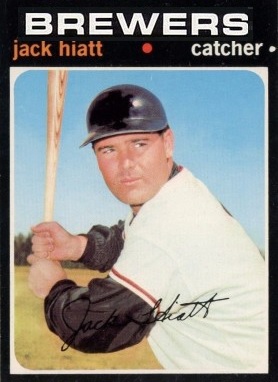
It’s my experience that some people enjoy the GM factor more than the games itself and that you really become invested in the teams and players. I’ve reached the point in my league that I started in 1969 that I even make baseball cards for the folks on my team to wit:

My Version of Jack Hiatt’s 1971 card

However draft leagues have their downsides:

  • A: Considerably more time to manage
  • B: Handling the rosters
  • C The draft itself may take days or weeks
  • D Keeping Competitive balance
  • E More things to go wrong

Running a draft league means, handling rosters of every single team, running a draft and trying to do it fairly and if you are having a league that goes from season to season keeping up the competitive balance from season to season. All of these require extra work and time depending on the size of your league: (My current draft leagues are 16 players for 1996 and 20 for 1971) and of course the more players the more work.

Bottom line: Draft leagues are in my opinion the most fun but if I were new I’d start with an existing league first to get my feet wet:

Existing team leagues

Having a league of existing teams takes a lot of work out of the system. The adantages are clear:

  1. There is almost no managing of rosters
  2. No trying to get people together for a draft
  3. No worrying about a change from one season to the next
  4. If more than one person wants the Yanks, or Cubs they can have them
  5. You can mix eras
  6. As soon as you have your schedule made you can start at once

Most existing team league involve GREAT teams which is the pool for tournaments. These tend to be very popular because the teams are memorable although you can spice things up as I did by creating leagues that aren’t just great teams two examples:

All pathetic team leagues: Teams in such a league all have to have a minimum loss level (90, 100 or something in between) This makes for a very odd game where you are constantly hoping for players to roll of their opponent’s cards. Also it gets interesting when one such team has a superstar. A 1967 Mets team with Tom Seaver for example. Can you picture the number Seaver produces when only facing slubs?

All Mediocre teams (the SD Jones league) I ran a league of teams that all had records from 80-82 to 82-80. This makes for an interesting league as there is enough of a mix of slubs and stars to really involve managing games.

Either way with these teams you don’t have the same roster / upkeep issues although with some of the older teams you are more likely to run into situations where a team has no pitcher eligible to use.

The disadvantages of set teams are:

  1. Teams are static no variation.
  2. No GM or Draft or Trade type fun
  3. Balance (think 27 yanks vs well almost anyone)
  4. Less incentives for teams losing to continue
  5. The mix of eras can cause anomalies

Bottom line set teams are a good option to start out but tend to be one or two shot deals. They work with teams that

Replay Leagues

With a replay league you play a team in an actual season in order.

The advantages:

  1. Very realistic. Actual team, actual schedule
  2. Schedule is pre-made so faster start
  3. The system handles trades and signings when it happens
  4. Excellent for solo league play

There are however some huge disadvantages

  1. Your season only moves only as fast as the slowest player
  2. Locked into the number of games in the season (162) games
  3. Unbalanced a bad team is always bad

A season replay league is a great choice if you want to get familiar with the game in a hurry. But you want to be sure that the players in it are committed because you can’t move to July 21 till all of July 22’s games are done. You might impose a 24-48 hour limit to get things in.

You CAN make a season replay league into a draft league but the amount of work is considerable and if you do be prepared for a season to take a full year

C: Consider how many series you want in a week:

Unless you are playing a season replay which is played based on when a day is finished. The Dynasty league system allows you to schedule up to four series a week at any time you wish to set.

As a series can be set for anywhere from 2-4 games that means as little as 2 games a week and as many as 12.

The fewer series played in a week of course the easier it is for people to play without having to resort to autoplay but that also means the slower the season goes. Also consider that a game takes 30-45 min in my experience so a 4 game series can take 3 hours while a two game series can be done in 90 minutes.

Also remember that the more series you have in a week the less likely you are to draw in players who are already in a league or two who won’t be able to squeeze in those extra games.

And the more series a week the less time to reschedule when real life insists on asserting itself over your scheduiled gaming time.

D: Consider how many games you want in a season:

Unless you are playing a season replay which fixes you at 162 games (or 154 if you play 1957 or 60 if you play the COVID season) you have the option to set any number of games.

The longer the season you play the more real it will be and the less impact injuries and suspension will have. Of course a short season the season will be and the more chance that a streak of good or bad luck will carry the day.

Also consider a short season means that you can have multiple seasons in a year while a long season will likely mean two at the most.

And if you have a draft league remember the draft takes up time between seasons it doesn’t finish in a day (unless you play face to face).

But either way remember you are the guy who is going to have to make this schedule and enter it manually into dynasty

E: Consider How many players you want to manage:

Note that I didn’t ask you how many teams you wanted in your league I asked how many players you want to manage.

A smaller league means fewer players and the fewer players you have the easier it is to have guys show up when games are scheduled and to schedule more games in a week etc.

It’s also a lot easier to come up with a schedule with fewer teams.

A small intimate league is fun but of course there is nothing like a large league with 16-20 players and a great variety of styles of play and management, plus you get less “Superteams because so many players are used. For example in my current 1971 league there are only 6 pitchers not on someone’s roster.

But keep this in mind any online league usually involves people you don’t know personally. The only thing everyone has in common is a love of baseball and a willingness to pay for the game.

There are invariably going to be the basic problems, people from different time zone having issues being free etc but you are also going to run into disputes and errors and mistakes and if it’s your league you have to make the calls. Managing people of different temperaments, different ages et/al can be difficult so do your best to impartially stick to the rules.

I STRONGLY suggest that you avoid non-league stuff in conversation or in the slack room and if you’re on social media and are angry about something in the news don’t vent in the league space (I made that mistake a few years ago in a league and it’s a mistake I regret.)

But more than that I suggest not having any kind of cash league with a prize. Once money is involved everything changes and any mistake becomes magnified


Remember in the end it’s all about having fun, make the choices to allow the maximum amount of fun for yourself and all the work will pay off.