
Archive for August, 2023

By John Ruberry

Last week one of music’s giants, Robbie Robertson, the lead guitarist and the principle songwriter for The Band, died at the age of 80.

In this post I’ll rank their studio albums.

Much like Fleetwood Mac, The Band, when you reach back to their beginnings in Toronto, is one of the few musical acts that, like a nation, have a historical narrative.

Arkansas rockabilly singer Ronnie Hawkins found success with his backup band, the Hawks, in Canada in the lat 1950s. But one by one, each Hawk, except for drummer Levon Helm, got homesick and returned to America. The first Canadian to join the Hawks was Robertson, who was quickly supplemented by bassist Rick Danko, pianist Richard Manuel, and organist Garth Hudson, but all of the members of the band were multi-instrumentalists, particularly Hudson. The Band had three vocalists, Helm, Danko, and Manuel. Often, particularly on their first two albums, they would interchange leads—and beautifully harmonize.

The Hawks split from Hawkins in 1963, and under different names, performed as a first-rate bar band until becoming Bob Dylan’s concert backing band. Helm left during that tour. 

After Dylan was injured in a motorcycle accident in 1966, with the Hawks, he recorded new material that was released in 1975 as The Basement Tapes. Helm rejoined in 1967, after the newly-dubbed The Band was signed Capitol Records. 

After many ups and a few downs, The Band split after their final concert–with many guest performers–which was lovingly documented in the Martin Scorsese-directed movie, The Last Waltz. The soundtrack album is also an essential work of art.

In the 1980s, without Robertson, The Band reformed, went on tour, with the intention of returning to the recording studio. But Manuel committed suicide in 1986. The remaining Band members eventually recorded three albums in the 1990s, consisting mostly of covers, but the rump Band broke up for good after Danko’s death in 1999. Helm, who had been feuding with Robertson for years over songwriting credits and money in general, died in 2012. Hawkins passed away last year.

Hudson is the only surviving member of The Band.

And now let’s start the rundown of The Band’s albums. Yes, the ones with the original lineup.

Islands (1977): There are some great outtakes albums, The Who’s Odds and Sods and Elvis Costello’s Taking Liberties come to mind. Islands is like most of the others, where listeners can say to themselves, “I can see why these songs were left off of previous albums.” Because The Last Waltz soundtrack was promised to another label, Islands was compiled to satisfy The Band’s contractual obligation to Capitol Records.  It contains a curiosity, “Knockin’ Lost John,” the only Band song where Roberston sings lead. Next…

Cahoots (1971): Drugs had taken their toll on The Band by this time, and Robertson’s songs weren’t very good here. Cahoots starts off well enough, with “Life Is a Carnival,” but immediately sinks into them mud. Not even one of my favorites, Van Morrison, who co-wrote with Robertson “4% Pantomime,” which is about two drunk musicians in a bar complaining about life on the road, could save Cahoots. Listening to this album is about as enjoyable as sitting next to two drunk musicians in a bar as they…well, you get it. On the upside, the album artwork is gorgeous, and one of Morrison’s nicknames, the Belfast Cowboy, comes from “4% Pantomime.”

Moondog Matinee (1973): Two paragraphs ago Costello, who counts The Band as one of his major influences, received a compliment, now I’m evening the score. In 1995, Costello recorded an album of mostly obscure R&B covers, Kojak Variety. It’s a terrible record. Moondog Matinee, which also contains many lesser-known R&B tunes, is better than that. Predictably, it’s the better-known songs that The Band chose, including “I’m Ready,” “Mystery Train,” and “Promised Land,” which click. 

Yes, I do love The Band. Really, I do.

Now comes the good stuff.

Stage Fright (1970): While Cahoots understandably opens with its best song, on Stage Fright, the collection’s worst two songs, “Strawberry Wine” and “Sleeping” are the opening tracks. The first song was co-written by Helm with Robertson, and Manuel co-wrote the second one with Robbie. With the exception of one other tune, all of the rest of the songs were written solely by Robertson, including these Band standards, the title track, as well as “The Shape I’m In,” and “The W.S. Walcott Medicine Show.” More rock and R&B oriented than The Band’s first two albums, Stage Fright is also remembered for Todd Rundgren’s role as engineer.

Northern Lights-Southern Cross (1975): The Band, with their first studio album in four years, came back in a big way here. “Acadian Driftwood,” a musical cousin of sorts of “The Night They Drove Old Dixie Down,” recounts the ethnic cleansing of French speakers in the 1750s from Nova Scotia by the British. At the time, Robertson was married to a French-Canadian, tensions between Anglophone and Francophone Canada were at a peak then. Like the early days of The Band, Helm, Manuel, and Danko harmonize and swap lead verses. “Ophelia,” “Jupiter Hollow,” and “It Makes No Difference” are the other great tracks on this collection. Every song on Northern Lights-Southern Cross is a Robertson composition.

Music from Big Pink (1968): One of the best debut albums ever, and not just because of the great songs, such as “Chest Fever,” “The Weight,” and the Dylan-penned “I Shall Be Released.” No one knew it at the time, but Music from Big Pink was the first album of the Americana genre, or if you prefer, roots music. The album artwork featured a Dylan painting. “The Weight” is the ultimate Band song, Helm and Danko share lead vocals and Manuel adds perfect harmonies. Dylan cowrote, with Manuel and Danko respectively, “Tears of Rage” and “This Wheel’s on Fire.”

The Band (1969): Most bands with a great debut album effort suffer from a sophomore jinx. Not The Band, with their self-titled follow-up, also known as the Brown Album. There are no Dylan songs this time, but Robertson filled that vacuum with works that are now Americana classics, such as aforementioned “The Night They Drove Old Dixie Down,” as well as “Rag Mama Rag,” and “Up on Cripple Creek.” Sometimes it’s hard to ascertain why The Band was so great and so unique. “Jawbone,” a Robertson and Manuel collaboration, offers a clue. It was written in a 6/4 time signature, a rarity in popular music.

And so was Robbie Robertson, a rarity. Rest in peace.

John Ruberry regularly blogs at Marathon Pundit.

…was recorded on TV over 40 years ago:

It’s about status and income and the best part about woke Christianity instead of one sins becoming something one has to approach Christ with as a humble penitent seeking forgiveness, you get to flaunt them with pride and be celebrated by the world for being stunning and brave.

If you want to find out which side of the divide Sir Humphrey describes the penitent vs pride is the best way.

One of my jobs involves teaching classes for an internationally recognized certification exam. I teach both in-person and online, and I enjoy teaching the materials and helping people prepare to pass the exam. For me, this certification opened up a lot of doors, connected me with a great network, and in general changed my career for the better. I’m pretty passionate about it, and I try to bring that passion and care to the class.

But man, sometimes, it is hard.

Over the past few years, I’ve noticed a decline in the care level people place on education. Now, to be fair, education is always a challenge, especially if we’re talking middle or high school education. Many of those kids just don’t want to be there. I don’t measure that engagement. I teach post-secondary classes. My adult students should, theoretically, want to be in class, and place some value on it.

It shocks me how little the modern student cares. As an instructor, I’m full of knowledge about the certification exam, yet most students ask few if any questions about the exam. I’ve then had students that failed the exam say “I wish you would have covered this aspect of the exam…” only to have me send them a link to their class video where I explicitly state “This aspect is really critical and you need to memorize it for the exam.”

In college, I had an electrical engineering instructor that used to work for NASA. He was the guy that designed the carbon dioxide filter for the Apollo 13 mission. If you saw the movie and remember where they made a square filter fit a round hole…yeah, that was him.

Most of the people in my class never asked him any questions. He never volunteered information about his time in NASA, and it wasn’t until the last week of class that I had the opportunity to ask him about his NASA experience. I learned so much in just that short time, and I’m glad I took that opportunity while in college.

We live in an era of information abundance, where gaining knowledge is simply a matter of applying yourself. Gone are the days where knowledge was kept under lock and key, only reserved for the powerful or rich. Yet this abundance has resulted in seemingly dumber students who are not ready to actually work. When you have mechanical engineering graduates who can’t make basic parts on a lathe, you have to wonder what that person did for 4 years in college.

I don’t think its a matter of education availability. The opportunities are there, and they’ve been there since I was a student all the way to today. But whether its laziness, lack of care, or something in the water, our modern students suck.

This post represents the views of the author and not those of the Department of Defense, Department of the Navy, or any other government agency.

4th Doctor: Sit down. Sit down. What did you call those robots?
Leela: Creepy mechanical men.
4th Doctor: Yes. You know, people never really lose that feeling of unease with robots. The more of them there are, the greater the unease and of course the greater the dependence. It’s a vicious circle. People can neither live with them nor exist without them.
Leela: So what happens if the strangler is a robot?
4th Doctor: Oh, I should think it’s the end of this civilisation.

Doctor Who: The Robots of Death 1977

I’m a great believer in the idea that there is no point in buying a movie if you don’t watch it regularly.

So when I started buying movies on Amazon Prime I got into three different rotations on watching them

  1. Watching them in order that I bought them
  2. Watching them in order that they were released
  3. Watching then in the order of the year that the movie takes place in (for the LOTR movies I consider it pre-history)

I’ve been doing this for a couple of years now, it was a great time killer during the COVID lockdowns but it got a tad interesting a year or so back because I bought the TV series The Time Tunnel so I keep having to jump back into that series when they jump into a particular year comes up.

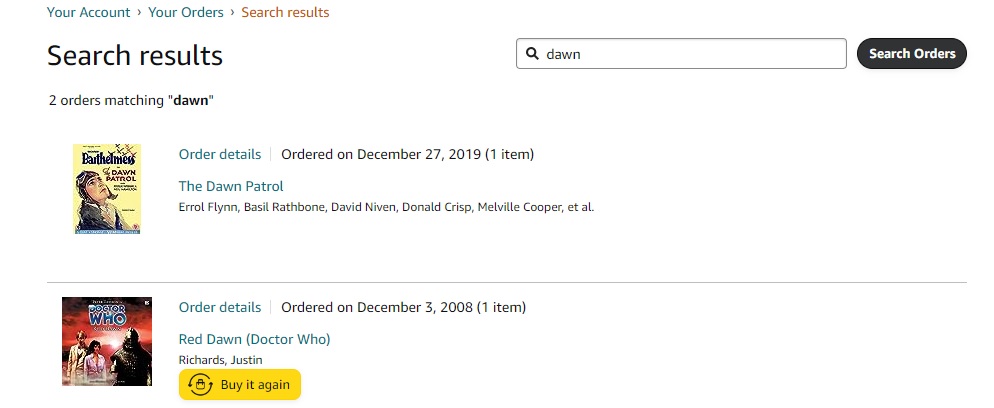
Yesterday I finally go to the 20th century and went to put on the 1938 version of Dawn Patrol staring Errol Flynn and Basil Rathbone which I bought back in 2019.

So imagine my surprise when instead of the propeller that opened the credits of the 1938 Errol Flynn movie I suddenly saw an opening announcing the 1930 version of the movie staring Richard Barthelmess in the role Errol Flynn would replace him in, Douglas Fairbanks Jr. in the role that David Niven would grab and Neil Hamilton who would gain worldwide fame as Commissioner Gordon in the 1960’s batman TV series in the role Basil Rathbone would take over 8 years later.

Now I had never seen the 1930 version so I began watching it but found myself a tad put out by the idea that I had bought one movie and had another one switched on me without my knowledge or permission.

I tried to search for the 1938 version on Amazon and found it was no longer offered as a streaming movie in the US (but it was still offered in England) which does me no good of course. I suspected that for some reason Amazon lost the rights to the Errol Flynn version and substituted the other.

And while all of the flight scenes (except the closeups) and all of the scenes of the Germans and 2nd unit stuff were actually identical I wanted the movie I purchased so I contacted Amazon and had them call me back.

This was quickly escalated beyond the basic guy and the advance tech I got had me look up my initial order from 2019. The screen shot looked like this:

You’ll note that while the description shows the cast of the movie I ordered the photo is from the one I didn’t but when I clicked on Order details: it got well interesting


As I had suspected they lost the streaming rights to the 1938 version and substituted the Howard Hawks 1930 one. That this was done is was bad enough but not only did they substitute the 1930 version of this movie in my movie library but they edited my invoice after the fact to say that the 1930 version of the movie was what I ordered.

That really pissed me off.

Well the guy did the best he could. He refunded the price of the picture and left the 1930 one in my library with the assurance that if the 1938 version became available to Amazon Prime for streaming again it would restored to my library automatically, but there is no way this should have been done without notification and even if I had been noticed the editing of my existing invoice to indicate a purchase I never made is beyond the pale.

Now in fairness the act of substituting the 1930 version might have been (and likely was) some kind of global edit in their system so they might not have realized it would have edited the invoices of old purchases, but they SHOULD have known.

There are three lessons to this story

  1. When you “buy” a movie or TV show from Amazon prime make sure you know you’re not “buying” a movie in the same way as a DVD, you’re buying a license for unlimited streaming of the movie for as long as Amazon has the rights to it, nothing more. Make sure you know this before you buy.
  2. When you have a digital order or any order from amazon for that matter look up the invoice and when it says “Print it for your records” do so the very day you made the purchase because you can not trust that the records in the Amazon system stored digitally will be the same as the day you bought.
  3. If you actually want to be sure that you will own a movie that you want BUY A HARD COPY

For myself Trust is gone I have made my last streaming purchase from Amazon, it will be BluRay or DVD’s or VHS tapes (I have my old Dawn Patrol copy around here somewhere) for me and when it comes to any other purchases from Amazon you can be damn well sure I’ll print out a physical copy of the order the moment I make it.

I can’t think of a greater incentive to go to your local department store and buy your goods in person.

Closing thought: Given what we’ve seen from other digital services like Youtube I think rules 1 & 2 should concerning Amazon should always apply across the digital world, particularly if you’re a conservative as I would not trust any of these services to refrain from creating a false digital trail for their own ends.