

Author Archive

The great migration continues

Posted: January 2, 2024 by chrisharper in Uncategorized

By Christopher Harper

The great migration from high-tax states to low or no-tax states continues virtually unabated, with the prospect of nearly a dozen House seats moving from places like California to Texas and Florida.

The U.S. Census reported recently that the U.S. population increased by 1.6 million between July 2022 and July 2023, with states in the South accounting for about 1.4 million of the growth. Leading the boom were Texas (473,453), Florida (365,205), Georgia (116,077), South Carolina (90,600), and Tennessee (77,512). 

Driving their growth was migration from other states. Overall, California lost the most residents to other states (-338,371), followed by New York (-216,778), Illinois (-83,839), New Jersey (-44,666), Massachusetts (-39,149), and Maryland (-30,905).

An interesting natural experiment has been the state of Washington, which gained tens of thousands of people each year in the last decade. But since enacting a 7% capital-gains tax on higher earners in 2021, Washington has been losing residents to other states at an accelerating pace—a total of 15,276 this past year.

A significant problem for Democratic-run states is that their affluent residents are leading the exodus., resulting, for example, in the drop of California’s tax revenue over the last five months to $24.5 billion below projections. Also, California’s corporate tax revenue is running about 50% below forecast, no doubt partly because businesses have shrunk their operations in the state. 

As a result, The Wall Street Journal estimates that California, New York, Illinois, Minnesota, Rhode Island, and Oregon would lose a combined 12 House seats in the 2030 reapportionment, which is as many as Florida, Georgia, Texas, Tennessee, North Carolina, Utah, and Idaho would collectively gain.

But the migration may not mean more Republicans get elected.

For example, retired California public employees are flocking to Idaho with their pension funds and have gained control of at least one town near Boise. The Los Angeles Times reported recently that the city of Eagle, Idaho, has seen an influx of retired cops and firefighters moving to their town, with many identifying as conservative but having rankled longtime conservatives in the locale. 

In Colorado, a recent documentary, “Rocky Mountain Heist,” focuses on how the state transitioned from red to blue, mainly because of the influx of outsiders from California and other liberal locales. 

When my wife and I decided to move from Philadelphia, we considered Idaho, where I was born and got my first newspaper job. Alas, the concerns of those in Eagle were the same as when we saw the results of recent elections. 

I spent my early years in Denver and still have a strong feeling toward the place. Again, however, the times have indeed changed for Colorado!

Even though migration may seem a good development, it’s essential to determine whether the people moving into conservative states share the same principles for effective government. 
Ending the indignity of self-checkout

Posted: December 26, 2023 by chrisharper in Uncategorized

By Christopher Harper


If you choose self-checkout, you may be considered a glutton for punishment.

With each selection, the automated voice gets more exasperated with your mistakes.

You need to place all the items in the bagging area.

Didn’t you get that necessity the first time? Or the second time? Now it’s the sixth time!

Have you checked all the items? Are you really trying to steal something?
Your card cannot be read. Please try again.

Would you like to add 57 cents to give money to people who aren’t jerks like you?

The card reader failed!

I’ve never liked shopping, and I guess it seemed that self-checkout would be faster the first time I used it. It probably is.

But self-checkout is a way to get me to do all the work that a real person has done for years.

But Ben Cohen of The Wall Street Journal wrote recently about a system that ends the frustration and the embarrassment of self-checkout.

At a clothing store called Uniqlo, the company has simplified the process using old rather than new technology: radio frequency identification readers or RFID tags.

“I picked one of the dozen self-checkout machines, followed the instructions on the screen, and placed my clothing in the box. The machine did the rest of the work. I confirmed the number of scanned items, tapped to pay, and grabbed my receipt. And that was it,” Cohen wrote.

The key to the whole operation was RFID tags and their declining cost. As the technology became more precise and less costly, retailers could afford to buy RFID chips in bulk and deploy them in novel ways: predicting demand, adjusting production, optimizing distribution, preventing theft—and reinventing self-checkout.

Uniqlo said the new self-checkout system cuts waiting times in half—and the longer it’s been in a market, the more customers prefer it.

Putting RFID cards on some products, such as tomatoes and bananas, may be difficult. But stores have found ways to counter such products’ lack of bar codes.

The only further change would be a way to silence the ever-present school marm who anticipates and notes every conceivable mistake you make!

Muncy’s Christmas story

Posted: December 19, 2023 by chrisharper in Uncategorized
Tags: , ,

By Christopher Harper

It was a Christmas mystery. 

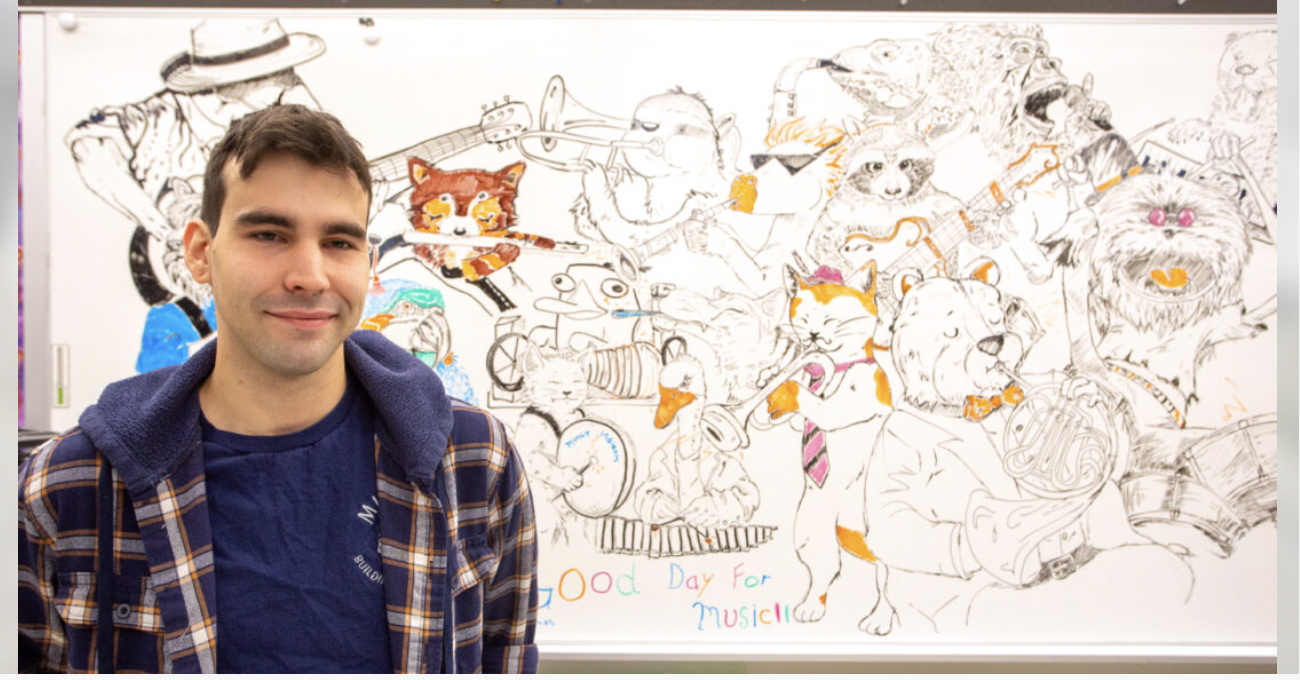
Last year, someone created detailed holiday drawings on the classroom whiteboards at the elementary school here in Muncy, Pennsylvania.

“It went through the elementary building like wildfire. It was a game every day for the kids to come in and see who got ‘elfed,'” said Corey Palmatier, the Muncy School District’s building grounds supervisor.

The morning the first drawing was done, the Ward L. Myers Principal Steve Haddon went to the classroom to check out the sketch.

“It was this amazing detailed picture,” Haddon said. “Then they started popping up all over, and nobody knew who it was. It excited everybody; the kids loved it.”

Amy Rosenbaum, a first-grade teacher, said her students guessed she was the secret artist. “They walked in and were completely shocked and they thought I drew it. I explained I definitely do not have this art skill.”

Over time, Logan Pena, one of the school district’s custodians, was found out.

“Last school year, he did it sporadically throughout the building, so you never knew whose room was going to have a drawing on the board. So the kids were trying to guess whose room was going to be next, that was exciting,” said Nevada Davidson, the lead custodian.

Pena could stay under the radar partially because his work schedule is the second shift, beginning at 2 p.m.

Pena, who is self-taught, has Asperger’s Syndrome, which can affect his social skills. But all the attention has brought Pena out of his shell, according to the staff.

“I like being by myself and just getting the job done,” Pena said. Doing the artwork is a great way to communicate — most of the time, I am just a ‘hi’ and ‘bye’ kind of person.”

One year later, the staff and students still requested drawings from Pena, whether students were asking for a particular animal or office staff wanted festive windows.

“We were just thanking Logan for taking the time to cheer up the building during that time of year — just spreading that holiday cheer,” Principal Haddon said.

Saving higher education

Posted: December 12, 2023 by chrisharper in Uncategorized
Tags: ,

By Christopher Harper

As I have written several times, higher education is an absolute mess, from its leftist culture to its ambivalence toward educating students about essential subjects.

Having suffered through numerous attacks at three universities for my conservative viewpoints, I have some suggestions on how to correct the problems in higher education.

First, eliminate tenure, which provides lifetime jobs and propagates the leftist culture. After only seven years, faculty members who are usually in their twenties when they arrive on campus don’t have to worry much about what they say or do for the next 40 or so years after tenure. 

Faculty members play an important role in hiring new faculty. It’s a bit like closed union shops where you only get accepted if you share political viewpoints or know someone already on the inside. 

Even CNN’s Fareed Zakaria acknowledged recently that higher education policies “use race, gender, and sexuality as political weapons to enforce intellectual conformity, dictate tenure decisions, and punish dissenters.” I guess a broken clock can be right twice a day!

Second, eliminate nonprofit status for private colleges and universities. Since these institutions have become political petri dishes, make them pay for their antics.

Third, look seriously at the amount of tax dollars that flow to higher education. Institutions of higher education get more than $1 trillion in tax money from various governmental agencies. State and local governments allocated about nine percent of their total budgets—more than the amount paid for highways and roads. About four percent of the federal budget goes to higher education—much of it in loans to students who end up heavily in debt. 

I am heartened that the public is starting to see that the emperors have no clothes. 

Americans’ attitudes about higher education have turned sharply negative in the past decade. In a Gallup poll, the percentage of young adults who said a college degree is important fell to 41 percent from 74 percent. Another poll found that about a third of Americans say they have a lot of confidence in higher education. In another Gallup poll, almost half of American parents say they’d prefer that their children not enroll in a four-year college.

Partly as a result of these attitudes, the number of college students has dropped dramatically in recent years. In the fall of 2010, more than 18 million undergraduates were enrolled in colleges and universities across the United States. That figure has been falling ever since, dipping below 15.5 million undergrads in 2021.

It’s time for individuals, colleges’ boards of trustees, and government entities to take a good, hard look at what higher education has become and make sure that the trends of intolerance and leftist thinking stop now!