
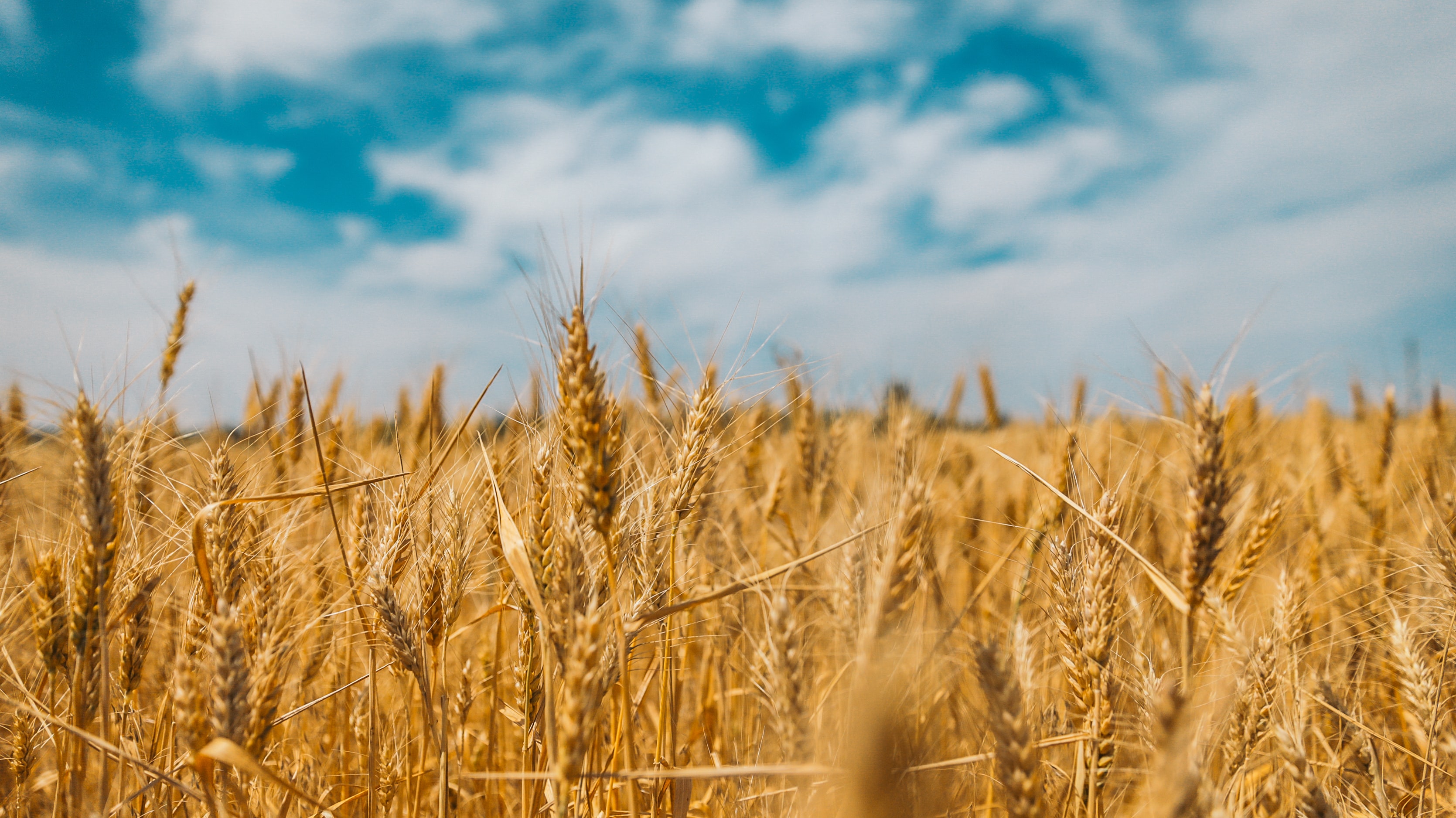
Photo by Polina Rytova on Unsplash

By: Pat Austin

SHREVEPORT – As President Biden warns of a “real” food shortage, my husband is on social media ranting about the CRP program and will certainly end up in the Facebook gulag again soon. It’s a matter of time.

The CRP, or Conservation Reserve Program, has been around since 1985, signed into law by President Reagan, and basically pays farmers not to grow certain crops on their land.

In exchange for a yearly rental payment, farmers enrolled in the program agree to remove environmentally sensitive land from agricultural production and plant species that will improve environmental health and quality. Contracts for land enrolled in CRP are from 10 to15 years in length. The long-term goal of the program is to re-establish valuable land cover to help improve water quality, prevent soil erosion, and reduce loss of wildlife habitat.

Besides conservation, it has the added benefit of stabilizing prices and keeping commodity prices from bottoming out.

As a native Iowan, he knows farmers who have prime agricultural land but grow nothing and instead collect a big check from the government each year to literally not grow crops. And then there are the occasional ones who collect their CRP check but also raise a crop and therefore double dip.

I’m not painting farmers as the bad guys; don’t mistake my point. In fact, recently farmers have been pleading with the Dept of Agriculture to open CRP lands:

“…Seven agriculture lobbying organizations fired off a letter to Ag Secretary Tom Vilsack this week asking the USDA for flexibility for farmers to plant crops on more than four million acres of “prime farmland” that’s currently enrolled in the Farm Service Agency’s CRP without penalty.

“It remains to be seen if Ukraine’s farmers will be able to safely plant crops,” the letter says. “Time is of the essence. The planting window in the United States is already open.”

While the CRP program does have certain conservation benefits, perhaps in the face of a worldwide food shortage, we need to take another look at this.

I have been hearing more and more people talking about planning gardens and stockpiling pantries in anticipation of rising food prices and shortages. Is this alarmist? Are we over-reacting? We all have seen shortages of various items since the Great Toilet Paper Shortage during Covid. The latest hard-to-come-by thing around here has been saltine crackers. So odd.

All of this does make one thing seriously about a self-sustaining lifestyle though; growing your own food, getting back to the very basics. We are currently in south Louisiana where the Cajun people know all about being self-reliant. I don’t see a lot of concern around here except in the few transplants that have moved in.

But, the more Biden warns of shortages, the more alarm will rise, and perhaps that is also the point because the Democrats believe only they can save us from ourselves.

Maybe we all need to plant a garden this spring and stockpile some rice and flour.

Bubbles, Battles and Reality

Posted: March 28, 2022 by datechguy in war
Tags:

Depending on where you go on the net or in the media you read a lot of different takes on the war in Ukraine.

You might hear one thing:

it is impossible to ascertain exact information about a battlefield situation on the other side of the globe, but these limited reports indicate that the Ukraine counter-offensive is making progress. If that is the case, we should soon begin hearing about fighting around Borodyanka, a key crossroads that would logically need to be taken by Ukrainian forces seeking to surround the Russian force at Bucha.

Or you might hear another:

The destruction inflicted on the Ukrainians by Russia is vast. If Ukraine still had a viable air force they would be challenging Russian combat aircraft and carrying out airstrikes on Russian positions. I have seen no reports in Western media about such actions.

In cities, such a Mariupol, that are besieged by Russian forces there has been no visible attempt to provide air support, artillery fire or reinforcements. The AZOV battalion left in an ever shrinking perimeter in Mariupol have no way out and are running out of ammunition and food. No soldier in the world survives long without ammo and chow.

There is evidence that a growing number of Ukrainian soldiers in other parts of the battlefield are surrendering

The problem are the bubbles. Both Russians and the West are being informed inside bubbles that do not acknowledge the failures and realities of war. The prime realities are these:

  • Any army that either doesn’t have or can’t be resupplied with food, fuel or ammunition can’t function.
  • A guerilla force can’t function If they can’t be supplied with ammunition and food.
  • Without either a safe air corridor or open and clear roads neither of these things can be provided for thousands of men on a daily basis

No amount of press briefings, internet memes or speeches in front of cameras changes these facts.

If Russia can’t supply their forces with these things those forces will be forced to withdraw or surrender.

If Ukraine can’t supply their forces with these things, they will have to do the same.

If neither can, then it will be a stalemate.

The big difference is that Russia can choose to resupply or relieve their forces from their own reserves, Ukraine can’t without western intervention

The real wild card is that we don’t know the actual war aim of Russia. If it was to secure eastern Ukraine they’ve pretty much already done so and everything else is gravy. They can pretty much stop fighting and declare victory at any time. It remains to be seen if Putin wants the whole thing (I suspect he does) not just because he wants to rebuild the old Soviet/Russian empire but also because Biden and company has given him the chance to achieve a bigger goal, the humiliation of the west and as long as the continued existence of the Ukraine is in doubt that goal is in reach.

Whatever happens Putin will declare victory.

Meanwhile Ukraine has a single goal, to survive as an independent nation. Even if Russia carves out large chunks of the nation if any is still there at the end they can claim to have held off the Russian bear. That’s the bottom line here, I predict that is the endgame of the western media and powers, to wait for this result and then declare it the greatest military victory since Midway. They have painted themselves into a corner so they will have to find a way to declare victory and that will be their best case scenario with the media lionizing Biden for his leadership if they manage this result.

We might be treated in the end to the odd spectacle of both sides declaiming victory but none of those claims will have any bearing on the reality on the ground which I suspect will continue to be unpleasant for all concerned.

In time that will become apparent because in the end reality doesn’t care about anybody’s spin.

By John Ruberry

Within the last month two new seasons of Viking-themed series began streaming on Netflix, Vikings: Valhalla and Season Five of The Last Kingdom. The former is a sequel to another Netflix series, Vikings, which I have not seen, but as the action of Valhalla occurs about 100 years after the first batch of shows, viewers need not have tuned in to Vikings to follow the new action.

The Last Kingdom and Vikings: Valhalla have much in common, besides Scandinavians battling the English. A main plot driver in both shows is the conflict between Christians and followers of the Norse gods. Presumably Valhalla begins the same year, 1016, when Canute the Great seized the crown of England. Ironically, only two English kings, Alfred, who is played by David Dawson in the first three seasons of The Last Kingdom, and Canute, gained the epithet “the Great.” Oh, when Canute was crowned, this Viking, who later became king of Norway and Denmark, was a Christian.

Both shows attempt to be even-handed between the two cultures, but they leave out one very nasty part of Viking life, slavery. Yes, there was slavery among Christian Europeans, but slaves–thralls are what the Norse called them–were an essential part of the spoils of Viking raids. However, both series portray human sacrifice by the Scandinavians.

Vikings: Valhalla, which consists of eight episodes, is the inferior of the two shows, so let’s get that one out of our way. Its central character is Leif Erikson (Sam Corlett). Yeah, he’s the same man who journeyed to North America around 1000. While there is no historical record that says Erikson participated in wars with the English, there’s no proof that he didn’t. It’s believed around the time of his journey to North America he converted to Christianity, but he’s a follower of the Norse gods here, although he dabbles with the Christian religion. His sister, Freydís Eiríksdóttir (Frida Gustavsson), is a devout follower of the Norse faith. Freydís is romantically involved with Harald Sigurdsson (Leo Suter), who history tells us was a newborn at the time of they were “getting it on” in the show.

The main action of Vikings: Valhalla originates in the Norwegian town of Kattegat, which is ruled by Jarl Haakon (Caroline Henderson), who history tells us was a white man, but here Haakon is a black woman.

I could go on for quite much longer on the many historical anomalies, but I will conclude here that had Vikings: Valhalla had an intriguing story line, if the performances were compelling–Henderson’s overacting is particularly annoying–and hey, if the CG was believable, then I’d say, “tune in.”

But don’t.

The Last Kingdom’s fifth last season takes place around 920. Its lead character, the fictional Uhtred, whose birthright as lord of Bebbanburg in Northumbia, England was usurped by the Danes in the first episode of Season One. He was raised by Danes, during that time he abandoned Christianity for the Norse gods, although he’s not very devout. When Uhtred reaches adulthood, he’s a skilled fighter and a ladies’ man, a James Bond of the Middle Ages.

The Last Kingdom is based on Bernard Cornwell’s Saxon Stories series of books.

Alfred the Great’s goal was not only to defeat the Danes–the word “Viking” is never uttered during The Last Kingdom–but also to create from his small kingdom of Wessex a unified England. It’s up to his son, King Edward, to complete the task, with Uhtred’s assistance of course.

All the while Uhtred is forced to confront a onetime romantic interest, fellow-Saxon and abductee, Brida (Emily Cox), whose faith in the Norse religion is strong.

Edward meanwhile has to confront betrayal within his court as a unified England seems within grasp.

While a bit wooden at times, the acting in The Last Kingdom is generally quite good. The battle scenes are intense, and the plotlines are strong enough to keep watching. But to figure out what is happening here, you absolutely have to watch the first four seasons beforehand. One flaw of The Last Kingdom, as with Ozark, which also took a year off from filming, presumably because of the COVID outbreak, is that it is need of very strong recaps at the beginning of each episode, of which there a ten this season. Hey, people forget things two years later. Another challenge in keeping the storyline straight is that many of the characters’ names, all based on historical figures, are similar; they incorporate the Old English prefix “Æthel,” which translates into modern English as “noble,” or Ælf. Had they asked me, I would have for starters changed the name of a duplicitous rat, Æthelhelm (Adrian Schiller), a character whose historical standing is foggy. In The Last Kingdom he’s the father of Edward’s second wife, Ælflæd (Amelia Clarkson). One son of Edward is Æthelstan (Harry Kilby) another is his half-brother Ælfweard (Ewan Horrocks), he’s the son of Ælflæd.

A spin-off of The Last Kingdom is in the works, a movie titled Seven Kings Must Die.

There are two more seasons of Vikings coming. I probably won’t be watching.

Both programs are rated TV-MA for violence, nudity, and sex.

John Ruberry regularly blogs at Marathon Pundit.

As I mentioned yesterday my Dynasty baseball team made it to the World Series for the first time this century and I looked forward to a hard fought world series against a Colorado team that like me had been two games away from missing the playoffs but had unlike me won 5 straight regular season and playoff game to make the series.

Alas for me that streak was extended to nine. All the games were close and in each game the tying run was either on base or on deck when the last out was made but the team just couldn’t manage to score the key runs. It seemed like every decision I made was the wrong one.

This sounds a lot like what has happened in Seattle Washington and Portland Oregon over the last two years except they don’t seem to be willing to note that they are in their current state due to their own bad decision on how to handle rioters and looters:

In the news section of the Seattle Times, for instance, a reader is unlikely to see any consideration of a link between policing and public safety. “No single cause for 2021’s surge in gunfire in Seattle,” declared a typical recent headline over an article that points only to possibilities such as the pandemic or an unlucky cycle of “retaliatory violence”. But the majority view in Seattle appears to have shifted toward an acknowledgement that the unrest and destruction that occurred after the killing of George Floyd in 2020 marked a turning point and that the city’s policies toward its police force, whose ranks are now depleted, are relevant to understanding the story. 

But just as it’s considered improper by the elites to note that Lia Thomas has a distinct advantage when swimming against actual women it is not publicly said the city fathers, their papers or the left that the lack of consequences for bad behavior produces more of it.

On 1 June, Mike Magan and a colleague from the Seattle bomb unit entered the site to look for possible video footage. The first floor, he says, was destroyed. “All the jewellery cases had been smashed,” he says. “All the cosmetics were gone. All the makeup was gone. Shoes were gone — bags. Everything.” As for tracking down the looters, that wasn’t on the agenda. “We were told: you will not investigate any of those things,” Magan says. “The city attorney wouldn’t file charges on them.”

In the end officers have left enmase and no amount of incentives seem to bring them or replacements back:

 Last October, as vaccine mandates caused even more officers to leave, the mayor put in place an emergency order offering $25,000 bonuses to new hires. But the mindset of the city seems to have mattered just as much to the officers in this story as financial considerations. “My young rockstar detectives are sniffing around these other departments where they’ll get treated like royalty,” Young says. “How do I compete with that?” The answer to that may depend on how much Seattle cares.

Meanwhile a few hundred miles south Portland is having the same problem with the same cause:

Beleaguered Mayor Ted Wheeler, who jumped on board the defund the police bandwagon back in 2020, has been trying to address both problem for the past year and so far he has very little to show for it. When it comes to violent crime, the city set a record for the number of shootings in 2021 and is currently on pace to surpass that record by double digits in 2022.

Portland Police Chief Chuck Lovell said for 2022, there have been an average of nearly 29 shootings per week in Portland.

If this trend continues, Chief Lovell says there will be a little over 1,500 shootings this year, which is a 14% increase compared to last year and a 266% increase from 2019.

At the same press conference where Chief Lovell made that announcement, the mayor was asked why his efforts to combat violent crime didn’t seem to be working. Mayor Wheeler rambled for a bit and then mentioned the elephant in the room.

“I’m determined to see gun violence reduced in our community and obviously that would happen much faster if we had more officers,” Wheeler said. Later in response to another question he added, “Portland has a critical shortage of law enforcement personnel right now. We are in a 28-year low on a per capita basis.”

John Sexton notes that what was unsaid was much more important than what was:

No one is saying the words “defund the police” but that’s what this is about. That and another word Mayor Wheeler never wants to say, “Antifa.” Portland police spent months battling violent goons in the street and got nothing for it but more criticism and the threat of a class action lawsuit by the protesters. 

A program initiated by the mayor to attract back retired officers had the same success rate as British Camel Spotters and drew caustic responses from those targeted for rehire insulted by the implication that they are at fault for leaving rather than the decision of the government to target the police rather than the mob:

Your letter states, “You left at a time of great despair for the Bureau and the City of Portland, 2020 became a perfect storm that thrust our Bureau and the City into a very dark period.” This sounds as if you feel that those who left, abandoned the city in her time of need, but in reality, it is the officers who were abandoned. The darkness, destruction and death to Portland was a result of your failed polices and the lack of leadership. The “perfect storm” of which you speak was the demonization of police by the Mayor’s office and City Council members, and the failure of PPB leadership to stand up to them in support of their own officers. Your letter mentions “considerable support from elected officials”. This is laughable. Portland has a Mayor who refuses to call out ANTIFA and condemn the riots, a DA who refuses to prosecute violent rioters and a Council Member who accuses police of committing the arsons and violence that were committed by the rioters.

This is an excellent example of cause and effect or more accurate the old saying that Democracy is the concept that the people should get what they want, good and hard.

As I said at the start of this piece like the leaders of Portland and Seattle my decisions led to my defeat, but unlike them I’ll be able to recover fairly quickly. It will be decades before either of these cities do, if ever.

At least there is one decision of mine that has stood the test of time. The decision of my wife and I not to move to Portland after we were married continues to be the best (non) move we have ever made.