Posts Tagged ‘frank’

Photo by Tim Mossholder on Unsplash

By:  Pat Austin

SHREVEPORT – A few days ago on this blog, datechguy wrote about a favorite local business that was a casualty of the Biden economy:

In the grand scheme of things it’s just one more business that has gone under thanks to the Biden Administration Economy and the steal of the last election. It’s just a few more jobs lost by people who worked there for decades, it’s just one more person whose decades of hard work building a business has gone for naught. Nobody in Washington will note it, it will not make the NY Time or the Washington Post or the TV news nor will those in the administration which insists we have a booming economy notice that it is gone.

Y’all. I could have written this myself because the same thing happened to me this week and I know it’s happening all over the country. I know it is.

One of my favorite local businesses is Champagne’s Bakery located in Henderson, Louisiana on the edge of the Atchafalaya Basin. The business began 134 years ago in Breaux Bridge and is known for their French bread which they sell wholesale to a large percentage of restaurants in the Acadiana region. At the bakery in Henderson, when the bread is fresh and hot, a flashing light like a siren will spin wildly on their sign. It’s a landmark!

Champagne’s (pronounced SHAM-pines)  is known for their trademark “pink cookies.” They are about the size of a quarter and are little sandwich cookies with icing as the filling. They are just the right size to pop into your mouth whole. During Mardi Gras they make them in purple and green; during football season you can get them in LSU purple and gold or Ragin’ Cajuns red. But always there are pink ones. They are delicious!

When the bakery announced on social media last week that they were closing, a large number of shocked commentors lamented the loss of the pink cookie.

A local radio station reached out to the owner for an explanation:

Paul said that, like most places, the bakery took a hit during the COVID-19 pandemic. Business slowed, but Paul said it wasn’t terrible.

The bakery was still recovering from the pandemic and things were looking pretty good until, he says,  the economy began to turn.

When I pressed him for more, he said that inflation is killing the business.

3 years ago, Paul was paying around $15 for a case of eggs. Today, he is paying around $60. A few years ago, shortening for the baker cost Paul about $28 for shortening. Today, that same package of shortening sets him back $90.

Who can survive increases like that?!

Not to mention that when we were there two weeks ago, they were having trouble getting supplies in because of trucking woes. Their suppliers couldn’t get their goods to them. Smaller trucking companies are having to lay people off and make adjustments of their own; look at the diesel prices to figure that one out.

So, yes, I’m mad that I’m losing my favorite bakery. I’m even more mad that another, yet ANOTHER, local mom ‘n pop business is going under, a casualty of the Biden economy. But what really bothers me is where this is going to end. The WalMarts are going to survive. They’ll be here forever. Most of your chain restaurants are going to survive too. But soon you’re going to lose the local flavor, and even part of the culture, of what makes your area unique.

You’ll have to participate in hyper-capitalism to get anything done, to buy goods and materials, to eat.

Our local diners, those that are left, are struggling. They’re raising prices, they’re closing a couple of days a week, they’re struggling to find employees. They have to take what they can get from the labor force and it’s often lackluster.

I diverge from my point a bit, but really, where is this going to end?

In The Advocate this morning was an article about struggling shrimpers; fishing is a major source of livelihood for people in south Louisiana but rising fuel prices are contributing to the demise of that for a lot of fishermen.

Where does it all end? What will out economy and our culture look like at the end of this?

The loss of our local bakeries, restaurants, diners, and shops will soon mean our country is generic from one end to the other. You won’t be able to tell New Orleans from San Francisco.

Maybe I exaggerate, but not by much.

Pat Austin blogs at And So it Goes in Shreveport and at Medium; she is the author of Cane River Bohemia: Cammie Henry and her Circle at Melrose Plantation. Follow her on Instagram @patbecker25 and Twitter @paustin110.
By: Pat Austin

SHREVEPORT – I think I’m going to give up eating out for a while.

Working under the same theory I used when I stepped back from social media to avoid general aggravation and blood pressure spikes, avoiding the restaurants and fast-food joints in my area for a while will serve two benefits: 1) I’ll save a few bucks, and 2) I’ll be less aggravated when my order is screwed up, if I ever get to place an order at all, that is.

My husband is blaming the low level of quality service on the stimulus and extended unemployment checks that were doled out during the pandemic. He’s probably not wrong, but may not 100% right, either.

It just seems that lately, service sucks. Period. There’s no pride in a job well done and so many people won’t do one iota more than what is in their job description.

Example: we went to Sonic for a quick hamburger for lunch on the way home from church. The place is busy, but not overwhelmed. We pull into the parking slot, push the button to order, and wait. And wait, And wait. “Reb button is activated! We’ll be with you soon!”  Waiting. Eventually we see a carhop stroll out to drop off drinks to the car next to us. My husband gets her attention, with some effort, as she walks back by us and asks if the call button is working properly and explains we’ve been waiting ten minutes to place our order. She shrugs and says “We shorthanded. They’ll get to you.” And she strolls away.

We left and went to Whataburger, a regional hamburger franchise we like. Again, business is steady but not overwhelming. But we waited literally 35 minutes after placing our order to get our hamburgers and fries. Husband walked up to the counter to inquire, and our food was sitting in the back; nobody had thought to bring it out. It was cold, but we took it and left.

This happens in restaurants too; it’s not just fast-food places. I took my son out for a steak dinner the other night and the steak was not cooked to order (not even close). Inedible.

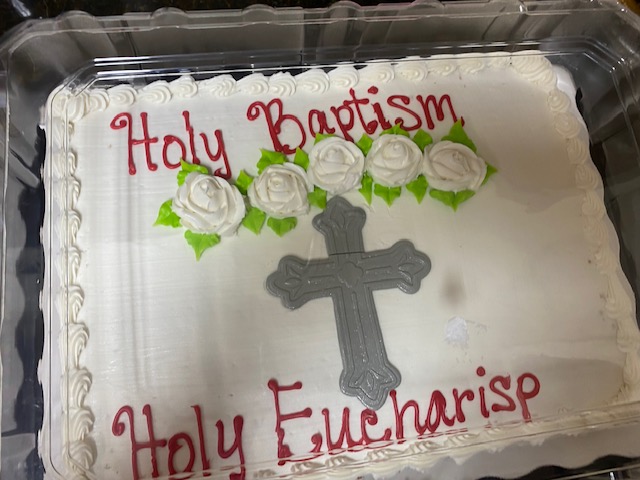
The cake in my picture above? “Holy Eucharisp” was written on a cake my church ordered to celebrate Baptism and First Communion on Pentecost. WHAT is a Eucharisp?  The bakery thought this was acceptable. And sent this product out to us. #fail.

I’m not a picky customer. Not by a long shot. But quality of service is declining. Am I the only one seeing this? Labor shortages are bringing us the lowest levels of productivity. Are we really to the point where any warm body behind the counter will do? It’s one thing when we are talking about hamburgers but what about when it’s happening in your pharmacy or your auto mechanics or your other service areas? For the record, my pharmacy used to be open seven days a week but now it closes on weekends.

These are scary times. Our society and our levels of acceptance for poor performance have changed. We’re so grateful to finally get that cold hamburger we just take it and move on. Obviously it’s not just hamburgers we’re talking about here. Think of all the things that metaphor could apply to.

We’re in trouble.

By: Pat Austin

ARNAUDVILLE LA – We are on the road again this week, down in south Louisiana. As it happens, this dysfunctional economy reaches all points of our nation, including tiny little Arnaudville in St. Landry parish.

Through our years traveling in this area, we’ve always known it to be a conservative stronghold; the more liberal elements of our voting population are over in New Orleans and that’s a whole ‘nother world, as they say. In south central Louisiana you find a lot of strong Catholic families who are of conservative belief in their politics. On top of that, this Cajun culture especially is comprised of hard working, independent people who want to raise their families, earn a living, and in many cases, build their business.

And so when you walk into a bakery, for example, and the proprietor is suffering because she can’t get the products she needs to create the goods she sells, the message hits home.

The frustration among business owners we’ve talked to around this part of the state is clear. One of the major issues right now is the cost of fuel; truckers are paying inflated prices for diesel, which is passed on to the business owner, which is passed on to the consumer. The bakery owner we talked to said she was told that the trucking company she uses is laying off drivers and others are shutting down completely. The smaller, independent companies can’t carry these prices increases much longer.

This is all anecdotal, but the fact is, we all see the higher gas prices. We talked to another business owner who can’t get the spirits and alcohol he uses in his bar business. They’re having to get creative in their mixology and sales. But, he said, in the end, they’re still losing money.

The story remains the same in nearly every shop, restaurant, business, that we’ve visited this week. Frustration is real. More and more people are talking about what I call “doomsday planning” – they’re putting in gardens and stocking up on basic supplies. We talked to one lady dining next to us in a restaurant this week who said she’s storing up cans of tuna, dried beans, water, just as a precaution. “I’ll still be able to eat; I’ll still be able to feed my family,” she said.

And that’s what it comes down to. People want to be able to provide for themselves and their families and pretty much nobody I’ve talked to wants any handouts.

I feel fairly certain this is the case throughout the country, not just in south Louisiana with perhaps the exception of those liberal pockets who want to keep making excuses about it being the fault of the conflict in the Ukraine. People around here scoff at that and are quick to remind that gas prices were rising long before that conflict erupted.

I’m not usually a worrier about things I can’t control, but I suspect all of this is going to get a lot worse before it gets better. And I also suspect that the midterms are going to be a bloodbath for the Democrats. People don’t like living like this and the only thing we can do about it is vote correctly.

By: Pat Austin

The Kelley Brothers

On Memorial Day I am re-running one of my former posts on Shreveport’s Kelley brothers. As we remember those who gave the ultimate sacrifice in service to their country, take time to learn about some of these heroes in your own community. In Shreveport,  one family lost three sons in less than two years in World War II.  During that war many families across our nation lost more than one son, but as far as I know, the Kelley family is the only family in Shreveport that lost three sons– one of them in the invasion of Normandy on June 6, 1944.

Like all of America, Shreveport watched the unfolding events at Pearl Harbor in 1941 with horror.  

In February 1942, William G. Kelley (his friends and family called him “Bob”) felt the call to service and enlisted in the Army Air Corps.  He had graduated from the local high school, attended Louisiana College, and was attending seminary.  He was ordained at the First Baptist Church in Shreveport. When he enlisted, Bob was preaching at the Evangeline Mission, a new church in town that he helped build with the assistance of the Queensborough Baptist Church.

Bob Kelley went to officers’ school and became a bombardier; he went with the Eighth Air Force to England.  Lt. Kelley had been overseas only six weeks when his plane crashed near Fontainebleau, France and claimed his life on November 10, 1944.  He was twenty-four years old.

The Evangeline Mission, where Bob was a preacher, was renamed for him as Kelley Memorial Baptist Church

A second Kelley son, Bose, Jr., died in the D-Day invasion.  Al McIntosh, writing for the Rock County Star Herald, wrote on June 8, 1944, after learning that the expected invasion of France had finally taken place:

“This is no time for any premature rejoicing or cockiness because the coming weeks are going to bring grim news.  This struggle is far from over – it has only started – and if anyone thinks that a gain of ten miles means that the next three hundred are going to go as fast or easy, he is only an ostrich.”

He was correct:  the grim news was only beginning. Bose Kelly, Jr. enlisted in May 1942.  Bose graduated from Fair Park High School in Shreveport.  He was married to Betty Miller and worked as a mechanic at Central Motor Company, a car dealership.  Bose volunteered for the Army Airborne, went to jump school, and became a paratrooper.  Bose was part of the 507 PIR which became attached to the 82nd Airborne in 1943. The 507 PIR was activated at Fort Benning, Georgia on July 20, 1942, and trained there and in Alliance, Nebraska.  In 1943, the 507th PIR shipped out to Northern Ireland, then England, and it was in Nottingham where they prepared for the coming Allied invasion of France.  They studied sand tables, drop zones, and were given Hershey’s chocolates and a carton of cigarettes.

Bose was on a C-47, number 13 in his stick, as the plane lumbered through the fog banks toward Drop Zone T, near the west bank of the Merderet River.  Because of the fog and the incoming German flak, the C-47s flew faster and higher than anticipated which caused almost all the paratroopers to miss the drop zone.  They were scattered over a 15-mile area.  The 507th was the last regiment to jump and by the time Bose Kelley’s C-47 was over the Cotentin peninsula the entire area was stirred up with flak coming from every direction. There were sixteen men in Bose Kelley’s stick and at least eight of them were killed that night.  The Germans had flooded the valley as a defensive tactic and some paratroopers, weighted down by equipment and unable to swim, drowned.  Bose Kelley was killed by a direct hit from an artillery shell.

Major General Paul F. Smith wrote in his Foreword to Dominique Francois’s history of the 507th,

“This regiment unquestionably received the worst drop of the six US parachute regiments dropped that night.”

Howard Huebner, who was number 3 in Bose’s stick, survived that drop.  He wrote:

I am a Paratrooper! I was 21 yrs old when we jumped into Normandy. 

We knew the area where we were supposed to land, because we had studied it on sand tables, and then had to draw it on paper by memory, but that all faded as our regiment was the last to jump, and things had changed on the ground. Most of us missed our drop zone by miles.  As we were over our drop zone there was a downed burning plane. Later I found out it was one of ours. The flack was hitting our plane and everything from the ground coming our way looked like the Fourth of July. 

When I hit the ground in Normandy, I looked at my watch.  It was 2:32 AM, June 6, 1944. I cut myself out of my chute, and the first thing I heard was shooting and some Germans hollering in German, “mucksnell toot sweet Americanos”. 

We the 507th, was supposed to land fifteen miles inland, but I landed three or four miles from Utah Beach by the little town of Pouppeville. I wound up about 1000 yards from a French farmhouse that the Germans were using for a barracks, and about 200 feet from a river, an area that the Germans had flooded. If I would have landed in the water, I may not be here today as I can’t swim. A lot of paratroopers drowned because of the flooded area.

Local writer Gary Hines spoke to Bose’s widow, Betty, for an article he wrote for the August 2000 issue of SB Magazine.  She told him, “He was going to win the war and come back home.”  Betty was married at 18 and a widow at 20.  She told Mr. Hines “We were both young enough to feel that he was coming home.  He wasn’t going to be one of the ones who was lost.”

A third Kelley son, Edgar Rew, was drafted into the Army in 1943.  He was sent to Camp McCain in Mississippi where he died five weeks later from an outbreak of spinal meningitis.  He never made it out of basic training.  He was 27 years old; he left behind a wife of five years.

The remaining Kelley brother was Jack.  Jack Richard Kelley was serving in the medical corps in Washington at Fort Lewis.  His father, Bose Kelley, Sr., wrote to U.S. Representative Overton Brooks and pleaded with him to prevent his oldest son from going overseas.   It is reminiscent of the scene in Saving Private Ryan where General Marshall reads the Bixby letter to his officers.  In this case, in a letter dated December 8, 1944, Mr. Kelley received word that his son Jack would remain stateside for the duration of the war.  Jack Kelley died in 1998.

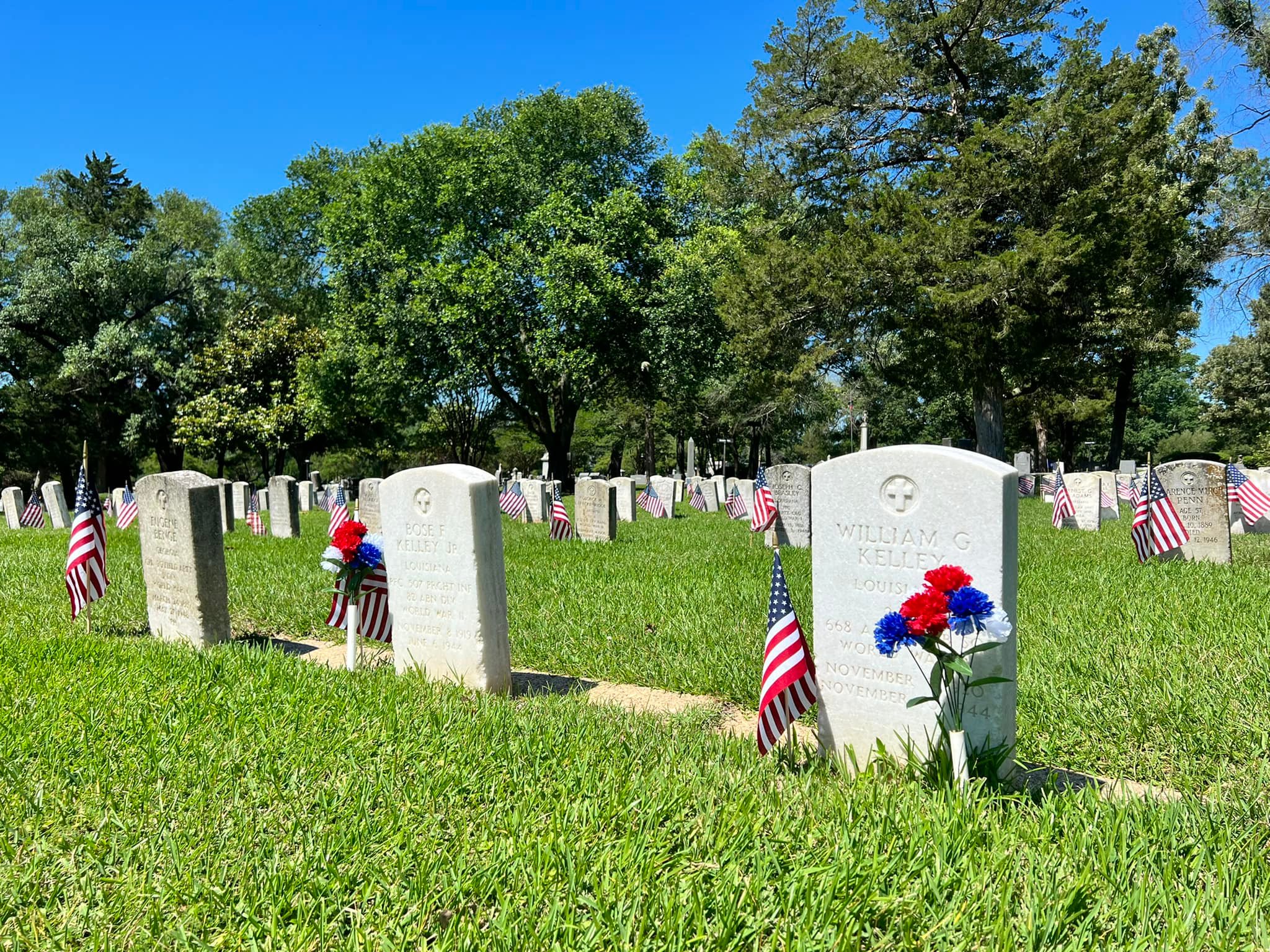
The bodies of Bose Kelley, Jr. and his brother William (Bob) were buried in separate military funerals in France but were returned to the United States in September 1948.  Bose and his brother now rest side by side in the veteran’s section of Greenwood Cemetery in Shreveport.  Their brother, Edgar Rew Kelley, is in a civilian cemetery across town, the Jewella Cemetery on Greenwood Road.  Their father, who pleaded for his fourth son to be spared, died just one month after Bose and William’s bodies were buried in Greenwood Cemetery.  It’s as if he was just waiting for them to come home.

For sixty-five years their sister, Ruby, tended the graves of her brothers.  There has never been a time that I visited the graves that there was not a crisp American flag flying over each and flowers.  Ruby died a few years ago, and the graves are now tended by Ruby’s daughter.  I visited the graves of Bose and William last week and sure enough, there were two new flags and flowers steadfastly in place.

As we observe this 70th anniversary of D-Day, we remember the sacrifices of young men like the Kelleys all across the country. Their name belongs alongside the Sullivan brothers, the Borgstrum brothers, the Niland brothers, and the Wright brothers.  It is their heroism and their sacrifice, along with that of so many others, that we remember and honor.