
Posts Tagged ‘john ruberry’

By John Ruberry

Conservatives, I certainly like to think, have great political ideas, such as believing in smaller, and therefore less expensive government, and we believe in aggressively pursuing overall public safety.

And that is where conservative political acumen, particularly in states like Illinois, ends. Much less so than liberals, we are people of the private, not public sector, and we are not constantly thinking about, or scheming, about politics. I’m pretty sure leftists think about politics as often as 16-year-old boys think about sex. In both situations, that’s too much, but conservatives need to have their political radar–and sonar–always switched on.

That is why the unhappy conservatives in Illinois need to begin now to plan for the 2028 vote to call for a constitutional convention. The current constitution, which is deeply flawed despite its relative youth, went into effect in 1970. 

While the Illinois General Assembly can call for constitutional convention any time, Article XIV of the 1970 constitution stipulates that every 20 years the question of holding a “con-con” must be presented to voters. If 60 percent of voters–or a majority of those casting a ballot in that election–votes “Yes,” then a constitutional convention must follow. Voters in the next general election can choose to accept or reject the resulting document. 

Four years from now–yeah, 2028.

But what about the 2024 presidential and congressional races? And the 2026 midterms? Yeah, they’re important too. But conservatives need a long game. A very long game. Make that a winning game.

Leftists plan for the expected as well as the unexpected. As for the latter, once the COVID lockdowns started, liberals were calling for widespread mail-in and early voting, as well as a plethora of ballot drop boxes. 

They had contingences in already mind–and now Joe Biden is our president. Do you understand yet?

As for right now, we can start with talking about the many flaws of Illinois government, generating what urban activists call “street heat.”

A new Illinois constitution can attack those problems.

And there are so many problems in Illinois, which has been annually losing population for ten years.

Gerrymandering. This is a problem statewide. Saying that legislators draw their own districts is not correct. It’s the state House speaker and the state Senate president who drive the redistricting process. Independent commissions should draw General Assembly districts and for all counties and municipalities with more than 50,000 residents.

An attempt in 2016 to change the decennial redistricting process by a constitutional amendment was ruled unconstitutional by the state Supreme Court.

Legislative leaders. Boss Michael Madigan, a Chicago Democrat who is currently under indictment for racketeering, was House speaker for all but two years from 1983 until 2021. He’s been around for so long that Madigan was delegate to the 1970 constitutional convention. One of the arguments against calling for a con-con in 2008, when this issue last faced voters, was that Madigan wouldn’t be around forever. But he hung on for another 13 years. After Madigan was ousted from the speakership–amid a federal investigation–his replacement and the state Senate president drew another gerrymandered General Assembly remap. It was signed into law by Gov. JB Pritzker, breaking his campaign promise to veto partisan redistricting. Forgive me, I know it took me a while to get here, but House speakers and Senate presidents should be limited to single two-year terms.

Term limits are needed for all elected offices. Statewide, from municipal library boards up to governor, elected public officials should be limited to eight years in office. Just before Christmas, Chicago alderman Ed Burke, after 54 years in the City Council, was convicted on over a dozen corruption charges. A quick look at Madigan and Burke’s careers shows that they weren’t able to amass enough power to abuse it until they had been in office for about a decade. ‘Nuff said.

Illinois’ electoral votes. Liberals hate the Electoral College and Illinois conservatives hate that every four years every electoral vote in the Land of Lincoln goes to the Democratic presidential candidate. Instead, Illinois needs to distribute its electoral votes in the same manner Nebraska and Maine do it. The presidential candidate who wins the most votes in Illinois gets two electoral votes. As for the rest of Illinois, the candidate who wins the most votes in a congressional district–Illinois currently has 15–gains that district’s electoral vote. I suspect liberals won’t be on board because winner-take-all benefits them in the Prairie State, but didn’t I mention that leftists hate the Electoral College? Oh, speaking of Nebraska, the Cornhusker State has a unicameral state legislature. All Canadian provinces have the same system. Just saying, but Maybe Illinois doesn’t need a state House and a state Senate?

Cash bail. The most fundamental duty of any government is to protect its citizens. The SAFE-T Act, which went into effect three months ago, abolishes cash bail. It’s bad legislation. Re-establish cash bail as part of the law enforcement process.

Township government. Illinois has more units of government, despite being only the sixth-most populous state, than any other state. Pennsylvania is a distant second. Illinois needs to remove the deadwood, starting with township government, a 19th-century relic.

State holidays. This may seem petty, but holiday creep is a problem in Illinois. Limit state holidays to federal holidays and Lincoln’s Birthday. Require a 2/3 vote in the General Assembly to add a new state holiday. Sorry state workers, you need to show up to work on Casimir Pulaski Day, General Election Day, and the day after Thanksgiving. As someone with a December birthday, the day after Thanksgiving is an ideal one for me to renew my driver’s license.

Rotten schools. Give parents the right to send their children to private schools with vouchers. Establish home schooling as a parental right. According to the latest Illinois Report Card, only 35 percent of students read at grade level and just 27 percent of them are proficient in mathematics.

Too many statewide offices. The constitutional offices of treasurer and comptroller should be combined, and the position of lieutenant governor should be abolished. Place the attorney general next in line when the governor’s office is vacant.

Corruption. But add one more statewide elected office, that of inspector general, who will be responsible for investigating corruption from the governor’s office down to village halls.

Lockdowns. Permit the governor to issue statewide stay-at-home orders only after a 2/3 vote by the General Assembly.

Pensions, the 800-pound beast. The 1970 constitution has a pension guarantee clause. Drop it and establish a non-partisan commission to resolve state and municipal underfunded pension plans. And compel new state workers to pay into Social Security but make 401(k) programs available to them.

I know, Illinois is a deep blue state and I’m a dreamer. But we have four years–almost five, really–to plan for the 2028 vote for an Illinois constitutional convention.

You have your new year’s resolution.

John Ruberry, a fifth-generation Illinois, regularly blogs at Marathon Pundit.

By John Ruberry

“Some men see things as they are and say, ‘Why?’ I dream things that never were and say, ‘Why not?’” Robert F. Kennedy Sr.

“When people fear the government, there is tyranny. When government fears the people, there is liberty.” Thomas Paine.

Former Chicago alderman alderperson Edward M. Burke, who for much of his–wait for it–54 years as a member of Chicago’s City Council, was the second-most powerful politician in the city, because he was the chairman of that body’s Finance Committee. 

Last week Burke was convicted on over a dozen corruption and racketeering charges. Burke, according to federal prosecutors, abused the powers of his office to shakedown businesses, such as the owner of a Burger King restaurant in his ward who was told by Burke if he wanted a construction permit, he needed to retain the alderman’s law firm. 

Developers of the massive old US Post Office and even the venerable Field Museum were victims of Burke’s extortion schemes. I suspect there were hundreds more.

Burke is appealing his guilty verdict of course. Once the appeals are exhausted, barring a successful appeal, the lifetime politician is likely headed to prison.

I’m not a lawyer–so forgive my naivete here. Then again, since I’m not an attorney–and not enmeshed in the gears of the rotten system–maybe I’m the right person to tackle this subject.

For thirteen years of Burke’s crooked career, I was a resident of Chicago. Because I was denied honest services by Burke, so that gives me standing to sue Burke for damages. Right?

Wrong. 

Qualified immunity protects public officials from such suits. My interpretation of the legal concept–again, I’m not an attorney—is that if officials, let’s say the head of a state highway department, fears being sued over a possible bridge collapse, it may mean that no new bridges are built.

Back to Burke.

It’s difficult to see where Burke’s public career as an alderman alderperson began and where his private legal practice ended. It was a hybrid beast. In short, Burke was running a racket.

So, since a jury ruled that Burke was using his public office for private gain, why should qualified immunity protect him?

Why shouldn’t Burke, and other corrupt Illinois pols such as former governors Rod Blagojevich and George Ryan, be subject to taxpayer lawsuits? Or class action lawsuits?

“To join this lawsuit now–call the 800 number on the bottom of your screen–time is limited! Make that politician pay!”

Taking my idea to the federal level, there’s a recent case with bribery allegations against a sitting US senator and his wife. I mean, I’m just saying…

Wouldn’t it be wonderful if crooked pols could be sued for every penny they have? And their vacation homes? And their gold bars?

Everything!

That just might scare these pols into honesty.

Change the law. Or laws. 

Drop qualified immunity for crooked public officials. Call it–ahem–Ruberry’s Law. Consider it my Christmas gift this year.

Back to Illinois.

As Illinois’ SAFE-T Act law–which by the way I believe it should be repealed–was being drafted, dropping qualified immunity for police officers was suggested. So clearly, at least in Illinois, qualified immunity is not sacred.

One more item. Since 1973, 38 members of the Chicago City Council have been convicted of crimes.

John Ruberry regularly blogs from Illinois at Marathon Pundit. During his lifetime, four Illinois governors have served time in federal prison.

By John Ruberry

Last Thursday, Chicago’s new mayor, Brandon Johnson, the candidate of the far-left Chicago Teachers Union, held a press conference. It was one of those dog-and-pony shows, also in attendance was the city’s police superintendant, Larry Snelling a Johnson appointee, and other municipal officials.

Armed with brochures, Johnson unveiled the “People’s Plan for Community Safety.” Who are the people that devised the plan? Presumably that group doesn’t include cops and crime victims, and it almost certainly doesn’t include the South Side family who had two cars stolen in separate incidents last month. One theft was a carjacking that was captured in a horrifying video

Crime was the main campaign issue in this spring’s runoff election for mayor. Paul Vallas, a moderate Democrat, promised to beef up law enforcement. It was the center piece of his lackluster campaign. Johnson, appealing to his African American and leftist whites, vowed to attack crime at the root causes–just like the outgoing mayor, Lori Lightfoot.

Crime soared under Lightfoot. And now that she is gone, it’s still high. While Chicago’s murder rate is a little bit lower, post-pandemic, it’s still higher than it was in 2019. There are more robberies and auto thefts than a year ago, and many more compared to pre-pandemic levels.

Predictably, Johnson and the other city officials at the presser focused on the “root causes” of Chicago crime.

From the event’s press release:

There is a shattered sense of safety in Chicago that has been driven by decades of purposeful disinvestment in our communities. It is time for a new community safety approach – one that addresses the root of the problem by investing in our people and neighborhoods to secure a safer Chicago for generations to come. The People’s Plan for Community Safety calls upon our entire city, and especially those most impacted by violence, to create solutions together.

Lightfoot’s failures as mayor went beyond law enforcement. But Chicago tried the healie-feelie approach to crime under Lightfoot. It didn’t work.

Chicagoans voted to double-down on dopey.

Commenting the next day on the Morning Answer with Dan and Amy, co-host Dan Proft threw a penalty flag at Johnson’s root causes crimefighting strategy. Reminding listeners that Johnson is half of a two-parent household, Proft said Johnson is focusing on the wrong root causes. 

Indeed.

A few days earlier in the Wall Street Journal, Proft noted, Jason L. Riley pointed his finger at the true root cause of rising crime rates, the proliferation of fatherless households since 1960. Referring to what is known as “the success sequence,” Riley wrote: 

A decade ago, New York City launched a campaign to combat teen pregnancy. It featured ads on buses and subway cars that read: “If you finish high school, get a job, and get married before having children, you have a 98% chance of not being in poverty.”

He continued: 

We could use more of that moralizing from public officials, whether the issue is solo parenting, substance abuse or crime. The success sequence works to keep people not only off the dole but also out of trouble with the law. High-school graduates and children raised by both parents are much less likely to end up in jail. “Virtually every major social pathology,” political scientist Stephen Baskerville writes, “has been linked to fatherless children: violent crime, drug and alcohol abuse, truancy, unwed pregnancy, suicide, and psychological disorders—all correlating more strongly with fatherlessness than with any other single factor, surpassing even race and poverty.”

Chicago, and most American large cities, as well as many suburbs and rural communities, have been on a failure sequence for decades.

I’m not claiming to have the answers to turning around the failure sequence, ignoring the problem, along the lines of placing electric tape over the check engine light on your car when it flashes, of course means more failure. And yes, there are single moms who do a stupendous job raising kids.

One time-tested way out of poverty is quality education. Utilizing education to achieve success worked for that Founding Father without a father, Alexander Hamilton.

But Johnson, a former Chicago Public Schools teacher who was a longtime paid organizer for the Chicago Teachers Union, even while serving as a Cook County commissioner, remains overly loyal to the CTU.

Also last week, the Chicago Board of Education, which includes six Johnson appointees, approved a resolution, in the name of equity of course, that has long been on the CTU’s anti-education wish list, removing the ability of students to attend high schools–better high schools–outside of their neighborhoods. Most of the students who benefit from the doomed program are minorities. Of low-income 11th-grade CPS students, less than 20 percent of them score at grade level in reading and math.

In another attack on students, the state’s private school tuition tax credit program, the Invest in Kids Act, which was signed into law six years ago by a Republican governor, will be allowed to expire next year.

Chicago–and Illinois–are focusing on the wrong root causes.

John Ruberry regularly blogs at Marathon Pundit.

By John Ruberry

For many Netflix subscribers, their focus is on the next week’s release of the second part of the final season of The Crown. While I have enjoyed the series, the first batch of Season Six of The Crown was a huge disappointment for me.

A more enjoyable use of your time–75 minutes to be precise–can be found by watching Radical Wolfe, a documentary about the legendary writer Tom Wolfe, a pioneer of the New Journalism movement of the 1960s who later, and seamlessly, made the transition into fiction, penning one of the greatest novels ever, The Bonfire of the Vanities.

Radical Wolfe, which had a brief theatrical run this autumn, is directed by Richard Dewey. It is filled with interviews of Wolfe; Jon Hamm narrates passages from Wolfe’s work. The documentary is based on an Esquire article by Michael Lewis.

Gay Talese, Tom Junod, Christopher Buckley, and Lewis are among the writers interviewed for Radical Wolfe.

Buckley’s father, conservative firebrand William F. Buckley, says here. “Tom Wolfe is probably the most skillful writer in America. I mean by that is that he can do more things with words than anyone else.”

“If you want to be a writer,” Wolfe, who died in 2018 said of himself, “you’ve got to be standing in the middle of the tracks to see how fast the train goes.”

“Nobody is writing like Tom Wolfe today,” Junod says in Radical Wolfe. “And no one has written like Tom Wolfe.”

Wolfe is someone America needs now. Oh, to have seen him running loose among the hypocrites at COP28.

The title of the film comes from Wolfe’s 1970 essay for New York magazine, Radical Chic: That Party at Lenny’s, when Wolfe, after co-opting an invitation to a fundraiser for bail money for some Black Panthers held at Leonard Bernstein’s Park Avenue home, skewered the liberal virtue signaling culture, even before that term existed.

Oh yeah, phrases. Phrases!!! Besides “radical chic,” Wolfe coined the terms “the right stuff,” the title of his of his rollicking yet informative bestseller about the early days of the space program, and “masters of the universe,” the group that Sherman McCoy, the lead character in The Bonfire of the Vanities, placed himself in. 

Not mentioned in the documentary while Wolfe didn’t create the now-common phrase “pushing the envelope,” which is used repeatedly in The Right Stuff, he popularized it.

Wolfe began his career as a who-what-where when-why–journalist in the northeast. After convincing Esquire in the early 1960s to let him write an article about the California custom car culture, Wolfe suffered writer’s block. Which was the best thing, career-wise, that ever happened to the author. Eventually the floodgates opened, Wolfe brought sound effects to print journalism, shown in the title of that piece, There Goes (Varoom! Varoom!) That Kandy-Kolored (Thphhhhhh!) Tangerine-Flake Streamline Baby (Rahghhh!) Around the Bend (Brummmmmmmmmmmmmmm)…

The repeated use of ellipses (…) and multiple exclamation points (!!!) are a trademark of Wolfe’s early work.

As with the fetid film version of The Bonfire of the Vanities, Radical Wolfe tiptoes around race. Wolfe was a master storyteller and, strictly in the storytelling sense, race presents a crucial ingredient for any narrative–conflict. The Reverend Bacon character in Bonfires, an Al Sharpton knockoff, is a comic foil. Fareek “The Cannon” Fanon, an African American college football star in Wolfe’s 1998 novel, A Man in Full, comes across as a boor when he confuses lead character Charlie Coker’s old moniker as a 60-Minute Man, not as a football starter on both defense and offense, but as a man who could, let’s say, “do it” in bed for 60 minutes.

Black people can be boors in Wolfe’s world. As can white people. As can everyone. That’s the way it ought to be. Because that’s the way society is.

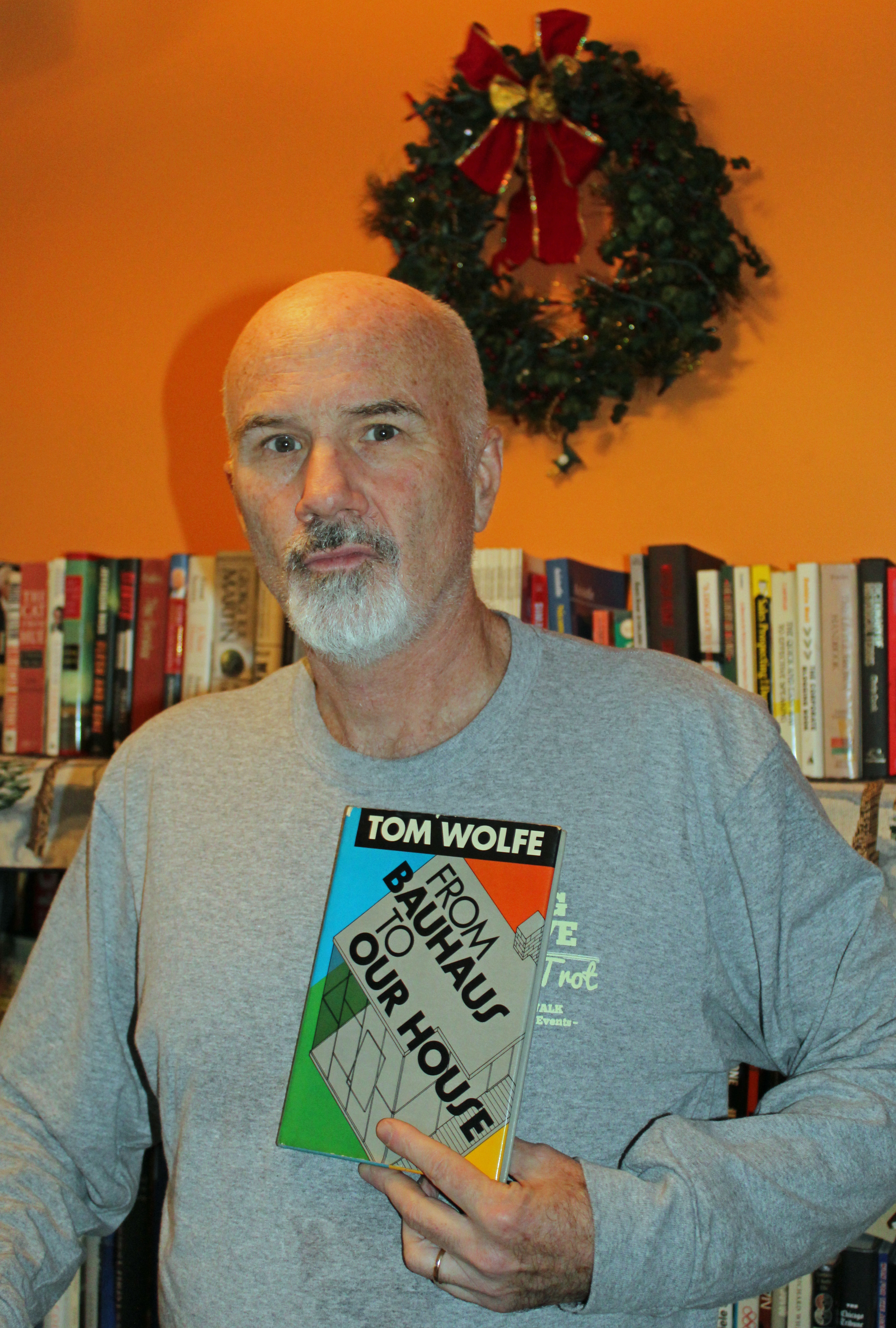
In Wolfe’s takedown of ugly glass-box and faceless architecture, From Bauhaus to Our House, he gives a rundown of the horrors of public housing, and joyously recalls the response when tin-eared bureaucrats in St. Louis–after decades of failing the residents of the city’s housing projects–finally did the unthinkable. They asked the tenants of the notorious Pruitt-Igoe homes, most of them Black, what they wanted done to the buildings. Their response? They chanted, “Blow it up.”

And the bureaucrats did just that. Why isn’t this poignant story in Radical Wolfe?

Wolfe was always coy about his political stance. “I belong to the party of the opposition,” he says in the documentary. But I suspect he was a slightly conservative, with a strong libertarian bent.

Despite the quibbles I mentioned, I loved Radical Wolfe. Oh, one more thing. To capture the Varoom!!! Varoom!!! uniqueness of Wolfe’s genius, a surreal mashup, along the lines of the one in The Life and Death of Peter Sellers, would have been a welcome addition.

Last year, Netflix sent a message to its workers that not all of its programming–not these words of course–will kowtow to wokeism. Radical Wolfe is a big step in the right direction for the streaming service. Next year Netflix will stream a six-episode limited series based on Wolfe’s A Man in Full. It will star Jeff Daniels and Diane Lane.

Keep it up, Netflix.

But I have one more quibble. Radical Wolfe is rated TV-MA for–wait for it–language and smoking.

Really? TV-MA?

Yep.

John Ruberry regularly blogs at Marathon Pundit.