
Posts Tagged ‘lockdown’

By John Ruberry

Last week, during a run on the North Branch Trail at Harms Woods in Skokie, Illinois, a speeding cyclist came close to running me over and causing enormous physical harm to me.

And that got me thinking.

Chicagoans voted for a handful when they elected Brandon Johnson as mayor. He’s a leftist whose candidacy was pretty much paid for by the Chicago Teachers Union. 

In July, his transition team released “A Blueprint for Creating a More Just and Vibrant City for All,” their gameplan for America’s third-largest city. In it you’ll find a recommendation that Chicago should “lower the default citywide speed limit to 20 mph generally and 10 mph on residential streets.” Currently, unless otherwise posted, the statewide urban default speed limit, when no signs are posted, is 30 miles per hour. 

That means for what you might call a through street, or an arterial street, such as Cicero Avenue or 111th Street, unless posted differently–and yes, possibly higher–the speed limit is 30-mph. Expressways have a 55-mph speed limits in Chicago.

Residential streets, or what Chicagoans have always called side streets, appear to also have a 30-mph speed limit too. Although, common sense–there are pockets of it here and there in the city–compels most drivers to motor along around 20-mph. The many stop signs on Chicago side streets, as well as the numerous but not-so-clearly marked speed bumps, which are tall enough to scrape the bottoms of most sedans and SUVs if you are driving too fast–are another form of discipline. And believe it or not, many drivers keep an eye out for pedestrians and cyclists. I do.

An aside: A Southwest Side man, fed up with an alley speed bump damaging his car, removed it. He was fined $500.

These proposed lower speed limits are another bad idea from Chicago, which seems destined to be passed in population soon by Houston. It’s another utopian parlor game idea brought to the mainstream. Most people, even those who don’t drive cars, probably agree with me. Our economy and our society are auto-centric and will remain so indefinitely. Disclosure: I work in the automotive industry. People like their cars. And if people don’t own one, often they wish they did.

In 2014, New York City recently lowered its default speed limit to 25-mph. Residents are fleeing New York too.

That’s not to say that bike riders have a legitimate beef about idiotic and reckless drivers. Many cyclists are severely injured and killed by cars. While running, I’ve been nearly hit by an automobile a few times. But bikers aren’t all angels either. More on that in a bit.

Now one thing conservatives and moderates don’t do, is yell and scream when liberals present fringe ideas. “That’ll never happen,” is a typical response they offer.

Abolishment of cash bail is one of those “loony” ideas that no one took seriously ten years ago. Well, liberals kept pushing, albeit slowly at first, but next week the SAFE-T Act takes effect in Illinois–it abolishes cash bail. The defund the police movement–and some municipal police departments, not in Illinois, did see cuts in funding. Defund the police was another left-wing parlor game dream concept. Thankfully there has been some pushback lately. The left’s war on popular home appliances, such as natural gas stoves, dishwashers, and even ceiling fans, has begun.

One can view the low default speed limit movement as a secondary front of government’s war on internal combustion engine automobiles. But Chicago drivers, few of whom drive EVs, also have to cope with seemingly omnipresent red-light cameras as well as speed cameras that spew out tickets to motorists for driving just 6-mph over the speed limit. A 20-mph arterial street speed limit offers a new revenue stream for Chicago, which, because of unfunded pension mandates, is functionally bankrupt.

Why aren’t more Chicagoans going full “Howard Beale?” He was the tormented antihero in the Network movie. You know, sticking your head out of the window of your home and screaming, “I’m mad as hell and I’m not gonna take it anymore!” Watch the clip in the link. And the Howard Beale reaction works much better in cities.

Oh, let me return to those bicycle riders. Presumably, the proposed default 20-mph speed limit in Chicago would also apply to them. Or would it? What I call the cyclist lobby possesses the imperiousness of the green movement and the aggressiveness of a testosterone rush after a brutal workout. 

Prior to the COVID-19 lockdowns in 2020, I saw many senior-citizen regulars on the North Branch Trail during my runs. But lockdown queen Lori Lightfoot, Johnson’s predecessor as mayor, closed Chicago’s Lakefront Bike Trail

Where did the cyclists go? 

Some brought their bikes, or rode them, to the North Branch Trail. Several cyclists nearly ran me over in 2020. My guess is that they were speeding along well over 30 mph. Did I say speeding? Harms Woods is part of the Forest Preserve District of Cook County, and the speed limit on paved and dirt trails is 15 miles per hour. I suspect there were many complaints about these Tour de France wannabes, because in 2021 I noticed newly posted 15 mph speed limit signs on these trails. A year or so later, all of those signs were gone. Likely there were more complaints, but not from the same people. And not only were those speed limit signs gone, but so were those elderly trail walkers. Those hiking regulars never returned.

Wait, there’s more! 

Many of these speeding trail cyclists ride three abreast on a very narrow trail. And it’s now a rarity when I hear a bell ring, horn honk, or an “on your left” shout out from cyclists passing me during a run. 

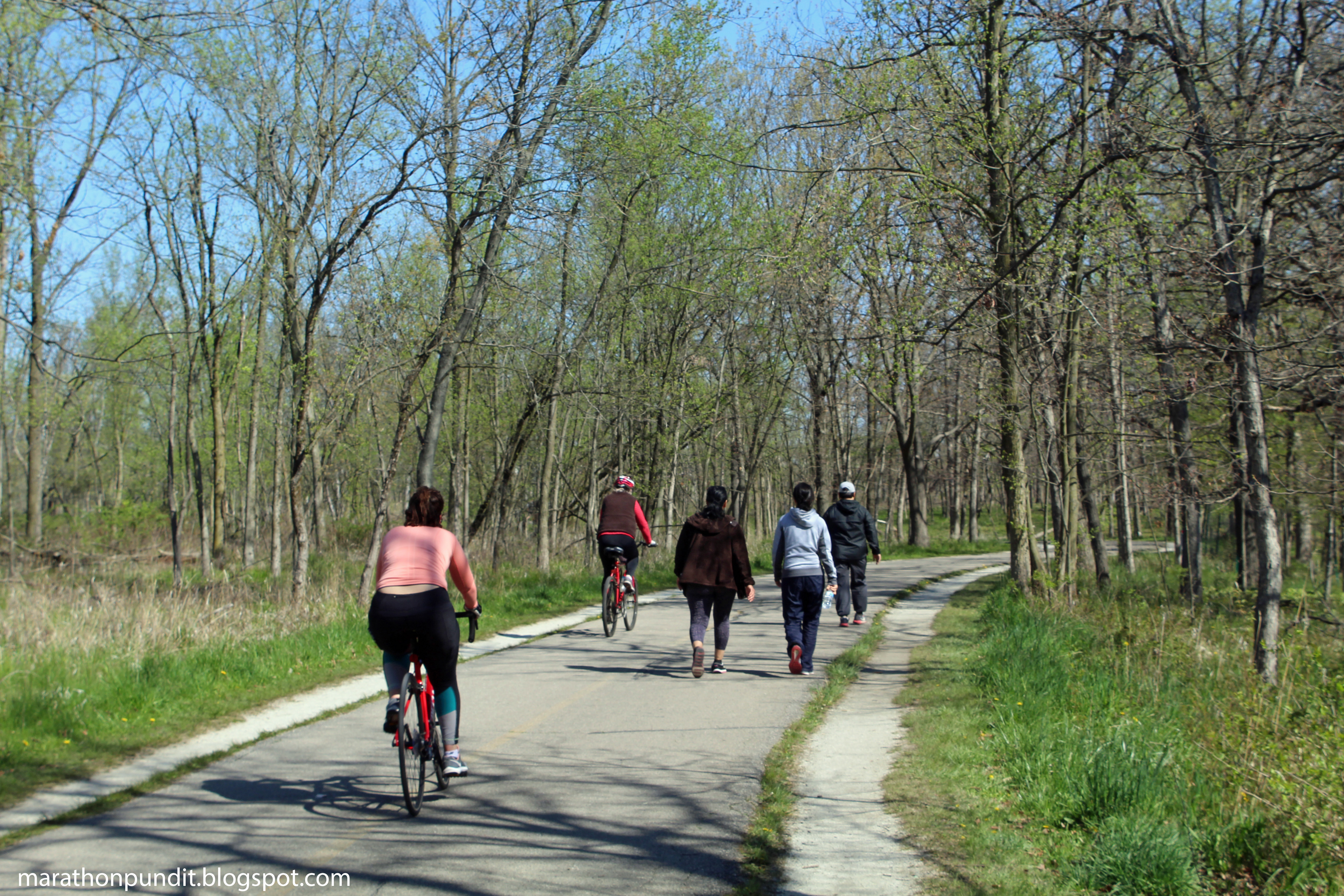
The photograph at the top of this post is of the North Branch Trail during the 2020 lockdown.

When I pass a walker or a runner on a path, I always say, “On your left.” My parents taught me manners.

Oh, until the running and cyclist paths were separated on Chicago’s Lakefront Trail, I experienced numerous close collision calls with cyclists while running there. Just as when there is a crash between cyclist and a car the “winner” of that collision is obvious, so it is when a bicyclist plows over a runner, particularly one like me, who is nearing retirement age. But don’t feel sorry for me. When it’s between me and a cyclist racing up an elevated bridge on the North Branch Trail over a busy street, I usually prevail.

Northeast of where I live is Sheridan Road, which bisects some of the wealthiest communities in America. Sometimes I see packs of bicyclists of more than a dozen, zooming in and out of traffic, seemingly oblivious to cars. 

While I don’t see those bike packs within Chicago’s city limits, with a 20-mph default speed limit, will emboldened cyclists misbehave recklessly in the same manner?

As for myself, I can take solace knowing that in three months the North Branch Trail will be nearly bike rider-free. Winter will be here, and the cyclists will retreat into hibernation. As they will in Chicago, whether there is a 20-mph speed limit or not.

While I see fewer runners on the trails on rainy days, particularly cold ones, I almost never see cyclists. 

Say what you will about automobiles, but they have roofs and windshield wipers, as well as heating and air conditioning.  Unless your car’s A/C is broken, unlike a cyclist commuting to work on a hot summer day, you won’t need to shower when you arrive at your jobsite to remove newly acquired body odor.

Oh, on occasion, I do ride a bicycle. And yes, I’m one of the good ones.

UPDATE September 12:

They’re not all gone! During this morning run, I saw a 15 mph “Share the Trail” sign in Harms Woods just north of Golf Road. I also saw many cyclists–and one jerk on a motorized bike–going much faster.

John Ruberry regularly blogs at Marathon Pundit.

By John Ruberry

Last Friday, Rock and Roll Hall of Fame inductee Van Morrison released his 44th studio album, the exuberant Moving on Skiffle

What is skiffle? Well, the first time I heard of it was in was in an unusual place–maybe not for an American–in the movie This Is Spinal Tap. Before joining the band that would become the heavy metal act Spinal Tap, David St. Hubbins (Michael McKean) was a member of a skiffle group.

Wonderful observation, you might be saying, but once again, what is skiffle? In the late 1920s, it developed as an offshoot of jug music, a genre of the American South and performed mainly by African Americans. The original skiffle was a bit country, a bit folk, and a bit delta blues. Then skiffle died once the Great Depression hit. 

Only it didn’t completely perish. 

Like a sprout from an errant wildflower seed, skiffle surprisingly blossomed again a couple of decades later in Great Britan. The UK’s biggest skiffle star was a Scotsman, Lonnie Donegan. Another skiffle performer, Chris Barber, a British aficionado of New Orleans style jazz, often recorded with Donegan

Growing up in 1950s Belfast, Morrsion was one of many UK youths listening to skiffle on the radio. Soon Morrison joined a skiffle band, but by the mid-1960s he was fronting Them, a blues-rock act best known for “Gloria,” before going solo in 1967. Well, you probably know the rest of his story.

Just as skiffle quickly reemerged in Britain, it all but vanished as a popular music phenomenon in the early 1960s. Only its disappearance wasn’t mysterious. The tsunami of the Beat Groups–known as the British Invasion in the United States–which included Them, was the culprit. 

The Belfast Cowboy maintained his love for skiffle thru the decades. Morrison recorded a live album with Donegan and Barber, The Skiffle Sessions – Live in Belfast 1998.

For Moving on Skiffle, Morrison issues a double album of additional classic skiffle songs–there are no repeats from the live collection.

Morrison, who turns 78 this summer, has been newsworthy of late because of his fervent opposition to COVID-19 lockdowns.

In 2021, Morrison released Latest Record Project, Volume 1, a double album. Many of the tracks, including “Stop Bitching, Do Something” and “Why Are You on Facebook?” pushed back on government and Big Tech power. Last year, on What’s It Gonna Take?Van the Man more directly challenged the lockdowns and creeping totalitarianism, in such tracks as “Dangerous,” which was in response to comments made by Northern Ireland’s health minister, Robin Swann, about Morrison’s anti-lockdown stance. Swann has since sued Van the Man, Morrison has counter-sued

On what will likely be remembered as his”COVID albums,” Morrison penned all of the tracks. Moving on Skiffle is a covers collection.

Morrison, who is not a doctor or a scientist, has been proven, in my firm opinion at least, to be correct that lockdowns would not be an effective defense against COVID-19. The harm of lockdowns, such as an overall increase in mental illness and declining school test scores, is apparent.

Yes, COVID, along with pre-exisiting conditions, killed millions, despite lockdowns, masking, and vaccine mandates. But Florida, which didn’t pursue an aggressive lockdown and masking policy, didn’t see a higher COVID death rate compared to lockdown states like New York.

Moving back to Moving on Skiffle, this sparkling collection stays away from politics, except for the strongest track on the collection, “Gov Don’t Allow,” a reworking of the 1920s folk standard “Momma Don’t Allow,” with new lyrics authored by Morrison.

“Gov don’t allow any freedom of speech in here,” he sings, “but I think it’s going overreach–gov don’t allow any freedom of speech in here.”

Now that I have politics out of the way, let’s discuss the rest of Moving on Skiffle.

Other highlights of this ninety-minute collection include another musical reworking, “This Little Light of Mine” becomes “This Loving Light of Mine,” where Morrison adds “Amen” verses. “Gypsy Davy” has a Celtic feel, and there are two Hank Williams songs, “Cold Cold Heart” and “I’m So Lonely I Could Cry.” 

Overall, the collection has a Creedence Clearwater Revival flavor, partly because of the inclusion of Lead Belly’s “Cotton Fields,” which CCR covered on Willy and the Poor Boys. Their hit from that album, “Down on the Corner” has a classic has a jug band feel. 

If you are a Van and Man enthusiast from way back, you’ll adore the final cut on Moving on Skiffle, “Green Rocky Road,” a nine-minute-long track that echoes Morrison stream-of-consciousness gems such as “And The Healing Has Begun” and “Listen to the Lion.”

Skiffle has many definitions. So if you’d prefer you can define Morrison’s latest work possibly as an Americana collection, albeit one with gospel music overtones. 

Oh, I nearly forgot. As with all Van Morrison albums, the singing here, including the work of the backup vocalists, as well as the musicianship–down to the washboard–are spectacular. 

Moving on Skiffle can be downloaded from iTunes or purchased at Van Morrison.com.

Related post:

As Van Morrison turns 77, here are his ten best albums

John Ruberry regularly blogs at Marathon Pundit.

Lori Lightfoot

 By John Ruberry

A poll with surprising findings was released on Thursday by Fox Chicago about Chicago’s mayoral election on Friday. Yeah, yeah, I know, many political polls about the recently concluded congressional elections were wrong, and there were serious polling errors in 2016 and 2018 as well. But stick with me here.

The mayoral poll, conducted by M3 Strategies, shows that US Rep. Jesus “Chuy” Garcia is favored by 28 percent of respondents, followed by former Chicago Public Schools CEO Paul Vallas at 19 percent, incumbent Lori Lightfoot at 15 percent, and Willie Wilson, a businessman and philanthropist, at 13 percent. 

There are eleven candidates for mayor of America’s third-largest–for now–city, although petition challenges might winnow the field. The first round of voting, along with races for alderpersons in each of Chicago’s 50 wards, as well as for city clerk and treasurer, will be held on February 28, if no candidates achieve a majority in their races, the top two candidates are matched in an April runoff. 

So, if the poll is correct, that means that Lori Lightfoot, who in my opinion is America’s worst big city mayor, she won’t make it to the second round. Lightfoot’s term in mayor has been disastrous on many levels–too many to list here.

On the latest episode Fox Chicago Flannery Fired Up show, host Mike Flannery said about crime, “nearly three-fourths of Chicago voters now say is their number one issue.” Lightfoot, as a candidate said that the crime levels of 2019 were “unacceptable.” Flannery then fact checked Lightfoot’s recent statement that “we are down 15 percent in homicides, 20 percent in shootings.” But those are numbers looking back to last year. Flannery did the right thing, scolding Lightfoot.

“When she took office in 2019,” Flannery said, “she inherited a dramatically declining rate of bloody street violence, but the medical examiner reports that homicides this year are 41 percent higher than in 2019.”

It’s easy to understand why Lightfoot is polling so terribly. M3 Strategy’s Matt Podgorski was a guest on that Flannery Fired Up installment, of the incumbent he said, “You’re looking at a situation where [there is] a negative view of 74 percent of likely voters and about 70 percent of them think she does not deserve another term. Only two percent of Chicago voters haven’t formed an opinion of Mayor Lightfoot.”

“Those are unprecedently bad numbers,” Podgorski concluded.

I can’t see a way out for Lightfoot. Apparently, Chicago voters, up to a point, aren’t completely stupid. 

Besides her inability to stem Chicago’s rise in violence–which her apologists point out is part of a national increase in mayhem while failing to mention that Los Angeles and New York, which are more populous, have lower murder totals–Lightfoot’s petulant and overbearing COVID-19 lockdown policy produced a tragic irony. After she spotted a large group of males congregating on a beach, the next day she ordered Chicago police officers to enforce the closure of that beach. Later that day, cops did next to nothing as rioters tore up and looted Chicago’s North Michigan Avenue shopping district. 

Lightfoot has acted bizarrely, once allegedly told an Italian-American group who supports the return of Chicago’s Christopher Columbus statues to public view, “I have the biggest d*ck in Chicago.” She once went full-Jack Nicholson in The Shining in a repetitive email rant. 

Chicago voters, as I alluded earlier, still have much room for improvement. Chuy Garcia, then a Cook County commissioner, surprisingly forced incumbent Rahm Emanuel into a runoff in the 2015 mayoral race, running to the left of Emanuel. In 2016 Garcia endorsed Bernie Sanders for president. Last year the leftist magazine In These Times, in a collaboration with the Chicago Reader, gushingly wrote of Garcia’s working with the Squad in Washington, “It’s not surprising that García has taken up with Congress’ left rebels.” 

Garcia enjoys a sizeable lead in the Fox Chicago poll. Garcia collected $2,900 from indicted FTX CEO Sam Bankman-Fried. Worse, the Protect our Futures PAC spent over $150,000 on glossy mailers to introduce Garcia to new voters in his redrawn congressional district, even though Chuy was running unopposed in the November election.

Buying something, SBF?

What about the other two top contenders to replace Lightfoot? Willie Wilson, a gadfly candidate who somehow has convinced some Chicago conservatives he is one of them, can arguably–because of his regular grocery and gasoline giveaways--be called a vote buyer. Paul Vallas, another perennial candidate, is the only mayoral candidate talking real sense about crime. Unless I missed something, he’s the only mayoral candidate who is explicitly critical of Cook County’s catch-and-release prosecutor, Kim Foxx. 

Whoever is Chicago’s next mayor, the, ahem, winner faces a monumental series of challenges. Besides crime, the mayor will have to cope with a declining tax base, as businesses are fleeing. And Chicago’s pension bomb looms–eventually it will explode. Chicago is the most corrupt city in America. And what about the lead in Chicago’s water pipes?

John Ruberry regularly blogs at Marathon Pundit.

By John Ruberry

A few months ago Van Morrison released his 43rd studio album, What’s It Gonna Take? It’s a stupendous work, and most of its songs focus on the COVID-19 lockdown. Van the Man gives well-deserved musical punch in the nose to lockdown zealots Mark Zuckerberg, Bill Gates, and Klaus Schwab. 

This week, on August 31, Van Morrison turns 77. He’s still touring, in fact, he begins a short American tour the day after his birthday, which includes, hello Peter, two gigs in Massachusetts.

In 2020 was a rare year for Morrison as he didn’t release a studio album, but he did issue three anti-lockdown songs, “Born to Be Free,” “As I Walked Out” and “No More Lockdowns.” Eric Clapton, another foe of lockdowns, recorded a Morrison-penned anti-lockdown song, “Stand And Deliver.” Morrison has been the most prominent artist who has stood up to opposition to the 2020-2021 shutdown of musical venues.

Of course Morrison is rich, but most musicians aren’t. Many are just getting by.

My DTG review of “What’s It Gonna Take?” is here. And yes, sometimes I am wrong. I predicted the mainstream media, as it did with the collection’s predecessor, the double album Latest Record Project: Volume 1, would savage it. On the contrary, because the hostile reviews of that collection probably helped sales–it charted well, the media took a different approach this time. By mostly ignoring What’s It Gonna Take? But not entirely. Morrison has “descended into lunacy,” is what one reviewer, Arthur Lazarus, a psychiatry professor, said of the album in his review. I was under the impression that mental health professionals now avoid words like “lunacy.” Who is the “crazy” one here, Lazarus? On a positive note, National Review gave a favorable notice to What’s It Gonna Take?

To a small extent, Van Morrison, a member of the Rock and Roll Hall of Fame, has become a non-person. Oh, he appears in Google News searches, as the media dutifully covers his concert appearances. I follow Morrison on Twitter. And like myself, likely because he shares views that run counter to those of the Twitter leftists, in his case about COVID, he’s almost certainly been shadowbanned. I never see the Belfast Lion’s Tweets on my feed, although he has been quiet there lately. Remember, this is a person whose first hit, “Brown Eyed Girl,” is one of the most-played songs on radio–ever.

I’ve been a Van Morrison fan for decades, so I decided to listen to every studio album of his, remember, there are 43 of them–in succession–about a week after I posted my Da Tech Guy writeup on What’s It Gonna Take? It was a wondrous musical adventure that took me through many musical genres, mainly, especially in the second half of his career, Chicago blues, but also of course rock, as well as jazz, country, Celtic, swing, as well as Van the Man’s stream-of-consciousness works, best exemplified on his Astral Works landmark album.

Morrison is a multi-instrumentalist, playing guitar, harmonica, keyboards, and saxophone. But outside of the craftmanship of the songs he writes, he’s best know for his vocals. Morrison’s singing style is a combination of Hank Williams, Muddy Waters, James Brown, and here’s an obscure name for you, Louis Prima. Oh, on a side note, Prima was one of my mother’s favorites. And about that voice, it’s most distinctive quality is “the growl,” which I believe is inspired by bluesmen like Waters. 

Morrison has influenced many artists, including Bob Seger, Graham Parker, Elvis Costello, and Bruce Springsteen. Of the latter two, on their debut albums the feel of Van is quite apparent.

During my Morrison musical sojourn, during which I ironically contracted COVID-19–I am fully recovered–I decided to write a blog post where I list, well, in my opinion at least, his ten best albums. It’s time for me to be Casey Kasem–so let the countdown begin!

Oh, but first, links in the album’s titles bring you Morrison’s website, where you can purchase or download each collection, and also find the Wikipedia article on each of them. 

10: Hymns To The Silence (1991). Morrison’s first double album is a tad long, but it contains one of his best ballads, “Carrying A Torch.” You’ll find an even better rendition of that song on Morrison’s duet album, where Clare Teal accompanies him. Van the Man on this record takes a song that has been covered countless times, Ray Charles’ hit “I Can’t Stop Loving You,” but he gives it a fresh take by having traditional Irish musicians the Chieftains accompany him. There’s also an intriguing spoken word piece too, “On Hyndford Street.”

9: No Guru, No Method, No Teacher (1986). Morrison’s 1980s efforts were mostly jazz and Celtic-influenced songs, many of them expressing a love of nature, with some stream-of consciousness songs throw in. The best of these is No Guru, No Method, No Teacher. Its highlights include “In The Garden,” “Tir Na Nog,” and an homage to his 1970s pop hits, “Ivory Tower.” It was around this time I saw Morrison in concert–so far the only time I have done so. I was under the impression, based on his ’80s works, that the Belfast Lion had lost the roar of his growl. Wrong. He growled a lot that night and it returned to his later studio albums.

8: Three Chords & the Truth (2019). The title alone makes this effort at least an honorable mention. “Angry Van” of the 2020s didn’t emerge once the COVID lockdowns kicked in. In “Nobody In Charge” Morrison decries, “politicians that waffle endlessly.” A haunting love sing, “Dark Night Of The Soul,” is another highlight. And Van offers a gorgeous re-working of “Auld Lang Syne” on “Days Gone By.”

7: What’s It Gonna Take? (2022). I’ve discussed this work already in this blog post–but to flesh out my love for this album, it’s as fresh as breathing in, mask-free, mountain air in spring. While anti-COVID lockdown songs dominate the collection, including “Dangerous,” which Morrison’s response to comments about him made by Northern Ireland’s health minister, Robin Swann, as well as “Fighting Back Is The New Normal” and “Fodder For The Masses,” the collection ends with another great love ballad, “Pretending.”

6: Veedon Fleece (1974). Stream-of consciousness Van is at the forefront here. Like gourmet cuisine, you may not appreciate Veedon Fleece at first bite, but it’s a hearty musical meal. “Bulbs,” “Linden Arden Stole The Highlights,” and “Streets Of Arklow” are among the great tracks.

5: Saint Dominic’s Preview (1972). Released 50 summers ago, this album contains two of Morrison’s best-known songs, the title track and “Jackie Wilson Said (I’m In Heaven When You Smile).” Van the Man’s greatest “stream” work, “Listen To The Lion,” is an 11-minute long masterpiece.

4: Magic Time (2005). This is the best Van Morrison album you’ve never heard of. There is quite a bit of swing music influence on Magic Time. While Van the Man, as we discussed early, re-worked “Auld Lang Syne” in 2019, he gifts us a New Year’s Eve alternative here with “Celtic New Year.” There’s another preview of “Angry Van” on “Keep Mediocrity At Bay.” Magic Time opens with another great ballad, “Stranded.” And there is a luscious sequel to “Listen To the Lion” in “The Lion This Time.”

3: Into The Music (1979). The Belfast Cowboy–Morrison has a lot of nicknames–ended the 1970s with a bang. It opens with two now-familiar songs, “Bright Side Of The Road” and “Full Force Gale.” There is rock, blues, gospel, and more here. And if Morrison’s “growl” is what you enjoy about him the most, then Into The Music is your album.

2: Moondance (1970). Like many all-time-best albums, Moondance comes across as a greatest hits album. The title track, “Caravan,” “Crazy Love,” and “Into The Mystic” are just four of the great tracks here. And while “Brown Eyed Girl” from Morrison’s first album is one of the most played songs on radio, “Into The Mystic” is a popular song at funerals. And “Crazy Love” is played at many wedding receptions.

1: Astral Weeks (1968). Arguably his first album, as his debut collection, Blowin’ Your Mind, was released without his input, Morrison, with jazz musicians backing him up, recorded a collection that sounded like nothing else up to that point. Is Astral Weeks a rock album? Jazz? Folk? Blues? The answer is none of the above. It’s simply Van Morrison. “The Way Young Lovers Do” foreshadows his 1970s hits, but like Veedon Fleece, stream-of-consciousness dominates here. “Cyprus Avenue” and “Ballerina” are majestic songs. “Madame George” is an enigmatic work, which is one of its enduring qualities.

So, if you are now inclined to explore Van Morrison, you might be wondering “Where do I start?” As I’ve said before, I deplore the term “classic rock,” but if that is your “jones,” then start with Moondance. If your first love is vintage country, then take a look at Pay The Devil. Blues? Get an album that just missed my top ten, Too Long In Exile, where John Lee Hooker teams up Morrison to revisit his “Gloria” hit that he recorded with his band Them in 1964. Are you a punk rocker? Then dig into Morrison’s recordings with Them. If your a jazz aficionado, I recommend Versatile to you. How ’bout Celtic music? Morrison collaborated with The Chieftains on Irish Heartbeat.

Now that I’ve listened to all 43 of Van Morrison’s studio albums I have a plan for what’s next: the Belfast Cowboy’s live albums.

John Ruberry regularly blogs at Marathon Pundit.