

Posts Tagged ‘lori lightfoot’

By John Ruberry

Last Thursday, Chicago’s new mayor, Brandon Johnson, the candidate of the far-left Chicago Teachers Union, held a press conference. It was one of those dog-and-pony shows, also in attendance was the city’s police superintendant, Larry Snelling a Johnson appointee, and other municipal officials.

Armed with brochures, Johnson unveiled the “People’s Plan for Community Safety.” Who are the people that devised the plan? Presumably that group doesn’t include cops and crime victims, and it almost certainly doesn’t include the South Side family who had two cars stolen in separate incidents last month. One theft was a carjacking that was captured in a horrifying video

Crime was the main campaign issue in this spring’s runoff election for mayor. Paul Vallas, a moderate Democrat, promised to beef up law enforcement. It was the center piece of his lackluster campaign. Johnson, appealing to his African American and leftist whites, vowed to attack crime at the root causes–just like the outgoing mayor, Lori Lightfoot.

Crime soared under Lightfoot. And now that she is gone, it’s still high. While Chicago’s murder rate is a little bit lower, post-pandemic, it’s still higher than it was in 2019. There are more robberies and auto thefts than a year ago, and many more compared to pre-pandemic levels.

Predictably, Johnson and the other city officials at the presser focused on the “root causes” of Chicago crime.

From the event’s press release:

There is a shattered sense of safety in Chicago that has been driven by decades of purposeful disinvestment in our communities. It is time for a new community safety approach – one that addresses the root of the problem by investing in our people and neighborhoods to secure a safer Chicago for generations to come. The People’s Plan for Community Safety calls upon our entire city, and especially those most impacted by violence, to create solutions together.

Lightfoot’s failures as mayor went beyond law enforcement. But Chicago tried the healie-feelie approach to crime under Lightfoot. It didn’t work.

Chicagoans voted to double-down on dopey.

Commenting the next day on the Morning Answer with Dan and Amy, co-host Dan Proft threw a penalty flag at Johnson’s root causes crimefighting strategy. Reminding listeners that Johnson is half of a two-parent household, Proft said Johnson is focusing on the wrong root causes. 

Indeed.

A few days earlier in the Wall Street Journal, Proft noted, Jason L. Riley pointed his finger at the true root cause of rising crime rates, the proliferation of fatherless households since 1960. Referring to what is known as “the success sequence,” Riley wrote: 

A decade ago, New York City launched a campaign to combat teen pregnancy. It featured ads on buses and subway cars that read: “If you finish high school, get a job, and get married before having children, you have a 98% chance of not being in poverty.”

He continued: 

We could use more of that moralizing from public officials, whether the issue is solo parenting, substance abuse or crime. The success sequence works to keep people not only off the dole but also out of trouble with the law. High-school graduates and children raised by both parents are much less likely to end up in jail. “Virtually every major social pathology,” political scientist Stephen Baskerville writes, “has been linked to fatherless children: violent crime, drug and alcohol abuse, truancy, unwed pregnancy, suicide, and psychological disorders—all correlating more strongly with fatherlessness than with any other single factor, surpassing even race and poverty.”

Chicago, and most American large cities, as well as many suburbs and rural communities, have been on a failure sequence for decades.

I’m not claiming to have the answers to turning around the failure sequence, ignoring the problem, along the lines of placing electric tape over the check engine light on your car when it flashes, of course means more failure. And yes, there are single moms who do a stupendous job raising kids.

One time-tested way out of poverty is quality education. Utilizing education to achieve success worked for that Founding Father without a father, Alexander Hamilton.

But Johnson, a former Chicago Public Schools teacher who was a longtime paid organizer for the Chicago Teachers Union, even while serving as a Cook County commissioner, remains overly loyal to the CTU.

Also last week, the Chicago Board of Education, which includes six Johnson appointees, approved a resolution, in the name of equity of course, that has long been on the CTU’s anti-education wish list, removing the ability of students to attend high schools–better high schools–outside of their neighborhoods. Most of the students who benefit from the doomed program are minorities. Of low-income 11th-grade CPS students, less than 20 percent of them score at grade level in reading and math.

In another attack on students, the state’s private school tuition tax credit program, the Invest in Kids Act, which was signed into law six years ago by a Republican governor, will be allowed to expire next year.

Chicago–and Illinois–are focusing on the wrong root causes.
John Ruberry regularly blogs at Marathon Pundit.
By John Ruberry

Last week, during a run on the North Branch Trail at Harms Woods in Skokie, Illinois, a speeding cyclist came close to running me over and causing enormous physical harm to me.

And that got me thinking.

Chicagoans voted for a handful when they elected Brandon Johnson as mayor. He’s a leftist whose candidacy was pretty much paid for by the Chicago Teachers Union. 

In July, his transition team released “A Blueprint for Creating a More Just and Vibrant City for All,” their gameplan for America’s third-largest city. In it you’ll find a recommendation that Chicago should “lower the default citywide speed limit to 20 mph generally and 10 mph on residential streets.” Currently, unless otherwise posted, the statewide urban default speed limit, when no signs are posted, is 30 miles per hour. 

That means for what you might call a through street, or an arterial street, such as Cicero Avenue or 111th Street, unless posted differently–and yes, possibly higher–the speed limit is 30-mph. Expressways have a 55-mph speed limits in Chicago.

Residential streets, or what Chicagoans have always called side streets, appear to also have a 30-mph speed limit too. Although, common sense–there are pockets of it here and there in the city–compels most drivers to motor along around 20-mph. The many stop signs on Chicago side streets, as well as the numerous but not-so-clearly marked speed bumps, which are tall enough to scrape the bottoms of most sedans and SUVs if you are driving too fast–are another form of discipline. And believe it or not, many drivers keep an eye out for pedestrians and cyclists. I do.

An aside: A Southwest Side man, fed up with an alley speed bump damaging his car, removed it. He was fined $500.

These proposed lower speed limits are another bad idea from Chicago, which seems destined to be passed in population soon by Houston. It’s another utopian parlor game idea brought to the mainstream. Most people, even those who don’t drive cars, probably agree with me. Our economy and our society are auto-centric and will remain so indefinitely. Disclosure: I work in the automotive industry. People like their cars. And if people don’t own one, often they wish they did.

In 2014, New York City recently lowered its default speed limit to 25-mph. Residents are fleeing New York too.

That’s not to say that bike riders have a legitimate beef about idiotic and reckless drivers. Many cyclists are severely injured and killed by cars. While running, I’ve been nearly hit by an automobile a few times. But bikers aren’t all angels either. More on that in a bit.

Now one thing conservatives and moderates don’t do, is yell and scream when liberals present fringe ideas. “That’ll never happen,” is a typical response they offer.

Abolishment of cash bail is one of those “loony” ideas that no one took seriously ten years ago. Well, liberals kept pushing, albeit slowly at first, but next week the SAFE-T Act takes effect in Illinois–it abolishes cash bail. The defund the police movement–and some municipal police departments, not in Illinois, did see cuts in funding. Defund the police was another left-wing parlor game dream concept. Thankfully there has been some pushback lately. The left’s war on popular home appliances, such as natural gas stoves, dishwashers, and even ceiling fans, has begun.

One can view the low default speed limit movement as a secondary front of government’s war on internal combustion engine automobiles. But Chicago drivers, few of whom drive EVs, also have to cope with seemingly omnipresent red-light cameras as well as speed cameras that spew out tickets to motorists for driving just 6-mph over the speed limit. A 20-mph arterial street speed limit offers a new revenue stream for Chicago, which, because of unfunded pension mandates, is functionally bankrupt.

Why aren’t more Chicagoans going full “Howard Beale?” He was the tormented antihero in the Network movie. You know, sticking your head out of the window of your home and screaming, “I’m mad as hell and I’m not gonna take it anymore!” Watch the clip in the link. And the Howard Beale reaction works much better in cities.

Oh, let me return to those bicycle riders. Presumably, the proposed default 20-mph speed limit in Chicago would also apply to them. Or would it? What I call the cyclist lobby possesses the imperiousness of the green movement and the aggressiveness of a testosterone rush after a brutal workout. 

Prior to the COVID-19 lockdowns in 2020, I saw many senior-citizen regulars on the North Branch Trail during my runs. But lockdown queen Lori Lightfoot, Johnson’s predecessor as mayor, closed Chicago’s Lakefront Bike Trail

Where did the cyclists go? 

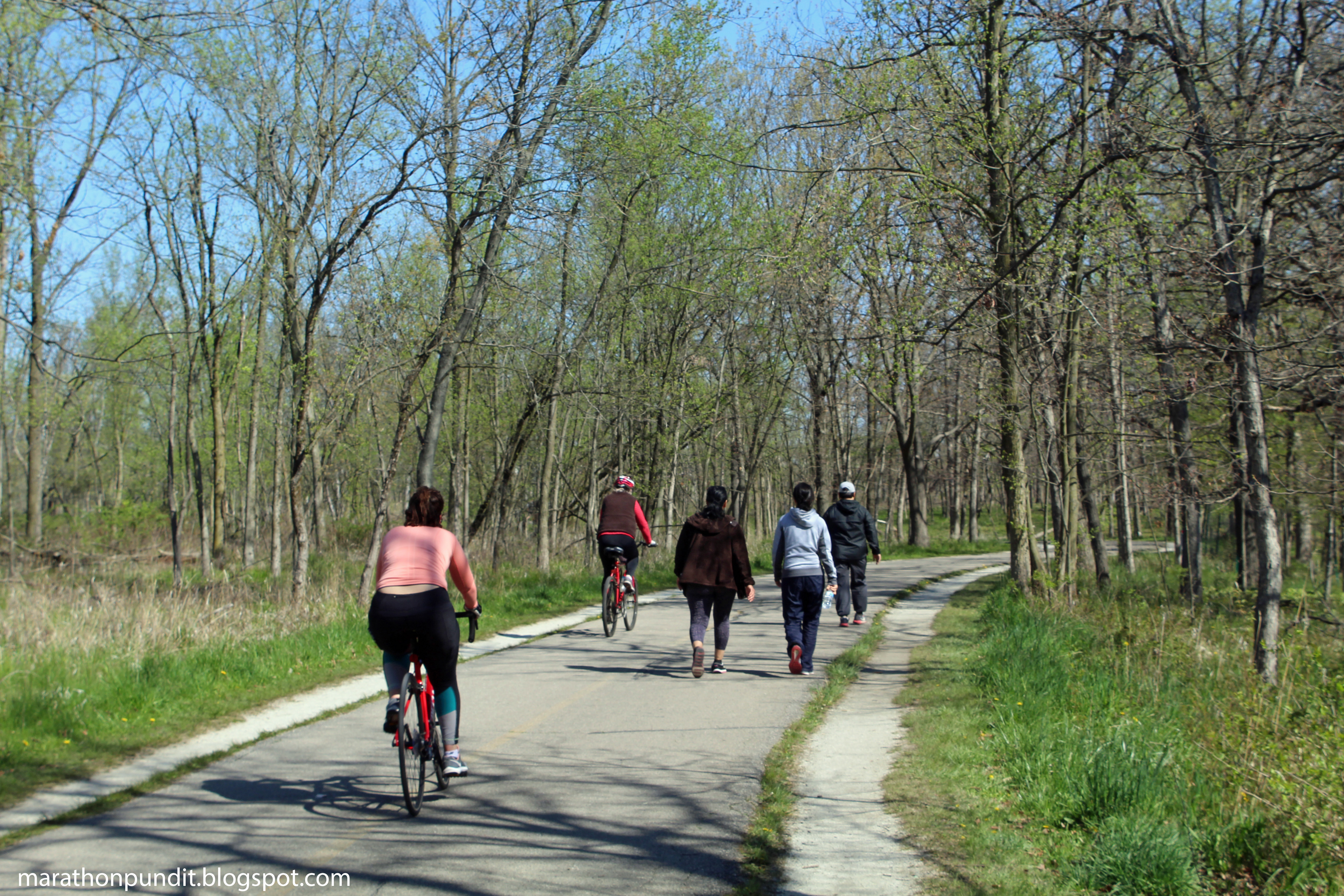
Some brought their bikes, or rode them, to the North Branch Trail. Several cyclists nearly ran me over in 2020. My guess is that they were speeding along well over 30 mph. Did I say speeding? Harms Woods is part of the Forest Preserve District of Cook County, and the speed limit on paved and dirt trails is 15 miles per hour. I suspect there were many complaints about these Tour de France wannabes, because in 2021 I noticed newly posted 15 mph speed limit signs on these trails. A year or so later, all of those signs were gone. Likely there were more complaints, but not from the same people. And not only were those speed limit signs gone, but so were those elderly trail walkers. Those hiking regulars never returned.

Wait, there’s more! 

Many of these speeding trail cyclists ride three abreast on a very narrow trail. And it’s now a rarity when I hear a bell ring, horn honk, or an “on your left” shout out from cyclists passing me during a run. 

The photograph at the top of this post is of the North Branch Trail during the 2020 lockdown.

When I pass a walker or a runner on a path, I always say, “On your left.” My parents taught me manners.

Oh, until the running and cyclist paths were separated on Chicago’s Lakefront Trail, I experienced numerous close collision calls with cyclists while running there. Just as when there is a crash between cyclist and a car the “winner” of that collision is obvious, so it is when a bicyclist plows over a runner, particularly one like me, who is nearing retirement age. But don’t feel sorry for me. When it’s between me and a cyclist racing up an elevated bridge on the North Branch Trail over a busy street, I usually prevail.

Northeast of where I live is Sheridan Road, which bisects some of the wealthiest communities in America. Sometimes I see packs of bicyclists of more than a dozen, zooming in and out of traffic, seemingly oblivious to cars. 

While I don’t see those bike packs within Chicago’s city limits, with a 20-mph default speed limit, will emboldened cyclists misbehave recklessly in the same manner?

As for myself, I can take solace knowing that in three months the North Branch Trail will be nearly bike rider-free. Winter will be here, and the cyclists will retreat into hibernation. As they will in Chicago, whether there is a 20-mph speed limit or not.

While I see fewer runners on the trails on rainy days, particularly cold ones, I almost never see cyclists. 

Say what you will about automobiles, but they have roofs and windshield wipers, as well as heating and air conditioning.  Unless your car’s A/C is broken, unlike a cyclist commuting to work on a hot summer day, you won’t need to shower when you arrive at your jobsite to remove newly acquired body odor.

Oh, on occasion, I do ride a bicycle. And yes, I’m one of the good ones.

UPDATE September 12:

They’re not all gone! During this morning run, I saw a 15 mph “Share the Trail” sign in Harms Woods just north of Golf Road. I also saw many cyclists–and one jerk on a motorized bike–going much faster.

John Ruberry regularly blogs at Marathon Pundit.

By John Ruberry

For all of you cynics who says there is no real choice in most elections, next month’s runoff race for Chicago mayoral election proves you wrong. 

The unpopular and incompetent incumbent, Lori Lightfoot, finished third in last week’s first round of voting, collecting an anemic 17 percent of the vote in a nine-candidate field. Former Chicago Public Schools CEO Paul Vallas took first place with 33 percent of the vote and Cook County commissioner and Chicago Teachers Union organizer Brandon Johnson in second with 21 percent of the tally.

Chicago’s municipal elections are non-partisan, but the remaining candidates are Democrats.

Vallas has been largely successful in other education jobs, including posts in Philadelphia, New Orleans, and Bridgeport, Connecticut–but he has butted heads repeatedly with teachers’ unions, most notably the far-left Chicago Teachers Union, which has strongly backed Johnson’s candidacy. And that’s not all. Johnson, who earns over $100,000-a-year as a Cook County commissioner, also has collected nearly $400,000 as a legislative coordinator for the CTU over the past five years.

So not only is Johnson in the pocket of the Chicago Teachers Union, the CTU is in Johnson’s pocket. 

As of this writing, Johnson has not said if he will quit his CTU post and stop cashing that paycheck. 

According to the Illinois Policy Institute, over the first two months of 2023, Johnson’s campaign was the recipient of over $4 million in contributions. Over half of that came from the Chicago Teachers Union and its affiliated unions. Of the rest, most of that cash was contributed by other unions, while just five percent of his campaign funds came from other sources.

Watch out, taxpayers. 

Johnson favors, as does the CTU, an array of anti-business and anti-consumer taxes and fees, including the hated employee head tax that Mayor Rahm Emanuel eliminated in 2014, although Johnson only wants large companies to pay for a new head tax.

The 2020 riots devastated Chicago’s main shopping and tourism district, North Michigan Avenue. Johnson supports “new user fees for high-end commercial districts frequented by the wealthy, suburbanites, tourists and business travelers.” Such fees will finish off North Michigan Avenue and similar areas. I used to work in the hospitality industry, and Chicago’s hotel taxes, the highest in the nation, were frequently used by officials in other cities to lure conventions away–Johnson wants to hike those hotel taxes by 66 percent. The COVID-19 has devastated ridership on Metra, the Chicago metropolitan area’s public train system, Johnson wants to institute a suburban commuter tax for Metra riders.

Johnson also backs a real estate transfer tax on high-end homes, a financial transaction tax, and maybe, a 3.5 percent municipal income tax on wealthy Chicagoans. In regard to the city income tax, which the Chicago Teachers Union supports, he said that it was a mistake by another far-left group, presumably United Working Families, to wrongly says he backs it.

Fine, that very well may be true. But late last month, on his Fox Chicago Flannery Fired Up show, host Mike Flannery asked Johnson five times if he backs a city income tax. Johnson deflected–he refused to answer “Yes” or “No.”

Detroit, Baltimore, Cleveland, and St. Louis are among the failed cities with a municipal income tax.

Most Chicagoans believe that crime is the biggest issue in the city. Where does Johnson stand on crime and the police?

“I don’t look at it as a slogan,” Johnson said of the defund the police movement in 2020, “it’s an actual real political goal.”

Since then, Johnson has waffled, he says many 911 calls are over domestic disturbances. Quite true. But the day after Election Day, a Chicago Police officer, Andre Vasquez-Lasso, was murdered by an 18-year-old gang member. Vasquez-Lasso was responding to a domestic disturbance call.

Last week, when former Chicago Police superintendant Garry McCarthy was asked by Amy Jacobson on WIND’s Morning Answer about Johnson’s support for sending social workers to respond to such domestic altercation calls, he replied, “We’re gonna end up with some dead social workers.”

And if Chicago elects Brandon Johnson mayor next month–remember, Vallas only received only one-third of the vote last week—get ready for an emptying city. The Detroit-doom scenario for Chicago is not far-fetched.

I’ll end with an apocryphal story about an Illinois governor, Adlai Stevenson, who twice was the Democratic nominee for president.

“Every thinking person in America will be voting for you,” someone remarked to Stevenson. The governor replied, “I’m afraid that won’t do—I need a majority.”

Let’s not go Brandon.

John Ruberry regularly blogs five miles north of Chicago at Marathon Pundit.

By John Ruberry

Okay, Republicans, you have an easy lay-up shot at the basket. But of course, sure things, such as Red Wave midterm blowouts, can end up as air balls. 

America’s worst big city mayor, Chicago’s Lori Lightfoot, is running for reelection. She has eight opponents, a couple of whom, such as Ja’Mal Green and the Chicago Teachers Union-endorsed Brandon Johnson, are extreme leftists who provide answers to the question, “Can Chicago have a worse mayor than Lori Lightfoot?

Chicago’s elections are non-partisan. In the likely scenario that no candidate achieves 50 percent of the vote in the first round of voting, which is February 28, the top two candidates face off in an April 4 runoff. As with the congressional midterms, polling has been all over the place in the mayoral race, but the top four candidates in terms of popularity appear to be Lightfoot, former Chicago Public Schools CEO Paul Vallas, businessman and vote-buyer Willie Wilson, and US Rep. Jesus “Chuy” Garcia. 

The Chicago mayoral race is the first major election, unless you count December’s Georgia Senate runoff race, since the collapse of cryptocurrency firm FTX.

By most accounts Garcia, who endorsed Bernie Sanders over Hillary Clinton in the 2016 presidential campaign, was the early frontrunner in the contest. But then Lightfoot went on the attack. 

You see, Garcia’s congressional campaign fund accepted $2,900 from former FTX CEO Sam Bankman-Fried, who was indicted last year for charges surrounding the collapse of the crypto currency firm. Worse, SBF’s PAC, Protect our Futures, spent over $150,000 on glossy mailers sent to Chuy’s remapped and gerrymandered 4th congressional district to introduce him to new voters for the 2022 Democratic primary. Only Garcia was running unopposed in that race. Chuy is a member of the House Financial Services Committee, which oversees cryptocurrency. The $2,900 Bankman-Fried contribution to Garcia has since been donated to charity.

And Lighfoot’s attack appears to be a solid blow against Garcia in a TV spot where she connects Garcia not only to SBF, but also to former Illinois Democratic Party chairman and state House speaker, Boss Michael Madigan, who was indicted last year, as well as Chicago’s deservedly unpopular red-light cameras. 

Most of the Lightfoot attack ad against Garcia begins at the 1:22 mark in this Fox Chicago video.

The upshot? In the two most recent polls, one that you should look at with suspicion comes from an internal survey from the Lightfoot campaign, and the other one from a suburban Republican pollster, Garcia has dropped to third place. Lighfoot’s poll has her on in the lead, the other poll has Vallas in the lead with Lighfoot close behind–but both surveys have the top two in a statistical tie. 

Garcia, although he did force Rahm Emanuel into a runoff in the 2015 mayoral race, is accustomed to comfortable elections, so it might be a struggle for Chuy to fight back.

Back to the GOP.  

Republicans, you know, or should know, what to do. Target every Democrat who has taken Sam Bankman-Fried cash so hard that voters will believe that these Dems have SBF as a running mate.

Even if it means following Lori Lightfoot’s lead.

John Ruberry regularly blogs just north off Chicago at Marathon Pundit.