
Posts Tagged ‘USSR’

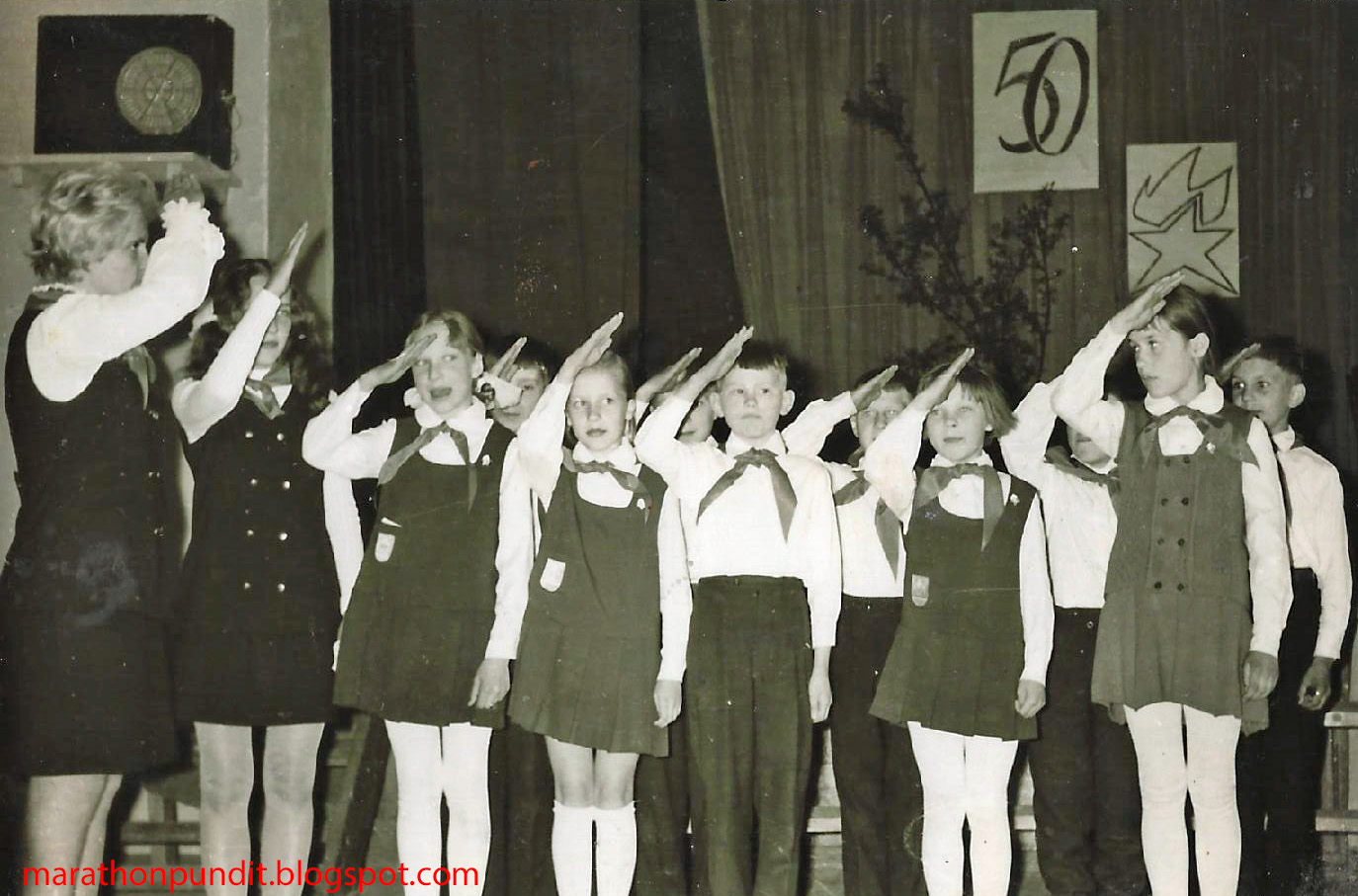
Mrs. Marathon Pundit, third from left, at Young Pioneers event in Sece, Latvia, in 1976.

By John Ruberry

On Friday, the far-left Chicago Teachers Union organized a rally for voting age Chicago Public School students, during school hours, the “Student Power Forum.” 

They might as well have called it the Young Pioneers march.

The event was co-sponsored by Bring Chicago Home, which is working to pass a referendum, also called Bring Chicago Home, that will increase Chicago’s real estate transaction tax on properties selling for more than $1 million.

Election day in Illinois is Tuesday.

Proponents call Bring Chicago Home a “mansion tax,” but many retail storefronts and apartment buildings, and probably all skyscrapers, are worth more than that. I call it a jobs killer and a rent raiser. Funds from the tax hike, if voters approve it, will aid the homeless. No specifics are given as to how the homeless will benefit from Bring Chicago Home.

Of course, Chicago’s leftist mayor, Brandon Johnson, enthusiastically supports Bring Chicago Home. Johnson, who prior to his election as mayor, had no executive experience, but he’s a former CPS teacher and a longtime Chicago Teachers Union organizer. 

The rally, argues the center-right Illinois Policy Institute, likely violates CPS ethics rules, and the group quickly filed an ethics complaint. CTU called that move “racist.”

Now that Johnson is mayor, it’s difficult to ascertain a difference between Chicago Public Schools and the Chicago Teachers Union. Johnson, besides being a former CTU employee, appointed six of the seven members of the Chicago Board of Education. Johnson is a mentor of CTU president Stacey Davis Gates–she has a son attending a Catholic high school–and she recently suggested, as collective bargaining between the two “separate” entities could end up costing taxpayers $50 billion. I hope she was joking.

CPS and CTU will be negotiating against itself. Let’s call them CPS/CTU.

Let’s return to the Young Pioneers. Regular readers here and my own blog know that Mrs. Marathon Pundit was born in Latvia when it was part of the Soviet Union. Enrollment in the Young Pioneers was mandatory after children turned nine. Nadezhda Krupskaya, Vladimir Lenin’s wife, was a driving force in the creation of the Young Pioneers. Similar groups were founded in most of the other communist states. 

Krupskaya recognized that young minds are malleable and vulnerable to manipulation. So does the Chicago Teachers Union. 

Some of the Young Pioneers activities were similar to what the Girl Scouts enjoy, Mrs. Marathon Pundit told me, but there was some communist indoctrination that she had to endure.

These are the four leftist education Rs: Reading, writing, arithmetic, and radicalism. 

CPS/CTU is heading in that direction in regard to kids.

As for the first three Rs, CPS/CTU is doing a wretched job in addressing them. In both reading and mathematics, only about 20 percent of CPS seniors perform at grade level.

There is some good news. Chicago conservatives–yes, they exist–found some surprising allies in opposing CPS/CTU pulling voting age students out of school to attend the Bring Chicago Home rally. Former Chicago alderman Dick Simpson, as well as journalists Eric Zorn and Laura Washington–all liberals–have decried the move.

As I mentioned earlier, there are no specifics on how Bring Chicago home revenue will be spent, assuming the referendum passes. But the Chicago Teachers Union has an idea. According to a leaked document obtained by the Illinois Policy Institute, CTU will be making a not-so-surpising demand as part of its focus on housing, which it says, “begins now with Bring Chicago Home on March 19.” At the top of the CTU list is this shakedown, “Financial assistance for CTU members to live & work in the city.”

Are there homeless CPS/CTU teachers?

Chicago’s high school “Young Pioneers” are what Lenin called “useful idiots.”

There could be five Rs in Chicago schools soon, rent assistance for teachers would be the fifth.

John Ruberry regularly blogs at Marathon Pundit.

By John Ruberry

“Most times you can’t hear ’em talk, other times you can
 All the same old clichés, is it woman, is it man?
 And you always seem outnumbered, so you don’t dare make a stand.”
 Bob Seger, “Turn the Page.” 

Those lyrics, from legendary Michigan rocker Bob Seger, may turn out to be prescient, because the Michigan House of Representatives, which has a Democrat majority, passed a bill in June that, among other things, will impose a hefty fine or imprisonment, if a person maliciously refuses to use another person’s preferred pronoun. 

The bill, HB 4474, expands on a Michigan law that covers religion, race, ethnicity, and sexual orientation.

Newsweek noted that Dylan Mulvaney, a man who claims to be woman, said in a video a while back about people like me who misgender him, “I feel like that should be illegal, I don’t know. That’s just bad journalism.”

No, it’s not. Mulaney, an internet influencer who has done to Bud Light what Eric Idle’s S. Frog character did to Monty Python’s fictional Conquistador Coffee, is wrong, as he is on so many things, What I wrote in the previous paragraph is good journalism because it’s the truth. Sorry, wokesters, but men who “transition” into women do not have ovaries, do not have menstrual periods, and do not undergo menopause. Women who do the opposite do not have testicles, a prostate gland, or Y chromosomes. I could go on, but I don’t have to.

Some people need to simply follow the science. 

Except, maybe soon in Michigan, if its Senate passes HB 4474 and Gov. Gretchen Whitmer, a Democrat, signs it into law, following the science and speaking out about it might get someone like me fined or worse. 

In her Senate confirmation hearing, Justice Ketanji Brown Jackson could not–or in my opinion, would not–define what a woman is. But according to HealthyChildren.org, at around age two, toddlers know the difference between the two genders. Again, follow the science.

The headline of this blog post is colored red. How do I know? Because when I was at the age when I figured out what males and females are, my mother probably said something along these lines to me, “That color is red.” And that information was confirmed to me when I attended kindergarten.

Some things are that simple.

Well, it should be that simple. Transgendered people complain about being bullied. Well, bullying is wrong. I suppose Mulvaney considers it bullying when internet trolls visit his Instagram page and comments, “You’re a man.” Oh, a word for you trolls. Don’t you have anything better to do? Surely there is trash on a roadside near your home that needs to be collected.

On the flip side, in regard to gender, we are at a stage in America when someone says, “Dylan Mulvaney is a man” in mixed company–especially at work–it has to be spoken in whispered tones, sotto voce as the French say. 

Being labeled a transphobe–phobe, by the way means irrational fear–can get many people in trouble on the job. Or maybe soon in Michigan, getting fined or being imprisoned. And it’s not an irrational fear to lose out on a promotion or getting fired for being deemed a transphobe.

I call that bullying. 

As regular readers know, my wife was born in the Soviet Union, in Latvia. At school a number of decades ago, repeatedly, her teachers told her that Latvia, along with Estonia and Lithuania, voluntarily joined the USSR in 1940. Of course, that was a lie. Her parents knew it–and so did every adult in the Baltic States at that time. Yes, that includes the teachers. But my wife didn’t discover what really happened in 1940, beginning with learning of the Molotov-Ribbentrop Pact, until she reached adulthood.

During my wife’s childhood, adults in the Soviet Union were afraid of the repercussions of telling the truth. So my wife’s parents never discussed the USSR seizing the Baltic States with her until Mikhael Gorbachev was the Soviet leader.

In the New York Sun, Dean Karayanis, reminded me that Soviet citizens faced prison if they were caught spilling coffee on a picture of Joseph Stalin. Aleksandr Solzhenitsyn, the author of the Gulag Archipelago, spent eight years in the Gulags for criticizing Stalin in private letters, even though he took the precaution of using a codename for the dictator.

American society isn’t at that more frightening point yet. But Michigan just took a baby step in that direction. 

Or maybe we are there. Remember that Seger song? “And you always seem outnumbered, so you don’t dare make a stand.” Well, I’m making one. Is anyone else with me?

Fortunately, the new Michigan “pronouns” bill will almost certainly be challenged in court on First Amendment grounds. 

Which is another reason why I’m grateful for the 6-3 conservative majority on the US Supreme Court.

John Ruberry regularly blogs at Marathon Pundit.

Blogger with a Soviet-made Volga sedan in Sece, Latvia. Behind the car is a newly-built tractor barn.

By John Ruberry

Late last month I traveled to Latvia, where Mrs. Marathon Pundit was born and raised, for the first time in 25 years. I had also visited with her in 1994.

I expected a different Latvia, and indeed that was the case.

First, a little history. A series of nations ruled Latvia, the last being czarist Russia, until 1918. The Bolsheviks recognized Latvian independence in 1920.

But along with neighboring Estonia and Lithuania, while most of the world was focused on Nazi Germany’s aggression in western Europe, Latvia was forcibly annexed by the Soviet Union in 1940. The Nazis attacked the USSR a year later, but the Soviets recaptured the Baltic States later in the war. 

Three months before the collapse of the Soviet Union, the Evil Empire recognized the independence of the Baltic States. 

When Latvia regained its independence, the population as just 52 percent Latvian. Russians, many of them brought to Latvia to replace Latvians deported to Siberia in the 1940s, made up about a third of the population in the last days of the Latvian SSR. Many of them quickly left after independence, but Russians still make about one-quarter of the population of Latvia. Riga, Latvia’s capital and largest city, has a Russian population of about 35 percent. Russians are a clear majority in Daugavpils, Latvia’s second city. 

The Latvia I saw in the 1990s was poor, my guess is, without the abject poverty, economically speaking it was on the level of Mexico. 

But in 2004, the Baltic States joined the European Union, also that year they became members of NATO. 

Since then, it’s been full steam ahead for Latvia, notwithstanding the 2008-09 recession. 

What I saw in Latvia in June was a prosperous European nation. Gone are the gray–literally, they were gray–retail stores. They have been replaced by colorful and brightly lit retail outlets. Many of these stores, as well as hotels, utilize English-language names. Instruction in English began in Latvian schools after independence was achieved. All Latvians under 35 speak pretty good English.

I’m a runner, and I was one of the few when I hit the roads for a workout. Now there are many running, or if you prefer, cycling trails. 

During my first visits I saw many Russian-made cars on the Latvian streets and highways. My wife and I traveled hundreds of miles during my nine days there–she will be in Latvia for another week—and I saw just two Russian-made cars, both Ladas. I’m pictured with an old Volga above. That make was discontinued in 2010. Volkswagen, Audi, and BMW are the most popular cars in Latvia.

Mrs. Marathon Pundit and I spent a lot of time in rural communities. She grew up on a collective farm in Sece, which is pretty much at the center of Latvia. They grew an assortment of crops, mostly potatoes, beets, and cucumbers, and while driving thru Latvia in the 1990s, the look of the land betrayed that odd lot cultivation. While Latvia doesn’t look like Iowa–there are few cornfields and about half of Latvia is forested–it’s becoming a nation of mega-farms. Wheat, canola, oats, are the major crops. And potato growing is hanging on. 

My wife attended her high school reunion in Sece, she was one of three in attendance from her graduating class of seventeen. One our hosts was another, and the third, almost certainly the wealthiest man in Sece, has been buying, one by one, parcels of land that were part of those old collective farms that were divided up after independence, in Sece, from people to old to tend to the soil, or who have no interest to do so. 

The prosperous farmer is the owner of that Volga in the photograph.

The graduating class sizes of my wife’s old school is now roughly 10 students per year. Rural Latvia, just like rural America, is shrinking.

Only rubble remains of the farmhouse where my wife grew up. Thousands of Latvians can attest to the same situation.

Scattered throughout Latvia are the ugly white-brick buildings, poorly built, that are long-abandoned. “That used to the community creamery in Sece,” Mrs. Marathon Pundit said to me. “That used to be the tractor motor pool, the tractors parked next to them haven’t moved in years.” She could have said the same to me every dozen miles or so when we drove past similar structures. Nearly every one of these collective farm buildings have been long abandoned. They are miniature Pompeiis that were never buried, sad monuments to the failure of communism, an economic and political system that never should have been implemented. Sadly, after over a century of proven failure, there are still people falling for Marxist nonsense.

In the cities and the small towns, khrushchevka apartment buildings, known in the West as “commieblock” structures, are still omnipresent. Most of them utilize those same unpleasant white bricks.

And in the cities, especially Riga, you’ll find many abandoned buildings that were Soviet-era factories. 

Yes, I know, we have abandoned buildings in our American cities. But Riga has many new buildings–beautiful ones. I’m particularly fond of the National Library of Latvia.

Yes, but what about Donald Trump?

Okay, that was an abrupt transition, but most Latvians don’t like him. With the war in Ukraine showing no sign of ending, and when I was in Latvia when the apparent Wagner Group attempted coup occurred, his name, and that of Vladimir Putin, was brought up many times. 

Oh, Joe Biden is viewed in Lativa as an ineffective old man. 

But wait, what about Trump?

To a person, Latvians are pissed off about Trump’s compliments of Putin. For instance, shortly after Russia invaded Ukraine, he called Putin’s move “genius” and “savvy.” I explained that Trump is running to regain the White House, and the former president, dating back to his career as a real estate mogul, is the consummate negotiator, Trump, in my opinion, could be simply playing mind games with Putin. He used a similar strategy with Kim Jong Un. Trump’s flattery is analogous, I tried to reason, to entering a store and being complimented on the shirt I am wearing by a flirtatious saleswoman. Suddenly, my guard is dropped. True, Putin is likely made of tougher stuff than I am. I think.

Only the Latvians I spoke to weren’t buying my explanation. Don’t forget, Russia borders Latvia on the east, and Putin’s puppet state of Belarus is on Latvia’s southeast. In spite of their nation’s membership in NATO, it’s understandable that Latvians are quite nervous about Russia. Dual invasions from Russia’s Kaliningrad exclave and from Belarus into Lithuania could quickly isolate all three Baltic nations.

Latvia faces challenges, a declining population is the biggest one. While life is better now in Latvia, it’s even better in Scandinavia and Germany. European Union membership presents a dilemma for Latvia. 

But I am confident that Latvia will succeed. 

John Ruberry regularly blogs at Marathon Pundit.

Pro-Ukraine protest in downtown Chicago this spring

By John Ruberry

There is good news out of Ukraine, its forces have made gains in the Kharkiv region and they are near Russian border. There is much ground still to liberate, not only land that Russia has seized in the war that began early this year, but also the area that have been controlled by Russian separatists in the Donetsk region since 2014, as well as Crimea, which Vladimir Putin annexed the same year.

Ukraine has endured an unhappy history. World War II and the Holocaust devastated Ukraine. And in order to impose communism on wealthier peasants in Ukraine, Josef Stalin engineered a famine in the early 1930s, known there as the Holodomor, translating roughly into “man-made starvation.” Roughly four million people perished as a result of Stalin’s atrocities against the kulaks in Ukraine.

Even in a closed society, it’s difficult to coverup a famine. And news trickled out of Ukraine about the Holodomor. But a New York Times reporter, based in Moscow, Walter Duranty, dismissed such stories, instead of “famine” he wrote of “malnutrition” in Ukraine, for instance. 

For a series of 1931 articles about the Soviet Union, Duranty, for his “dispassionate interpretive reporting,” he was awarded a Pulitzer Prize. 

While in Moscow, Duranty, was granted a rarity, interviews with Stalin; he also enjoyed another rarity, a luxury apartment in the Soviet capital. During the entire history of the USSR, housing of any kind was scarce. In Moscow Duranty had a mistress, whom he impregnated, and a chauffeur. Automobiles were also rare in Russia in the 1930s. 

In 1933, another journalist, or I should say, a real one, Gareth Jones, visited Ukraine and he was horrified by what he found. “If it is grave now and if millions are dying in the villages, as they are, for I did not visit a single village where many had not died, what will it be like in a month’s time?” Jones wrote for the London Evening Standard. “The potatoes left are being counted one by one, but in so many homes the potatoes have long run out.” 

Duranty’s response to Jones was a New York Times article, “Russians Hungry, But Not Starving.” That same year, Duranty wrote to a friend, “The famine is mostly bunk.”

Another shameful sentence from Duranty, about Stalin’s brutal policies as the Holodomor continued, “To put it brutally,” Duranty wrote for the Times, “you can’t make an omelet without breaking eggs.”

Since the war began attention has been brought to Duranty’s undeserved Pulitzer. Even NPR took notice. “He is the personification of evil in journalism,” Oksana Piaseckyj told NPR earlier this year of Duranty. She is a Ukrainian-American activist who emigrated here as a child over 70 years ago. “We think he was like the originator of fake news,” Piaseckyj added.

The New York Times admitted on its corporate website about Duranty’s work, “Since the 1980’s, the [Times] has been publicly acknowledging his failures.” But it has not returned the tainted Pulitzer. It also notes that twice, most recently in 2003, the Pulitzer board has decided not to revoke its award to Duranty. 

It’s time for them to reconsider.

John Ruberry regularly blogs at Marathon Pundit.