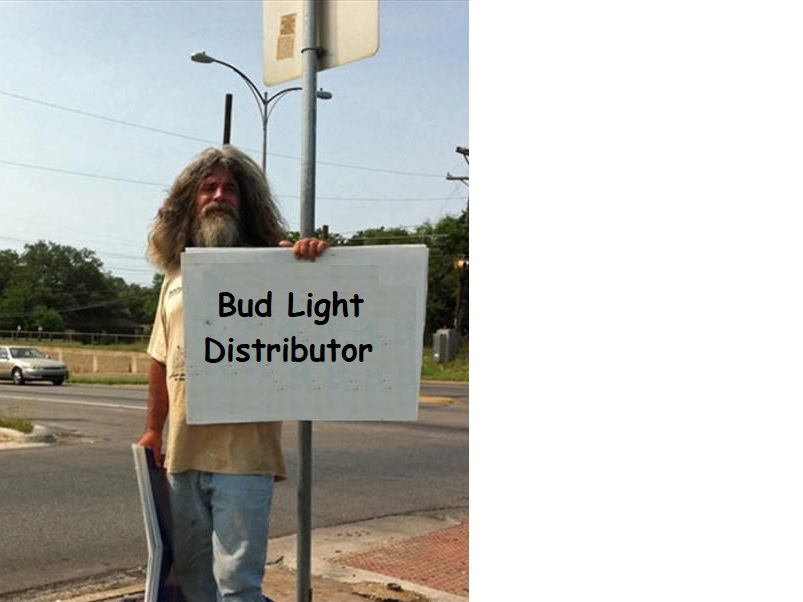
They will be more careful to just talk beer in the future
Murica!
without coming out and saying the words: We’re sorry to have f*****up and we won’t insult our customer base again, the good folks at Anheuser-Busch might have hoped this would reverse or slow the sales drop they have experienced so far:
Bud Light sales continued to worsen for the week ended April 29, NielsenIQ data showed, amid controversy around the brand’s partnership with a transgender influencer.
The country’s No. 1-selling beer brand saw in-store sales of $71.6 million that week, off 23.4% from the same week in 2022.
The company will provide “direct financial support” to workers, including delivery drivers, sales representatives, wholesalers and bar owners, Doukeris said.
Because apparently you can’t make a living selling Anheuser-Busch anymore in the US.
This means several things:
This isn’t going to change until you get an explicit apology from Anheuser Busch
The company is going to have to be willing to take the short term media hit when they do
The salutary effects this is having on other companies thinking of going woke will continue
The left will be desperate for a scalp to generate greater fear than this boycott has
In the end AB will have to choose between the gay bars in Chicago and the vast swath of beer drinkers, If their primary fear as individuals is dealing with angry leftists a permanent drop of 25% in sales might be acceptable. To a company actually interested in the bottom line it would be an easy choice.
The clock is ticking because if the decide to keep stalling eventually people will get used to their new choices in beer and the game will be over.
I love the music of Dolly Parton and Willie Nelson, but they’re country artists, not rockers.
Is Kool Herc an important representative of rap because he scratched turntables?
Like many teenagers, I played in a rock ‘n’ roll band. Unlike most, we had some success, recording several songs, including one that made it to the Billboard 100. We’ve also been inducted into two rock halls of fame in South Dakota and Iowa!
That’s why rock and its cathedral in Cleveland are vital to me!
Let me name just a few of the noteworthy musicians who haven’t been honored and probably never will.
Joe Cocker has many proponents for the hall. For example, Billy Joel voiced his support back in 2014, the same year Cocker died: “I’m amazed that he’s not in yet, but I’m throwing in my vote for Joe Cocker,” Joel told fans at Madison Square Garden while covering “With a Little Help From My Friends” as Cocker once did. He’s been eligible since 1995 but never nominated.
The Spencer Davis Group has never been nominated, despite being eligible since 1991. “[Spencer Davis] was a man with a vision and one of the pioneers of the British invasion of America in the ’60s,” former band member Steve Winwood said to Rolling Stone in 2020. “I feel that he was influential in setting me on the road to becoming a professional musician, and I thank him for that.”
Emerson, Lake & Palmer’s bid for respect for progressive rock has long been an uphill battle. That was Greg Lake’s view when considering why the band hadn’t been inducted into the rock hall, despite being eligible since 1996. Years have passed, and they still haven’t been nominated, which the late ELP vocalist took as a big slight. “Groups like ELP were playing stadiums. Not clubs, stadiums,” Lake said a decade ago. “It’s not something you can overlook: ‘Oh, I didn’t notice that.'”
Grand Funk Railroad has never received a nomination, despite five platinum albums and hugely popular hits like “Walk Like a Man” and “We’re an American Band.” The omission doesn’t sit well with Grand Funk co-founder Mark Farner. “It just shows the illegitimacy of that rock hall,” he said, “and the [fans] are definitely smart enough to know this. They need to be reminded, though, that the rock hall is not a representation of the will of the people; it is a representation of the will of the owners of the rock hall.”
Procol Harum has been eligible since 1993 but has been nominated just once for the class of 2013. Five years later, their classic song “A Whiter Shade of Pale” was inducted into the rock hall’s singles category. “We all know the history of music can be changed with just one song, one record,” E Street guitarist Steven Van Zandt said when introducing the category. “In three minutes, we suddenly enter a new direction, a movement, a style, an experience. That three-minute song can result in a personal revelation, an epiphany that changes our lives.”
Many others deserve consideration: Meat Loaf, Harry Nilsson, Steppenwolf, Three Dog Night, Toto, Edgar and Johnny Winter, and maybe even the Monkees.
Sadly, many influential artists haven’t been considered for the hall, which means something is wrong.
And yet, I’m leaving. Why could that be? The simple fact is that this State and County have set themselves on a course to disaster. And the worst part is that the agency for whom I work has backed literally every policy change that had the predicable, and predicted, outcome of more crime and more people getting hurt.
That’s bad enough but now it’s becoming personal:
Many years ago my family found a nice quiet corner of the suburbs. Now my son, who is only 5, hears gunfire while playing at our neighborhood park, and a drug dealer is open-air selling behind my house (the second one in two years). If it were just me to consider, I’d stick it out. I’ve been through stupid State’s Attorney policies before. But this Office’s complete failure to even think for a moment before rushing into one popular political agenda after another has put my family directly in harm’s way.
That’s where the rubber meets the road:
I will not raise my son here. I am fortunate enough to have the means to escape, so my entire family is leaving the State of Illinois. I grew up here, my family and friends are here, and yet my own employer has turned it into a place from which I am no longer proud to be, and in which my son is not safe.
Hey I’m sure there are positions in Florida where an experienced prosecutor can find work.
The sad thing about all of this is it’s a choice that is actively being made to advance an agenda for the sake of power, wealth and position.
The Kinks are celebrating the 60th anniversary of their founding. In March, the legendary band released a two-CD compilation, The Journey – Part 1 (1964-1975), which is a great place to acquaint yourself with these wonderful performers.
To further immerse yourself with the Kinks, I have determined what I believe are their ten-best albums.
By the way, what is one test to ascertain if someone is intelligent? Well, if a person is a Kinks fan, then you found smart guy or gal.
The Kinks were founded in 1963 in Muswell Hill in North London. The heart of the band are the Davies (pronounced Davis) brothers, Ray, the principal songwriter, lead vocalist, and rhythm guitarist, and Dave, lead guitarist, and occasional songwriter, who sometimes sings lead. Mick Avory is the drummer.
The band broke up in the 1990s, Avory departed the band in 1984. Over the years the Kinks, first a quartet then a quintet, had a series of bassists and keyboardists. Although they haven’t toured or recorded since then, the Davies brothers reformed the Kinks in 2018, Avory is included as a member.
Last summer, at Skokie’s Backlot Bash, an annual event held near my home north of Chicago–the festival coincidentally honors another English phenomenon–Charlie Chaplin–local band Tribotosaurus put on a Kinks show. In his introductory remarks, the band’s lead singer remarked, “The Kinks are the forgotten band of the British Invasion.” Quite true.
Early Kinks tours were tumultuous affairs as they fought each other and anyone else in their way. “At the height of our success in the 1960s,” the narrator in Ray’s solo song ‘Invaders’ explained, “the Kinks were banned from touring the USA for four years, when we did return, we toured the USA relentlessly, tour after tour. Year after year. To win back what we’d lost.”
Who was behind that ban? The American Federation of Musicians. And those years spanned from 1965-1969, musically they were transformational years when rock was transformed from being pop music into an art form.
Here is one account about why the ban occurred, but there are many others.
While what became into the holy trilogy of British rock–the Beatles, the Rolling Stones, and the Who–looked outward musically, Ray and the Kinks turned introspective during their ban from America. For inspiration, they turned to the British music hall songs they learned from the parents. Music hall, the UK version of vaudeville, also describes a style of music. Famous music hall tunes that you probably have heard include, “It’s a Long Way to Tipperary,” “Pack Up Your Troubles in Your Old Kit-Bag,” and “I’m Henery the Eighth, I Am.” Hermans Hermits scored a hit with the last one in 1965.
That sounds horrible for the Kinks, right?
Wrong. The Kinks’ best work was recorded during their “lost period” in America. Only two Kinks singles charted in the United States from 1967-1969, and they peaked deep in the bottom half of Billboards’ Hot 100. But the hits kept coming in Britain and elsewhere.
The Kinks have been cursed with bad luck– and some of those wounds were self-inflicted. In their last album with new material, the mostly-live album To The Bone, Ray looked back in his introduction to their song, “I’m Not Like Everyone Else.” Of that composition he said, “It kind of sums up what we’re all about, the Kinks, because everyone expects us to do wonderful things, and we mess it all up, usually.”
The Kinks’ bad luck even extended to that Tributosaurus gig in Skokie. The band pumped out four great classic Kinks songs, but then a Caddyshack-level thunderstorm struck, which forced the rest of the show, as well as the final night of the Backlot Bash, to be cancelled.
Even if the Kinks’ career consisted of one song, “You Really Got Me,” their international hit from 1964, their place in rock and roll history would be secure. That power cord classic inspired four rock genres, heavy metal, hard rock, punk rock, and new wave.
But there is so much more to the Kinks.
Let the countdown begin.
Not before, that is, a big shout out to the USA-only compilation The Kink Kronikles. That collection not only does a great job covering the Kinks’ “lost years” in America, but it contains such wondrous non-album singles such as “Wonderboy,” “Autumn Almanac,” and “Days.” Those singles, however, often appear on extended versions of some of these albums you’ll soon learn about.
But I’m reviewing the original releases.
10) Give the People What They Want (1981): There are some strong tracks here, particularly “Destroyer,” where Ray rips off himself with an homage to the Kinks’ earlier hit, “All Day and All of the Night.” The Kinks were firmly ensconced in the arena rock phrase of their career when this collection was released, and “Around the Dial” captures that era in just under five minutes. On the other hand, the best track here, “Better Things,” reaches back to that “lost period.” The Pretenders’ Chrissie Hynde, with whom Ray had a romantic relationship at the time, contributes background vocals on four songs.
9) Schoolboys in Disgrace (1975): Beginning in the early 1970s the Kinks recorded a series of concept albums. During supporting tours, these efforts were presented as low-budget stage shows. The last such Kinks “musical” offers a huge helping of 1950s-styles rock, along with a look back at the Kinks power-chord early days. But it betrays Kinks bad luck too. The “rock and roll revival,” rocks first nostalgia movement, which was partially inspired by the Beatles White Album, had run its course by 1975. Power chord music would bounce back in the late 1970s. Wrong place, wrong time. “The Hard Way” would have been a hit in 1979, the same year the Knack scored a number one smash with “My Sharona.” Ironically, the next year the Knack covered “The Hard Way.” Other strong tunes here include “Education,” “No More Looking Back,” and “Jack the Idiot Dunce.”
8) Sleepwalker (1977): The Kinks’ first non-thematic album in nearly a decade, Sleepwalker was a mainstream effort that proved that the band could still rock as well as anyone else. The title track, “Juke Box Music,” “Life on the Road,” and “Life Goes On” are the best tracks.
7) The Kink Kontroversy (1965): In the mid-1970s, Van Morrison recorded an album titled A Period of Transition. That would be fitting moniker for this collection, the Kinks’ third album. “Till the End of the Day” was their last power chord hit. Very early in their career the Kinks recorded many blues rock songs, and there are some on this offering, the best of which here is “Gotta Get the First Plane Home.” Another shining moment, “Where Have All the Good Times Gone,” is sung from the perspective of a middle-aged man, but written by Ray, who was 21 at the time. It foreshadows future greatness.
6) Muswell Hillbillies (1971): We’ll hear about the predecessor to this collection, Lola Versus Powerman and the Moneygoround, Part One soon, but that album brought the Kinks back to prominence and a well-deserved place, albeit briefly, at the head table of rock’s elite. You remember Ray’s remark about the Kinks–that “everyone expects us to do wonderful things, and we mess it all up, usually.” Not that Muswell Hillbillies is bad. Far from it. But the “Lola” album was mostly a hard rock effort, and the Kinks certainly confused its new American fan base with Muswell’s country rock and music hall flavor. Besides the title tune, “20th Centry Man,” “Oklahoma USA,” and “Have a Cuppa Tea” are standouts.
5) Face to Face (1966): Ray emerged as a first-rate storyteller here. While not a concept album, a minor narrative can be found on Face to Face with “A House in the Country,” “Most Exclusive Residence for Sale,” and “Sunny Afternoon,” the Kinks last American hit until 1970. “Holiday in Waikiki” was composed during the Kinks’ disastrous 1965 tour. And had Buddy Holly not taken that fateful airplane flight in 1959 in Iowa, he may have been writing songs like “I’ll Remember” in 1966.
4) Something Else by the Kinks (1967): This is the Kinks most-music hall album. “Harry Rag” might be the most typical of this collection, as “Harry Rag” is old British slang for a cigarette and it’s a sing-a-long tune, and many music hall tunes were written with audience participation in mind. Dave sings lead in a Ray/Dave composition, “Death of a Clown.” But “Waterloo Sunset,” a smash hit just about everywhere except in America, is the best song here, and arguably the Kinks’ greatest recording.
3) Lola Versus Powerman and the Moneygoround, Part One (1970): In the United States, other than “You Really Got Me,” the sorta-title track “Lola,”which is about a strange encounter with what we now call a transgendered woman, is the Kinks best-known song. It was an international hit–and a second single from this album, “Apeman,” also did well as a single. A Dave tune, “Strangers,” is an eerie song about friendship that is one of the Kinks most covered works. This album is yet another band “mess up,” because there was never Part Two. Oh, I nearly forgot, “Get Back in Line” tells the story of worker who a capricious union boss refuses to hire. Yes, it’s a musical punch at the American Federation of Musicians.
2) Arthur (Or the Decline and Fall of the British Empire) (1969): It wasn’t their fault, but here’s another Kinks “mess up,” albeit a brilliant one. Arthur is the soundtrack for a television movie, but that film was never made, although it’s not the fault of the Davies et al. This wondrous collection starts off with the rollicking “Victoria,” the band’s hardest rocker since 1965. “Shangri-La,” a sprawling epic, looks, not so fondly, at the British class system. “Some Mother’s Son” ranks with the best anti-war songs ever written.
And number 1 is:
The Kinks Are the Village Green Preservation Society (1968): Released the same day as the Beatles White Album, VGPS, another music hall-inspired gem, has Ray telling stories about a sleepy English village. Like the central character of his “Autumn Almanac,” in regard to the title track, it’s difficult to fathom if Ray is celebrating, presumably at least, the little old ladies who are members of the Village Green Preservation Society, or mocking them, as he sings, “God save little shops, china cups and virginity.” Don’t forget, we’re in 1968 here. “Do You Remember Walter” looks at the inevitable disappointment when childhood dreams don’t match up with adult reality. The mellotron driven “Phenomenal Cat” is about a legendary, in the imagination of “idiot boys,” flying feline, who, after traveling the world, decides the best life him is to live in a tree and pursue obesity. While “Animal Farm,” which has nothing to do with the George Orwell novel, views rural life more fondly.
There is no rock album quite like VGPS. XTC’s masterpiece, “Skylarking,” thematically comes close.
If you don’t like my choices, well, that’s why we have a comments section here.
And finally, God save the Kinks.
John Ruberry has seen the Kinks twice in concert, both times in Champaign, Illinois. He usually blogs at Marathon Pundit.


 Da Techguy's (no longer backup) Blog