
Posts Tagged ‘advertising’

By John Ruberry

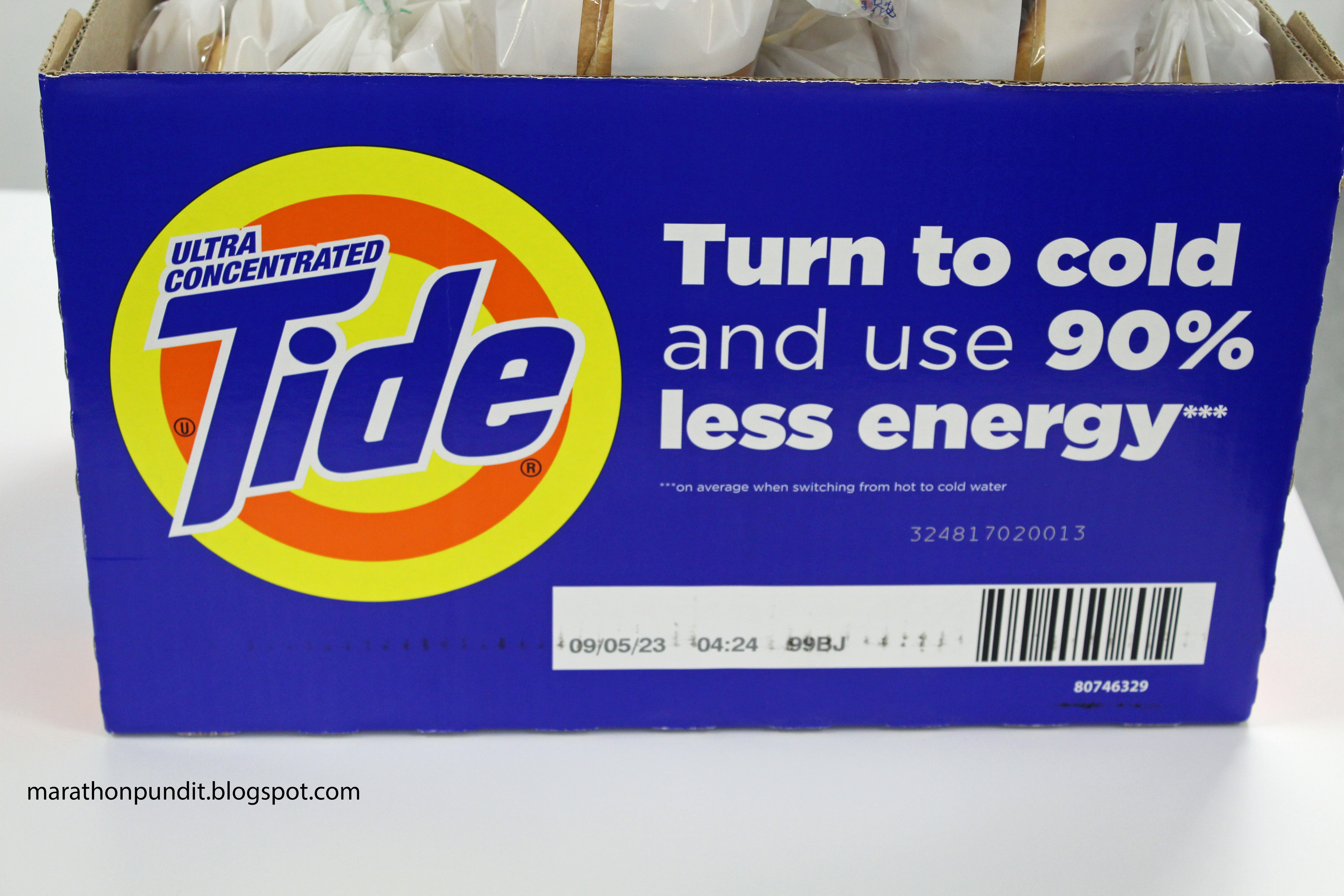
After years of calling out the outrages and absurdities of political correctness and its successor, wokeness, I still manage to be regularly shocked. Yesterday I stumbled across a box while grocery shopping that boasted, “Ultra concentrated Tide–turn to cold to use 90 percent less energy***.”

Yes, even laundry detergent has gone woke. 

Okay, who wants to save money?

Pretty much everyone. 

However, when you look at the triple asterisks–you mean one isn’t enough?–you learn about the cold water claim, according to Tide, it occurs “on average when switching from hot to cold water.”

What if you mostly use warm water laundry washes?

Tide’s propagandistic green marketing push goes back to 2021. The ultimate goal of Tide, which is owned by Proctor & Gamble, is to “save the planet.”

Of course, it is.

When Mrs. Marathon Pundit and I purchase detergent, we look for fair prices, which means we don’t buy overpriced Tide, but more importantly, we want soap that cleans our clothes without damaging them. 

That’s all. We are modest folks.

The Marathon Pundit household is confident that the fate of Earth is not connected to our choice of laundry detergent.

As for Tide, it has a sustainability page on its website, where among other things, Tide claims people washing their clothes can “get great results, no matter the water temperature. Tide is specially designed to give you the best clean in every wash, even in cold water. Tide even cleans better in cold water than the bargain brand does in warm.”

Sorry I don’t believe it.

I have reasons to be skeptical of overreaching claims, as I am old enough to remember being told that carbon emissions would lead to a new ice age. That is, until I was lectured by my “betters” that carbon emissions would lead to global warming and the melting of the polar ice caps, as soon as the last decade. Al Gore predicted that last one. Yes, he did–don’t believe the lying fact-checkers.

Not only am I skeptical of leftist claims, but I am also doubly so of marketers’ claims.

As a liberated 21st century male, I do a lot of our family’s laundry. Unless a fabric is super-delicate, most of what I wash is–sorry Tide–done in warm water. Our clothes come out cleaner and there is no soap residue, as is usually the case when, against my better judgement, I wash clothes in cold. With whites I use the hot water cycle.

But Tide tells us cold water is better.

Hogwash.

Oh, my guess is that the marketing geniuses with Tide are out-of-touch rich slobs who have hired help handling their laundry chores.

If you are squeamish, you may want to skip the next three paragraphs.

I’m a runner and I run about 40 miles a week. Athletes’ foot and jock itch, usually caused by the ringworm fungus, is something I have to cope with every summer. The best way to eliminate this pernicious fungus is to wash infected garments in hot water. You hear that, Tide? Color garments might get damaged by hot water, yes, but apple cider vinegar soaking for infected color garments is great way to kill fungus.

Let’s stick with white socks. And if you had any doubts, now you know why athletes wear white socks.

Not only is cooler water, both cold and warm, ineffective in killing fungus, washing in such temperatures runs the risk of spreading the fungus to other garments. Oh, if you have a significant other who you share a bed with and you are infected with a fungus skin rash, and then your partner pulls a sheet from you as you are sleeping, guess who might acquire that rash? Even after your bedsheets go through a full cycle of a cold or warm water wash.

Oh, I’ve unknowingly put on infected clothes months after a failed wash, and guess what happened?

Let’s just say fungi are survivors.

Once again, Tide, I buy laundry detergent to clean our clothes. My way. Without wokeness, haughtiness, and without soap stains and the spread of fungus.

Back to bed sheets: Hot water washes, not cold or warm, kill bed bugs.

And finally, I don’t believe Tide’s claim that using cold water while washing clothes and bed sheets consumes “90 percent less energy.” I’ve been lied to way too many times.

Use Tide detergent. Save the planet. Get bitten by bed bugs. Spread fungal infections.

John Ruberry regularly blogs at Marathon Pundit.

By John Ruberry

Another company, this time the CMT Network, finds itself in trouble by angering its base by going woke. Now both are facing boycotts. The Bud Light one has been devastating for what until recently was America’s best-selling beer.

Last week, CMT, whose core audience comprises of country music listeners, pulled the video for Jason Aldean’s “Try That in a Small Town.” The song, which was released in May with no controversy, decries the pro-criminal sentiments celebrated in big cities, like New York City, where CMT is headquartered, and it shows BLM and Antifa riot news clips as Aldean croons.

That was too much for CMT. 

Country music fans lean right. I am one of them, although I favor the Americana genre over mainstream country. Country listeners are likely to be the men and women who repair your car, service your air conditioner, or build your home. They may not have Ivy League degrees like Bud Light’s vice president of marketing, the on-leave Alissa Heinerscheid, but these “deplorables” are not dopes. And they aren’t Manhattan-style know-it-alls. 

I imagine, until the Heinerschied-led marketing debacle with trans influencer Dylan Mulvaney, many country music fans drank Bud Light. 

As of this writing on the evening of July 23, Aldean’s “Try That in a Small Town” is the number one song on iTunes and it has been viewed 15 million times on YouTube. 

For Friday’s CMT Music 12 Pack Countdown, Aldean’s massive hit was not among the dozens of songs nominated for the final cut. 

Clearly, CMT is as out of touch with its consumers as much as Anheuser-Busch and Bud Light are.

CMT has Nashville offices but as I mentioned earlier, it is based in New York. Anheuser-Busch has its headquarters where it was founded 171 years ago, in St. Louis, although it is now owned by Belgian firm InBev. 

But Anheueser-Busch’s marketing offices are in Manhattan, where Heinersheid lives.

Would things be different now for Anheuser-Busch if Heinerscheid and her marketing geniuses were instead based in St. Louis? And while no one is coming forward from CMT claiming credit for pushing the “kill” button on Aldean’s video, my guess is that the decision came from someone at their New York headquarters. 

The anger that brought forth the Bud Light and CMT boycotts are byproducts of elites who are isolated from the consumers they are supposed to be experts on. 

Can these brilliant minds do their jobs from places like St. Louis? Nashville? Of course, they can. As they can in Cincinnati, Billings, and Oklahoma City. You know, medium-sized cities. To be sure, they’re not Aldean-favored small towns, but these other cities are filled with less sophisticated types than the “betters” that you find in New York City.

Oh, there are telephones, computer lines in those smaller cities. And there is this thing called Zoom.

However, Bud Light did farm out the Mulvaney campaign to an advertising agency thousands of miles from Manhattan.

It was to a firm based in suburban San Francisco.

John Ruberry, who regularly blogs at Marathon Pundit, was a bachelor’s degree in advertising from the University of Illinois at Urbana-Champaign. He’s pictured here at Penn Station (correction Grand Central Station) in New York.

By John Ruberry

A societal seismic shift, a black swan moment, occurred for the American elite, our “betters,” on April 1. Yep, April Fools Day, but the joke was on the elites. It was April 1 when on his–yes his–Instragram page, the transgendered influencer, Dylan Muvlaney, announced his sponsorhip deal with Bud Light, a beer brewed by Anheuser-Busch that is, or was, favored mainly by macho types.

The backlash was immediate. A boycott of the brew–with conservative celebrities leading the charge began–and Anheuser-Busch has since lost $5 billion in value.

Receiving the blame for this debacle is Alissa Heinerscheid, Bud Light’s vice president of marketing, who went on a leave of absence last week.

It’s likely that Bud Light triggered a tripwire, likely, to use Bill Maher’s words, Americans are angry because “they’ve had an agenda shoved down their throat.” Like the dimwitted sheep in George Orwell’s Animal Farm, many elites, particularly in the media, believe transgendered women are women. Most Americans disagree. 

And most Americans, unless they are woke, aren’t dopes. They know that males have an inherent physical advantage over women in most sports. If they decide to think about it–they know that the annual physical for Rachel Levine, the Biden administration’s assistant secretary for health who is transgendered, consists of a prostate exam. They are aware that after “gender-affirming” surgeries, some trans people want to switch back.

These same people are horrified of reports that some school officials, without knowledge of their parents, are encouraging minors to “transition.”

And these same folks are fed up with being called a bigot or some sort of “phobe” when they raise their objections to the transgender ideological movement.

And they are sick of transgendered women appearing in clothing ads wearing garments designed for females. 

Unlike Supreme Court Justice Ketanji Brown Jackson, most Americans are able define what a woman is. And they know that men cannot give birth to babies.

As for the elites, many of whom like Heinerscheid have an Ivy League education, they’re the types of folks who don’t interact with smelly people who drink Bud Light. These smug know-it-alls are stupefied that the Mulvaney sponsorship has damaged the brand. 

The elites live in their bubble, which makes them quite vulnerable to a black swan moment.

What has happened to Bud Light takes me back to 1979 and the Disco Demolition stunt that was part of a Chicago White Sox Teen Night promotion during a twi-night doubleheader with the Detroit Tigers. Oh, “Disco Sucks” wasn’t just a Chicago thing, I saw my first “Disco Sucks” T-shirt a year earlier on sale on the boardwalk at Ocean City, Maryland.

I was a 17-year-old when Steve Dahl, a morning disc jockey for rock station WLUP-FM, began humorously “blowing up” disco records during his show. He’d play some crappy–aren’t they all?–disco tune for thirty-seconds or so, and then blow them up, not for real, but with sound effects. Dahl also took his act on the road, including a mock “takeover” of a suburban disco club, and the same thing happened at each event. Crowd control was an issue–too many people in too small of a space.

Surely, Mike Veeck, the son of White Sox owner Bill Veeck, thought that Comiskey Park, the home of the White Sox, could comfortably host Dahl and his minions, known as the Insane Coho Lips. The ballpark had a capacity of 45,000. 

But the doubleheader sold out and there were an estimated thirty thousand others outside Comiskey Park clamoring to get in. Teens who deposited disco records at the turnstiles were admitted for 98 cents, which was dirt cheap even in 1979. 

Dahl, in faux military garb, as you’ll see in the YouTube clip, exploded the records in spectacular fashion as the Insane Coho Lips chanted “disco sucks” following the conclusion of the first game of the doubleheader, a White Sox defeat. Immediately afterwards, about 7,000 of the rockers stormed the field and a riot broke out, one that included destroying the batting cage and igniting the crate from where the records were exploded. It was rock and roll’s first saturnalia. Police in riot gear promptly ended Disco Demolition 90 minutes later, and because the field was deemed by the umpires as unsafe for play, the second game was forfeited to the Tigers.

I watched the game at home on television with my parents and my brother. I hated disco and loved rock and roll, so I looked on with mixed emotions because I was also a Sox fan. I didn’t object when my brother pointed at me and said, “Hey, mom and dad, there are thousands of them on the TV, who are just like your son, tearing up the field.” Hey, don’t forget, I was 17 at the time.

Retro historians, often people who were born years after Disco Demolition, have tried to turn that night into a racist or anti-gay thing. Wrong. The people I knew who listened to disco were shallow and vapid–just like the music. It was love at first sight for them.

Here’s the disco black swan moment. 

The Disco Demolition coverage from the media, particularly the national media, was one of shock. Even more so than now, the elite media was based in New York, and they were the people who hung out at disco’s hallowed temple, Studio 54 in Manhattan. They lived in their ’70s bubble, one that didn’t include people who loved rock music and wore “Disco Sucks” T-shirts.

Up until Steve Dahl blew up those records, disco was seemingly everywhere–on TV shows, in commercials, and in the movies, most notably, with John Travolta dancing in Saturday Night Fever. Rock acts, including the Rolling Stones, the Kinks (sadly, one of my favorite bands), and Rod Stewart, recorded songs with a disco beat.

But post-Disco Demolition Night, the media, as well as the advertising and marketing “experts,” realized, after the totality of the riot, that more people hated disco than liked it. Disco didn’t die that night–even a freight train experiencing engine problems can’t be stopped on a dime, but disco went into a fatal tailspin. A month after Disco Demolition, Michael Jackson’s Off the Wall, a disco album, was released. It enjoyed brisk sales and a lot of airplay. But Jacko’s next album, Thriller, was more of an R&B album, it even included the King of Pop’s only hard rock song, “Beat It,” which was graced by guitar work from Eddie Van Halen.

Rockers had stopped cutting disco tracks well before Thriller was released.

A couple of weeks before Off the Wall arrived in record stores, principal photography began on a movie starring the Village People, Discoland . . . Where the Music Never Stops. Sensing trouble because of the anti-disco backlash, the film’s producer, Allan Carr, changed the name of his project to Can’t Stop the Music. It’s remembered as a legendary Hollywood box office bomb.

As the saying goes, “History doesn’t repeat itself but it rhymes.” One of supporting actors in Can’t Stop the Music was Bruce Jenner, who now goes by Caitlyn. 

By the early 1980s, the expression “As dead as disco” was common. 

Transgenderism isn’t going away. Over my life I’ve known a few men who have gone thru procedures that allows them, sort of, to live as women. Fine, it’s their life. If, as an adult, men and women want to transform themselves into something different, well, no one should stop them. The same goes for people who want to obliterate their faces with tattoos.

On the other hand, don’t shove your choice down our throats and demand us to celebrate you.

In the advertising and marketing world, using transgendered spokespeople to promote mainstream products just might be as dead as disco.

No one wants to be the next Alissa Heinerscheid. Her job was to sell Bud Light, not to drive people to avoid it.

There was never a Can’t Stop the Music sequel.

Marketing people must not be good at math. One percent of the population identifies as transgendered. Which means of course means 99 percent doesn’t.

John Ruberry regularly blogs at Marathon Pundit.

This week we begin a Christmas series in honor of our show selling out

Thanks to Embroid Me Fitchburg