I spoke to Catholic Children’s author Pia Imperial at the 2024 Catholic Men’s Conference at the DCU center in Worcester.
You can buy her books here.
Click here for DaTechGuyBlog.com Same Fedoras, Same Cannoli different domain.

Please Help DaTechGuy pay Da Bills

Click for the latest show
I spoke to Catholic Children’s author Pia Imperial at the 2024 Catholic Men’s Conference at the DCU center in Worcester.
You can buy her books here.
By John Ruberry
For many Netflix subscribers, their focus is on the next week’s release of the second part of the final season of The Crown. While I have enjoyed the series, the first batch of Season Six of The Crown was a huge disappointment for me.
A more enjoyable use of your time–75 minutes to be precise–can be found by watching Radical Wolfe, a documentary about the legendary writer Tom Wolfe, a pioneer of the New Journalism movement of the 1960s who later, and seamlessly, made the transition into fiction, penning one of the greatest novels ever, The Bonfire of the Vanities.
Radical Wolfe, which had a brief theatrical run this autumn, is directed by Richard Dewey. It is filled with interviews of Wolfe; Jon Hamm narrates passages from Wolfe’s work. The documentary is based on an Esquire article by Michael Lewis.
Gay Talese, Tom Junod, Christopher Buckley, and Lewis are among the writers interviewed for Radical Wolfe.
Buckley’s father, conservative firebrand William F. Buckley, says here. “Tom Wolfe is probably the most skillful writer in America. I mean by that is that he can do more things with words than anyone else.”
“If you want to be a writer,” Wolfe, who died in 2018 said of himself, “you’ve got to be standing in the middle of the tracks to see how fast the train goes.”
“Nobody is writing like Tom Wolfe today,” Junod says in Radical Wolfe. “And no one has written like Tom Wolfe.”
Wolfe is someone America needs now. Oh, to have seen him running loose among the hypocrites at COP28.
The title of the film comes from Wolfe’s 1970 essay for New York magazine, Radical Chic: That Party at Lenny’s, when Wolfe, after co-opting an invitation to a fundraiser for bail money for some Black Panthers held at Leonard Bernstein’s Park Avenue home, skewered the liberal virtue signaling culture, even before that term existed.
Oh yeah, phrases. Phrases!!! Besides “radical chic,” Wolfe coined the terms “the right stuff,” the title of his of his rollicking yet informative bestseller about the early days of the space program, and “masters of the universe,” the group that Sherman McCoy, the lead character in The Bonfire of the Vanities, placed himself in.
Not mentioned in the documentary while Wolfe didn’t create the now-common phrase “pushing the envelope,” which is used repeatedly in The Right Stuff, he popularized it.
Wolfe began his career as a who-what-where when-why–journalist in the northeast. After convincing Esquire in the early 1960s to let him write an article about the California custom car culture, Wolfe suffered writer’s block. Which was the best thing, career-wise, that ever happened to the author. Eventually the floodgates opened, Wolfe brought sound effects to print journalism, shown in the title of that piece, There Goes (Varoom! Varoom!) That Kandy-Kolored (Thphhhhhh!) Tangerine-Flake Streamline Baby (Rahghhh!) Around the Bend (Brummmmmmmmmmmmmmm)…
The repeated use of ellipses (…) and multiple exclamation points (!!!) are a trademark of Wolfe’s early work.
As with the fetid film version of The Bonfire of the Vanities, Radical Wolfe tiptoes around race. Wolfe was a master storyteller and, strictly in the storytelling sense, race presents a crucial ingredient for any narrative–conflict. The Reverend Bacon character in Bonfires, an Al Sharpton knockoff, is a comic foil. Fareek “The Cannon” Fanon, an African American college football star in Wolfe’s 1998 novel, A Man in Full, comes across as a boor when he confuses lead character Charlie Coker’s old moniker as a 60-Minute Man, not as a football starter on both defense and offense, but as a man who could, let’s say, “do it” in bed for 60 minutes.
Black people can be boors in Wolfe’s world. As can white people. As can everyone. That’s the way it ought to be. Because that’s the way society is.
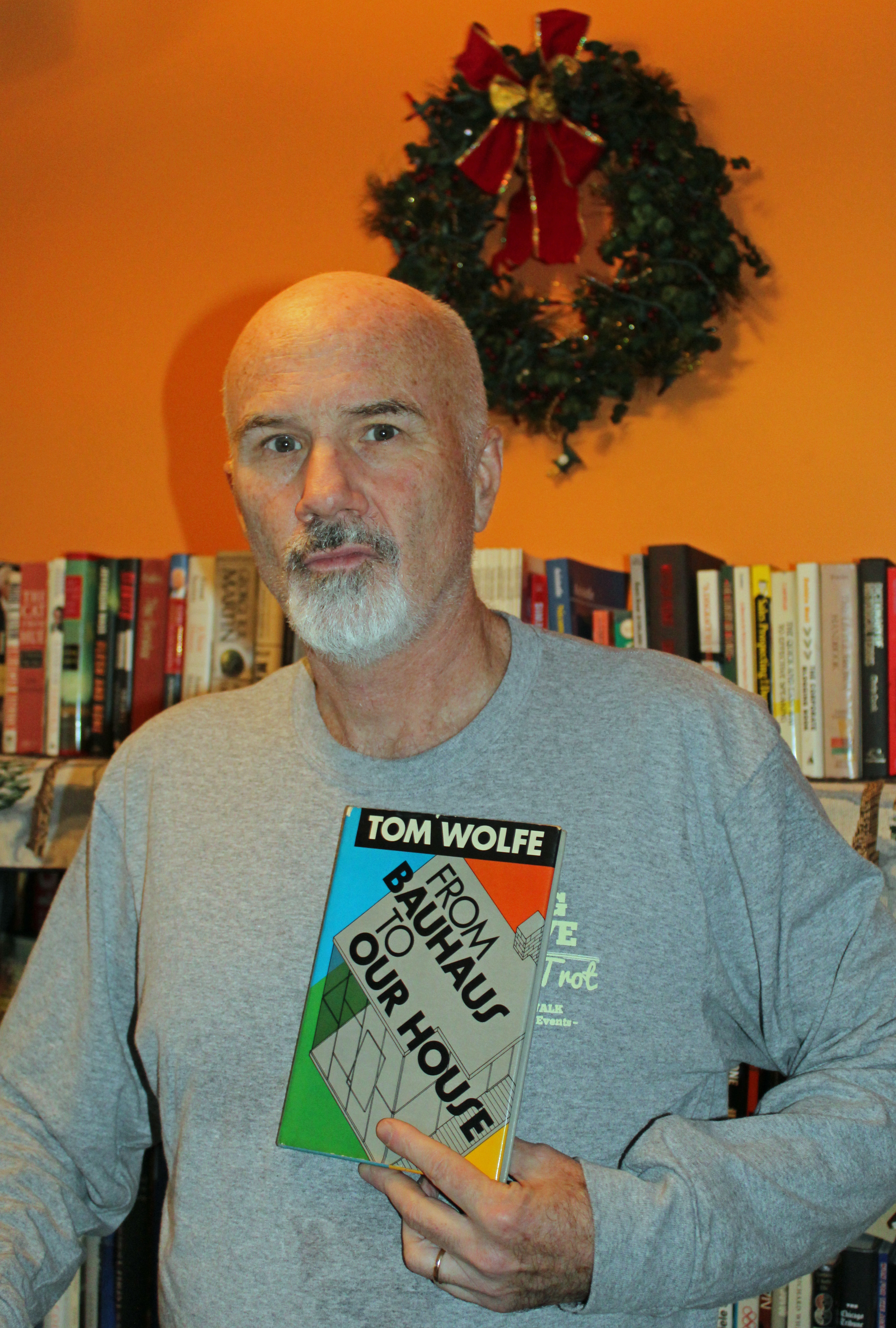
In Wolfe’s takedown of ugly glass-box and faceless architecture, From Bauhaus to Our House, he gives a rundown of the horrors of public housing, and joyously recalls the response when tin-eared bureaucrats in St. Louis–after decades of failing the residents of the city’s housing projects–finally did the unthinkable. They asked the tenants of the notorious Pruitt-Igoe homes, most of them Black, what they wanted done to the buildings. Their response? They chanted, “Blow it up.”
And the bureaucrats did just that. Why isn’t this poignant story in Radical Wolfe?
Wolfe was always coy about his political stance. “I belong to the party of the opposition,” he says in the documentary. But I suspect he was a slightly conservative, with a strong libertarian bent.
Despite the quibbles I mentioned, I loved Radical Wolfe. Oh, one more thing. To capture the Varoom!!! Varoom!!! uniqueness of Wolfe’s genius, a surreal mashup, along the lines of the one in The Life and Death of Peter Sellers, would have been a welcome addition.
Last year, Netflix sent a message to its workers that not all of its programming–not these words of course–will kowtow to wokeism. Radical Wolfe is a big step in the right direction for the streaming service. Next year Netflix will stream a six-episode limited series based on Wolfe’s A Man in Full. It will star Jeff Daniels and Diane Lane.
Keep it up, Netflix.
But I have one more quibble. Radical Wolfe is rated TV-MA for–wait for it–language and smoking.
Really? TV-MA?
Yep.
John Ruberry regularly blogs at Marathon Pundit.
By John Ruberry
Ray Bradbury in a way predicted Disney’s latest outrageous move.
Bradbury’s Fahrenheit 451, published in 1953, is a dystopian novel that is overshadowed by two other great 20th century works about an unpleasant future, Brave New World and 1984. Fahrenheit 451’s lead character is Guy Montag, a fireman, only in Bradbury’s world, buildings are fireproof; Montag and other firemen are dispatched to homes to burn books. Nearly of them. Only comic books are permitted in that unhappy future.
Michiko Kakutani, in a New York Times career appraisal written on the day after Bradbury’s death in 2012, remarked that Fahrenheit 451 “is at once a parable about McCarthyism and Stalinism, and a kind of fable about the perils of political correctness and the dangers of television and other technology.” Yep, Kakutani said “political correctness,” the term for “woke” from that not-too-distant time. In a 1994 interview Bradbury, in very blunt language even for the 1990s, attacked that PC culture while discussing Fahrenheit 451. “Political correctness is the real enemy these days,” he said. “The black groups want to control our thinking and you can’t say certain things. The homosexual groups don’t want you to criticize them. It’s thought control and freedom of speech control.”
In a memorable passage from Fahrenheit 451, Montag’s boss explained–without government involvement mind you–how books became toxic.
The bigger your market, Montag, the less you handle controversy, remember that! All the minor minor minorities with their navels to be kept clean. Authors, full of evil thoughts, lock up your typewriters. They did. Magazines became a nice blend of vanilla tapioca. Books, so the damned snobbish critics said, were dishwater. No wonder books stopped selling, the critics said. But the public, knowing what it wanted, spinning happily, let the comic books survive. And the three-dimensional sex-magazines, of course. There you have it, Montag. It didn’t come from the Government down. There was no dictum, no declaration, no censorship, to start with, no! Technology, mass exploitation, and minority pressure carried the trick, thank God. Today, thanks to them, you can stay happy all the time, you are allowed to read comics, the good old confessions, or trade journals.
Last week, Hollwood Elsewhere noticed the omission of the “N-word” from the Gene Hackman classic police thriller The French Connection from the Criterion Channel streaming service. The use of the racial slur helps define Hackman’s character, Popeye Doyle, as a great cop but a flawed man.
Not as controversially, Doyle regularly refers to two French criminals as “Frog 1” and “Frog 2.” Those ethnic putdowns remain in the film. So does the iconic scene of Hackman gunning down Frog 2 on a set of stairs. For now, at least.
It’s widely believed that Disney, which owns the rights to The French Connection, is behind the stealth editing. To use Bradbury’s words, “It didn’t come from the Government down.”
Disney of course has gone full-blown woke in recent years, the outrage prior to this one, from last month, involved a mustachioed man wearing a dress and eye shadow, a fairy godmother’s apprentice named Nick, greeting guests, including children, at the Bibbidi Bobbidi Boutique at Disneyland. Before that, Disney’s prior woke atrocity there was an anti-white people song performed in the Disney+ children’s series, The Proud Family.
Disney’s theme parks are supposed to be “the happiest place on earth.” That’s it? Humans are only about happiness?
Back to Bradbury and Fahrenheit 451:
You must understand that our civilization is so vast that we can’t have our minorities upset and stirred. Ask yourself, what do we want in this country, above all? People want to be happy, isn’t that right?
We won’t be happy, I believe, as dumbed down dolts.
The entertainment industry, a fortress of the left, constantly reminds us, especially during award ceremonies, that they are the vanguard for free expression. Sure, a censoring of the “N” word doesn’t seem like a noble hill to die on but remember the dystopian world of Bradbury’s Fahrenheit 451. The slippery slope began in order to placate a few people who were offended.
Why stop with the “N” word? What about the French Connection’s Frog 1 and Frog 2? Smoking in movies? And what Donald Trump’s cameo in Home Alone 2?
Viewers might get triggered.
Don’t laugh about that Trump scene. The star of Home Alone 2, Macaulay Culkin. wants the Trump bit cut. And he’s not alone.
John Ruberry regularly blogs at Marathon Pundit.
By John Ruberry
Deep down every wokester is weak. Just as most bullies are. You criticize a woke person and you are called a racist, a bigot, or some sort of “phobe” or another. They expect you to cower in shame afterwards.
And if you don’t?
Like the dystopia described in Ray Bradbury’s Fahrenheit 451, the editing of books deemed offensive has begun. The endgame in Bradbury’s storyline was the banning of all books.
Last week the publisher of Roald Dahl, Puffin, announced it was editing some of his works–which include the classics Charlie and the Chocolate Factory, James and the Giant Peach, and Matilda–to remove language they deem offensive. Augustus Gloop, the gluttonous German boy in the first book, will no longer be “fat,” he’ll be “enormous.” In Matilda, “mothers and fathers” become “parents.” The bald witches in The Witches will come with a disclaimer about baldness.
Next came the backlash.
But let’s talk about the author first.
Dahl, who died in 1990, had slight misanthropic and even more direct anti-Semitic sentiments. At the very least he was a beast of a person. Dahl’s marriage to Hollywood actress Patricia Neal–one of my late mother’s favorite performers by the way–was tumultuous. Neal suffered a stroke while pregnant, and as she recovered, she couldn’t remember the words of many things. Dahl, a serial adulterer throughout their marriage, refused to give his wife things she asked for, including food, until she used the correct word.
Neal’s nickname for her husband was “Roald the Rotten.”
Dahl’s publisher for much of his career was Alfred A. Knopf.
After asking Knopf that a person who was “competent and ravishing” should send him dozens of Dixon Ticonderoga pencils, Dahl was sent different ones, after his first request was laughed off. Dahl made more demands and then threatened to send his writings to a different publisher.
But instead, Knopf released the popular author. Employees of the publishing house cheered when they heard the news of Dahl’s dismissal. They fought back against a bully and won.
Salman Rushdie, who lost his sight in one eye after a recent attack, was one of the prominent writers who came to Dahl’s defense. “Roald Dahl was no angel but this is absurd censorship,” Rushdie Tweeted. “Puffin Books and the Dahl estate should be ashamed.”Even Queen Camilla voiced her support for him.
A few days later Puffin backed off. Oh, it will still publish the edited, make that censored, versions of Dahl’s books. But the original Dahl works will also be printed. Here’s my prediction: Woke Dahl, just like the New Coke debacle several decades ago, will go down as colossal failure. Vintage Dahl will win.
Heroes are hard to find in these complicated times. But the legacy of “Roald the Rotten” has been used to fight back against another bully, the woke movement, which deems itself morally correct and beyond reproach.
John Ruberry regularly blogs at Marathon Pundit.
 Da Techguy's (no longer backup) Blog