Sir Humphrey Appleby:I strongly advise you not to ask a direct question.
James Hacker: Why?
Sir Humphrey Appleby: It might provoke a direct answer.
Yes Minister: The Moral Dimension 1982
Were the sacrifices of World War 2 worth it?
My father who served in the pacific braving Kamikazes & Subs to keep capital ships & carriers supplied died would have turned 104 last week on Halloween but died just after I was engaged but before I was married at the age of 65 so while I have an opinion of what he might think of this subject I can’t state it as fact.
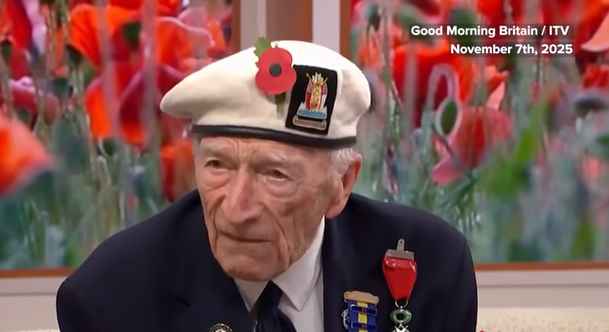
However Alec Penstone who served in the Royal Navy is still with us at the age of 100. As soon as he was of age he left his factory job for the Royal Navy braving U-Boats and Air attacks to protect Great Britain from actual Nazis (as opposed to the phony Antifa cosplayers of today) and saw many of his friends lose their lives doing so.
Thus is was an awful shock to the British TV show when on Good Morning Britain he was asked what Remembrance Day (Veterans day for us) means to him and he answered thus:
However the moving segment took a turn when Kate asked him what Remembrance Sunday means to him. He said he felt that winning the war was “not worth” how the country had turned out today. “My message is, I can see in my mind’s eye those rows and rows of white stones and all the hundreds of my friends who gave their lives, for what? The country of today?” he said sadly.
“No, I’m sorry – but the sacrifice wasn’t worth the result of what it is now. What we fought for was our freedom, but now it’s a darn sight worse than when I fought for it.”
It’s one thing for a blogger like myself online or even a Tommy Robinson during a protest to say that The Few, the term used to describe the pilots in the battle of Britain who defeated the German Luftwaffe, would be ashamed of what the Brits have done with the freedom they bought for them. It’s very easy for the powers that be to dismiss us.
It’s quite another thing for a man who fought and saw his friends die enduring all the Nazi Kriegsmarine could throw at him saying so on live television to an entire nation.
Here is the full interview:
What was really interesting however was his response when one of the hosts Aldi Ray followed up with a question concerning what he had just said:
“What do you mean by that, though?” the GMB host probed, prompting the WWII veteran to reply: “What we fought for, and what we fought for was our freedom.
“We find that even now it’s downright worse than when I fought for it.”
Ms Garraway intervened to bring the discussion to a close before Mr Penstone could face any further questions from Mr Ray. “Oh, Alec, I’m sorry you feel like that,” she said.
Ray is ironically getting hit for asking that follow up question because even those who have been so determined to Bring down the Britain that Mr. Penstone fought for dare not publicly attack him for giving that honest answer. As the Irish Sun put it:
It was a heartbreaking admission from a war hero and a damning indictment on the state of Britain today.
'What we fought for was our freedom, even now [the country] is worse than it was when I fought for it,' says 100-year-old World War II Veteran Alec Penstone. pic.twitter.com/M9HSsS5sIW
Alec Penstone may not realize it but he just preformed one last great duty for his country speaking the truth outloud for the entire country to hear. Giving one final warning concerning the path that those he fought to protect have taken.
How the nation reacts to that warning will determine if Britain falls.
As a rule for this series you’ve seen groups or individuals who have done Christmas Albums. The Rock Group Slade formed in the 1960’s did only one Christmas song, but if you go to Britain it is THE Christmas song which every single year makes returns to chart when the season comes. Slade has a long and storied history in the annuls of pop music but long after they are dead and gone this song will be played and remembered throughout the UK.
So as we have a bonus day of Christmas due to the Church’s calendar this year for this 14th day I give you Slade performing live their Christmas hit: Merry Christmas Everybody
Earlier this month Season Six of the BBC gangster drama, Peaky Blinders, began streaming on Netflix.
The show centers on a Birmingham Romani organized crime family, the Shelbys, and the leader of that gang, Tommy Shelby (Cillian Murphy). He’s a World War I veteran suffering from post-traumatic stress syndrome, who manages to build a business empire, while getting elected to Parliament as a member of the Labour Party.
This will be the final season of Peaky Blinders, although a movie is said to be in the works.
The next two paragraphs contain some Season 5 and 6 spoilers.
During Season 5 a new major character, Oswald Mosley (Sam Claflin), a Birmingham member of Parliament like Tommy Shelby, is introduced. He’s the founder of a British fascist party–and Mosley was a real person. Shelby’s relationship with Mosley is complicated, which fits the show as the plot lines are anything but simplistic. Shelby’s plot to assassinate Mosley–the real Oswald died of natural causes in 1980–is foiled by the Irish Republican Army. The IRA kills the would-be assassin and other member of the Peaky Blinders, the “muscle” end of the Shelby operation.
While Tommy is the leader of the gang, his aunt, Elizabeth Pollyanna “Polly” Shelby Gray (Helen McCrory), was the glue of the enterprise, formally known as Shelby Family Limited. But McCrory died at 52 of lung cancer in 2021, just as production of this season started. Other than Tommy Shelby, Aunt Polly was the most important character in Peaky Blinders. Her off-screen death was a tough blow for the show. To compensate, the role of Tommy’s sister, Ada Thorne (Sophie Rundle), is elevated, but Rundle is placed in an impossible position. Meanwhile, Polly’s son, Michael Gray (Finn Cole), holds Tommy responsible for Polly’s murder.
Also back in Season 5, another new character Gina (Anya Taylor-Joy), Michael’s wife, makes her debut. We learn in the new season that Gina is the niece of South Boston gangster Jack Nelson (James Frecheville). He’s a not-too-thinly disguised characterization of Joseph P. Kennedy Sr. Like the patriarch of the Kennedy dynasty, Nelson has anti-Semitic and fascist leanings. Calm down my liberal friends, it’s true about Kennedy. With Prohibition over, Tommy and Nelson hope to offset the end of it by smuggling opium into Boston.
Mosley has a new lover, Lady Diana Mitford (Amber Anderson). She declares herself to Ada, in cruder terms, as a bisexual but she also has her eyes on Tommy. The real Mitfort was the first cousin of Winston Churchill’s wife, Clementine. Unless this plotline is being saved for the Peaky Blinders movie, I am stupefied why this angle wasn’t developed into the storyline. The future wartime leader, amazingly is portrayed by three actors over the six seasons, makes a cameo appearance in Season 6.
Season 5 ends and Season 6 begins with Tommy wallowing in mud. And mud is fitting metaphor for this season, while good, falls short of the greatness of Peaky Blinders, although I didn’t care for the Russian diversion in Season 3. The final episode of this last season, nearly 90 minutes long, is the best, as Tommy’s older brother, Arthur (Paul Anderson), emerges somewhat from his alcohol and drug induced haze as the Shelbys face a two-front war. A third front of sorts is there too as Tommy’s marriage with Lizzie (Natasha O’Keeffe) faces challenges.
In regard to Nelson, Season 6 would have been much more interesting if instead Joseph P. Kennedy was the Boston foil for Tommy.
Surprisingly, while the show continues with a dark and gothic soundtrack, the unofficial theme song, Nick Cave and the Bad Seeds’ “Red Right Hand” is sadly missing. But arguably the worst song Bob Dylan ever recorded, “All The Tired Horses,” covered by Lisa O’Neill, is included.
All six seasons of Peaky Blinders are currently streaming on Netflix. It is rated TV-MA for nudity, drug use, foul language, and violence.
Listening to music is a serendipitous adventure. And it was on one of those journeys I uncovered another great band that you’ve probably never heard of, The Divine Comedy. Last year before the post was swallowed up by a memory hole at Da Tech Guy, I profiled another undeservedly unknown band, the Rainmakers. Only I first encountered the Rainmakers on a local radio station years ago.
I discovered The Divine Comedy when I downloaded the “Inspired by the Kinks” compilation on Apple iTunes. A great collection, yes, and easily the standout cut for me was “The National Express,” a satirical look at a ride on the eponymous company’s bus line.
Unknown? As this is an American blog with, I believe, a predominately American readership, that’s true. But The Divine Comedy has scored hits in Europe, particularly in Great Britain and Ireland, which is understandable as the band’s only constant member is Neil Hannon, who is from Northern Ireland.
As great as “The National Express” is, there’s just one small issue in my opinion. I’m a huge Kinks fan, but unless you count that British band’s last big hit, “Come Dancing,” it doesn’t sound like any other Kinks tune.
Listen for yourself!
The Divine Comedy’s first album, since cancelled by Hannon, was the R.E.M. inspired Fanfare for the Comic Muse, which was released in 1990. The only place it seems to be available is on YouTube. If you somehow find a copy of it at a rummage sale or used record store, grab it if it’s priced cheap, as it is probably a collector’s item.
The band then “regenerated” three years later into a chamber pop, or if you prefer Britpop band, for Liberation. Actually I prefer the moniker baroque pop. Regardless of the name, what kind of music am I talking about? Think along the lines of “Penny Lane” by the Beatles, “Senses Working Overtime” or “Easter Theatre” by XTC, or “Never My Love” by The Association, the glimmering song that was used with such beautiful yet chilling effect in the final episode of the most recent season of Outlander. Oh, throw in a bit of Cole Porter too. Back to Liberation: My favorite song from that collection is “The Pop Singer’s Fear of the Pollen Count,” which is cleary inspired by the Beach Boys. Yes, I suffer from allergies too so I can commiserate.
Hannon, who writes nearly all of the band’s songs, is a clever lyricist who brings wit and even snarkiness to many of his songs. The Divine Comedy’s melodies are striking and the musicianship is superb.
With her military might She could defeat anyone that she liked And she looked so bloody good on a horse They couldn’t wait For her to invade Catherine the Great.
Yes, there is a sly reference here to the historical gossip that the Empress of Russia died from a mishap during carnal relations with a stallion.
One more Divine Comedy favorite of mine is “Gin Soaked Boy” from the 1999 compilation A Secret History…The Best of the Divine Comedy, which might be good place for you to see if The Divine Comedy is for you. Or you can begin as I did on Apple Music with their “Essentials” and “Next Steps” collections.
Of the band’s dozen studio albums Fin de Siècle, which contains “The National Express,” is my favorite. If you prefer to see what the Divine Comedy is up to now, its latest album is Office Politics. The track I enjoy the most on this collection is “Philip and Steve’s Furniture Removal Company.” It’s about a proposed sitcom and its theme song, both devised by Hannon, in which minimalist classical composers, Philip Glass and Steve Reich, operate a furniture removal business in the 1960s in New York.
Silly? Of course. Brilliant? Definitely.
Oh yes, I said “regenerated” earlier. Regeneration is the title of the Divine Comedy’s 2001 album. Perhaps not coincidentally Hannon contributed a couple of solo tracks, “Song for Ten” and “Love Don’t Roam” to Doctor Who: Original Television Soundtrack from 2006.
In addition to Apple Music works by The Divine Comedy are also available on Amazon.


 Da Techguy's (no longer backup) Blog