Only in Florida…California Disney requires a four year degree from a liberal school!
I just came back from a family visit to Disney. Yes, yes, I’ve been watching the news about Disney’s stupid comments about Florida’s anti-grooming laws. Yes, I know some people totally went on a Disney boycott and canceled their vacations. But that’s not me. I’d been planning a Disney trip since March 2020, and now two years later I wasn’t going to tell my kids we couldn’t go.
So we drove the nearly 12 hours to Disney, stayed at a nearby Marriott and went to Magic Kingdom, Hollywood Studios and Epcot.
Did I see any crazy wokeism.
Nope.
I was looking for it to. Sure, the guy handing us our parking pass to Epcot had a really, really nice manicure (although black really isn’t his color!), but otherwise I didn’t see anything overt. All of my kids interactions with characters were…normal. Elsa didn’t try to persuade my son he was really a girl, nor did Alice in Wonderland try to talk my daughters into kissing other girls. Heck, we even heard “Ladies and Gentlemen, Boys and Girls!” when we were at Magic Kingdom.
Even stranger was the interaction I had with a security guard. Since I was pushing the stroller with two little kids, I went in a separate line to get screened. The guard noticed the Navy command on my hat (which is not obvious, so he was paying particular attention to me) and asked if I was in the service. After I told him I was, he asked me a strange question:
“Are you a fan of the former President?”
To which I replied “In fact, I am.”
Then he knocked me to the ground with a chop across my back, handcuffed me and yelled “F%^&ing J6 insurrectionist!” right in my face!
…
Just kidding, that didn’t happen. Instead, he reached into his pocket, pulled out a coin and handed it to me.
Yup, I was not expecting that. That coin is now proudly displayed in my coin rack at home.
Now, I’m not making excuses for Disney’s actions. They’ve had a woke problem for years. It’s sad because Walt Disney himself was a pretty great American. At the parks there is a museum devoted to Walt Disney’s artistic talent, and I was surprised by the large number of war related propaganda and cartoons he drew. The man was truly American, and to have to watch lesser men take his company and its legacy and flush it down the toilet to please a bunch the alphabet people is just sad.
But perhaps there is some hope for Disney. Removing their special governance was a solid shot across the bow. Perhaps we’ll see more conservative shareholders and more conservative employees voice their displeasure, and maybe Disney will get back on track. If nothing else, there are far more fellow conservatives at Disney than I would have given it credit for.
This post represents the views of the author and not those of the Department of Defense, Department of the Navy, or any other government agency. If you liked this article, consider supporting the author by purchasing one of his books on Amazon
Back in September I warned that military recruiting would nose dive over the next few years, complicated with a rise in early retirements and people leaving after their first enlistment. Given the trend starting in 2018 when the Blended Retirement fully replaced the old retirement system, my estimate was that in 2024 we would reach maximum recruiting pain, where people would be leaving and we couldn’t keep up.
A flurry of recent stories seems to indicate that this prediction is still valid.
Camarillo said the Army’s end strength, or total number of forces, would go from 485,000 soldiers currently to 476,000 in fiscal year 2022, which ends in September, and further down to 473,000 in fiscal year 2023.
He said the Army decided on reducing its recruitment goals instead of lowering standards.
Breitbart
But maybe this is just an Army problem? Or maybe the Army was told to shrink and this is a face saving measure? While that’s possible, let’s look at the Air Force.
The Air Force recruitment goal is 27,452 new airmen by Sept. 30. Halfway into the fiscal year, 9,920 new recruits are in uniform and 5,314 have signed contracts, according to Air Force data.
“We will struggle to meet our recruiting goal for fiscal year 2022,” Thomas said. “This is really the hardest recruiting environment since about 1999.”
The Navy is offering up to $50,000 bonuses for someone to enlist for six years. That’s unheard of in the Navy unless you happen to be a nuclear trained Sailor. The only reason you throw lots of money at a human resource problem is because you can’t get the talent with your current method.
And the Marines? They do a better job hiding it, calling it “Becoming pickier” about who they recruit, but its still right in first paragraph: “…as the Corps looks to recruit fewer and better Marines…”
Recruiting is getting tougher. That point is pretty clear. But why is it getting tougher? Well, if you trust the Army and Air Force, they say its because Americans are fatter and mentally less fit.
“The biggest disqualifying factors are obesity, fitness and mental health issues. This should not come as a surprise. Obesity in America, including among youth, continues to increase. More and more youth are being treated for mental health issues and being prescribed psychotropic drugs for treatment. Current numbers coming out of the Pentagon are that the percentage of individuals qualified to enlist without a waiver has dropped from 29% in 2016 to less than 25% in 2022.”
Now, obesity is on the rise. Whether or not you trust the CDCs numbers, there are plenty of other graphs showing Americans, on average, being more overweight and more grossly overweight. There is also a rise in mental health issues, but I think its a problem of classifying darn near everything as a mental health issue and prescribing drugs for it. Its also not nearly as big an issue as one might think: by the CDCs data, its affecting somewhere around 6% of children.
I’d like to offer a different view here, and that is that even if the populace got healthier overnight, the military would struggle to recruit anyway, because the public no longer trusts the military.
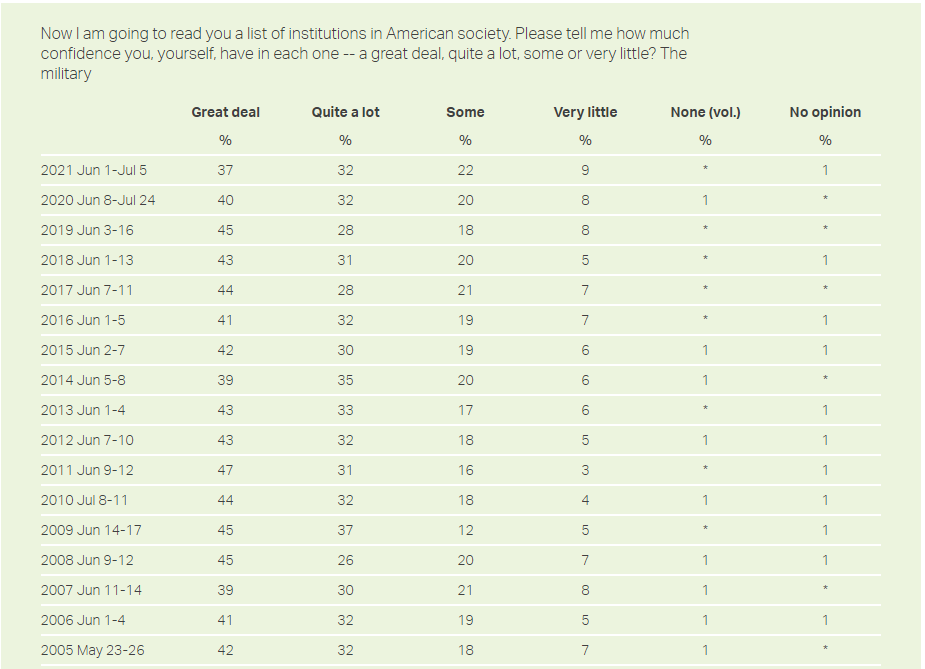
There are plenty of pollsters that track trust in the military, often as part of a larger poll looking at trust in government institutions. If you look at Gallup, you’ll see a slight decline in trust, although Gallup lumps “a great deal” and “quite a lot” into the same category of trust when reporting numbers. It’s still a decline though, and when you look at a more in-depth breakout, we see the percentage of people responding “a great deal” declining while the “some” and “very little” crowd slowly grows.
Other polls also show this. This poll from the Reagan Foundation shows a massive drop in people who trust the military “a great deal,” and a large rise in people who don’t trust it “much at all.” Now, given its the Reagan Foundation, I was skeptical as to who they selected for the poll, but scrolling down to the bottom showed a pretty even split between Republicans, Democrats and Independent voters, so I’d like to think this is fairly representative of all Americans.
This lack of trust manifests itself in a lot of ways, from voting in politicians who actively campaign to cut defense spending to parents suggesting alternatives to their children desiring to join the military. When nearly half of parents would actively push their kids away from joining the military, that’s a pretty stark indicator that parents lack trust in the military. These actions make it much harder to recruit new members.
Take the disastrous Afghanistan withdrawal. While almost no Americans (except the CEOs at Northrup Grumman and BAE) supported staying in Afghanistan, most Americans wanted an orderly withdrawal from Afghanistan, similar to the US withdrawal from Iraq that left an intact government (no, not the Obama withdrawal, the Trump one). Did we get that? Nope. Not by a longshot. Afghanistan was at a stalemate, and the number of deaths and injuries had dropped to nearly zero. An orderly withdrawal over a year or two would likely have left a functioning government and a decent US and NATO victory in the region. Instead, we got a cowardly retreat.
What about the military’s COVID-19 vaccine policy? The military chose to die on this hill and forced out hundreds, likely soon to be thousands, of members over the COVID vaccine. Religious waivers were denied out of hand, to the shock of many. The military really said the quiet part out loud: they wanted compliance, and they would crush people as needed to get it.
What about the military’s increasingly woke pandering, alluded to in the Army article? The recent push to be more “inclusive,” along with extremism training, has really irked plenty of service members. While its hard to get numbers on this, many service members are voting with their feet. It is starting to show in retention numbers. The military has always been a triangle, with lots of junior people on the bottom and less on the top. But that relies on the bottom people staying past their first enlistment. And well, they aren’t. The trend is slow, but with the Navy numbers here, you can see that there are less E4 and E5 Sailors staying around. The E6 and above numbers are steady, but as those members reach 20 years, many will choose to retire, and the new retirement system doesn’t incentivize staying in the military long term, so the young people joining today will be leaving in droves after a 4-6 year enlistment.
Let’s also look at one more statistic that is pretty shocking: the military’s use of non-judicial punishment. Most people don’t realize that if the military suspects a service member committed a crime, they really can violated the rights that citizens normally have in terms of due process. The process of punishing a service member through non-judicial punishment (called NJP) involves gathering some evidence and declaring that there is a “preponderance of evidence” to find them guilty. This legal standard means that the judge (in most cases, a military officer not trained in the law) finds there to be enough evidence that he or she is convinced by at least 50% that the service member committed a crime. Contrast this with “beyond a reasonable doubt,” which requires members to be convinced that there is essentially no real doubt that a member committed a crime.
If this sounds like it can be abused, you better believe it is. It’s hard to get data, but the Air Force released some information on the number of NJP cases per thousand airmen. If I add up the numbers, I get a rate of 45.32 cases per thousand in 2019, or 4,532 cases per 100 thousand. That seems really high, especially given that crime overall is falling in the US. Comparing it to total property crime rates in the US (1,953 per 100 thousand) and total violent crimes (398 per 100 thousand), it seems really high. Are Airmen engaging in more criminal behavior then their civilian counterparts? What kind of people are we recruiting that we get this high number? Or perhaps the system is grinding on otherwise innocent people in the disguise of “maintaining good order and discipline.” If that’s the case, how long will service members want to stay in a system like this?
The point here is that the military has become a hostile work environment, which is motivating people to seek employment elsewhere. Blaming obesity and mental health is a cop-out, because its something external to the organization that allow you to throw up your hands and say “People are fat and mentally unstable, thus I cannot reach my recruiting goals!” The SEALs and Marines have had tough standards for years, yet they always made numbers, largely due to people trusting those organizations and wanting to be there. That trust is gone due to actions the military took. Between losing wars, eliminating benefits and promoting an justice system that is broken and corrupt, the military has only itself to blame for creating a workplace that nobody wants to work in anymore.
This post represents the views of the author and not those of the Department of Defense, Department of the Navy, or any other government agency. That should be obvious, since those organizations will tell you everything is just fine with them. If you liked this article, please consider donating to Da Blog and purchasing a book by the author for you or your friends.
When my dad retired from the Marine Corps after 20 years of service, I don’t think he knew what to do with himself. He legitimately had a mid-life crisis, flipping back and forth a bit until he settled into a job as a program manager for the government. For him, going from a 20 year career that had everything laid out for him to being his own person was a bit of a jarring change.
The United States is having that same jarring change right now. In the past, the US was the world’s only true superpower, and it sought to insert itself into…well, everything. From running banana republics in Central and South America to putting troops in darn near every country in the Middle East and Africa, the US had decided it would be in all places at all times. This was pretty costly and required a lot of defense spending, but it gave the US the ability to respond to any crisis whatsoever.
It also gave every nation aligned with the US the excuse to not have a military. Countries around the world spent their money on universal health care and various forms of social security. Why not? They didn’t need a big defense budget, because the US covered that. These countries tolerated the US essentially running the financial and technology sectors because it allowed them to get rich with little risk. For a while, this worked well, especially as the Soviet Union fell apart, China continued to kill its own people and terrorism remained a local issue.
That’s all changing. The US has embraced a multi-polar world with China as a major player and Russia, the EU, UK, Japan and India as minor players. I say embraced because if the US truly wanted to be a superpower, we’d have built a hypersonic nuclear missile base on the moon and threatened to wipe China off the map if they step too far. Seriously. You can’t tell me that we watched China research weaponry for years that would defeat our defense system and were surprised when it worked? We had to know, and multiple people at high levels of government simply shrugged and said “oh well.”
This multi-polar world runs on different rules though. One rule is that superpowers get a sphere of influence and other superpowers have to stay out of it. China and Russia both consider themselves superpowers, so they take authoritarian actions in what they consider their sphere of influence. They will tolerate some minor transgressions (like US Navy Freedom of Navigation patrols), but ultimately they will do what they want without regard for anyone else.
Why is Putin willing to invade Ukraine and shell cities with no regards for civilian casualties? Because he’s a superpower and he gets to make the rules in his sphere. If you don’t like it, well, too bad.
Most Americans, including most liberals, are operating on rules fit for one superpower. In the past, if we, the US, told two nations to knock it off, they would. With one superpower, you can basically stare down an opponent and make them stop with limited military action. Think Korea and Vietnam, where we stopped Communist governments from expanding without declaring war or using nuclear weapons.
But using this set of rules on Ukraine doesn’t work. We can literally cut Russia off from everything and they will continue to do what they want, because we’re treating them as equals.
This isn’t to say we should send troops to Ukraine. There are good reasons to stay out. I was strongly supportive of President Trump’s decision to stay out of Syria, since we had no real interests there, and far better to let the Russians get bogged down then us. Ukraine might be different, and maybe we have good reasons to go there. If so, we need to be very open about them and understand it will put us in direct conflict with a nation that has nuclear weapons. That’s OK, by the way, if we’re open and honest about it and understand the potential consequences.
We can’t play by unilateral rules in a multilateral world, and we’re suffering consequences for it. Everyone applauded the crippling sanctions, but already nations are finding alternatives to the US Dollar and the SWIFT system of banking. They see whats happening to Russia and they know it could happen to them. Watch how more countries, including non-authoritarian countries, discover how to build their own industries, financial institutions and economies in order to beat future sanctions.
The US forgot that it grew up into a superpower, and now its having a mid-life identity crisis.
This post represents the views of the author and not those of the Department of Defense, Department of the Navy, or any other government agency. If you enjoyed this article, please support the author by purchasing one of his books for you or a friend.
When I was in college, I had enough time to pick some sort of extra curricular activity outside of ROTC. Instead of something geeky like using 3D printers, the chess club or computer gaming design, I chose to compete in ballroom dance. That got more than a few snickers from my other male friends, until one of them came to watch a local competition, and realized that all of the Latin ballroom dances (think cha-cha, rumba, etc.) were basically excuses for women to wear tight fitting clothing (and very little of it at that!) and dance in front of a bunch of judges…and with me! It was pretty glorious, especially as a shy male in my early twenties that needed a bit of help talking to women.
Ballroom was enough of a good time that I even ended up taking a ballet class at college to finish off an odd non-technical degree requirement that the university required for engineering students. I was one of two guys in the class, and since the other guy was about 100 pounds overweight, so I got all the female attention.
Ballroom and ballet have changed significantly since then, and unfortunately not in a good way. In college, it was obvious that there was a big push for women to wear more revealing clothing and for much more sexualized movements. Ballroom, with its focus on executing a set of movements in the same way each time, was a bit of a bulwark against this, but at advanced levels the rules sort of disappear and its all in how you want to interpret it. But at least the stodginess is there, and there is some modesty, however slight.
Ballet though…nope. Not even close. Even at the younger levels.
My daughters are currently at a Christian ballet studio, which I used to think didn’t matter all that much, until I went to a “ballet” competition to watch them dance. I put ballet in quotes because over the 2 hours we were there, I think maybe 30% of the dances could be considered ballet. The rest was an ugly mix of girls moving in very sexualized motions, wearing very little clothing and dancing to music that while it omitted swearing, left nothing else left to the imagination. It was a bit shocking.
I thought it was a one-off. I was wrong.
Last weekend at another competition, a girl that couldn’t have been older than 11 danced to the Janet Jackson song “Black Cat.” Now, a throwback to Janet Jackson could be pretty cool, but that wasn’t this. She was dressed like a stripper, and danced like a stripper. All she needed was a pole. While she was the worst one I saw, I looked at the song list and there were definitely others competing in that race to the bottom.
What the heck happened to kids ballet?
How did we go from dancing Swan Lake and The Nutcracker to little girls practicing moves that should be relegated to R-rated movies?
And all to parents applause! How on earth are people applauding this, and then shocked when their teenager engages in risky behavior later in life. Like, duh, where do you think they learned it from?
It doesn’t have to be that way. There were plenty of performances to more modern songs that still used all the ballet techniques. There were plenty of upbeat and fun performances that didn’t require girls to dress like they were auditioning for the world’s oldest profession. There is no excuse for this, and yet it seems like that is all that is taught at most dance studios.
When we wonder later in life why our young women make risky choices with their sexual behavior, we’ll need to remember when we clapped to them acting those decisions out on a dance stage. And then maybe we’ll make some better decisions of our own.
This post represents the views of the author and not those of the Department of Defense, Department of the Navy, or any other government agency. If you enjoyed this post, stop by the author’s page on Amazon and order a book!






 Da Techguy's (no longer backup) Blog