
Posts Tagged ‘reviews’

By John Ruberry

This week Elvis Costello turned 70.

The angry young man whose first album, My Aim Is True, was released in 1977, has released 32 studio albums. His most recent collection, The Boy Named If, was issued in 2022.

Costello, whose real name is Declan Patrick MacManus, was part of the new wave movement of rock, and to this day, he’s still lumped into that genre. But Costello has released country, jazz, rhythm and blues, baroque pop, and Americana albums as well. The London-born singer, songwriter, and guitarist is a walking musicology department. 

Although he’s made extensive use of session musicians, Costello has mostly worked with two backing bands. The Attractions, consisting of Steve Nieve on keyboards, Pete Thomas and drums, and Bruce Thomas (no relation) on bass. 

Depending on who you talk to, Bruce left the Attractions in the late 1990s–or he was kicked out. Davey Faragher replaced Thomas on bass in 2001, the new lineup was renamed the Imposters. Nick Lowe produced Costello’s first five albums and two others later on, T-Bone Burnett produced several mid-career collections.

Generally, when you purchase a Costello album–there are a couple of exceptions, The Juliet Letters and Kojak Variety come to mind–you’ve made a smart buy.

But let’s talk about Costello’s 10 best albums.

Oh, first, a clarification. Early in his career, Elvis’ American albums and British albums varied a bit by a song or two. My selections are based on the USA collections.

10) Secret, Profane & Sugarcane (2009): An Americana offering, Burnett was behind the boards on this collection. “Red Cotton” is one of the best condemnations of slavery ever recorded. “Hidden Shame,” a Costello-penned tune that was originally recorded by Johnny Cash, is another highlight.

9) Trust (1981): This is a forgotten album of sorts from Costello. But Elvis was remembering when he recorded it. He had an enormous influence on other new wave artists, and here Elvis gives a nod to those new wavers who followed. “You’ll Never Be a Man” is a nod to the Pretenders, “Fish and Chip Paper” salutes Squeeze, and “White Knuckles” is a tribute to XTC. Squeeze’s Glenn Tilbrook contributes vocals “From a Whisper to a Scream.” But the best of the bunch is the opening track, “Clubland.” 

8) Brutal Youth (1994): This might be a good collection for the Costello novice. The last Elvis album to be produced by Nick Lowe, it includes baroque pop with “London’s Brilliant Parade” and “You Tripped at Every Step,” as well as echoes from the new wave with “Pony Street” and “Sulky Girl.”

7) My Aim Is True (1977): Costello’s debut, with American country rock group Clover backing him, usually is ranked higher by his fans. The Van Morrison and Graham Parker influences are evident, particularly on songs like “Pay It Back.” But several of his most recognizable songs, “Miracle Man,” “Watching the Detectives,” “Alison,” and “Mystery Man” are here. Great stuff–but greater stuff was coming.

6) Spike (1989): The first results of Costello’s songwriting collaboration with Paul McCartney appear here, and not surprisingly, “Veronica,” Elvis’ biggest hit single in America, was one of the songs they partnered on. While it’s a single album, there’s a deluge of musical instruments–and styles–which makes Spike feel like a double album. Other great tracks here include “Any King’s Shilling,” “…This Town…” and “God’s Comic.”

5) Armed Forces (1979): Perhaps Costello’s’ best-known work, “Accidents Will Happen,” “Oliver’s Army,” and the Nick Lowe-composed “(What’s So Funny ‘Bout) Peace, Love, and Understanding” are among Costello-fan favorites found here. A couple of weak songs, “Two Little Hitlers” and “Chemistry Class” prevents Armed Forces from ranking higher. As do some bizarre Nazi Germany references used–besides the cuts mentioned earlier.

4) King of America (1986): Like the work of the Band–that group’s output was a major influence on Costello’s work, this is an Americana album before anyone knew such a genre existed. While the Attractions appear on one song, the soaring “Suit of Lights,” California-based session musicians, most prominently the Other Elvis’ backing group, the TCB Band, support Costello on this Burnett production. Other standout songs include “Brilliant Mistake,” “Jack of All Parades,” and “Indoor Fireworks.”

3) Get Happy!! (1980): After recording demos for his fourth album, Costello thought the tracks sounded “too new wave.” So, he rearranged most of the songs as if they were 1960s Memphis rhythm and blues tunes–a sound that was not that fashionable in 1980. But Get Happy!! has aged well. “Temptation,” “Riot Act,” and “High Fidelity” are particularly strong songs among the 20 found here.

2) This Year’s Model (1978): Regardless of the talent of the artist, second albums are usually disappointments. Inspired by punk, Costello revved up his act–backed for the first time by the Attractions—and his sophomore effort gave listeners a punchier sound with iconic classics such as “Pump It Up,” “Radio, Radio,” and “You Belong to Me.”

1) Imperial Bedroom (1982): Produced by Geoff Emerick, who did engineering work for the Beatles, Costello’s best album is clearly inspired by mid-1960s work of the Fab Four, as well as old-school songwriters such as Cole Porter and George Gershwin. It’s a dazzling preview of Costello’s later baroque pop work. “Beyond Belief,” “Almost Blue,” “You Little Fool,” and “Man out of Time” are particularly notable. 

Happy birthday, Elvis! 

John Ruberry regularly blogs at Marathon Pundit.
By John Ruberry

Under the radar, a new Van Morrison album has arrived. On Morrison’s website, the release of Live at Orangefield, had been promised for a while, and last month, on vinyl and CD, on Van the Man’s Orangefield Records, it went on sale. 

I subscribe to iTunes, and with any artist whose work I’ve downloaded, I will usually find that performer’s latest effort on the “New Releases” tab of my Apple Music homepage. But not always with Morrison, a Rock and Roll Hall of Fame member who has released an astounding 45 studio albums since 1967. 

Morrison, a native of Belfast, Northern Ireland, also has cut six live albums. His first one, It’s Too Late to Stop Now–an expanded edition was issued in 2016–is one of the best live albums ever. His second live collection, Live at the Grand Opera House Belfast, obviously was recorded in his hometown. 

As was Live at Orangefield. The Belfast Cowboy’s first live performance took place with his skiffle group in 1959 at Orangefield High School when he was a student there. In 2014, the school closed, and to salute the school–and even more so Belfast–Morrison, with his always tight band, returned.

A Facebook Morrison group–Van, by the way, is no fan of Facebook–alerted me that Live at Orangefield was available to download. Apple didn’t notify me. Possibly, because both musically and in interviews, Morrison was probably the most strident opponent among entertainment industry figures of the COVID lockdowns, that online slight was intentional. Three Morrison singles, one recorded with Eric Clapton, attacked government COVID-related restrictions. The triple-vinyl album, Latest Record Project Volume One and its follow-up, What’s It Gonna Take?–continued the pushback. 

While there were some favorable reviews, most critics savaged, unfairly, that output. Rock critics are mostly an intellectually vapid lot–and like sportswriters, most of them prefer writing about politics when the opportunity arises. Morrison, despite his legendary status, offered those mental midgets a ripe target. But history has been kind to this septuagenarian rebel. At the very least, the COVID lockdowns were an overreach. Still, in the media and the music business, Van Morrison, is almost certainly purposely ignored. 

In a Google News search, as of this writing, I could only find two reviews of Live at Orangefield.

And that’s a pity, because Live at Orangefield is an essential Morrison work. While Morrison has a reputation as an aloof and ornery fellow–which is either not true or it is possibly an exaggeration pushed by those self-worshipping rock critics–he offers some charm here.

In a mostly spoken-word piece on this album, “On Hyndford Street,” Morrison calls out to the crowd, “If any of the guys from ‘the street’ are here, give me a shout if you remember this one.” 

Playing ’round Mrs. Kelly’s lamp
Going out to Holywood on the bus 
And walking from the end of the lines to the seaside
Stopping at Fusco’s for ice cream [loud cheers follow] 
In the days before rock ‘n’ roll.

I looked it up–I don’t know if the establishment I found online is the same Fusco’s that Morrison and his pals used to patronize, but there is a Fusco’s in Belfast.

Van the Man was born on August 31, 1945 at 145 Hyndford Street. And particularly with “On Hyndford Street,” which as originally released on the Hymns to the Silence double album, but also on other tracks here, listeners get the feeling that they are participating in a walking tour of Belfast–with Morrison as a tour guide.

I’ve only seen Morrison once in concert–he was fantastic. Morrison has a reputation for not playing many of his hits from the overexposed “classic rock” era. But Van is a performer, not a fossil, and if he had fossilized his career, then he’d be on the stale casino circuit along with Lynard Skynard, which carries on even though that band has no original members left on its roster. But they play the hits, as do the Van Morrison tribute bands. 

But there are some of those Van hits on Live at Orangefield. The album opens with the instrumental “Celtic Excavation,” and then segues to “Into the Mystic.” Belfast of course is a seaport. I don’t know if this stanza is about Belfast, but it could be.

And when that foghorn blows
I will be coming home
And when the foghorn blows 
I want to hear it 
I don’t have to fear it.

Another hit, albeit a minor one, “Cleaning Windows,” follows. Morrison’s job before becoming a full-time musician was toiling as a window washer in Belfast. Then comes “Orangefield” and “Moondance.”

Other Belfast-related songs include “Got to Go Back” and “Northern Muse (Solid Ground).”

Another highlight here is “That’s Life,” the Frank Sinatra song, which Morrison recorded with Georgie Fame in 1995. Lyrically it’s an important addition to the set list, and musically too. In the 2000s and the following decade, much of Van the Man’s output had a jazzy and swing feel. New age jazz is a genre Morrison worked with in the 1980s; several of the songs I mentioned earlier utilize that sound. 

Live at Orangefield is an essential collection for the Morrison fan, and it’s a good place to start, particularly if you enjoy jazz-flavored popular music, if you want to learn more about this fantastic musician. 

And if you live in Belfast–then, man, what are you waiting for?

One more thing: Smart people listen to Van Morrison.

Live at Orangefield is available in vinyl and CD forms at Van Morrison.com. And you can download it at iTunes and stream it on Spotify.

John Ruberry regularly blogs at Marathon Pundit.

By John Ruberry

With the nomination of Sen. J.D. Vance as Donald Trump’s running mate, of course there is renewed interest in his memoir, Hillbilly Elegy, and the Ron Howard movie based on it.

I’ve yet to read book, but I saw the movie in 2020 on Netflix, which distributed the film, and I thought it was a captivating look at Vance’s life. 

Both the book and the movie draw on Vance’s upbringing in the southwestern Ohio post-industrial city of Middletown. His maternal grandparents were from Jackson, Kentucky–in the Appalachian portion of the state, which is where Hillbilly Elegy begins. The young Vance (Owen Asztalos) gets a quick lesson in the importance of family loyalty after losing a fight. The Vances, unfortunately, are quite the dysfunctional family, particularly his drug-addicted mother, Beverly (Amy Adams). Eventually, Vance ends up in the care of his grandmother, Bonnie “Mawmaw” Vance (Glenn Close), a chain-smoking, cussing, mean, but ultimately loving authority figure.

The movie contains many flashbacks as the adult J.D. (Gabriel Basso), a US Marine veteran who is a Yale law student, finds his promising future tangled up with his troubled past. His girlfriend, Usha (Freida Pinto), provides him much needed emotional support.

As I said earlier, this is a captivating film, and Howard, a gifted director, makes skilled used of imagery, including perhaps his favorite, water, and a stunning symbolic use of the Middletown rail bridge tunnel.

However, by 2020, Vance was vocal about his conservative beliefs, and he had moved from the Never Trump camp of the Republican Party to being a supporter of the 45th president. Which, in my opinion, led to movie critics, a group which politically consists mostly of leftists, to offer a large dose of negative reviews of Hillbilly Elegy. The Chicago Sun-Times’ Richard Roeper was a notable exception, he gave the movie a four-stars-out-of-four review.

An even worse response came from the 2021 Golden Raspberry Awards, better known as the Razzies. The bad movie answer to the Academy Awards nominated Hillbilly Elegy for three Razzies: Worst Director (Howard), Worst Adapted Screenplay (Vanessa Taylor), and Worst Supporting Actress (Close). However, Close, was also nominated for a Best Supporting Actress Oscar for the same role, and Hillbilly Elegy also garnered a Best Makeup and Hairstyling Oscar nomination.

Was this hatred was triggered by Vance’s politics?

I am certain of that, because also that year, Razzie “winners” included the documentary Absolute Proof, which questioned the results of the 2020 presidential election. Mike Lindell of My Pillow fame “won” Worst Actor for his role in that movie, and Rudy Giuliani “won” for Worst Supporting Actor for his brief role in Borat Subsequent Moviefilm.

Voters for the Razzies are not required to see the movies they vote on. Other “winners” of Razzies, not surprisingly, include other conservatives, among them are Ronald Reagan, Dinesh D’Souza, and Jon Voigt.

I apologize for that brief diversion, but the Golden Raspberry Awards needs a serious and prolonged slapping around.

To summarize, don’t believe the critics. Unless you are an unhinged leftist suffering from Trump Derangement Syndrome, Hillbilly Elegy is well worth your time.

The lessons from Hillbilly Elegy are conservative ones. Family bonds, hard work, and perseverance, while not a guarantee of success, make success more likely. 

I suspect that left-wing critics will have one more group lash-out at Hillbilly Elegy.

And from the only presidential term of Joe Biden comes another lesson: Don’t believe the media. Even movie reviewers can’t be trusted.

Hillbilly Elegy is available for streaming on Netflix, where as of this writing is ranked #4 in the movie category. It is rated R for violence, drug use, and foul language.

John Ruberry regularly blogs at Marathon Pundit.

By John Ruberry

For many Netflix subscribers, their focus is on the next week’s release of the second part of the final season of The Crown. While I have enjoyed the series, the first batch of Season Six of The Crown was a huge disappointment for me.

A more enjoyable use of your time–75 minutes to be precise–can be found by watching Radical Wolfe, a documentary about the legendary writer Tom Wolfe, a pioneer of the New Journalism movement of the 1960s who later, and seamlessly, made the transition into fiction, penning one of the greatest novels ever, The Bonfire of the Vanities.

Radical Wolfe, which had a brief theatrical run this autumn, is directed by Richard Dewey. It is filled with interviews of Wolfe; Jon Hamm narrates passages from Wolfe’s work. The documentary is based on an Esquire article by Michael Lewis.

Gay Talese, Tom Junod, Christopher Buckley, and Lewis are among the writers interviewed for Radical Wolfe.

Buckley’s father, conservative firebrand William F. Buckley, says here. “Tom Wolfe is probably the most skillful writer in America. I mean by that is that he can do more things with words than anyone else.”

“If you want to be a writer,” Wolfe, who died in 2018 said of himself, “you’ve got to be standing in the middle of the tracks to see how fast the train goes.”

“Nobody is writing like Tom Wolfe today,” Junod says in Radical Wolfe. “And no one has written like Tom Wolfe.”

Wolfe is someone America needs now. Oh, to have seen him running loose among the hypocrites at COP28.

The title of the film comes from Wolfe’s 1970 essay for New York magazine, Radical Chic: That Party at Lenny’s, when Wolfe, after co-opting an invitation to a fundraiser for bail money for some Black Panthers held at Leonard Bernstein’s Park Avenue home, skewered the liberal virtue signaling culture, even before that term existed.

Oh yeah, phrases. Phrases!!! Besides “radical chic,” Wolfe coined the terms “the right stuff,” the title of his of his rollicking yet informative bestseller about the early days of the space program, and “masters of the universe,” the group that Sherman McCoy, the lead character in The Bonfire of the Vanities, placed himself in. 

Not mentioned in the documentary while Wolfe didn’t create the now-common phrase “pushing the envelope,” which is used repeatedly in The Right Stuff, he popularized it.

Wolfe began his career as a who-what-where when-why–journalist in the northeast. After convincing Esquire in the early 1960s to let him write an article about the California custom car culture, Wolfe suffered writer’s block. Which was the best thing, career-wise, that ever happened to the author. Eventually the floodgates opened, Wolfe brought sound effects to print journalism, shown in the title of that piece, There Goes (Varoom! Varoom!) That Kandy-Kolored (Thphhhhhh!) Tangerine-Flake Streamline Baby (Rahghhh!) Around the Bend (Brummmmmmmmmmmmmmm)…

The repeated use of ellipses (…) and multiple exclamation points (!!!) are a trademark of Wolfe’s early work.

As with the fetid film version of The Bonfire of the Vanities, Radical Wolfe tiptoes around race. Wolfe was a master storyteller and, strictly in the storytelling sense, race presents a crucial ingredient for any narrative–conflict. The Reverend Bacon character in Bonfires, an Al Sharpton knockoff, is a comic foil. Fareek “The Cannon” Fanon, an African American college football star in Wolfe’s 1998 novel, A Man in Full, comes across as a boor when he confuses lead character Charlie Coker’s old moniker as a 60-Minute Man, not as a football starter on both defense and offense, but as a man who could, let’s say, “do it” in bed for 60 minutes.

Black people can be boors in Wolfe’s world. As can white people. As can everyone. That’s the way it ought to be. Because that’s the way society is.

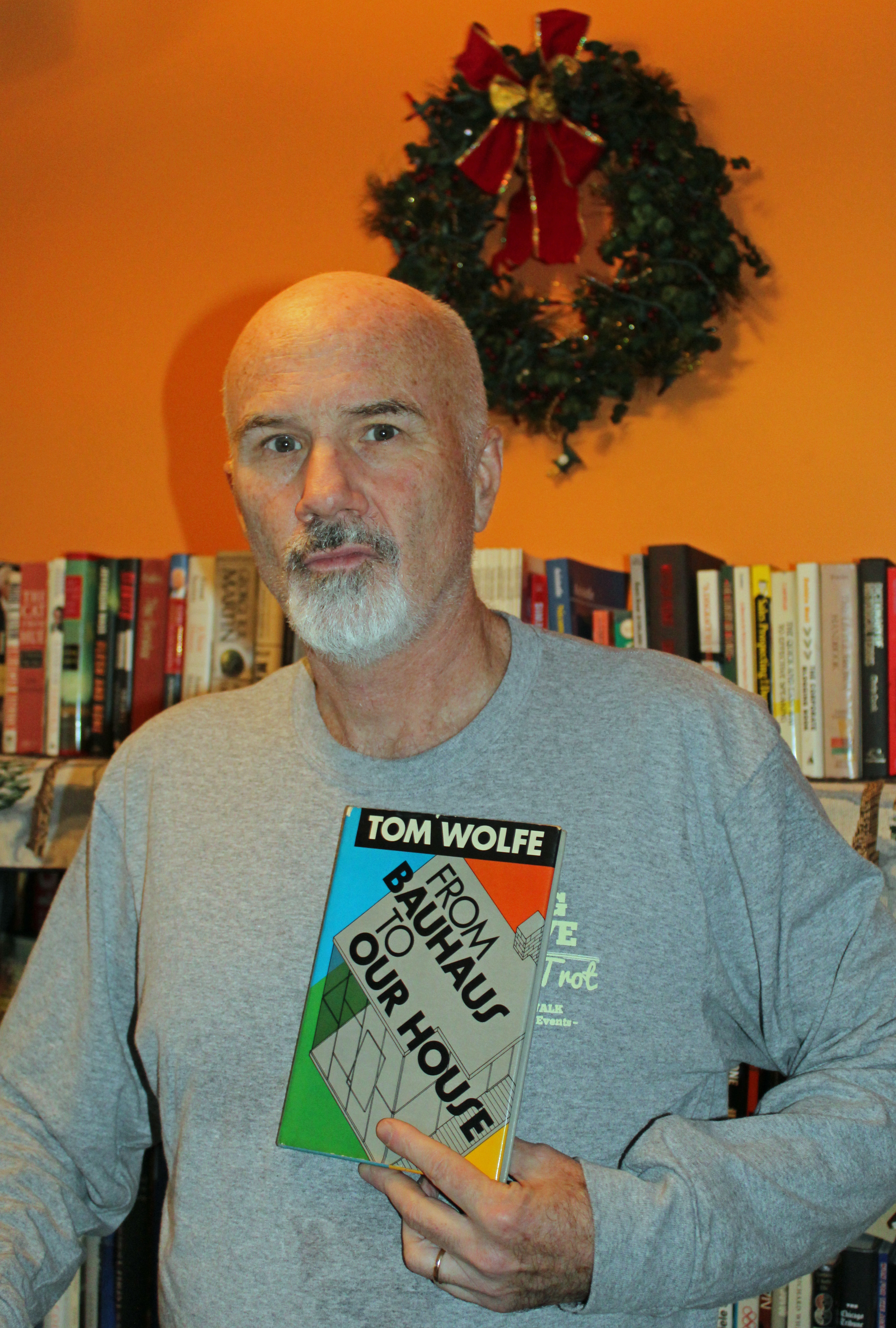
In Wolfe’s takedown of ugly glass-box and faceless architecture, From Bauhaus to Our House, he gives a rundown of the horrors of public housing, and joyously recalls the response when tin-eared bureaucrats in St. Louis–after decades of failing the residents of the city’s housing projects–finally did the unthinkable. They asked the tenants of the notorious Pruitt-Igoe homes, most of them Black, what they wanted done to the buildings. Their response? They chanted, “Blow it up.”

And the bureaucrats did just that. Why isn’t this poignant story in Radical Wolfe?

Wolfe was always coy about his political stance. “I belong to the party of the opposition,” he says in the documentary. But I suspect he was a slightly conservative, with a strong libertarian bent.

Despite the quibbles I mentioned, I loved Radical Wolfe. Oh, one more thing. To capture the Varoom!!! Varoom!!! uniqueness of Wolfe’s genius, a surreal mashup, along the lines of the one in The Life and Death of Peter Sellers, would have been a welcome addition.

Last year, Netflix sent a message to its workers that not all of its programming–not these words of course–will kowtow to wokeism. Radical Wolfe is a big step in the right direction for the streaming service. Next year Netflix will stream a six-episode limited series based on Wolfe’s A Man in Full. It will star Jeff Daniels and Diane Lane.

Keep it up, Netflix.

But I have one more quibble. Radical Wolfe is rated TV-MA for–wait for it–language and smoking.

Really? TV-MA?

Yep.

John Ruberry regularly blogs at Marathon Pundit.