
Archive for the ‘business’ Category

4th Doctor: Sit down. Sit down. What did you call those robots?
Leela: Creepy mechanical men.
4th Doctor: Yes. You know, people never really lose that feeling of unease with robots. The more of them there are, the greater the unease and of course the greater the dependence. It’s a vicious circle. People can neither live with them nor exist without them.
Leela: So what happens if the strangler is a robot?
4th Doctor: Oh, I should think it’s the end of this civilisation.

Doctor Who: The Robots of Death 1977

I’m a great believer in the idea that there is no point in buying a movie if you don’t watch it regularly.

So when I started buying movies on Amazon Prime I got into three different rotations on watching them

  1. Watching them in order that I bought them
  2. Watching them in order that they were released
  3. Watching then in the order of the year that the movie takes place in (for the LOTR movies I consider it pre-history)

I’ve been doing this for a couple of years now, it was a great time killer during the COVID lockdowns but it got a tad interesting a year or so back because I bought the TV series The Time Tunnel so I keep having to jump back into that series when they jump into a particular year comes up.

Yesterday I finally go to the 20th century and went to put on the 1938 version of Dawn Patrol staring Errol Flynn and Basil Rathbone which I bought back in 2019.

So imagine my surprise when instead of the propeller that opened the credits of the 1938 Errol Flynn movie I suddenly saw an opening announcing the 1930 version of the movie staring Richard Barthelmess in the role Errol Flynn would replace him in, Douglas Fairbanks Jr. in the role that David Niven would grab and Neil Hamilton who would gain worldwide fame as Commissioner Gordon in the 1960’s batman TV series in the role Basil Rathbone would take over 8 years later.

Now I had never seen the 1930 version so I began watching it but found myself a tad put out by the idea that I had bought one movie and had another one switched on me without my knowledge or permission.

I tried to search for the 1938 version on Amazon and found it was no longer offered as a streaming movie in the US (but it was still offered in England) which does me no good of course. I suspected that for some reason Amazon lost the rights to the Errol Flynn version and substituted the other.

And while all of the flight scenes (except the closeups) and all of the scenes of the Germans and 2nd unit stuff were actually identical I wanted the movie I purchased so I contacted Amazon and had them call me back.

This was quickly escalated beyond the basic guy and the advance tech I got had me look up my initial order from 2019. The screen shot looked like this:

You’ll note that while the description shows the cast of the movie I ordered the photo is from the one I didn’t but when I clicked on Order details: it got well interesting
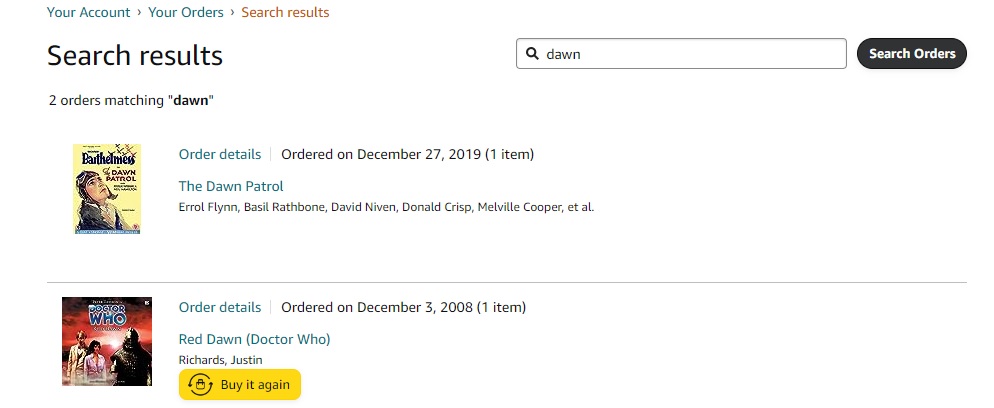

As I had suspected they lost the streaming rights to the 1938 version and substituted the Howard Hawks 1930 one. That this was done is was bad enough but not only did they substitute the 1930 version of this movie in my movie library but they edited my invoice after the fact to say that the 1930 version of the movie was what I ordered.

That really pissed me off.

Well the guy did the best he could. He refunded the price of the picture and left the 1930 one in my library with the assurance that if the 1938 version became available to Amazon Prime for streaming again it would restored to my library automatically, but there is no way this should have been done without notification and even if I had been noticed the editing of my existing invoice to indicate a purchase I never made is beyond the pale.

Now in fairness the act of substituting the 1930 version might have been (and likely was) some kind of global edit in their system so they might not have realized it would have edited the invoices of old purchases, but they SHOULD have known.

There are three lessons to this story

  1. When you “buy” a movie or TV show from Amazon prime make sure you know you’re not “buying” a movie in the same way as a DVD, you’re buying a license for unlimited streaming of the movie for as long as Amazon has the rights to it, nothing more. Make sure you know this before you buy.
  2. When you have a digital order or any order from amazon for that matter look up the invoice and when it says “Print it for your records” do so the very day you made the purchase because you can not trust that the records in the Amazon system stored digitally will be the same as the day you bought.
  3. If you actually want to be sure that you will own a movie that you want BUY A HARD COPY

For myself Trust is gone I have made my last streaming purchase from Amazon, it will be BluRay or DVD’s or VHS tapes (I have my old Dawn Patrol copy around here somewhere) for me and when it comes to any other purchases from Amazon you can be damn well sure I’ll print out a physical copy of the order the moment I make it.

I can’t think of a greater incentive to go to your local department store and buy your goods in person.

Closing thought: Given what we’ve seen from other digital services like Youtube I think rules 1 & 2 should concerning Amazon should always apply across the digital world, particularly if you’re a conservative as I would not trust any of these services to refrain from creating a false digital trail for their own ends.

By John Ruberry

“There it is, dear,” I whispered to Mrs. Marathon Pundit last Sunday during the seemingly endless parade of movie trailers as we awaited Oppenheimer (great film, by the way), at AMC Village Crossing in Skokie, Illinois last Sunday, “that is Disney’s next flop.” 

“That” was Haunted Mansion, which is yet another movie based on a Disney theme park attraction. Disneyland, Walt Disney World, and Tokyo Disneyland all have Haunted Mansions. The last time I was visited Disney World, Little Marathon Pundit and I went on the Haunted Mansion ride, way back in 2001, neither of us were impressed. 

And do you know what? Barring an unexpected flocking to the Haunted Mansion movie turnstiles, I have already been proven right about the film, which stars LaKeith Stanfield Tiffany Haddish, and Owen Wilson, and it includes appearances by Jamie Lee Curtis and Danny DeVito.

Disclosure: Other than the below trailer, I haven’t seen Haunted Mansion, nor the 2003 Disney film, The Haunted Mansion, which starred Eddie Murphy. Nor do I ever intend to see either. However, I might take a look at Muppets Haunted Mansion, a Disney Halloween television special which first aired in 2021.

You know when a movie is in trouble when a two-minute-long trailer can’t make it look appealing.

The Murphy vehicle made money, but it was critically panned. The new Haunted Mansion is currently receiving a 41 percent Tomatometer at Rotten Tomatoes. 

Here is the opening sentence of Manohla Dargis’ New York Times review: “There is a mansion, it is haunted, boo, blah, the end.”

Disney’s woke remake of Hans Christian Andersen’s The Little Mermaid, which featured an African American Ariel, at best will make a modest profit for the studio. Other recent House of Mouse family-oriented flops include Elemental, Strange World, and Lightyear. The latter includes a same-sex kissing scene.

Back to the new Haunted Mansion: Its director, Justin Simien, who is African American makes note of the setting of the movie, New Orleans. “I felt it was really important for the lead to be Black, because this is set in New Orleans and it’s an 85% Black town,” Simien told Yahoo Entertainment. Adding, “I wanted to make [the movie] as Black as I can because that’s New Orleans.” Oh, while New Orleans has been a majority African American town for decades, it is currently has roughly a sixty-percent Black population. 

Okay, Simien and Disney can make any kind of movie it wants. But instead of focusing on a movie that is “as Black as I can,” why not, instead produce a movie with a compelling storyline and great performances from actors, regardless of their race? While it’s impossible for any entertainment endeavor to please everyone, even with family-oriented projects, why not try to attract as many people as possible?

In defense of New Orleans, it is widely considered to be the most haunted city in America–again, regardless of race, so it is a good choice for the setting of Haunted Mansion.

Does Disney want to keep making bombs? It appears that it does.

Next year, in yet another remake, a live action version of Snow White will hit theaters. In the Grimm Brothers tale, the authors make it clear that Snow White had “skin white as snow, lips red as blood, and hair black as ebony.” A Hispanic woman will play the lead in the 2024 film. As for her seven dwarves, they’ve been recast with a multi-racial group of six men of average height–with just one dwarf to aid her in her struggles, which presumably will include battling the patriarchy, represented by the Huntsman, and maybe every once in a while, the Evil Queen. And in the new Snow White, will we learn why the Queen turned evil? I’m predicting the patriarchy will be at fault. Oh, don’t forget that Huntsman.

Walt Disney had many gifts, and a crucial one that made his studio a success is that he knew time-tested stories were also solid material for movies, which is why Walt made animated versions of classic fairy tales, including Sleeping Beauty, Cinderella, and of course, Snow White and the Seven Dwarves. And Walt didn’t rehash the same movies.

Contemporary Disney movies are diverse in casting, but not diverse in regard to imagination.

What’s next, besides a new Snow White, for Disney’s movie wing?

Back to Dargis’ New York Times review:

She looked back to NY Times critic Elvis Mitchell’s rundown of the Murphy Haunted Mansion, where he wrote that it was “only a matter of time before Parking Lot: The Movie and People-Mover: The Motion Picture” would hit the local cineplex. Well, that hasn’t happened. Yet.

On the other hand, there are over 150 Grimm Brothers tales, most of which haven’t been made into feature films.

Oh, one more idiotic thing about the new Haunted Mansion. Why was it released in July, instead of October? You know, when Halloween is? I know what stupid looks like–it has big mouse ears.

Meanwhile, the Sound of Freedom, made with a modest budget, is a financial success.

John Ruberry regularly blogs at Marathon Pundit.

By John Ruberry

Another company, this time the CMT Network, finds itself in trouble by angering its base by going woke. Now both are facing boycotts. The Bud Light one has been devastating for what until recently was America’s best-selling beer.

Last week, CMT, whose core audience comprises of country music listeners, pulled the video for Jason Aldean’s “Try That in a Small Town.” The song, which was released in May with no controversy, decries the pro-criminal sentiments celebrated in big cities, like New York City, where CMT is headquartered, and it shows BLM and Antifa riot news clips as Aldean croons.

That was too much for CMT. 

Country music fans lean right. I am one of them, although I favor the Americana genre over mainstream country. Country listeners are likely to be the men and women who repair your car, service your air conditioner, or build your home. They may not have Ivy League degrees like Bud Light’s vice president of marketing, the on-leave Alissa Heinerscheid, but these “deplorables” are not dopes. And they aren’t Manhattan-style know-it-alls. 

I imagine, until the Heinerschied-led marketing debacle with trans influencer Dylan Mulvaney, many country music fans drank Bud Light. 

As of this writing on the evening of July 23, Aldean’s “Try That in a Small Town” is the number one song on iTunes and it has been viewed 15 million times on YouTube. 

For Friday’s CMT Music 12 Pack Countdown, Aldean’s massive hit was not among the dozens of songs nominated for the final cut. 

Clearly, CMT is as out of touch with its consumers as much as Anheuser-Busch and Bud Light are.

CMT has Nashville offices but as I mentioned earlier, it is based in New York. Anheuser-Busch has its headquarters where it was founded 171 years ago, in St. Louis, although it is now owned by Belgian firm InBev. 

But Anheueser-Busch’s marketing offices are in Manhattan, where Heinersheid lives.

Would things be different now for Anheuser-Busch if Heinerscheid and her marketing geniuses were instead based in St. Louis? And while no one is coming forward from CMT claiming credit for pushing the “kill” button on Aldean’s video, my guess is that the decision came from someone at their New York headquarters. 

The anger that brought forth the Bud Light and CMT boycotts are byproducts of elites who are isolated from the consumers they are supposed to be experts on. 

Can these brilliant minds do their jobs from places like St. Louis? Nashville? Of course, they can. As they can in Cincinnati, Billings, and Oklahoma City. You know, medium-sized cities. To be sure, they’re not Aldean-favored small towns, but these other cities are filled with less sophisticated types than the “betters” that you find in New York City.

Oh, there are telephones, computer lines in those smaller cities. And there is this thing called Zoom.

However, Bud Light did farm out the Mulvaney campaign to an advertising agency thousands of miles from Manhattan.

It was to a firm based in suburban San Francisco.

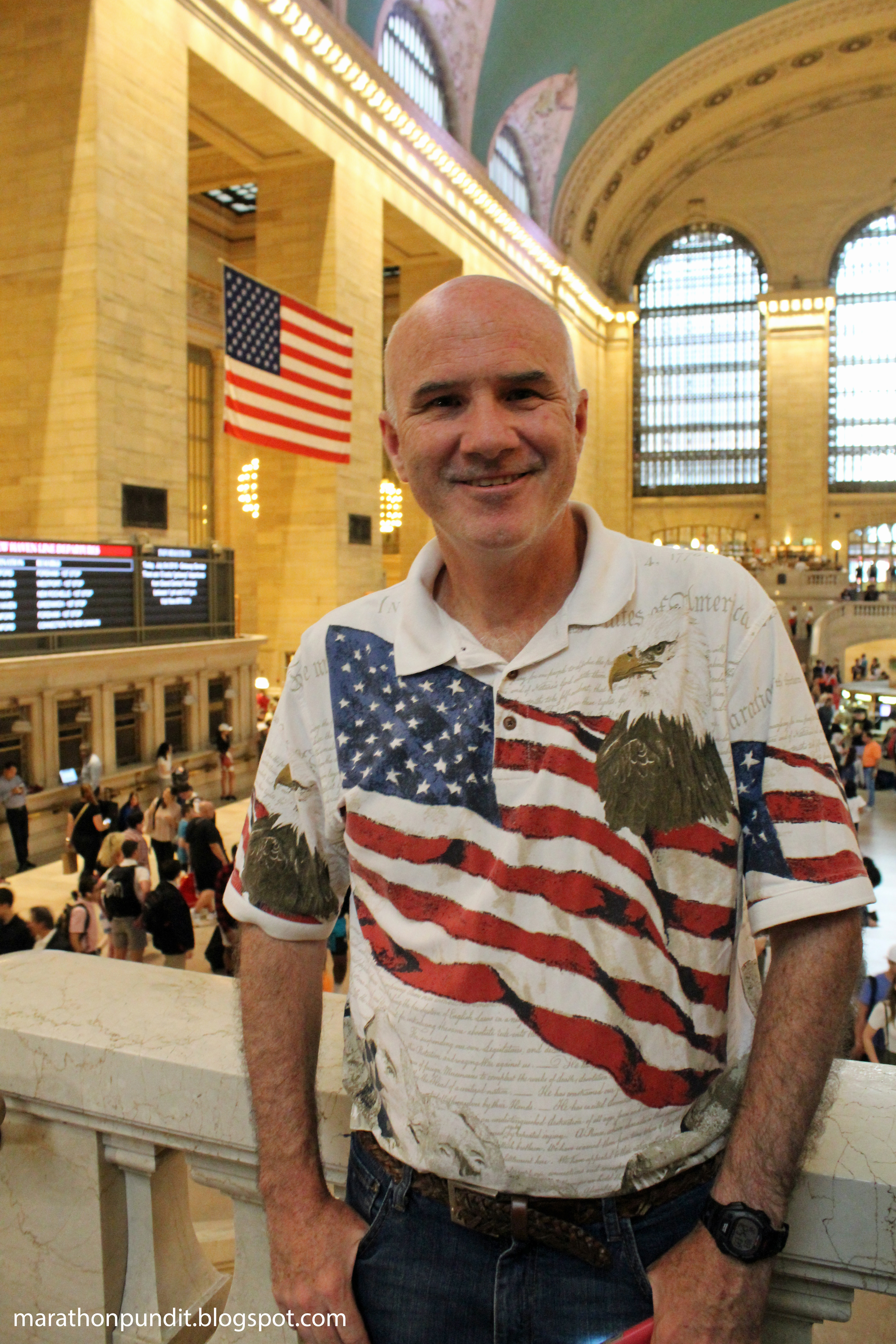
John Ruberry, who regularly blogs at Marathon Pundit, was a bachelor’s degree in advertising from the University of Illinois at Urbana-Champaign. He’s pictured here at Penn Station (correction Grand Central Station) in New York.

By John Ruberry

Ray Bradbury in a way predicted Disney’s latest outrageous move.

Bradbury’s Fahrenheit 451, published in 1953, is a dystopian novel that is overshadowed by two other great 20th century works about an unpleasant future, Brave New World and 1984. Fahrenheit 451’s lead character is Guy Montag, a fireman, only in Bradbury’s world, buildings are fireproof; Montag and other firemen are dispatched to homes to burn books. Nearly of them. Only comic books are permitted in that unhappy future. 

Michiko Kakutani, in a New York Times career appraisal written on the day after Bradbury’s death in 2012, remarked that Fahrenheit 451 “is at once a parable about McCarthyism and Stalinism, and a kind of fable about the perils of political correctness and the dangers of television and other technology.” Yep, Kakutani said “political correctness,” the term for “woke” from that not-too-distant time.  In a 1994 interview Bradbury, in very blunt language even for the 1990s, attacked that PC culture while discussing Fahrenheit 451. “Political correctness is the real enemy these days,” he said. “The black groups want to control our thinking and you can’t say certain things. The homosexual groups don’t want you to criticize them. It’s thought control and freedom of speech control.”

In a memorable passage from Fahrenheit 451, Montag’s boss explained–without government involvement mind you–how books became toxic. 

The bigger your market, Montag, the less you handle controversy, remember that! All the minor minor minorities with their navels to be kept clean. Authors, full of evil thoughts, lock up your typewriters. They did. Magazines became a nice blend of vanilla tapioca. Books, so the damned snobbish critics said, were dishwater. No wonder books stopped selling, the critics said. But the public, knowing what it wanted, spinning happily, let the comic books survive. And the three-dimensional sex-magazines, of course. There you have it, Montag. It didn’t come from the Government down. There was no dictum, no declaration, no censorship, to start with, no! Technology, mass exploitation, and minority pressure carried the trick, thank God. Today, thanks to them, you can stay happy all the time, you are allowed to read comics, the good old confessions, or trade journals. 

Last week, Hollwood Elsewhere noticed the omission of the “N-word” from the Gene Hackman classic police thriller The French Connection from the Criterion Channel streaming service. The use of the racial slur helps define Hackman’s character, Popeye Doyle, as a great cop but a flawed man. 

Not as controversially, Doyle regularly refers to two French criminals as “Frog 1” and “Frog 2.” Those ethnic putdowns remain in the film. So does the iconic scene of Hackman gunning down Frog 2 on a set of stairs. For now, at least. 

It’s widely believed that Disney, which owns the rights to The French Connection, is behind the stealth editing. To use Bradbury’s words, “It didn’t come from the Government down.”

Disney of course has gone full-blown woke in recent years, the outrage prior to this one, from last month, involved a mustachioed man wearing a dress and eye shadow, a fairy godmother’s apprentice named Nick, greeting guests, including children, at the Bibbidi Bobbidi Boutique at Disneyland. Before that, Disney’s prior woke atrocity there was an anti-white people song performed in the Disney+ children’s series, The Proud Family.

Disney’s theme parks are supposed to be “the happiest place on earth.” That’s it? Humans are only about happiness?

Back to Bradbury and Fahrenheit 451:

You must understand that our civilization is so vast that we can’t have our minorities upset and stirred. Ask yourself, what do we want in this country, above all? People want to be happy, isn’t that right?

We won’t be happy, I believe, as dumbed down dolts.

The entertainment industry, a fortress of the left, constantly reminds us, especially during award ceremonies, that they are the vanguard for free expression. Sure, a censoring of the “N” word doesn’t seem like a noble hill to die on but remember the dystopian world of Bradbury’s Fahrenheit 451. The slippery slope began in order to placate a few people who were offended.

Why stop with the “N” word? What about the French Connection’s Frog 1 and Frog 2? Smoking in movies? And what Donald Trump’s cameo in Home Alone 2?

Viewers might get triggered.

Don’t laugh about that Trump scene. The star of Home Alone 2, Macaulay Culkin. wants the Trump bit cut. And he’s not alone.

John Ruberry regularly blogs at Marathon Pundit.