The first in a series of occasional posts on forgotten movies that you should watch.
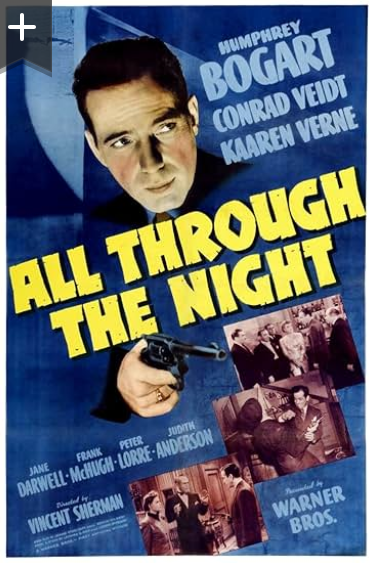
When you think of the names of Humphrey Bogart , Peter Lorie and Conrad Veidt in a motion picture naturally the classic movie Casablanca (1942) is the first picture that comes to mind and rightfully so as it is one of the greatest movies of all time. However if you go back to the beginning of that year, you will find another movie where the three of them appear that is worth your time to see. All Through the Night
Bogart plays “Gloves” Donahue who in addition to fixing bets and various swindle is known for his love of cheesecake and not just cheesecake but Miller’s Cheesecake. So when Mr. Miller disappears and turns up dead and a strange alluring woman (Karen Verne) turns up and disappears shortly afterward looking for him Donahue finds himself on a 24 romp that cumulates in murder, manhunts and finally reveals a Nazi 5th column in the heart of NY run by a man named Ebbing (Veidt) assisted by aides Pepi (Lorie) and Madame (Dame Judith Anderson).
The movie moves quickly and features a who’s who of soon to be comedy greats from William Demarest (his Lieutenant) to Jackie Gleason (one of his men) to Phil Silvers (The waiter) ably assisted by Frank McHugh whose attempt to enjoy his wedding night are stymied at every turn and Jane Darwell one of the grand dames of Hollywood who plays Bogart’s character’s mother who constantly has a feeling about things.
They’re plenty of fun, chases and suspense with a fair amount of danger thrown in. The writing is crisp and acting is strong and the one liners are very solid.
This is a movie that deserves to be watched and enjoyed by more people. I suggest you become one of them.
With the nomination of Sen. J.D. Vance as Donald Trump’s running mate, of course there is renewed interest in his memoir, Hillbilly Elegy, and the Ron Howard movie based on it.
I’ve yet to read book, but I saw the movie in 2020 on Netflix, which distributed the film, and I thought it was a captivating look at Vance’s life.
Both the book and the movie draw on Vance’s upbringing in the southwestern Ohio post-industrial city of Middletown. His maternal grandparents were from Jackson, Kentucky–in the Appalachian portion of the state, which is where Hillbilly Elegy begins. The young Vance (Owen Asztalos) gets a quick lesson in the importance of family loyalty after losing a fight. The Vances, unfortunately, are quite the dysfunctional family, particularly his drug-addicted mother, Beverly (Amy Adams). Eventually, Vance ends up in the care of his grandmother, Bonnie “Mawmaw” Vance (Glenn Close), a chain-smoking, cussing, mean, but ultimately loving authority figure.
The movie contains many flashbacks as the adult J.D. (Gabriel Basso), a US Marine veteran who is a Yale law student, finds his promising future tangled up with his troubled past. His girlfriend, Usha (Freida Pinto), provides him much needed emotional support.
As I said earlier, this is a captivating film, and Howard, a gifted director, makes skilled used of imagery, including perhaps his favorite, water, and a stunning symbolic use of the Middletown rail bridge tunnel.
However, by 2020, Vance was vocal about his conservative beliefs, and he had moved from the Never Trump camp of the Republican Party to being a supporter of the 45th president. Which, in my opinion, led to movie critics, a group which politically consists mostly of leftists, to offer a large dose of negative reviews of Hillbilly Elegy. The Chicago Sun-Times’ Richard Roeper was a notable exception, he gave the movie a four-stars-out-of-four review.
An even worse response came from the 2021 Golden Raspberry Awards, better known as the Razzies. The bad movie answer to the Academy Awards nominated Hillbilly Elegy for three Razzies: Worst Director (Howard), Worst Adapted Screenplay (Vanessa Taylor), and Worst Supporting Actress (Close). However, Close, was also nominated for a Best Supporting Actress Oscar for the same role, and Hillbilly Elegy also garnered a Best Makeup and Hairstyling Oscar nomination.
Was this hatred was triggered by Vance’s politics?
I am certain of that, because also that year, Razzie “winners” included the documentary Absolute Proof, which questioned the results of the 2020 presidential election. Mike Lindell of My Pillow fame “won” Worst Actor for his role in that movie, and Rudy Giuliani “won” for Worst Supporting Actor for his brief role in Borat Subsequent Moviefilm.
Voters for the Razzies are not required to see the movies they vote on. Other “winners” of Razzies, not surprisingly, include other conservatives, among them are Ronald Reagan, Dinesh D’Souza, and Jon Voigt.
I apologize for that brief diversion, but the Golden Raspberry Awards needs a serious and prolonged slapping around.
To summarize, don’t believe the critics. Unless you are an unhinged leftist suffering from Trump Derangement Syndrome, Hillbilly Elegy is well worth your time.
The lessons from Hillbilly Elegy are conservative ones. Family bonds, hard work, and perseverance, while not a guarantee of success, make success more likely.
I suspect that left-wing critics will have one more group lash-out at Hillbilly Elegy.
And from the only presidential term of Joe Biden comes another lesson: Don’t believe the media. Even movie reviewers can’t be trusted.
Hillbilly Elegy is available for streaming on Netflix, where as of this writing is ranked #4 in the movie category. It is rated R for violence, drug use, and foul language.
Abraham Lincoln: [speaking to a old freed slave who dropped to his knees before him] Don’t kneel to me, that is not right. You must kneel to God only, and thank Him for the liberty you will enjoy hereafter.
This trailer dropped from the folks at the Chosen:
In one respect this isn’t odd, you might recall from your movie history Cecil B DeMille’s silent movie King of Kings, the first movie adaption of the Gospels. It’s available at Youtube:
At the Turner Classic movies the lengths that DeMille took to keep things on the “right” path:
Cecil B. DeMille did not want to take any chances with the film. His two stars, ‘H. B. Warner’ and ‘Dorothy Cummings’ , were required to sign agreements which prohibited them from appearing in film roles that might compromise their “holy” screen images for a five-year period. DeMille also ordered them not to be seen doing any “un-biblical” activities during the film’s shooting. These activities included attending ball games, playing cards, frequenting night clubs, swimming, and riding in convertibles.
and Turner also reports that DeMille had some serious damage control to do:
Lead actor H.B. Warner, who played Jesus, was involved in an off-camera scandal with anonymous woman who was determined to blackmail Cecil B. DeMille by ruining the production. It is believed that DeMille paid the woman on the condition that she leave the U.S.
IMDB.com claims the woman was made to back off after being threatened with arrest. It also states that the pressure that Warner felt playing Christ was so intense that it brought back his drinking problem.
Now consider, this was one movie released in 1927 at a time when movies were not universal. Warner was already an established actor with a ton of credits behind him and decades of credits ahead of him (you might best remember him as Mr. Gower the druggist in It’s a Wonderful Life)
The Chosen has now been around for over four years. It has been seen by hundreds of millions all over the world. It is a global phenomena. Furthermore if you look at IMDB you will find that while Jonathan Roumie has credits dating back to 2001 you will see nothing in a significant staring role that might cause him to be memorable before the Chosen. His entire fames comes from playing Jesus and there are, I suspect, many particularly in a post Christian culture that have not known the Gospel before and are rediscovering faith for the first time, for whom he is the only Jesus they have ever known in their lives.
Imagine the pressure of playing the son of God under those conditions and add to that the aditional pressure when you consider Jonathan Roumie is a devout Catholic who is very conscious of the dangers of the sin of Pride and that his performance and how he carries himself in public could have a huge oversized effect on people trying to find God. An actor might worry about the effects of his words and actions hurting a production, a devout Christian would worry about his actions and their effect on souls.
And we haven’t even touched on those who despise this message and the messengers who deliver it, both natural and supernatural. I’ve written and spoken about how the clergy and particularly the higher ups are targets for the devil, that comes with the job. Jonathan Roumie is an actor. I suspect that Satan has painted a target on his back bigger than the one on any Bishop.
That he is able to function at all, let alone as a man of faith and devotion speaks volumes and by the time the final season of the Chosen has wrapped, if he didn’t have a complete understanding of redemptive suffering he’ll know it first hand.
I admire him for this task which I would not want for all the gold in the world.
I haven’t watched this documentary yet, but you can bet I’m going to.
Update: Apparently it’s in four parts and available on Amazon. Watching now
Speaking of Gold in the world this is the final day of Christmas and thus the final day of our fundraiser: We remain stuck $2345 away from our goal. I suspect we won’t manage that today but I’d be really delighted if we could get that number below $2000 before I get home. If you would like to help please hit DaTipJar below or to the left:
For many Netflix subscribers, their focus is on the next week’s release of the second part of the final season of The Crown. While I have enjoyed the series, the first batch of Season Six of The Crown was a huge disappointment for me.
A more enjoyable use of your time–75 minutes to be precise–can be found by watching Radical Wolfe, a documentary about the legendary writer Tom Wolfe, a pioneer of the New Journalism movement of the 1960s who later, and seamlessly, made the transition into fiction, penning one of the greatest novels ever, The Bonfire of the Vanities.
Radical Wolfe, which had a brief theatrical run this autumn, is directed by Richard Dewey. It is filled with interviews of Wolfe; Jon Hamm narrates passages from Wolfe’s work. The documentary is based on an Esquire article by Michael Lewis.
Gay Talese, Tom Junod, Christopher Buckley, and Lewis are among the writers interviewed for Radical Wolfe.
Buckley’s father, conservative firebrand William F. Buckley, says here. “Tom Wolfe is probably the most skillful writer in America. I mean by that is that he can do more things with words than anyone else.”
“If you want to be a writer,” Wolfe, who died in 2018 said of himself, “you’ve got to be standing in the middle of the tracks to see how fast the train goes.”
“Nobody is writing like Tom Wolfe today,” Junod says in Radical Wolfe. “And no one has written like Tom Wolfe.”
Wolfe is someone America needs now. Oh, to have seen him running loose among the hypocrites at COP28.
The title of the film comes from Wolfe’s 1970 essay for New York magazine, Radical Chic: That Party at Lenny’s, when Wolfe, after co-opting an invitation to a fundraiser for bail money for some Black Panthers held at Leonard Bernstein’s Park Avenue home, skewered the liberal virtue signaling culture, even before that term existed.
Oh yeah, phrases. Phrases!!! Besides “radical chic,” Wolfe coined the terms “the right stuff,” the title of his of his rollicking yet informative bestseller about the early days of the space program, and “masters of the universe,” the group that Sherman McCoy, the lead character in The Bonfire of the Vanities, placed himself in.
Not mentioned in the documentary while Wolfe didn’t create the now-common phrase “pushing the envelope,” which is used repeatedly in The Right Stuff, he popularized it.
The repeated use of ellipses (…) and multiple exclamation points (!!!) are a trademark of Wolfe’s early work.
As with the fetid film version of The Bonfire of the Vanities, Radical Wolfe tiptoes around race. Wolfe was a master storyteller and, strictly in the storytelling sense, race presents a crucial ingredient for any narrative–conflict. The Reverend Bacon character in Bonfires, an Al Sharpton knockoff, is a comic foil. Fareek “The Cannon” Fanon, an African American college football star in Wolfe’s 1998 novel, A Man in Full, comes across as a boor when he confuses lead character Charlie Coker’s old moniker as a 60-Minute Man, not as a football starter on both defense and offense, but as a man who could, let’s say, “do it” in bed for 60 minutes.
Black people can be boors in Wolfe’s world. As can white people. As can everyone. That’s the way it ought to be. Because that’s the way society is.
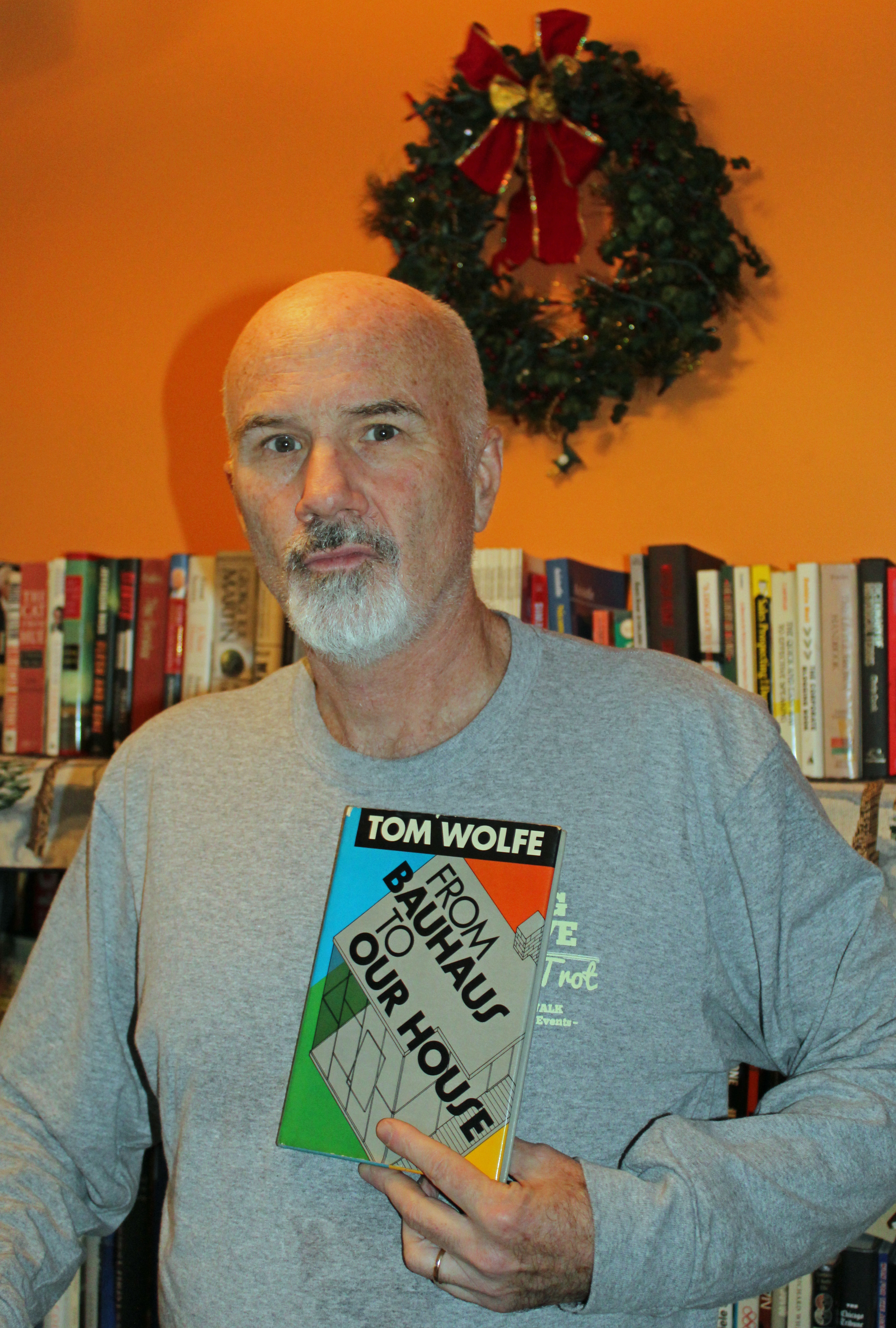
In Wolfe’s takedown of ugly glass-box and faceless architecture, From Bauhaus to Our House, he gives a rundown of the horrors of public housing, and joyously recalls the response when tin-eared bureaucrats in St. Louis–after decades of failing the residents of the city’s housing projects–finally did the unthinkable. They asked the tenants of the notorious Pruitt-Igoe homes, most of them Black, what they wanted done to the buildings. Their response? They chanted, “Blow it up.”
And the bureaucrats did just that. Why isn’t this poignant story in Radical Wolfe?
Wolfe was always coy about his political stance. “I belong to the party of the opposition,” he says in the documentary. But I suspect he was a slightly conservative, with a strong libertarian bent.
Despite the quibbles I mentioned, I loved Radical Wolfe. Oh, one more thing. To capture the Varoom!!! Varoom!!! uniqueness of Wolfe’s genius, a surreal mashup, along the lines of the one in The Life and Death of Peter Sellers, would have been a welcome addition.
Last year, Netflix sent a message to its workers that not all of its programming–not these words of course–will kowtow to wokeism. Radical Wolfe is a big step in the right direction for the streaming service. Next year Netflix will stream a six-episode limited series based on Wolfe’s A Man in Full. It will star Jeff Daniels and Diane Lane.
Keep it up, Netflix.
But I have one more quibble. Radical Wolfe is rated TV-MA for–wait for it–language and smoking.



 Da Techguy's (no longer backup) Blog