Artificial Intelligence, AI for short, is dangerous.
Musical instruments can be used to create beautiful and soul-stirring music, such as Beethoven’s 9th Symphony; they can also be abused to grind out aural rubbish such as Screaming Lord Sutch’s Lord Sutch and Heavy Friends, which a BBC poll found to be the worst album of all time.
Artificial intelligence can be twisted to produce ugliness, distortions, and lies.
On my smartphone, I asked Meta AI, thru Facebook, “Is Biden healthy?”
This is the answer I received:
President Joe Biden has generally been considered healthy for his age. In 2021, his physician, Dr. Kevin O’Connor, released a medical report stating that Biden was “healthy” and “vigorous” and that he was fit to serve as president.
However, like many people his age, Biden has had some health issues, including:
– A history of brain aneurysms (Successfully treated in 1988). – A pulmonary embolism (treated in 1988). – Atrial fibrillation (an irregular heartbeat). – High cholesterol. – Acid reflux. – A minor foot fracture in 2020. – COVID-19 in 2022 (mild symptoms).
Despite these issues, Biden has maintained an active schedule and has been cleared by his doctors to continue serving as president.
While I am not a doctor, but clearly the president is that the president is “an old 81” and at the very least, should submit to a full cognitive exam from a qualified and unbiased team of psychiatrists.
Meta AI doesn’t mention Biden’s frequent mental wanderings, the most recent of which was last month’s disastrous Biden press conference that was abruptly ended by Karine Jean-Pierre.
Let’s check into Meta AI’s opinion on the presumptive Republican nominee for president, Donald J. Trump.
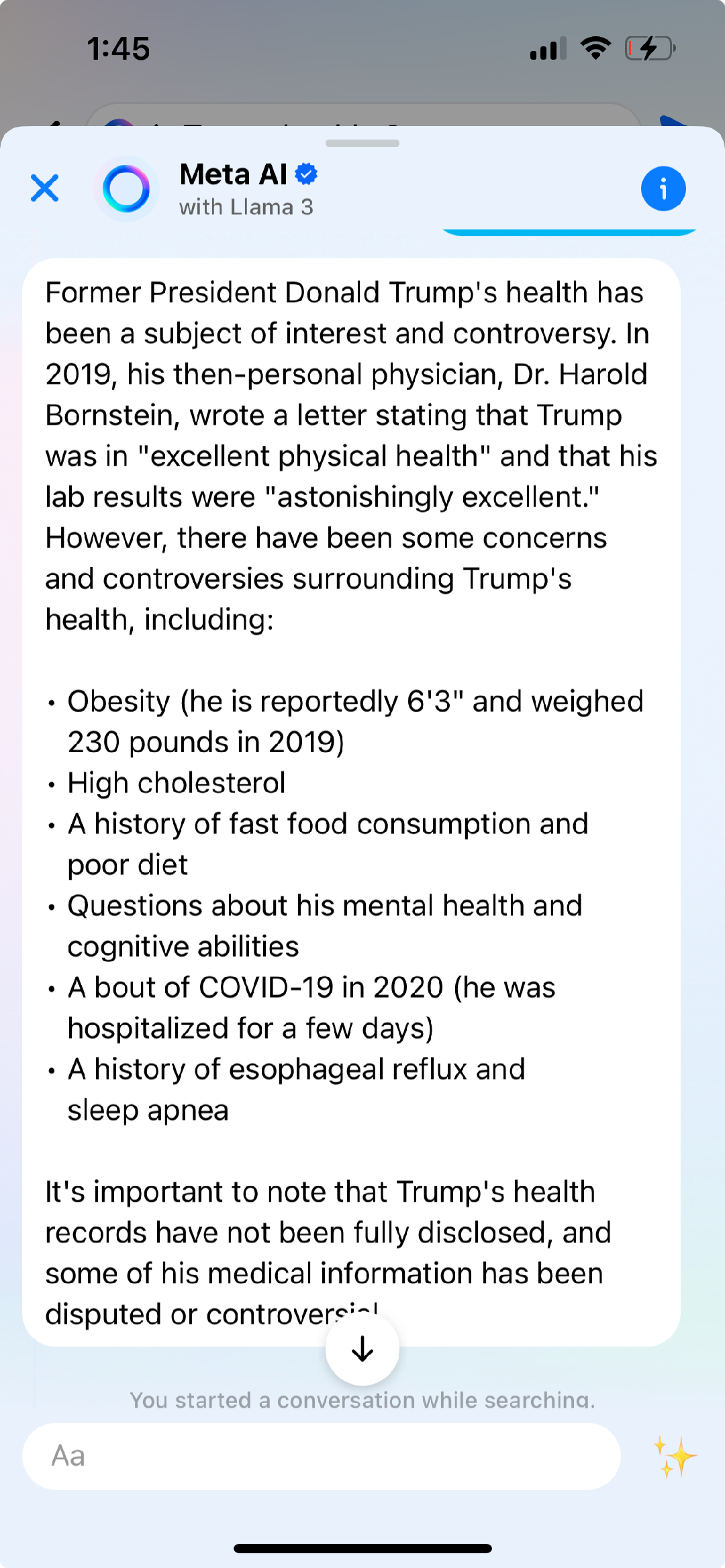
“Is Trump healthy?”
Former President Donald Trump’s health has been a subject of interest and controversy. In 2019, his then-personal physician, Dr. Harold Bornstein, wrote a letter stating that Trump was in “excellent physical health” and that his lab results were “astonishingly excellent.” However, there have been some concerns and controversies surrounding Trump’s health, including:
– Obesity (he is reportedly 6’3″ and weighed 230 pounds in 2019). – High cholesterol. – A history of fast food consumption and poor diet. – Questions about his mental health and cognitive abilities. . – A bout of COVID-19 in 2020 (he was hospitalized for a few days). – A history of esophageal reflux and sleep apnea.
It’s important to note that Trump’s health records have not been fully disclosed, and some of his medical information has been disputed or controversial.
Shameful.
As the Washington Post says, “Democracy dies in darkness.” It can also choke to death from lies.
Yes, Trump’s diet sucks and he’s overweight. Yet one Meta AI distortion about Trump jumps out: “Questions about his mental health and cognitive abilities.” Trump’s political rallies are an exercise of streams of consciousness. No one ever questioned James Joyce’s cognitive abilities. The same goes for legendary baseball manager Casey Stengel. Trump’s mind is as sharp as a pin, while Biden can’t even make it through a brief speech in front of a teleprompter.
“Controversy” and “controversial” are used in Meta AI’s account of Trump’s health, but not in Biden’s health rundown.
I could go on and on, but two more things: I’ve always been skeptical about the established line that Biden’s “minor foot fracture” was the result of the then-president-elect playing with his dog. And while Meta AI while mentions that Trump suffers from sleep apnea, it’s been widely reported–but not by Meta AI–that Biden uses a CPAP machine to treat his sleep apnea.
If America ever collapses, an Edward Gibbon of the future will need to include a chapter or two about social media in that account of the decline and fall.
I played around the Meta AI a bit more, not every answer about Trump’s health was a biased as the one documented here, but perhaps Meta AI was getting wise to me.
I’m sure Meta AI has a file on me that includes the words “right-wing lunatic.”
John Ruberry regularly blogs, without the use of AI, at Marathon Pundit.
If you only have a minute and you want to know, in a nutshell, what the Netflix adaptation of Tom Wolfe’s novel from 1998, A Man in Full, is all about, here it is: The lead character, Atlanta businessman Charlie Croker, is Donald Trump–orange hair and all. Then throw in elements of the George Floyd and Rodney King stories and add an even more shocking ending than the one in Boogie Nights.
Earlier this month, Netflix started streaming the six-episode series, which stars Jeff Daniels and Diane Lane.
Wolfe, who is my favorite writer, after a two-decade career in journalism, made a smooth transition into fiction with his first novel, The Bonfire of the Vanities. It encapsulates the boom years of 1980s–along with the mayhem of pre-Rudy Giuliani New York City. Three years later, the film version was released. It is godawful, starting with the miscasting of Tom Hanks in the lead role as “the Master of the Universe,” Sylvester McCoy. After I suffered through the movie, I said to myself, Vanities is a mini-series not a two-hour movie.
I had hopes, misguided ones it turns out, that A Man in Full would be better, because it is a mini-series. Adding to my anticipation was Netflix streaming last year the insightful documentary, Radical Wolfe.
As A Man in Full begins, Charlie Croker (Daniels) is celebrating his 60th birthday at a party with Shania Twain entertaining his friends, family, and business associates. Two of those guests are executives from PlannersBanc, his principal lender, Raymond Peepgrass (Tom Pelphrey) and Harry Zale (Bill Camp). While it appears that Croker is an Atlanta version of a Master of the Universe, he’s broke–Charlie owes PlannersBanc $600 million. He’s overextended with other lenders too. Peepgrass and Zale want to carve up Croker’s empire, starting with his quail hunting plantation and his corporate jet. A rescue is offered by the mayor of Atlanta, Wes Jordan (William Jackson Harper), who is campaigning for reelection, and Croker’s attorney, Roger White (Aml Ameen). But to save his neck, Croker will have to betray his former Georgia Tech football teammate, Norman Bagovitch (John Lacy), who is running against Jordan.
Bagovitch–wait for it–decries the status of the white male in his campaign. Jordan is Black.
David E. Kelley wrote the script, and he should be ashamed. No serious candidate for public office would campaign on such bigoted idiocy. And in Atlanta?!? Why does Kelley insult his audience?
Oh yeah, he wants to demonize Trump. Orange Croker Bad. Oops, I mean Orange Man Bad.
Joyce Newman (Lucy Liu) is an alleged victim of a sexual assault from Bagovitch. In the book, well, let’s just say there is fear of a race riot because of the racial angle of that alleged rape.
Wolfe, brilliantly in my opinion, centered much of his plot on racial contrast and conflict, but also on Croker being an anachronism. The series is set in 2024, but events in the book take place a quarter of a century earlier. Croker, nicknamed the 60 Minute Man because he starred on offense and defense for Georgia Tech, played a lead role for a national championship Yellowjackets team, at a time when major college sports teams in the South were not integrated. Croker came of age just as the civil rights protests were picking up steam, and when Jim Crow laws were still in force in Georgia and other southern states. The world changed, but Croker, not so much. Sure, of course Croker in the novel knew blacks had equal rights, but they still belonged– and I’m not endorsing his sentiment–“in their place.”
Kelley, and the directors, eliminates that angle by turning Croker into Trump. He even does away with Charlie’s redemption in Wolfe’s novel.
There’s even a climate change dig included in the series. I mean, why not?
As Croker, Daniels, who is usually very good, is an embarrassment, beginning with his overwrought Foghorn Leghorn southern accent and his Trump-sized abdominal paunch. On the other hand, Diane Lane, as Charlie’s first wife, shines. I had the pleasure of seeing her at Chicago’s Goodman Theatre in Tennessee Williams’ Sweet Bird of Youth a decade ago.
Wolfe’s novel is over 700 pages long, so it’s understandable that some storylines are condensed.
For instance, Conrad Hensley in the book is the child of worthless white hippies who, in spite of them, still manages to develop a strong moral compass. He works for Croker Foods in the East Bay area of California Hensley’s life, like Charlie’s, collapses. He ends up on the wrong side of the law after he violently tries to retrieve his towed car. By the way, anyone who has had his car towed and is forced to pay usurious fees to retrieve it, will sympathize with Hensley. In the series Hensley (Jan Michael Hill) is Black, and well, I already mentioned Rodney King and George Floyd.
The subplot with Peepgrass and Martha Croker remains, with the Boogie Nights twist added. If you crave more details on that, click on this Daily Mail link.
Oh, the Crokers’ son, Wally (Evan Roe), sure looks a lot like Barron Trump in the series.
Astonishingly, Trump-hating Fulton County district attorney Fani Willis doesn’t appear here. Maybe she was on a cruise with Nathan Wade during filming.
I guess I needed to suffer for some forgotten sins, because I endured all six episodes of A Man in Full. Of the other Netflix series that I punished myself with, in full, only The Pentaverate and Vikings: Valhalla were worse.
On the flipside, the cinematography for A Man in Full is sharp–Atlanta never looked so good. The soundtrack, compiled by Craig DeLeon, is spectacular, it’s as splendid as the best work of T-Bone Burnett. Keep an eye on DeLeon.
Wolfe, who died in 2018, didn’t like The Bonfire of the Vanities film. I don’t think he’d care for the series based on A Man in Full either.
I hated it.
A Man in Full is currently streaming on Netflix. It is rated TV-MA for violence, foul language, sex, and nudity.
I firmly believe that abortion is murder. No one has a right to commit murder therefore there can be no right to an abortion. For the past 50 years we have witnessed the most heinous genocide ever perpetrated, the slaughter of hundreds of millions of unborn children worldwide.
Because abortion is murder it should never have been legalized here in the United States. Roe v Wade was a particularly monstrous decision because it overturned abortion bans that 46 states had enacted. This I learned from Google.
Prior to Roe v. Wade, 30 states prohibited abortion without exception, 16 states banned abortion except in certain special circumstances (e.g. rape, incest, and health threat to mother), 3 states allowed residents to obtain abortions, and New York allowed abortions generally.
Roe v. Wade was profoundly unconstitutional because the Constitution did not grant any branch of the federal government the authority to overturn state abortion bans.
Thanks to the Marxists who call themselves Progressives, abortion has polarized the United States like no other issues. This past Monday President Trump issued a major policy statement on this most thorny issue: Read Trump abortion statement | The Hill
Many people have asked me what my position is on abortion and abortion rights, especially since I was proudly the person responsible for the ending of something that all legal scholars, both sides, wanted and, in fact, demanded be ended: Roe v. Wade. They wanted it ended.
“It must be remembered that the Democrats are the radical ones on this position because they support abortion up to and even beyond the ninth month. The concept of having an abortion in the later months, and even execution after birth — and that’s exactly what it is. The baby is born, the baby is executed after birth — is unacceptable, and almost everyone agrees with that.”
Pointing out just how radical the Democrats’ position on abortion is was a strategically sound decision by President Trump.
“My view is now that we have abortion where everybody wanted it from a legal standpoint. The states will determine by vote or legislation or perhaps both, and whatever they decide must be the law of the land. In this case, the law of the state. Many states will be different. Many will have a different number of weeks or some will have more conservative than others, and that’s what they will be.”
“At the end of the day this is all about the will of the people. You must follow your heart, or in many cases your religion or your faith. Do what’s right for your family and do what’s right for yourself, do what’s for your children, do what’s right for our country, and vote. So important to vote.”
At the end of the day it’s all about will of the people. That’s where we are right now, and that’s what we want. The will of the people.”
I believe taking the middle ground was a strategically wise decision by President Trump. Taking a hard line on this issue would have been a major turn off for moderates and would have energized the left.
“Like Ronald Reagan, I am strongly in favor of exceptions for rape, incest and life of the mother.”
“You must follow your heart on this issue, but remember, you must also win elections to restore our culture and in fact to have our country, which is currently and very sadly a nation in decline. Our nation needs help. It needs unity, it needs all of us to work closely together. Democrat, Republican, liberal, conservative, everyone. We have to work together. We have to bring our nation back from the brink, and that’s where it is. It’s at the brink. And we will. We will do it. I promise you, we will do it.”
“Always go by your heart, but we must win. We have to win. We are a failing nation, but we can be a failing nation no longer. We will make our nation great. We will make our nation greater than ever before. Thank you very much.”
Taking a hard line on abortion would have made it easier for the Democrats to steal another election because it would have shifted a significant number of votes to Biden.
President Trump is Constitutionally correct when he stated that abortion is an issue that must be left in the hands of the states. The Constitution does not grant federal government the authority to define or punish the crime of murder.
The reviews of President Trump’s abortion speech were mixed. Check out these two articles:
Today, Donald Trump issued his statement on abortion, disavowing federal involvement. It was both a correct decision and a politically smart one. Democrats have always used abortion to bring voters into its fold. Now, it cannot do that anymore.
The Republican once hailed as the most successful pro-life president in American history made clear on Monday that he is softening his position on abortion and beefing up his support for in vitro fertilization ahead of the 2024 general election.
“Saying the issue is ‘back to the states’ cedes the national debate to the Democrats who are working relentlessly to enact legislation mandating abortion throughout all nine months of pregnancy. If successful, they will wipe out states’ rights,” Susan B. Anthony Pro-Life America President Marjorie Dannenfelser said in her response statement.
Blogger with a Soviet-made Volga sedan in Sece, Latvia. Behind the car is a newly-built tractor barn.
By John Ruberry
Late last month I traveled to Latvia, where Mrs. Marathon Pundit was born and raised, for the first time in 25 years. I had also visited with her in 1994.
I expected a different Latvia, and indeed that was the case.
First, a little history. A series of nations ruled Latvia, the last being czarist Russia, until 1918. The Bolsheviks recognized Latvian independence in 1920.
But along with neighboring Estonia and Lithuania, while most of the world was focused on Nazi Germany’s aggression in western Europe, Latvia was forcibly annexed by the Soviet Union in 1940. The Nazis attacked the USSR a year later, but the Soviets recaptured the Baltic States later in the war.
Three months before the collapse of the Soviet Union, the Evil Empire recognized the independence of the Baltic States.
When Latvia regained its independence, the population as just 52 percent Latvian. Russians, many of them brought to Latvia to replace Latvians deported to Siberia in the 1940s, made up about a third of the population in the last days of the Latvian SSR. Many of them quickly left after independence, but Russians still make about one-quarter of the population of Latvia. Riga, Latvia’s capital and largest city, has a Russian population of about 35 percent. Russians are a clear majority in Daugavpils, Latvia’s second city.
The Latvia I saw in the 1990s was poor, my guess is, without the abject poverty, economically speaking it was on the level of Mexico.
But in 2004, the Baltic States joined the European Union, also that year they became members of NATO.
Since then, it’s been full steam ahead for Latvia, notwithstanding the 2008-09 recession.
What I saw in Latvia in June was a prosperous European nation. Gone are the gray–literally, they were gray–retail stores. They have been replaced by colorful and brightly lit retail outlets. Many of these stores, as well as hotels, utilize English-language names. Instruction in English began in Latvian schools after independence was achieved. All Latvians under 35 speak pretty good English.
I’m a runner, and I was one of the few when I hit the roads for a workout. Now there are many running, or if you prefer, cycling trails.
During my first visits I saw many Russian-made cars on the Latvian streets and highways. My wife and I traveled hundreds of miles during my nine days there–she will be in Latvia for another week—and I saw just two Russian-made cars, both Ladas. I’m pictured with an old Volga above. That make was discontinued in 2010. Volkswagen, Audi, and BMW are the most popular cars in Latvia.
Mrs. Marathon Pundit and I spent a lot of time in rural communities. She grew up on a collective farm in Sece, which is pretty much at the center of Latvia. They grew an assortment of crops, mostly potatoes, beets, and cucumbers, and while driving thru Latvia in the 1990s, the look of the land betrayed that odd lot cultivation. While Latvia doesn’t look like Iowa–there are few cornfields and about half of Latvia is forested–it’s becoming a nation of mega-farms. Wheat, canola, oats, are the major crops. And potato growing is hanging on.
My wife attended her high school reunion in Sece, she was one of three in attendance from her graduating class of seventeen. One our hosts was another, and the third, almost certainly the wealthiest man in Sece, has been buying, one by one, parcels of land that were part of those old collective farms that were divided up after independence, in Sece, from people to old to tend to the soil, or who have no interest to do so.
The prosperous farmer is the owner of that Volga in the photograph.
The graduating class sizes of my wife’s old school is now roughly 10 students per year. Rural Latvia, just like rural America, is shrinking.
Only rubble remains of the farmhouse where my wife grew up. Thousands of Latvians can attest to the same situation.
Scattered throughout Latvia are the ugly white-brick buildings, poorly built, that are long-abandoned. “That used to the community creamery in Sece,” Mrs. Marathon Pundit said to me. “That used to be the tractor motor pool, the tractors parked next to them haven’t moved in years.” She could have said the same to me every dozen miles or so when we drove past similar structures. Nearly every one of these collective farm buildings have been long abandoned. They are miniature Pompeiis that were never buried, sad monuments to the failure of communism, an economic and political system that never should have been implemented. Sadly, after over a century of proven failure, there are still people falling for Marxist nonsense.
In the cities and the small towns, khrushchevka apartment buildings, known in the West as “commieblock” structures, are still omnipresent. Most of them utilize those same unpleasant white bricks.
And in the cities, especially Riga, you’ll find many abandoned buildings that were Soviet-era factories.
Yes, I know, we have abandoned buildings in our American cities. But Riga has many new buildings–beautiful ones. I’m particularly fond of the National Library of Latvia.
Yes, but what about Donald Trump?
Okay, that was an abrupt transition, but most Latvians don’t like him. With the war in Ukraine showing no sign of ending, and when I was in Latvia when the apparent Wagner Group attempted coup occurred, his name, and that of Vladimir Putin, was brought up many times.
Oh, Joe Biden is viewed in Lativa as an ineffective old man.
But wait, what about Trump?
To a person, Latvians are pissed off about Trump’s compliments of Putin. For instance, shortly after Russia invaded Ukraine, he called Putin’s move “genius” and “savvy.” I explained that Trump is running to regain the White House, and the former president, dating back to his career as a real estate mogul, is the consummate negotiator, Trump, in my opinion, could be simply playing mind games with Putin. He used a similar strategy with Kim Jong Un. Trump’s flattery is analogous, I tried to reason, to entering a store and being complimented on the shirt I am wearing by a flirtatious saleswoman. Suddenly, my guard is dropped. True, Putin is likely made of tougher stuff than I am. I think.
Only the Latvians I spoke to weren’t buying my explanation. Don’t forget, Russia borders Latvia on the east, and Putin’s puppet state of Belarus is on Latvia’s southeast. In spite of their nation’s membership in NATO, it’s understandable that Latvians are quite nervous about Russia. Dual invasions from Russia’s Kaliningrad exclave and from Belarus into Lithuania could quickly isolate all three Baltic nations.
Latvia faces challenges, a declining population is the biggest one. While life is better now in Latvia, it’s even better in Scandinavia and Germany. European Union membership presents a dilemma for Latvia.





 Da Techguy's (no longer backup) Blog