
Archive for the ‘media’ Category

By John Ruberry

Late in 2021, the father of Chicago Tribune City Hall reporter Gregory Pratt, died. Father and son shared the same name, but the younger Pratt hadn’t seen his dad since he was five. That is, until shortly before the passing of the older Pratt, which the reporter, in a behind-the-pay-wall column, movingly wrote about in the Tribune. 

Last week, the Chicago City Wire, a newspaper often dismissed as “fake” and “pink slime” by liberals, noticed something in Pratt’s column, a link to a GoFundMe page organized by a cousin for the reporter, to defray the senior Pratt’s medical bills, That GoFundMe link should have immediately raised eyebrows. But it was the “fake” source that got the scoop.

The Chicago Tribune’s lead City Hall reporter Gregory Pratt solicited and received at least $1,790 in donations in a GoFundMe.com fundraiser benefiting his family from sources he covers– including elected officials, political consultants and lobbyists.

The donors included Cook County State’s Attorney Kim Foxx, who gave him $150, along with Evelyn Chinea-García, the wife of recent mayoral candidate, U.S. Rep. Jesus “Chuy” Garcia ($500) and former Illinois Deputy Governor and State Attorney General candidate Jesse Ruiz ($100).

Three members of the Chicago City Council Pratt covers – Ald. Gil Villegas (36th), Ald. Samantha Nugent (39th) and Ald. Matt O’Shea (19th)– also contributed to Pratt, along with Metropolitan Water Reclamation District Commissioner and lobbyist Michael Alvarez ($250) and Chicago political operatives Rebecca Carroll, Eli Stone, Carolyn Grisko and Joanna Klonsky, who recently worked for Chicago Mayor Lori Lightfoot.

Chicago City Wire, and several other papers, are published by Local Government Information Services, which was founded by conservative activist and WIND-AM radio personality Dan Proft in 2016.

I wrote about these publications here at Da Tech Guy last year.

A Twitter fight between Proft and Pratt ensued, which led former Chicago Tribune columnist John Kass to respond in the comments thread, “When a news organization gives editorial control to billionaire Bolshevik like George Soros, that news organization has no credibility. Any comment @chicagotribune @CTGuild @royalpratt???

Kass’ referral to @CTGuild is in regard to the Chicago Tribune Guild, the union representing Trib reporters. It is the organization that fought with the longtime conservative columnist at the Tribune over a 2020 column highly critical of Kim Foxx–you know, Jussie Smollett’s protector–where Kass brings up how Foxx and other big city Democratic catch-and-release prosecutors are funded by leftist billionaire George Soros. The Guild, of which Kass was not a member, in a biased manner deemed that column as anti-Semitic. The Guild’s protest led to a de facto demotion for Kass.

Pratt, whose Twitter handle is @royalpratt, displays the Chicago Tribune Guild logo on his Twitter page. 

As legendary baseball announcer Mel Allen used to say, “How about that?”

To be fair, for all I know, Kass and Pratt are best pals. Then again, probably not.

Proft and Kass’ objections to the GoFundMe linkage are fair. Could those donors who work in politics, and who Pratt is expected to cover without bias, expect more sympathetic coverage if he knows they contributed to his dad’s GoFundMe page?

I don’t know.

Here’s what the New York Times, on its ethics page, says about possible improprieties.

Personal relations with sources: Relationships with sources require the utmost in sound judgment and self discipline to prevent the fact or appearance of partiality. Cultivating sources is an essential skill, often practiced most effectively in informal settings outside of normal business hours. Yet staff members, especially those assigned to beats, must be sensitive that personal relationships with news sources can erode into favoritism, in fact or appearance. And conversely staff members must be aware that sources are eager to win our good will for reasons of their own.

Which brings me to beat reporting. Years ago, the Trib used to move around reporters in a seemingly bizarre fashion. For instance, Bruce Buursma went from the religion beat to covering the Chicago White Sox. Such transfers create more-rounded journalists –and since Chicago’s two baseball teams went nearly a century for one–and over a century for the other–between World Series titles, a faith reporter might have been just what baseball fans reading the Tribune needed at that time.

Sadly, for reporters coving elected officials, mostly but not exclusively on the left, politics is their religion. They are not journalists, they’re activists playing on the same team.

Here’s one more old story. Jay McMullen, who later married Chicago mayor Jane Byrne, was for over twenty years was the City Hall reporter for the Chicago Daily News and the Chicago Sun-Times. Eventually his bosses viewed McMullen as being too cozy with the pols he covered–so he was exiled to the real estate page. McMullen later worked for his wife during her single term in office.

Note: Two days ago, I emailed Gregory Pratt about my intention to write a blog post about the GoFundMe page controversy. I received an out-of-office reply that suggested I contact another person. As of the evening of April 30, I have not received a non-automated response from either of them.

John Ruberry regularly blogs at Marathon Pundit.
By John Ruberry

A societal seismic shift, a black swan moment, occurred for the American elite, our “betters,” on April 1. Yep, April Fools Day, but the joke was on the elites. It was April 1 when on his–yes his–Instragram page, the transgendered influencer, Dylan Muvlaney, announced his sponsorhip deal with Bud Light, a beer brewed by Anheuser-Busch that is, or was, favored mainly by macho types.

The backlash was immediate. A boycott of the brew–with conservative celebrities leading the charge began–and Anheuser-Busch has since lost $5 billion in value.

Receiving the blame for this debacle is Alissa Heinerscheid, Bud Light’s vice president of marketing, who went on a leave of absence last week.

It’s likely that Bud Light triggered a tripwire, likely, to use Bill Maher’s words, Americans are angry because “they’ve had an agenda shoved down their throat.” Like the dimwitted sheep in George Orwell’s Animal Farm, many elites, particularly in the media, believe transgendered women are women. Most Americans disagree. 

And most Americans, unless they are woke, aren’t dopes. They know that males have an inherent physical advantage over women in most sports. If they decide to think about it–they know that the annual physical for Rachel Levine, the Biden administration’s assistant secretary for health who is transgendered, consists of a prostate exam. They are aware that after “gender-affirming” surgeries, some trans people want to switch back.

These same people are horrified of reports that some school officials, without knowledge of their parents, are encouraging minors to “transition.”

And these same folks are fed up with being called a bigot or some sort of “phobe” when they raise their objections to the transgender ideological movement.

And they are sick of transgendered women appearing in clothing ads wearing garments designed for females. 

Unlike Supreme Court Justice Ketanji Brown Jackson, most Americans are able define what a woman is. And they know that men cannot give birth to babies.

As for the elites, many of whom like Heinerscheid have an Ivy League education, they’re the types of folks who don’t interact with smelly people who drink Bud Light. These smug know-it-alls are stupefied that the Mulvaney sponsorship has damaged the brand. 

The elites live in their bubble, which makes them quite vulnerable to a black swan moment.

What has happened to Bud Light takes me back to 1979 and the Disco Demolition stunt that was part of a Chicago White Sox Teen Night promotion during a twi-night doubleheader with the Detroit Tigers. Oh, “Disco Sucks” wasn’t just a Chicago thing, I saw my first “Disco Sucks” T-shirt a year earlier on sale on the boardwalk at Ocean City, Maryland.

I was a 17-year-old when Steve Dahl, a morning disc jockey for rock station WLUP-FM, began humorously “blowing up” disco records during his show. He’d play some crappy–aren’t they all?–disco tune for thirty-seconds or so, and then blow them up, not for real, but with sound effects. Dahl also took his act on the road, including a mock “takeover” of a suburban disco club, and the same thing happened at each event. Crowd control was an issue–too many people in too small of a space.

Surely, Mike Veeck, the son of White Sox owner Bill Veeck, thought that Comiskey Park, the home of the White Sox, could comfortably host Dahl and his minions, known as the Insane Coho Lips. The ballpark had a capacity of 45,000. 

But the doubleheader sold out and there were an estimated thirty thousand others outside Comiskey Park clamoring to get in. Teens who deposited disco records at the turnstiles were admitted for 98 cents, which was dirt cheap even in 1979. 

Dahl, in faux military garb, as you’ll see in the YouTube clip, exploded the records in spectacular fashion as the Insane Coho Lips chanted “disco sucks” following the conclusion of the first game of the doubleheader, a White Sox defeat. Immediately afterwards, about 7,000 of the rockers stormed the field and a riot broke out, one that included destroying the batting cage and igniting the crate from where the records were exploded. It was rock and roll’s first saturnalia. Police in riot gear promptly ended Disco Demolition 90 minutes later, and because the field was deemed by the umpires as unsafe for play, the second game was forfeited to the Tigers.

I watched the game at home on television with my parents and my brother. I hated disco and loved rock and roll, so I looked on with mixed emotions because I was also a Sox fan. I didn’t object when my brother pointed at me and said, “Hey, mom and dad, there are thousands of them on the TV, who are just like your son, tearing up the field.” Hey, don’t forget, I was 17 at the time.

Retro historians, often people who were born years after Disco Demolition, have tried to turn that night into a racist or anti-gay thing. Wrong. The people I knew who listened to disco were shallow and vapid–just like the music. It was love at first sight for them.

Here’s the disco black swan moment. 

The Disco Demolition coverage from the media, particularly the national media, was one of shock. Even more so than now, the elite media was based in New York, and they were the people who hung out at disco’s hallowed temple, Studio 54 in Manhattan. They lived in their ’70s bubble, one that didn’t include people who loved rock music and wore “Disco Sucks” T-shirts.

Up until Steve Dahl blew up those records, disco was seemingly everywhere–on TV shows, in commercials, and in the movies, most notably, with John Travolta dancing in Saturday Night Fever. Rock acts, including the Rolling Stones, the Kinks (sadly, one of my favorite bands), and Rod Stewart, recorded songs with a disco beat.

But post-Disco Demolition Night, the media, as well as the advertising and marketing “experts,” realized, after the totality of the riot, that more people hated disco than liked it. Disco didn’t die that night–even a freight train experiencing engine problems can’t be stopped on a dime, but disco went into a fatal tailspin. A month after Disco Demolition, Michael Jackson’s Off the Wall, a disco album, was released. It enjoyed brisk sales and a lot of airplay. But Jacko’s next album, Thriller, was more of an R&B album, it even included the King of Pop’s only hard rock song, “Beat It,” which was graced by guitar work from Eddie Van Halen.

Rockers had stopped cutting disco tracks well before Thriller was released.

A couple of weeks before Off the Wall arrived in record stores, principal photography began on a movie starring the Village People, Discoland . . . Where the Music Never Stops. Sensing trouble because of the anti-disco backlash, the film’s producer, Allan Carr, changed the name of his project to Can’t Stop the Music. It’s remembered as a legendary Hollywood box office bomb.

As the saying goes, “History doesn’t repeat itself but it rhymes.” One of supporting actors in Can’t Stop the Music was Bruce Jenner, who now goes by Caitlyn. 

By the early 1980s, the expression “As dead as disco” was common. 

Transgenderism isn’t going away. Over my life I’ve known a few men who have gone thru procedures that allows them, sort of, to live as women. Fine, it’s their life. If, as an adult, men and women want to transform themselves into something different, well, no one should stop them. The same goes for people who want to obliterate their faces with tattoos.

On the other hand, don’t shove your choice down our throats and demand us to celebrate you.

In the advertising and marketing world, using transgendered spokespeople to promote mainstream products just might be as dead as disco.

No one wants to be the next Alissa Heinerscheid. Her job was to sell Bud Light, not to drive people to avoid it.

There was never a Can’t Stop the Music sequel.

Marketing people must not be good at math. One percent of the population identifies as transgendered. Which means of course means 99 percent doesn’t.

John Ruberry regularly blogs at Marathon Pundit.

So Pilate said to him, “Then you are a king?” Jesus answered,

“You say I am a king.For this I was born and for this I came into the world, to testify to the truth. Everyone who belongs to the truth listens to my voice.”

Pilate said to him, “What is truth?” 

John 18:37-38a

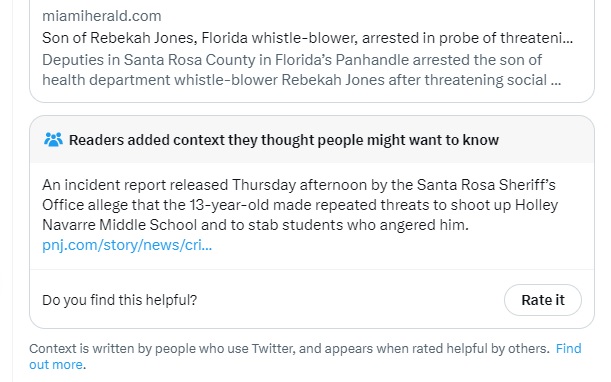
As Christians mark Good Friday and Catholics around the world at their churches read the exchange between Jesus and Pilate on Truth we saw an example of the question of what is truth from the Miami Herald. Concerning Rebekah Jones she of the Everybody Blog About Rebekah Jones Day and her son.

Apparently Rebekah was a tad worried about some things her son was doing and called police. Police took him into custody.

Immediately Jones decided that Ron DeSantis had her son arrested and proclaimed such to the world.

Now unstable people making wild accusations is one thing but apparently the Miami Herald decided that the chance to attack Ron DeSantis was too good to pass up and thus:

Alas for the Herald there is this thing in twitter these days called community notes that can explain what truth actually is:

And VIOLA the headline at the Miami Herald changed:

Apparently while the Miami Herald didn’t know what “truth” was they could be educated with a bit of help, although the designation of Jones as a “whistleblower” is at best iffy.

Closing thought: Speaking of Pilate and the press here is a headline from Hotair.com:

Krugman: even if Trump is innocent, this is justice

As I recall Pilate decided it was the best thing to hand a man he knew was innocent of the charges against him to the mob too.

Update: Hotair has more, it’s worse

By John Ruberry

Two years ago here at Da Tech Guy, I had this to say about the first season of Shadow and Bone, a Netflix fantasy series.

If you like elaborate clothes, eye-catching special effects, and being transported to an alternative yet familiar civilization, then Shadow and Bone could be for you. But if you expect fully-developed characters and a coherent plot line, then stay away.

With the second season, which began streaming mid-month, we have more of the same.

Shadow and Bone is based on a young adult fiction series of books, set-in an alternative universe centered mostly on the nation of Ravka, which in turn is based on circa–1880s Russia. The costumes are Emmy-worthy, as is the CG art direction. The acting? Not so much.

The central character of Shadow and Bone is a Grisha, Alina Starkova (Jessie Mei Li), a practitioner, although this term isn’t used much in the show, of magic. She’s a Chosen One character, an orphan like Harry Potter, who is dubbed the Sun Summoner. Alina is reluctantly placed in the position to heal the world of many ills, including disposing of “The Fold,” a smoke wall of sorts, inhabited by pterodactyl-like beasts that divides Ravka–kind of how the Ural Mountains separate European and Asian Russia.

The Fold is the creation of an evil Grisha, General Kirigan (Ben Barnes), also known as the Darkling. His dream is–along the lines of Darth Vader’s recruitment of his son, Luke Skywalker–to combine their talents and create a dark version of Utopia. 

Season Two begins as Alina, accompanied by her love interest who she met in an orphanage years earlier, Mal Oretsev (Archie Renaux), are headed to Noyvi Zem, an African-like nation. They are internationally known fugitives and…well really now, do you think they’ll go unnoticed? It is in Noyvi Zem where they connect with a key figure, Sturmhond (Patrick Gibson), a pirate, or as he calls himself, a privateer. 

Also back for the second season are the Crows, a midlevel trio of organized crime schemers: Kaz Brekker (Freddy Carter), Jesper Fahey (Kit Young), and Inej Ghafa (Amita Suman). They were hired by an underworld figure to kidnap Alina. The Crows have returned to their base of Ketterdam, a thriving city of vice based on Amsterdam. The Crows have two new members, another Grisha, Nina Zenik (Danielle Galligan), and an explosives expert, Wylan Van Eck (Jack Wolfe).

If there are midlevel hoodlums in Ketterdam, then of course there must be a Big Boss. That man is Pekka Rollins (Dean Lennox Kelly).

I observed in my Season One review that the Crows are much more interesting characters than Alina and Mal–and apparently, I’m not the only person who believes that, because a spinoff series centered around the Crows may be in the works. But if viewership of the second season tails off and the show is cancelled, we probably won’t see a Crows series.

As of today, Shadow and Bone is ranked fourth in viewership on Netflix.

There are many more Shadow and Bone characters–too many of them. And too many subplots. 

What about those Grisha? Even they are confusing.

There are three levels, I think, of Grishas. They are the Summoners who have power of wind, water and fire, Alina is one of those, the Heartrenders, whose powers are over the body, and Durasts, whose domain is chemicals, rocks, and the like. But the Grishas are not explicitly defined in Shadow and Bone, unless I missed something. A vintage-era Hollywood scriptwriter could have solved that head-scratcher by adding a one-minute conversation between Alina and a random passenger on the ship to Noyvi Zem, who could ask her, “Tell me about all of the Grishas?”

One of my criticisms of Season One is that maps showing the different countries were needed for coherency. This season has them.

Are there monsters? Yes, some ho-hum smoke beasts who are impervious to gunfire. And as I’ve seen too many times in bad mid-20th century science-fiction serials, of course that doesn’t stop characters here from shooting at them again and again.

While the universe of Shadow and Bone is of the late 19th century, there are some 21st century flavors. Ravka (Russia) is predominately white but multiracial. Nearly all of the romantic pairings are interracial–and there is nothing wrong with that.

But rather than focusing on check-box casting, Shadow and Bone needs to present viewers plotlines that are easy to follow, stronger performances from lead actors, and more frightening monsters.

Shadow and Bone is rated TV-14 for violence.

John Ruberry regularly blogs at Marathon Pundit.