Another company, this time the CMT Network, finds itself in trouble by angering its base by going woke. Now both are facing boycotts. The Bud Light one has been devastating for what until recently was America’s best-selling beer.
Last week, CMT, whose core audience comprises of country music listeners, pulled the video for Jason Aldean’s “Try That in a Small Town.” The song, which was released in May with no controversy, decries the pro-criminal sentiments celebrated in big cities, like New York City, where CMT is headquartered, and it shows BLM and Antifa riot news clips as Aldean croons.
That was too much for CMT.
Country music fans lean right. I am one of them, although I favor the Americana genre over mainstream country. Country listeners are likely to be the men and women who repair your car, service your air conditioner, or build your home. They may not have Ivy League degrees like Bud Light’s vice president of marketing, the on-leave Alissa Heinerscheid, but these “deplorables” are not dopes. And they aren’t Manhattan-style know-it-alls.
I imagine, until the Heinerschied-led marketing debacle with trans influencer Dylan Mulvaney, many country music fans drank Bud Light.
As of this writing on the evening of July 23, Aldean’s “Try That in a Small Town” is the number one song on iTunes and it has been viewed 15 million times on YouTube.
For Friday’s CMT Music 12 Pack Countdown, Aldean’s massive hit was not among the dozens of songs nominated for the final cut.
Clearly, CMT is as out of touch with its consumers as much as Anheuser-Busch and Bud Light are.
CMT has Nashville offices but as I mentioned earlier, it is based in New York. Anheuser-Busch has its headquarters where it was founded 171 years ago, in St. Louis, although it is now owned by Belgian firm InBev.
Would things be different now for Anheuser-Busch if Heinerscheid and her marketing geniuses were instead based in St. Louis? And while no one is coming forward from CMT claiming credit for pushing the “kill” button on Aldean’s video, my guess is that the decision came from someone at their New York headquarters.
The anger that brought forth the Bud Light and CMT boycotts are byproducts of elites who are isolated from the consumers they are supposed to be experts on.
Can these brilliant minds do their jobs from places like St. Louis? Nashville? Of course, they can. As they can in Cincinnati, Billings, and Oklahoma City. You know, medium-sized cities. To be sure, they’re not Aldean-favored small towns, but these other cities are filled with less sophisticated types than the “betters” that you find in New York City.
Oh, there are telephones, computer lines in those smaller cities. And there is this thing called Zoom.
However, Bud Light did farm out the Mulvaney campaign to an advertising agency thousands of miles from Manhattan.
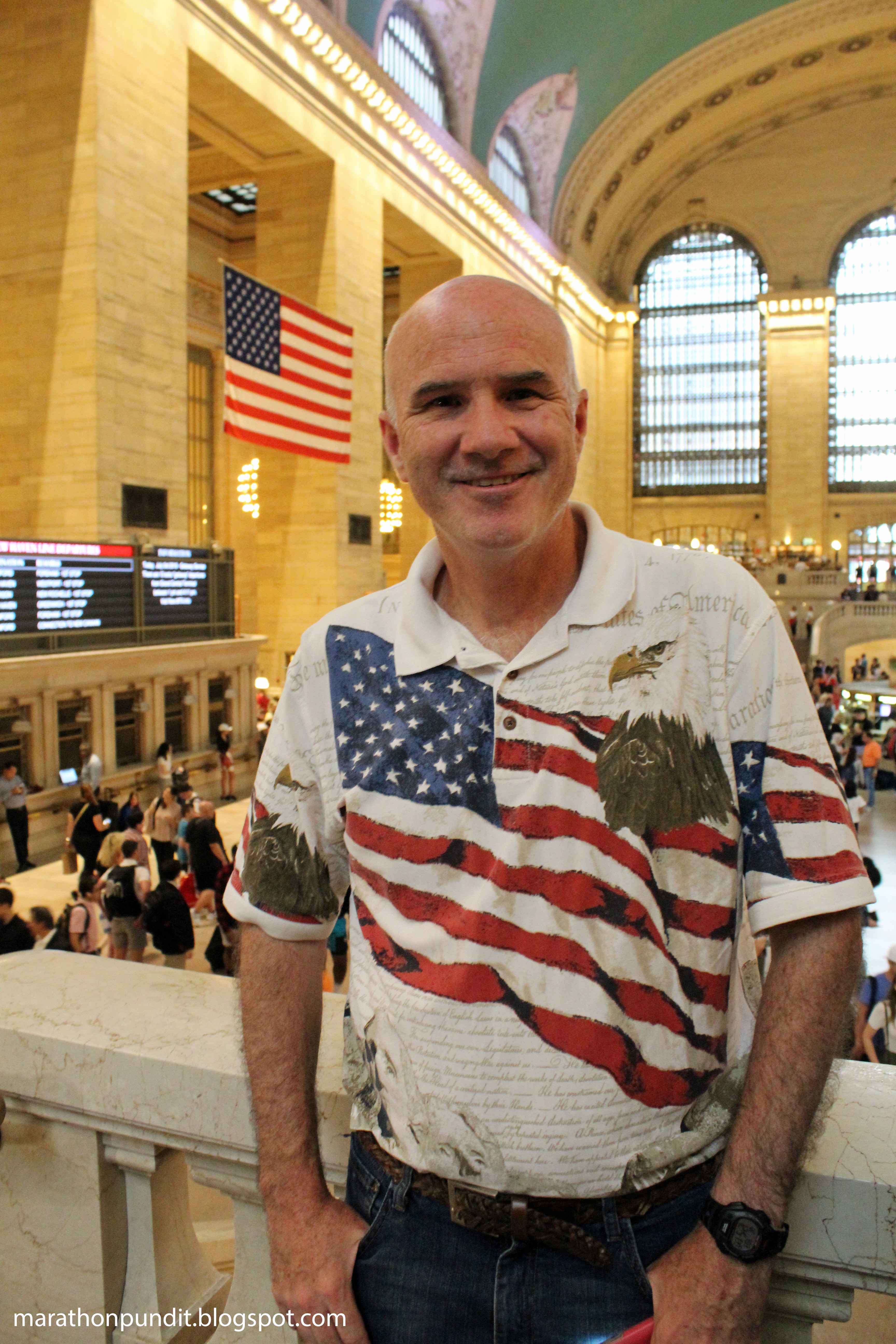
John Ruberry, who regularly blogs at Marathon Pundit, was a bachelor’s degree in advertising from the University of Illinois at Urbana-Champaign. He’s pictured here at Penn Station (correction Grand Central Station) in New York.
Three days ago, the Marathon Pundit family saw the revival of The Who’s Tommy at Chicago’s Goodman Theatre.
The original The Who’s Tommy was directed by Des McAnuff, who collaborated with Pete Townshend for the musical. Townshend, the Who’s lead guitarist wrote most of the songs for the Tommy rock opera. The original theatrical production was first performed in 1993, and that was directed, as is the Goodman Theatre production, by McAnuff.
While not the first rock opera, most rock scholars give that honor to Pretty Things’ S.F. Sorrow,Tommy was a commercial and critical success for the Who; they had struggled to gain attention in America, as did some of the other bands who emerged at the tail end of the British Invasion, such as Small Faces and the Move.
The plot of Tommy, the rock opera, is quite clunky. The atmosphere of Tommy is of the late 1960s, and it is a reaction to the guru culture of that strange time, which was filled with charlatans such as Timothy Leary, the Maharishi Mahesh Yogi, and much more darkly, Charles Manson. A better guru was Meher Baba–Pete Townshend remains a follower of his teachings.
However, inexplicably, Townshend set the story of Tommy to begin shortly after the end of World War I.
Tommy Walker becomes deaf and blind at around age four after he witnesses his father, who his mother believed was killed in the Great War, shooting her lover to death. Tommy’s parents look for a cure for their son, those attempts include bringing him to a “gypsy,” the Acid Queen, who fails to cure Tommy with LSD. Two relatives abuse him, Uncle Ernie, sexually, and Cousin Kevin, who tortures him. Tommy, despite his deafness and blindness, becomes a pinball champion and a celebrity. Tommy’s mother notices that her son often stares intently at mirrors. She smashes a mirror during one such gaze, which cures Tommy. He then becomes a cult leader, but eventually his followers reject him. Finally, Tommy realizes that he isn’t special, but everyone else is, as he sings in “We’re Not Gonna Take It.”
Listening to you I get the music Gazing at you, I get the heat Following you I climb the mountains I get excitement at your feet.
But it was the songs, despite some dull filler such as “Underature,” that made the Tommy rock opera a smash. And the Goodman Theatre makes the most of the best-known numbers–along with some stupendous dancing–including “I’m Free” and of course “Pinball Wizard,” but also lesser-known tunes, such as “Amazing Journey” and “Sensation.” With a church backdrop, “Christmas” shines.
For those Who purists out there, beware, some of the lyrics of the songs have been altered to fit the adapted narrative of the musical.
There are many stand-out performances, foremost by Ali Louis Bourzgui as an adult Tommy, Alison Luff as Mrs. Walker, and Adam Jacobs as Captain Walker. The supporting cast is also superb, particularly Christina Sajous as the Acid Queen and Bobby Conte as Cousin Kevin. There are no casting mistakes here, unlike Ken Russell’s over-the-top Tommy film from 1975, which, like The Who’s Tommy, begins the story right after World War II. While Russell got it right with Who lead singer Roger Daltrey as Tommy, Tina Turner as the Acid Queen, Elton John as the Pinball Wizard, and Ann-Margaret as Mrs. Walker, there were some serious casting disasters in that move, including Eric Clapton (not an actor), Jack Nicholson (not a singer), and Oliver Reed, a drunk who played a drunk, but on the flipside, Reed couldn’t sing either.
Back to The Who’s Tommy at the Goodman: Not to be overlooked, the lighting, the costumes, the sparse but effective scenery, and the computer graphics are dazzling.
The play ends in an undefined, presumably fascist, future, with Cousin Kevin looking a bit like Joseph Goebbels. And with an attack, somewhat understated, on today’s celebrity and social media influencer culture.
Last week, Bourzgui explained to the New York Times his interpretation of his Tommy portrayal, “He gets filled up by his followers,” adding “He keeps feeding off that, getting more gluttonous with power, until he realizes they’re following him because they want to feed off his trauma.”
The key word, in the 21st century context, is “followers.”
On the downside, a couple of songs, both penned by Who bassist John Entwistle and performed in succession, fall flat, “Cousin Kevin” and “Fiddle About.” In the latter, Uncle Ernie [John Ambrosino], sings about, well, I said what it is earlier. Both tunes are perfect times for a bathroom break, assuming you will be let back in before the end of first act. Mrs. Marathon Pundit dozed off during these tunes.
Townshend, since the release of the Tommy LP, said he was molested as a child. He was not charged after logging in a few times to a for-pay website that was advertising child pornography, stating at the time his motive to visit the site was “purely to see what was there” and that he was researching sexual abuse. In 2003, Townshend was placed on a sexual offenders registry for five years and he received a caution from the London Police. Townshend strongly denies every possessing child pornography. Citing those two sadistic Entwistle songs, Townshend said that he is too traumatized to ever perform Tommy again.
None of the other reviews of The Who’s Tommy I’ve read mentioned Townshend’s legal issues, but on the other hand, I paid for our tickets to this show.
Although not seen, the nine-piece band, led by Rick Fox, has some big shoes to fill by performing these songs–particularly those of Who drummer Keith Moon–is spectacular. I saw The Who in concert twice, in 1979 and 1980, with Kenney Jones on drums, Moon passed away in 1978. Entwistle died in 2002. Both of concerts were fantastic–and loud. My ears were ringing for days afterwards both times.
Yes, it was a Sunday matinee performance, but it was a geriatric audience, reminiscent of the crowd on the Lawrence Welk Show, in attendance for the Goodman of The Who’s Tommy that day. Earplugs were available for the “loud” music at the Goodman–which wasn’t that loud. Oh, have times ever changed.
The Who’s Tommy has been extended twice at the Goodman, some upcoming shows are sold out, the final Chicago performance is scheduled to be on August 6. The production is believed to be a dry-run for a return to Broadway, and presumably, a whole bunch of well-deserved Tony Award nominations.
Ray Bradbury in a way predicted Disney’s latest outrageous move.
Bradbury’s Fahrenheit 451, published in 1953, is a dystopian novel that is overshadowed by two other great 20th century works about an unpleasant future, Brave New World and 1984. Fahrenheit 451’s lead character is Guy Montag, a fireman, only in Bradbury’s world, buildings are fireproof; Montag and other firemen are dispatched to homes to burn books. Nearly of them. Only comic books are permitted in that unhappy future.
Michiko Kakutani, in a New York Times career appraisal written on the day after Bradbury’s death in 2012, remarked that Fahrenheit 451 “is at once a parable about McCarthyism and Stalinism, and a kind of fable about the perils of political correctness and the dangers of television and other technology.” Yep, Kakutani said “political correctness,” the term for “woke” from that not-too-distant time. In a 1994 interview Bradbury, in very blunt language even for the 1990s, attacked that PC culture while discussing Fahrenheit 451. “Political correctness is the real enemy these days,” he said. “The black groups want to control our thinking and you can’t say certain things. The homosexual groups don’t want you to criticize them. It’s thought control and freedom of speech control.”
In a memorable passage from Fahrenheit 451, Montag’s boss explained–without government involvement mind you–how books became toxic.
The bigger your market, Montag, the less you handle controversy, remember that! All the minor minor minorities with their navels to be kept clean. Authors, full of evil thoughts, lock up your typewriters. They did. Magazines became a nice blend of vanilla tapioca. Books, so the damned snobbish critics said, were dishwater. No wonder books stopped selling, the critics said. But the public, knowing what it wanted, spinning happily, let the comic books survive. And the three-dimensional sex-magazines, of course. There you have it, Montag. It didn’t come from the Government down. There was no dictum, no declaration, no censorship, to start with, no! Technology, mass exploitation, and minority pressure carried the trick, thank God. Today, thanks to them, you can stay happy all the time, you are allowed to read comics, the good old confessions, or trade journals.
Last week, Hollwood Elsewherenoticed the omission of the “N-word” from the Gene Hackman classic police thriller The French Connection from the Criterion Channel streaming service. The use of the racial slur helps define Hackman’s character, Popeye Doyle, as a great cop but a flawed man.
Not as controversially, Doyle regularly refers to two French criminals as “Frog 1” and “Frog 2.” Those ethnic putdowns remain in the film. So does the iconic scene of Hackman gunning down Frog 2 on a set of stairs. For now, at least.
It’s widely believed that Disney, which owns the rights to The French Connection, is behind the stealth editing. To use Bradbury’s words, “It didn’t come from the Government down.”
Disney of course has gone full-blown woke in recent years, the outrage prior to this one, from last month, involved a mustachioed man wearing a dress and eye shadow, a fairy godmother’s apprentice named Nick, greeting guests, including children, at the Bibbidi Bobbidi Boutique at Disneyland. Before that, Disney’s prior woke atrocity there was an anti-white people song performed in the Disney+ children’s series, The Proud Family.
Disney’s theme parks are supposed to be “the happiest place on earth.” That’s it? Humans are only about happiness?
Back to Bradbury and Fahrenheit 451:
You must understand that our civilization is so vast that we can’t have our minorities upset and stirred. Ask yourself, what do we want in this country, above all? People want to be happy, isn’t that right?
We won’t be happy, I believe, as dumbed down dolts.
The entertainment industry, a fortress of the left, constantly reminds us, especially during award ceremonies, that they are the vanguard for free expression. Sure, a censoring of the “N” word doesn’t seem like a noble hill to die on but remember the dystopian world of Bradbury’s Fahrenheit 451. The slippery slope began in order to placate a few people who were offended.
Why stop with the “N” word? What about the French Connection’s Frog 1 and Frog 2? Smoking in movies? And what Donald Trump’s cameo in Home Alone 2?
Viewers might get triggered.
Don’t laugh about that Trump scene. The star of Home Alone 2, Macaulay Culkin. wants the Trump bit cut. And he’s not alone.
We’re approaching the two-month mark of the Bud Light boycott, which of course began when transgender social media, utilizing his–yes his–goofy 1950s-sitcom ditz schtick to recklessly promote Bud Light beer.
Immediately, I was confident that this boycott had staying power, despite the increasingly irrelevant mainstream media telling its dwindling audience it did not. As Da Tech Guy himself explained, Anheuser-Busch’s problem is that Bud Light is too easy to boycott. Coors Light, Miller Lite, which taste similar–assuming that light beers have a distinguishable taste–are usually available in the same liquor stores, supermarkets, bars, and restaurants. And they are all priced about the same.
American megabrewers are selling image and personality. Beer? Not so much. And in a few days, Bud Light, after partnering with Mulvaney, torched its macho brand-building work of four decades in just a few days. “Fratty” is the word used by the now-on-leave marketing head for Bud Light, Alissa Heinerscheid. Anheuser-Busch’s non-apology from its CEO only fanned the flames.
Bud Light’s slogan is, “Easy to drink, easy to enjoy.” And it’s easy to boycott.
Boss (John Cleese character): Now, let’s have a look at the sales chart (indicates a plummeting sales graph). When you took over this account, Frog (Eric Idle character), Conquistador was a brand leader. Here you introduced your first campaign, “Conquistador Coffee brings a new meaning to the word vomit.” Here you made your special introductory offer of a free dead dog with every jar, and this followed your second campaign “the tingling fresh coffee which brings you exciting new cholera, mange, dropsy, the clap, hard pad, and athlete’s head. From the House of Conquistador.”
Yeah, I know, Bud Light’s Mulvaney campaign hasn’t been, so far, as awful for Anheuser-Busch as it was for the fictional Monty Python coffee brand. But sales of the beer continue to slide. Last week, by way of a $15 mail-in rebate, A-B started giving the beer away, because, unlike wine and hard liquor, beer has a brief shelf-life.
So, yes, boycotts can be effective.
But we were told by the mainstream media that boycotts don’t work.
Around that same time, Patrick Coffee (no relation to Python’s Conquistador Coffee) of the Wall Street Journal, while citing other experts, opined that about the Bud Light boycott that “such campaigns often have failed to deliver a meaningful blow.” (Paid subscription might be required to access the link.)
So where are the finger-waving fact-checkers? Why haven’t these articles been revised?
Meanwhile, Target is facing a boycott over its prominent promotions of “tuck-friendly,” that is, male-genitilia-hiding, swimsuits, as well as arguably promoting the trans agenda to children. It has lost $10 billion in market valuation since a boycott began against Target.