
Posts Tagged ‘New York Times’

By John Ruberry

On Friday night Substack journalist Matt Taibbi released the first installment of the Twitter Files, which outlined the efforts by Twitter, with assists from the Democratic National Committee, to suppress the Hunter Biden laptop story in 2020. It’s a dynamite story–a political party worked behind the scenes with a Big Tech company to suppress a damaging news story about a presidential candidate, in this case Joe Biden, so he could defeat the incumbent, Donald J. Trump.

That tale of intrigue is something that you would think that you would find only in political thrillers. You know, the stuff of books, movies, or TV series. Except the Twitter scandal really happened. In response, the elitist mainstream media chose one of three tactics, or a combination of them, to confront this scandal: ignore, bury, or insult. In this post I’m going to discuss the first one in depth, and I’ll get to that in a moment.

But first a look back at an incident from 2005, the year I started my own blog, Marathon Pundit. What was then called the blogosphere was a relatively happy place. In comment threads and in behind-the-scenes emails, there was regular communication between conservative and liberal bloggers and journalists, even some camaraderie, at least here in Illinois. Politically our two camps didn’t agree on much–but there was one subject where we were in unison. All of the Illinois bloggers and mainstream media reporters hated the Reverend Fred Phelps and his twisted house of worship, the Westboro Baptist Church of Topeka, Kansas. 

Some background: Phelps, who died in 2014, would bus in the few dozen members of his church, which then, as it does now, consisted only of the extended Phelps family, and protest at the funerals of soldiers and sailors killed in action in Iraq or Afghanistan. They held signs that read, among other things, “God Loves Dead Soldiers.” Phelps, who probably was in need of intensive psychiatric care, based his opinion on God and US military deaths on America’s acceptance of the gay lifestyle. 

Back to Illinois: There was a Phelps protest in East Peoria, Illinois in 2005 at the funeral of a US Marine gunnery sergeant, who was killed in Iraq, which the local paper, the Peoria Journal Star reported on, but it left out the Westboro Church protest. And that infuriated Bill Dennis, who wrote the now-inactive Peoria Pundit blog. 

Dennis had this say 17 years ago:

More than once, I’ve read the opinion that the media shouldn’t give Phelps and his people any “publicity.” Whether or not any particular groups gets publicity from news covering isn’t important. The news media needs to cover the news, whether or not it’s news we want to hear. It’s not the media’s job to keep us from having to hear ugly messages. The people who work in the information business need to reject the notion that the public is better off when it is kept in the dark. We wouldn’t tolerate the government doing that to us. Why does the media think it has the right to keep unpleasant news away from us?

It’s the news media’s job to answer questions, not to turn their head and pretend they didn’t hear the question.

The media’s opinion of what information should be provided to its consumers has now become dangerous. Big Tech, meaning of course Twitter, and as well as Google and Facebook, as well as traditional sources such as the legacy newspapers and broadcast networks, actively worked to suppress or ignore the Hunter Biden laptop story, which was revealed in October 2020 by the New York Post, as the presidential election season was underway. Yes, season–voting was already underway just about everywhere. Those media villains–I believe it’s fair to include those three Big Tech behemoths are part of the media–committed election interference. Think of a football game where the beat reporter for an NFL team is standing on the sidelines when the opposing team is about to score a touchdown–who then runs on to the field and tackles the player carrying the ball. Let’s call that wronged player “Trump.”

That’s what happened in 2020. 

What is the slogan of the Washington Post, which has so far has written just one story about the Twitter Files? Oh yeah, “Democracy dies in darkness.” At least the most recent time Clay Travis checked, which was this morning, the New York Times hasn’t reported on Taibbe’s Twitter revelations. Travis Tweeted a few hours ago, “It has now been two days since @twitter & @elonmusk posted actual emails & correspondence of internal documents relating to the Hunter Biden laptop censorship in 2020. The @nytimes has still not covered the story at all.”

In a story published today CBS news barely mentions Taibbi’s scoop–but it attacked Twitter owner Elon Musk. Oh yeah, attacking. A whole bunch of leftist journalists, propagandists really, went into that attack mode I discussed earlier, vilifying Taibbi for performing superb journalism.

And in regard to that Phelps story from ’05, it wasn’t just the Peoria Journal Star committing the sin of omission. You remember I said that back in the day conservative and liberal bloggers and journalists used to interact regularly about stories. I can’t find the email I sent so long ago, but I reached out to a big shot left-wing Chicago newspaper columnist about what the Peoria Pundit and I saw as media malpractice. His polite reply to me was something like this, “But if we report on Phelps and his hateful protests, then we are only doing what he wants–giving him publicity.” 

No, Mr. Newspaper Columnist, it is your job is to report the news. Not hide it, shape it, or twist it.

Democracy dies in darkness. So does the truth.
John Ruberry regularly blogs from the Chicago area at Marathon Pundit.
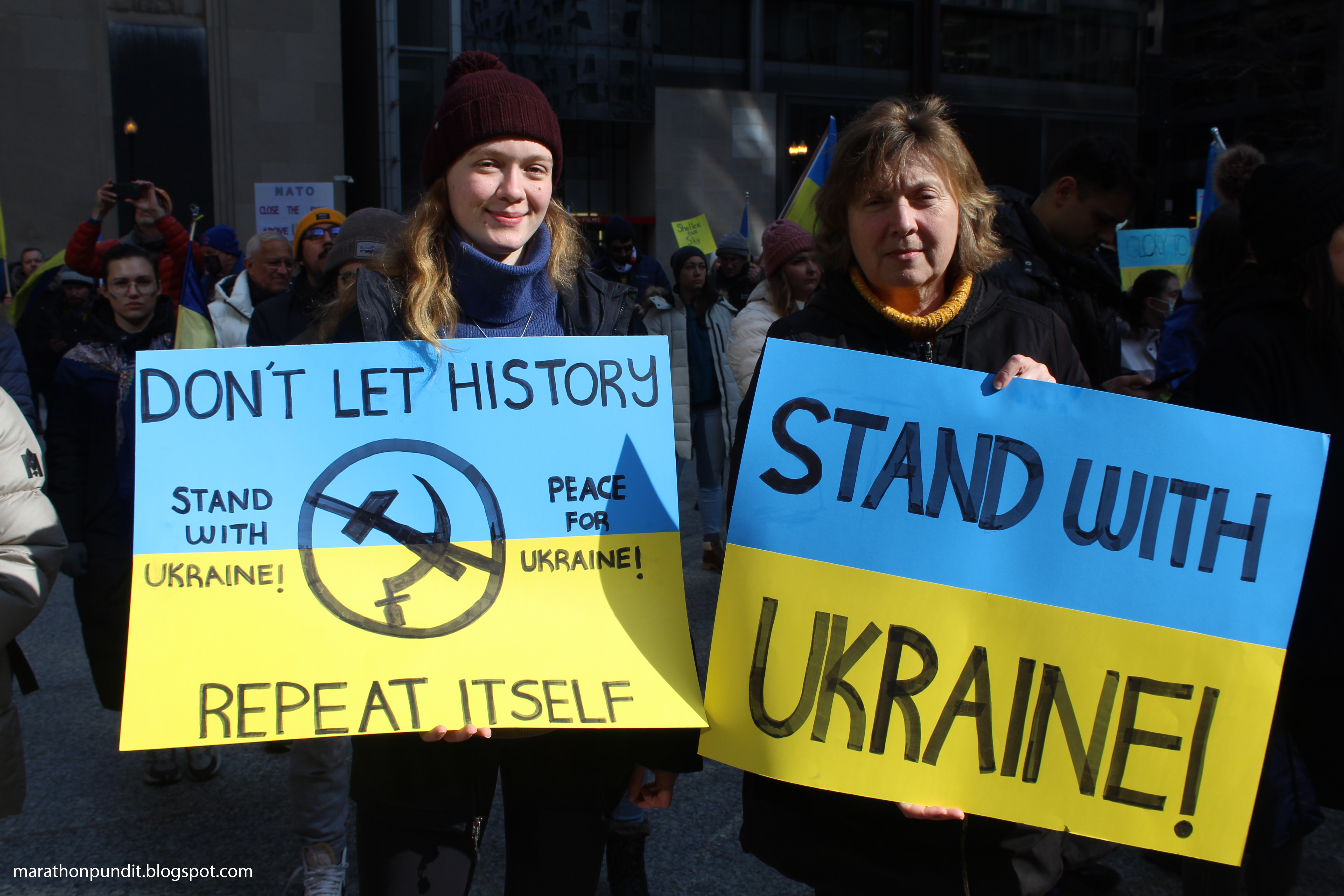
Pro-Ukraine protest in downtown Chicago this spring

By John Ruberry

There is good news out of Ukraine, its forces have made gains in the Kharkiv region and they are near Russian border. There is much ground still to liberate, not only land that Russia has seized in the war that began early this year, but also the area that have been controlled by Russian separatists in the Donetsk region since 2014, as well as Crimea, which Vladimir Putin annexed the same year.

Ukraine has endured an unhappy history. World War II and the Holocaust devastated Ukraine. And in order to impose communism on wealthier peasants in Ukraine, Josef Stalin engineered a famine in the early 1930s, known there as the Holodomor, translating roughly into “man-made starvation.” Roughly four million people perished as a result of Stalin’s atrocities against the kulaks in Ukraine.

Even in a closed society, it’s difficult to coverup a famine. And news trickled out of Ukraine about the Holodomor. But a New York Times reporter, based in Moscow, Walter Duranty, dismissed such stories, instead of “famine” he wrote of “malnutrition” in Ukraine, for instance. 

For a series of 1931 articles about the Soviet Union, Duranty, for his “dispassionate interpretive reporting,” he was awarded a Pulitzer Prize. 

While in Moscow, Duranty, was granted a rarity, interviews with Stalin; he also enjoyed another rarity, a luxury apartment in the Soviet capital. During the entire history of the USSR, housing of any kind was scarce. In Moscow Duranty had a mistress, whom he impregnated, and a chauffeur. Automobiles were also rare in Russia in the 1930s. 

In 1933, another journalist, or I should say, a real one, Gareth Jones, visited Ukraine and he was horrified by what he found. “If it is grave now and if millions are dying in the villages, as they are, for I did not visit a single village where many had not died, what will it be like in a month’s time?” Jones wrote for the London Evening Standard. “The potatoes left are being counted one by one, but in so many homes the potatoes have long run out.” 

Duranty’s response to Jones was a New York Times article, “Russians Hungry, But Not Starving.” That same year, Duranty wrote to a friend, “The famine is mostly bunk.”

Another shameful sentence from Duranty, about Stalin’s brutal policies as the Holodomor continued, “To put it brutally,” Duranty wrote for the Times, “you can’t make an omelet without breaking eggs.”

Since the war began attention has been brought to Duranty’s undeserved Pulitzer. Even NPR took notice. “He is the personification of evil in journalism,” Oksana Piaseckyj told NPR earlier this year of Duranty. She is a Ukrainian-American activist who emigrated here as a child over 70 years ago. “We think he was like the originator of fake news,” Piaseckyj added.

The New York Times admitted on its corporate website about Duranty’s work, “Since the 1980’s, the [Times] has been publicly acknowledging his failures.” But it has not returned the tainted Pulitzer. It also notes that twice, most recently in 2003, the Pulitzer board has decided not to revoke its award to Duranty. 

It’s time for them to reconsider.

John Ruberry regularly blogs at Marathon Pundit.

Always look on the bright side of life

Eric Idle

You know the Hatred of America and the institutions that make it great has become such a standard part of the American left and it’s allies that when I saw this at Instapundit from Sarah Hoyt about the NYT “cancelling” the Declaration of Independence

THEY’RE STILL TRYING TO INSERT ‘HE HAS DENYIED ABORTION’ AND ‘COLLUDED WITH RUSSIA’ INTO THE LIST OF KING GEORGE ABUSES:  NY Times ‘forgot’ to print Declaration of Independence for the first time in 100 years.

I was not in the least surprised. That was until I actually clicked the link and read the NY Post story on the subject. The “excuse” given for this omission in this story was no shock:

New York Times spokesperson Danielle Rhoades Ha explained that Times employees simply forgot to put the Declaration of Independence into print this year. 

She said, “We have a longstanding tradition of printing the Declaration of Independence in the July 4th print edition. Due to a human error, it wasn’t printed this July 4th so was included in the July 5th edition.”

Shades of classic Steve Martin:

It was no “shock” at all, all of these mistakes by the left media only go in one direction, however as unsurprising as the story was in general the second line of the piece was a complete shock to me:

After disgruntled readers voiced concern, the paper printed it on July 5.

Now admit it, If somebody told you the NYT had enough readers who would be “disgruntled” by the omission of the Declaration of Independence in the 4th of July edition of the paper that they would decided to print it on the fifth rather than just leave it out would you have believed it?

I wouldn’t have.

Perhaps there is still hope for America.

By Christopher Harper

The New York Times finally admitted that it published fake news over the past few years.

The admission wasn’t about the coverage of the Trump administration, but the errors stabbed at the very heart of what DaTimes considers its influence: international reporting.

You shouldn’t be surprised that you haven’t heard much about the massive editorial issues because DaTimes dumped the findings on the weekend before Christmas.

Reporter Rukmini Callimachi has been at the center of the publication’s coverage of terrorism, particularly the Islamic State.

In December 2014, Callimachi unearthed what appeared to be an important discovery. Syrian journalist Louai Abo Aljoud, Callimachi reported, said he had seen three American hostages while he was being held at an Islamic State facility in 2013. Upon further inspection, however, key details failed to bear out the “news,” resulting in an editor’s note affixed to the story on Friday.

“After the article was published, The Times learned that Mr. Aljoud had given inconsistent accounts of key elements of the episode to Times journalists and others,” the note reads in part.

After the publication of the editor’s note, Karam Shoumali, a Syrian journalist who worked with Callimachi, tweeted that he told the reporter about errors in the story. But she refused to change the details.

The tweet stands as evidence that as early as late 2014, less than a year after Callimachi jumped from the Associated Press to DaTimes, colleagues expressed concerns about her methods and conclusions.

But there’s a lot more. A key figure in DaTimes’ podcast, “The Caliphate,” which Callimachi created, was a fraud. Last September, Canadian authorities charged Shehroze Chaudhry for carrying out a terrorism hoax. Chaudhry was a key figure in “The Caliphate,” a 12-part series created in 2018. 

On Friday, DaTimes finally came clean. An editor’s note atop “Caliphate” admitted the collapse of key episodes. “In the absence of firmer evidence, ‘Caliphate’ should have been substantially revised to exclude the material related to Mr. Chaudhry. The podcast as a whole should not have been produced with Mr. Chaudhry as a central narrative character,” the note reads in part.

DaTimes failed to listen to various reporters from the news organization itself. This frequent problem has existed at the publication in past misadventures, such as Jason Blair and Judith Miller. 

Last week top editors who worked with Callimachi admitted their errors. But some reporters were not assuaged. C.J. Chivers, a former foreign correspondent and now a staff writer for the New York Times Magazine, was among the first Times reporters to complain to editors. 

“You discouraged people from using the fire alarm, and when some of us did use the fire alarm anyhow, we found the alarm was not connected to anything,” Chivers reportedly told the group. 

But there is a more fundamental question that runs through these problems at DaTimes, mainly since it is far from the first time that such egregious errors have happened. 

I gave up on DaTimes a few years ago. But it would seem its loyal readers should be asking a fundamental question: If someone got away with making stuff up for six years, shouldn’t the news organization take a harder look at all other aspects of the publication?