
Posts Tagged ‘race’

By John Ruberry

If you only have a minute and you want to know, in a nutshell, what the Netflix adaptation of Tom Wolfe’s novel from 1998, A Man in Full, is all about, here it is: The lead character, Atlanta businessman Charlie Croker, is Donald Trump–orange hair and all. Then throw in elements of the George Floyd and Rodney King stories and add an even more shocking ending than the one in Boogie Nights.

Earlier this month, Netflix started streaming the six-episode series, which stars Jeff Daniels and Diane Lane. 

Wolfe, who is my favorite writer, after a two-decade career in journalism, made a smooth transition into fiction with his first novel, The Bonfire of the Vanities. It encapsulates the boom years of 1980s–along with the mayhem of pre-Rudy Giuliani New York City. Three years later, the film version was released. It is godawful, starting with the miscasting of Tom Hanks in the lead role as “the Master of the Universe,” Sylvester McCoy. After I suffered through the movie, I said to myself, Vanities is a mini-series not a two-hour movie.

I had hopes, misguided ones it turns out, that A Man in Full would be better, because it is a mini-series. Adding to my anticipation was Netflix streaming last year the insightful documentary, Radical Wolfe.

As A Man in Full begins, Charlie Croker (Daniels) is celebrating his 60th birthday at a party with Shania Twain entertaining his friends, family, and business associates. Two of those guests are executives from PlannersBanc, his principal lender, Raymond Peepgrass (Tom Pelphrey) and Harry Zale (Bill Camp). While it appears that Croker is an Atlanta version of a Master of the Universe, he’s broke–Charlie owes PlannersBanc $600 million. He’s overextended with other lenders too. Peepgrass and Zale want to carve up Croker’s empire, starting with his quail hunting plantation and his corporate jet. A rescue is offered by the mayor of Atlanta, Wes Jordan (William Jackson Harper), who is campaigning for reelection, and Croker’s attorney, Roger White (Aml Ameen). But to save his neck, Croker will have to betray his former Georgia Tech football teammate, Norman Bagovitch (John Lacy), who is running against Jordan.

Bagovitch–wait for it–decries the status of the white male in his campaign. Jordan is Black.

David E. Kelley wrote the script, and he should be ashamed. No serious candidate for public office would campaign on such bigoted idiocy. And in Atlanta?!? Why does Kelley insult his audience?  

Oh yeah, he wants to demonize Trump. Orange Croker Bad. Oops, I mean Orange Man Bad.

Joyce Newman (Lucy Liu) is an alleged victim of a sexual assault from Bagovitch. In the book, well, let’s just say there is fear of a race riot because of the racial angle of that alleged rape.

Wolfe, brilliantly in my opinion, centered much of his plot on racial contrast and conflict, but also on Croker being an anachronism. The series is set in 2024, but events in the book take place a quarter of a century earlier. Croker, nicknamed the 60 Minute Man because he starred on offense and defense for Georgia Tech, played a lead role for a national championship Yellowjackets team, at a time when major college sports teams in the South were not integrated. Croker came of age just as the civil rights protests were picking up steam, and when Jim Crow laws were still in force in Georgia and other southern states. The world changed, but Croker, not so much. Sure, of course Croker in the novel knew blacks had equal rights, but they still belonged– and I’m not endorsing his sentiment–“in their place.”

Kelley, and the directors, eliminates that angle by turning Croker into Trump. He even does away with Charlie’s redemption in Wolfe’s novel.

There’s even a climate change dig included in the series. I mean, why not?

As Croker, Daniels, who is usually very good, is an embarrassment, beginning with his overwrought Foghorn Leghorn southern accent and his Trump-sized abdominal paunch. On the other hand, Diane Lane, as Charlie’s first wife, shines. I had the pleasure of seeing her at Chicago’s Goodman Theatre in Tennessee Williams’ Sweet Bird of Youth a decade ago.

Wolfe’s novel is over 700 pages long, so it’s understandable that some storylines are condensed. 

For instance, Conrad Hensley in the book is the child of worthless white hippies who, in spite of them, still manages to develop a strong moral compass. He works for Croker Foods in the East Bay area of California Hensley’s life, like Charlie’s, collapses. He ends up on the wrong side of the law after he violently tries to retrieve his towed car. By the way, anyone who has had his car towed and is forced to pay usurious fees to retrieve it, will sympathize with Hensley. In the series Hensley (Jan Michael Hill) is Black, and well, I already mentioned Rodney King and George Floyd. 

The subplot with Peepgrass and Martha Croker remains, with the Boogie Nights twist added. If you crave more details on that, click on this Daily Mail link.

Oh, the Crokers’ son, Wally (Evan Roe), sure looks a lot like Barron Trump in the series. 

Astonishingly, Trump-hating Fulton County district attorney Fani Willis doesn’t appear here. Maybe she was on a cruise with Nathan Wade during filming.

I guess I needed to suffer for some forgotten sins, because I endured all six episodes of A Man in Full. Of the other Netflix series that I punished myself with, in full, only The Pentaverate and Vikings: Valhalla were worse.

On the flipside, the cinematography for A Man in Full is sharp–Atlanta never looked so good. The soundtrack, compiled by Craig DeLeon, is spectacular, it’s as splendid as the best work of T-Bone Burnett. Keep an eye on DeLeon.

Wolfe, who died in 2018, didn’t like The Bonfire of the Vanities film. I don’t think he’d care for the series based on A Man in Full either.

I hated it.

A Man in Full is currently streaming on Netflix. It is rated TV-MA for violence, foul language, sex, and nudity.

John Ruberry regularly blogs at Marathon Pundit.
Sgt. Schultz: Oh I know nothing, I was not here, I didn’t even get up this morning!

Hogan’s Heroes Hold That Tiger 1965

If you’ve followed the MSM at all for the last 40 years you know that if there is one thing they love it’s stories that promote the disarming of citizens.

What they particularly love are stories that suggest the disarming of citizens that take place in Red States because that why they can point the finger at the GOP rather than themselves, and if that story is about a mass shooting well that’s the trifecta when it comes to creating a national story.

However there is one thing that can get in the way of such a story and that’s DaTechGuy’s 3rd Law of Media Outrage which states:

The MSM’s elevation and continued classification of any story as Nationally Newsworthy rather than only of local interest is in direct correlation to said story’s current ability to affirm any current Democrat/Liberal/Media meme/talking point, particularly on the subject of race or sexuality.

Well you would think a mass shooting with over 300 shots fired which took place in Memphis this week would qualify, even it it was in a blue city oasis in the middle of a Red State, alas there is a catch. See if you can spot it from this video of the event:

Alas the shooters were of the wrong race, and thus this story hurts the Democrat message on race. Even 300 shots and video are not enough to get this story onto any national broadcast so like the Superbowl shootings this story will be confined to the local news until it dies away.

Cue Ann Coulter:

By John Ruberry

For many Netflix subscribers, their focus is on the next week’s release of the second part of the final season of The Crown. While I have enjoyed the series, the first batch of Season Six of The Crown was a huge disappointment for me.

A more enjoyable use of your time–75 minutes to be precise–can be found by watching Radical Wolfe, a documentary about the legendary writer Tom Wolfe, a pioneer of the New Journalism movement of the 1960s who later, and seamlessly, made the transition into fiction, penning one of the greatest novels ever, The Bonfire of the Vanities.

Radical Wolfe, which had a brief theatrical run this autumn, is directed by Richard Dewey. It is filled with interviews of Wolfe; Jon Hamm narrates passages from Wolfe’s work. The documentary is based on an Esquire article by Michael Lewis.

Gay Talese, Tom Junod, Christopher Buckley, and Lewis are among the writers interviewed for Radical Wolfe.

Buckley’s father, conservative firebrand William F. Buckley, says here. “Tom Wolfe is probably the most skillful writer in America. I mean by that is that he can do more things with words than anyone else.”

“If you want to be a writer,” Wolfe, who died in 2018 said of himself, “you’ve got to be standing in the middle of the tracks to see how fast the train goes.”

“Nobody is writing like Tom Wolfe today,” Junod says in Radical Wolfe. “And no one has written like Tom Wolfe.”

Wolfe is someone America needs now. Oh, to have seen him running loose among the hypocrites at COP28.

The title of the film comes from Wolfe’s 1970 essay for New York magazine, Radical Chic: That Party at Lenny’s, when Wolfe, after co-opting an invitation to a fundraiser for bail money for some Black Panthers held at Leonard Bernstein’s Park Avenue home, skewered the liberal virtue signaling culture, even before that term existed.

Oh yeah, phrases. Phrases!!! Besides “radical chic,” Wolfe coined the terms “the right stuff,” the title of his of his rollicking yet informative bestseller about the early days of the space program, and “masters of the universe,” the group that Sherman McCoy, the lead character in The Bonfire of the Vanities, placed himself in. 

Not mentioned in the documentary while Wolfe didn’t create the now-common phrase “pushing the envelope,” which is used repeatedly in The Right Stuff, he popularized it.

Wolfe began his career as a who-what-where when-why–journalist in the northeast. After convincing Esquire in the early 1960s to let him write an article about the California custom car culture, Wolfe suffered writer’s block. Which was the best thing, career-wise, that ever happened to the author. Eventually the floodgates opened, Wolfe brought sound effects to print journalism, shown in the title of that piece, There Goes (Varoom! Varoom!) That Kandy-Kolored (Thphhhhhh!) Tangerine-Flake Streamline Baby (Rahghhh!) Around the Bend (Brummmmmmmmmmmmmmm)…

The repeated use of ellipses (…) and multiple exclamation points (!!!) are a trademark of Wolfe’s early work.

As with the fetid film version of The Bonfire of the Vanities, Radical Wolfe tiptoes around race. Wolfe was a master storyteller and, strictly in the storytelling sense, race presents a crucial ingredient for any narrative–conflict. The Reverend Bacon character in Bonfires, an Al Sharpton knockoff, is a comic foil. Fareek “The Cannon” Fanon, an African American college football star in Wolfe’s 1998 novel, A Man in Full, comes across as a boor when he confuses lead character Charlie Coker’s old moniker as a 60-Minute Man, not as a football starter on both defense and offense, but as a man who could, let’s say, “do it” in bed for 60 minutes.

Black people can be boors in Wolfe’s world. As can white people. As can everyone. That’s the way it ought to be. Because that’s the way society is.

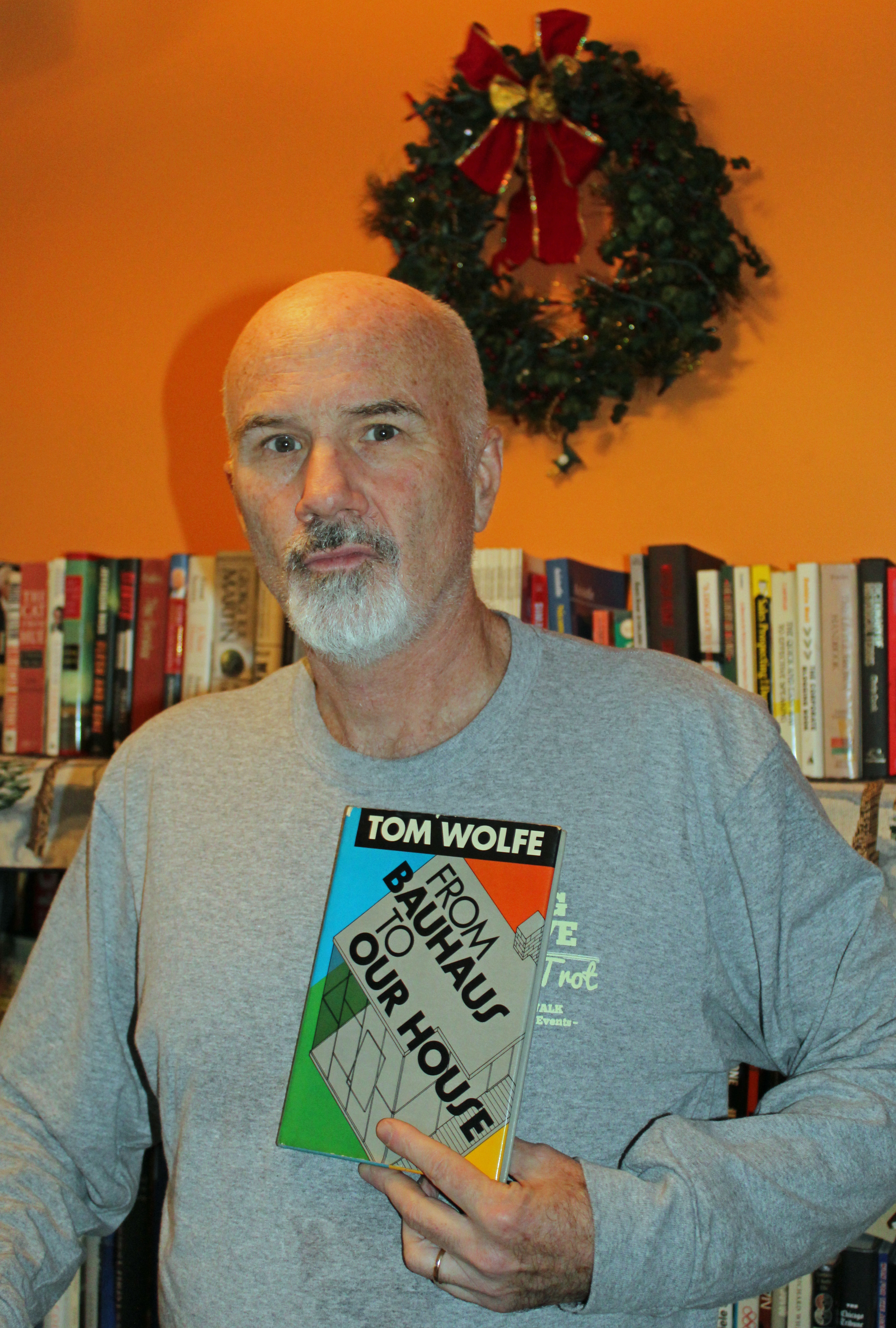
In Wolfe’s takedown of ugly glass-box and faceless architecture, From Bauhaus to Our House, he gives a rundown of the horrors of public housing, and joyously recalls the response when tin-eared bureaucrats in St. Louis–after decades of failing the residents of the city’s housing projects–finally did the unthinkable. They asked the tenants of the notorious Pruitt-Igoe homes, most of them Black, what they wanted done to the buildings. Their response? They chanted, “Blow it up.”

And the bureaucrats did just that. Why isn’t this poignant story in Radical Wolfe?

Wolfe was always coy about his political stance. “I belong to the party of the opposition,” he says in the documentary. But I suspect he was a slightly conservative, with a strong libertarian bent.

Despite the quibbles I mentioned, I loved Radical Wolfe. Oh, one more thing. To capture the Varoom!!! Varoom!!! uniqueness of Wolfe’s genius, a surreal mashup, along the lines of the one in The Life and Death of Peter Sellers, would have been a welcome addition.

Last year, Netflix sent a message to its workers that not all of its programming–not these words of course–will kowtow to wokeism. Radical Wolfe is a big step in the right direction for the streaming service. Next year Netflix will stream a six-episode limited series based on Wolfe’s A Man in Full. It will star Jeff Daniels and Diane Lane.

Keep it up, Netflix.

But I have one more quibble. Radical Wolfe is rated TV-MA for–wait for it–language and smoking.

Really? TV-MA?

Yep.

John Ruberry regularly blogs at Marathon Pundit.

By John Ruberry

“There it is, dear,” I whispered to Mrs. Marathon Pundit last Sunday during the seemingly endless parade of movie trailers as we awaited Oppenheimer (great film, by the way), at AMC Village Crossing in Skokie, Illinois last Sunday, “that is Disney’s next flop.” 

“That” was Haunted Mansion, which is yet another movie based on a Disney theme park attraction. Disneyland, Walt Disney World, and Tokyo Disneyland all have Haunted Mansions. The last time I was visited Disney World, Little Marathon Pundit and I went on the Haunted Mansion ride, way back in 2001, neither of us were impressed. 

And do you know what? Barring an unexpected flocking to the Haunted Mansion movie turnstiles, I have already been proven right about the film, which stars LaKeith Stanfield Tiffany Haddish, and Owen Wilson, and it includes appearances by Jamie Lee Curtis and Danny DeVito.

Disclosure: Other than the below trailer, I haven’t seen Haunted Mansion, nor the 2003 Disney film, The Haunted Mansion, which starred Eddie Murphy. Nor do I ever intend to see either. However, I might take a look at Muppets Haunted Mansion, a Disney Halloween television special which first aired in 2021.

You know when a movie is in trouble when a two-minute-long trailer can’t make it look appealing.

The Murphy vehicle made money, but it was critically panned. The new Haunted Mansion is currently receiving a 41 percent Tomatometer at Rotten Tomatoes. 

Here is the opening sentence of Manohla Dargis’ New York Times review: “There is a mansion, it is haunted, boo, blah, the end.”

Disney’s woke remake of Hans Christian Andersen’s The Little Mermaid, which featured an African American Ariel, at best will make a modest profit for the studio. Other recent House of Mouse family-oriented flops include Elemental, Strange World, and Lightyear. The latter includes a same-sex kissing scene.

Back to the new Haunted Mansion: Its director, Justin Simien, who is African American makes note of the setting of the movie, New Orleans. “I felt it was really important for the lead to be Black, because this is set in New Orleans and it’s an 85% Black town,” Simien told Yahoo Entertainment. Adding, “I wanted to make [the movie] as Black as I can because that’s New Orleans.” Oh, while New Orleans has been a majority African American town for decades, it is currently has roughly a sixty-percent Black population. 

Okay, Simien and Disney can make any kind of movie it wants. But instead of focusing on a movie that is “as Black as I can,” why not, instead produce a movie with a compelling storyline and great performances from actors, regardless of their race? While it’s impossible for any entertainment endeavor to please everyone, even with family-oriented projects, why not try to attract as many people as possible?

In defense of New Orleans, it is widely considered to be the most haunted city in America–again, regardless of race, so it is a good choice for the setting of Haunted Mansion.

Does Disney want to keep making bombs? It appears that it does.

Next year, in yet another remake, a live action version of Snow White will hit theaters. In the Grimm Brothers tale, the authors make it clear that Snow White had “skin white as snow, lips red as blood, and hair black as ebony.” A Hispanic woman will play the lead in the 2024 film. As for her seven dwarves, they’ve been recast with a multi-racial group of six men of average height–with just one dwarf to aid her in her struggles, which presumably will include battling the patriarchy, represented by the Huntsman, and maybe every once in a while, the Evil Queen. And in the new Snow White, will we learn why the Queen turned evil? I’m predicting the patriarchy will be at fault. Oh, don’t forget that Huntsman.

Walt Disney had many gifts, and a crucial one that made his studio a success is that he knew time-tested stories were also solid material for movies, which is why Walt made animated versions of classic fairy tales, including Sleeping Beauty, Cinderella, and of course, Snow White and the Seven Dwarves. And Walt didn’t rehash the same movies.

Contemporary Disney movies are diverse in casting, but not diverse in regard to imagination.

What’s next, besides a new Snow White, for Disney’s movie wing?

Back to Dargis’ New York Times review:

She looked back to NY Times critic Elvis Mitchell’s rundown of the Murphy Haunted Mansion, where he wrote that it was “only a matter of time before Parking Lot: The Movie and People-Mover: The Motion Picture” would hit the local cineplex. Well, that hasn’t happened. Yet.

On the other hand, there are over 150 Grimm Brothers tales, most of which haven’t been made into feature films.

Oh, one more idiotic thing about the new Haunted Mansion. Why was it released in July, instead of October? You know, when Halloween is? I know what stupid looks like–it has big mouse ears.

Meanwhile, the Sound of Freedom, made with a modest budget, is a financial success.

John Ruberry regularly blogs at Marathon Pundit.